
4-Shift System: Models, Sample Schedule & Template
Understand the 4-shift system: four planning patterns, sample schedule, staffing needs, Swiss rules and a free template for 24/7 operations.
What is a 4-shift system?
Short answer: A 4-shift system organises four teams so that early, late and night shifts plus the team off duty can cover a 24/7 operation. There is no single mandatory cycle: the sequence must fit weekly hours, rest periods, qualifications, holidays and reserve cover. The sample below is therefore a starting point, not a finished schedule for every company.
In practice, a 4-shift system mainly fits companies with 24/7 operations or very long opening hours. Important: the template below is a planning example, not a legal shortcut. Working hours, rest periods, night/Sunday work and collective agreement rules must be checked for the specific business.
Four-team staffing: calculate capacity including absence cover
Four teams do not automatically provide absence cover. A position that needs exactly one person at all times requires 24 × 7 = 168 coverage hours per week. Calculate each role separately: an available person without the required qualification cannot fill the gap.
- Base requirement: Assuming a 42-hour working week, 168 ÷ 42 = 4 full-time equivalents are needed, before holidays, sickness or training.
- Account for absences: If, for illustration, 20% of contractual hours are unavailable for this position, 42 × 0.80 = 33.6 hours remain. The requirement rises to 168 ÷ 33.6 = 5 full-time equivalents. The 20% is an assumption, not an industry benchmark.
- Check feasibility: Full-time equivalents are not automatically people or workable shift teams. Part-time schedules, break cover, handovers, qualifications and permitted shift sequences need separate checks.
Important: The team marked “off” is not automatically on call. Its recovery time is part of the cycle. Test a holiday absence together with a sickness absence: who can cover the actual shift without losing their own rest period?
Use the template below for an initial capacity check. If staffing and responses then need regular updates, compare the workflows in our Swiss scheduling software guide (German). Software replaces neither extra capacity nor a qualified review of the schedule.
This model is commonly used in industries that require continuous production or service:
- Industry and Production: Chemicals, pharmaceuticals, automotive
- Healthcare: Hospitals, nursing homes
- Logistics & Transport: Distribution centers, airports
- Energy & Utilities: Power plants, waterworks
- Security Services: Property protection, surveillance
In the example, the fourth group enables rotation between three staffed shifts and one group off duty. Time off is not planned absence cover. Adequate recovery and replacement cover depend on the full cycle and available capacity.
Quick decision: does a 4-shift system fit?
- Yes, if you need to cover 24/7 or very long operating hours with stable teams.
- Only with reserves, if sickness, holidays or short-notice extra shifts happen regularly.
- Probably not, if demand fluctuates heavily or you do not have enough people for four reliable teams.
Four planning patterns at a glance
| Pattern | Purpose | Key check |
|---|---|---|
| Continuous rotation | Three shifts plus one team off rotate continuously. | Average weekly hours, quick returns and reserve. |
| Forward-rotating blocks | Several early shifts, followed by late and night shifts. | Block length, recovery after nights and weekends. |
| Base roster plus reserve pool | Stable teams receive cover for holidays and absences. | Qualifications, real availability and pool size. |
| Demand-led four-team model | Staffing changes with workload or occupancy. | Minimum cover, handovers and transparent change rules. |
Get the 4-Shift Model Template for Free
Enter your email and first name – we will send you the template directly. Ideal if you want to plan your 4-shift model faster and document it clearly.
How does a 4-shift system work? One possible base pattern
The following 4-day pattern illustrates early, late, night and off shifts. It is deliberately simplified. With eight-hour shifts, permanently repeating three working days and one day off would average 42 hours per week, so a real cycle needs additional time off or other balancing elements.
Simplified 4-shift cycle
| Day | Team A | Team B | Team C | Team D |
|---|---|---|---|---|
| 1 | Early Shift (06:00-14:00) | Late Shift (14:00-22:00) | Night Shift (22:00-06:00) | Off |
| 2 | Late Shift (14:00-22:00) | Night Shift (22:00-06:00) | Off | Early Shift (06:00-14:00) |
| 3 | Night Shift (22:00-06:00) | Off | Early Shift (06:00-14:00) | Late Shift (14:00-22:00) |
| 4 | Off | Early Shift (06:00-14:00) | Late Shift (14:00-22:00) | Night Shift (22:00-06:00) |
The pattern shows the staggered coverage. Do not adopt it unchanged as a permanent roster: calculate weekly hours, breaks, rest periods, night work and reserve cover across the full planning period.
Alternative: assess longer work and rest blocks
You can explore other block lengths, but a short label is not a complete schedule. Write out each group's full cycle, including start and finish times, breaks and days off. Then check coverage, weekly hours and recovery periods. A different model name does not automatically create longer blocks of time off.
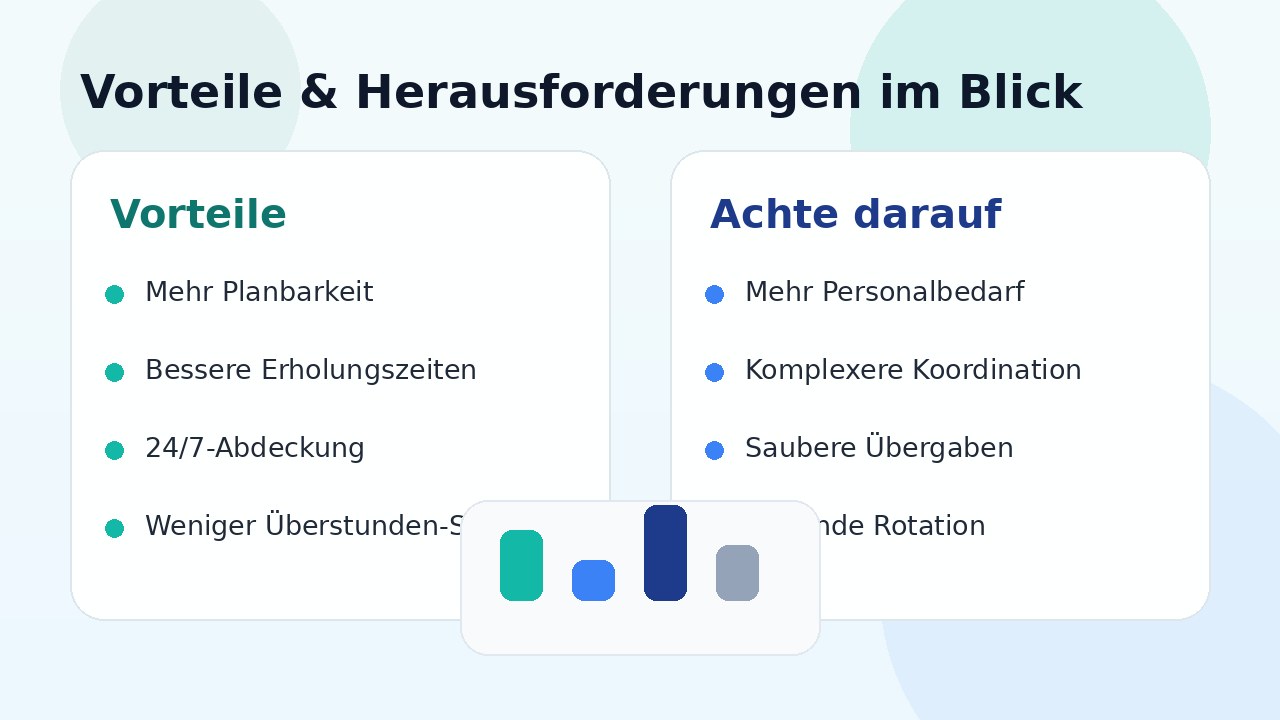
Advantages of the 4-Shift Model
For Employers
- Continuous operating hours: 24/7 production without interruption
- Higher utilization: Machines and equipment run around the clock – maximum efficiency
- Less overtime: With four teams, workload is better distributed, fewer absences due to illness or overload
- Planning reliability: Clear rotation, fewer conflicts in shift scheduling
- Competitive advantage: Faster delivery times, higher production capacity
For Employees
- Regular rhythm: Predictable shift rotation – you always know when you work
- More consecutive free time: Compared to the 3-shift model, there are more frequent longer free phases
- Allowances: Night, Sunday and holiday allowances (at least 25% for night work in Switzerland, see Night Allowance Switzerland)
- Flexibility: Free days can be used for appointments, family or hobbies
- Lower burnout risk: Better work-life balance than with 3-shift or permanent night shifts
Disadvantages of the 4-Shift Model
For Employers
- Higher personnel costs: Four teams mean more employees – plus allowances for night and weekend work
- More complex planning: Vacation coverage, sick leave and training must be coordinated across four teams
- Communication effort: Four teams never work simultaneously – information transfer is more difficult
- Training time: New employees need longer to adapt to the rhythm
For Employees
- Strain on biorhythm: Constant switching between early, late and night shifts can disrupt sleep
- Social restrictions: Weekend and holiday work, irregular working hours complicate family life and friendships
- Health risks: Long-term shift work increases risk of sleep disorders, cardiovascular diseases and gastrointestinal problems
- Less spontaneous free time: Free days are fixed, spontaneous activities are harder to plan
- Adjustment phase: Some people never fully adapt to shift work
Comparison Table: 4-Shift vs. 3-Shift vs. Alternating Shifts
| Feature | 4-Shift Model | 3-Shift Model | Alternating Shifts (2-Shift) |
|---|---|---|---|
| Teams | 4 | 3 | 2 |
| Operating hours | 24/7 | 24/7 | 16 hours/day (e.g. 06:00-22:00) |
| Off shift rhythm | Every 4th day off (or longer in variants) | Every 3rd day off | Weekly rotation (e.g. 1 week early, 1 week late) |
| Recovery time | High (longer free phases) | Medium | Medium to high (no night shift) |
| Personnel costs | High | Medium | Low |
| Planning complexity | High | Medium | Low |
| Allowances | Yes (night, Sunday, holiday allowances) | Yes (night, Sunday, holiday allowances) | Partially (only Sunday/holiday) |
| Typical industries | Industry, hospitals, logistics, energy | Production, service | Office, retail, light production |
| Work-life balance | Medium (more free time, but irregular) | Low (less free time) | High (no night shift) |
Conclusion: The 4-shift model offers the best balance between operating time and recovery time – but only if you cope well with shift work.
Template: Sample Schedule for the 4-Shift Model
Here is a practical 4-week shift schedule for four teams (A, B, C, D). Each team works on a 4-day cycle.
Week 1
| Day | Team A | Team B | Team C | Team D |
|---|---|---|---|---|
| Mon | Early Shift | Late Shift | Night Shift | Off |
| Tue | Late Shift | Night Shift | Off | Early Shift |
| Wed | Night Shift | Off | Early Shift | Late Shift |
| Thu | Off | Early Shift | Late Shift | Night Shift |
| Fri | Early Shift | Late Shift | Night Shift | Off |
| Sat | Late Shift | Night Shift | Off | Early Shift |
| Sun | Night Shift | Off | Early Shift | Late Shift |
Week 2
| Day | Team A | Team B | Team C | Team D |
|---|---|---|---|---|
| Mon | Off | Early Shift | Late Shift | Night Shift |
| Tue | Early Shift | Late Shift | Night Shift | Off |
| Wed | Late Shift | Night Shift | Off | Early Shift |
| Thu | Night Shift | Off | Early Shift | Late Shift |
| Fri | Off | Early Shift | Late Shift | Night Shift |
| Sat | Early Shift | Late Shift | Night Shift | Off |
| Sun | Late Shift | Night Shift | Off | Early Shift |
The cycle repeats over weeks 3 and 4.
Template as Excel/PDF Download
Need a ready-made template for your operation? Use the download above as a starting point. When the template becomes a real schedule with employees, availabilities, changes and time tracking, job.rocks for digital staff planning helps move cleanly from model to daily execution.
When is the 4-Shift Model Worthwhile?
The 4-shift model is not suitable for every company. Here are the main criteria:
The 4-Shift Model fits if…
- …your company must operate 24/7 (e.g. production, hospital, logistics)
- …you have enough staff to form four teams (at least 20-30 employees)
- …your employees are willing to work shifts (including night and weekend shifts)
- …you want to achieve a high utilization of your equipment
- …personnel costs are offset by higher productivity
The 4-Shift Model does NOT fit if…
- …you only work during the day or until evening → Then a 2-shift model is sufficient
- …you have too few staff → One team absence endangers the entire operation
- …your order situation fluctuates strongly → Then flexible models are better (e.g. part-time, floaters)
- …your employees are not healthy enough for shift work
FAQ: Frequently Asked Questions about the 4-Shift Model
How many employees do I need for a 4-shift model?
There is no reliable flat number for an entire company. Calculate each role from required people per shift, shifts to cover and the coverage factor based on weekly hours. Then add reserve for holidays, sickness, training and planned absences.
How high are the allowances in the 4-shift model?
There is no single percentage for every case. In Switzerland, temporary night work generally triggers a wage supplement, while regular or recurring night work generally focuses on compensatory time. Sunday and public-holiday work can involve further conditions, permits and collective-agreement rules. Check the specific operation and the applicable agreement.
Can I as an employee refuse the 4-shift model?
It depends on the employment contract, previous duties, any applicable collective agreement and the specific change. A blanket yes or no would be unreliable. Employers should obtain qualified advice and involve affected employees early.
Is the 4-shift model healthier than the 3-shift model?
Not automatically. Rotation direction, consecutive night shifts, length of recovery periods, workload and individual tolerance matter more than the number of teams alone. Shift work can affect health, so occupational-health advice belongs in the design.
- Occupational-health advice and examination rights under the applicable night-work rules
- Healthy diet, exercise, sufficient sleep
- Bright workspaces, ergonomic workplaces
How do I plan vacation in the 4-shift model?
First define minimum staffing and qualifications for every shift. Then plan holiday windows and reserve capacity transparently. A fixed “one person per team” rule does not fit every team size; the required cover after all absences is what matters.
What is the difference between the 4-shift model and continuous shift work?
"Continuous shift work" is the umbrella term for all models that run 24/7. The 4-shift model is a specific variant of this – with four rotating teams.
Are there legal requirements for the 4-shift model in Switzerland?
Yes. The Labour Act (ArG) regulates:
- Maximum working hours: max. 45-50 hours/week (depending on industry)
- Rest periods: at least 11 hours between shifts (can be reduced to 8 hours if compensated within 24 hours)
- Night work: max. 10 hours per shift, at least 25% allowance
- Sunday work: only with permission, allowance according to collective agreement
Conclusion: Is the 4-Shift Model Right for You?
The 4-shift model is a proven system for companies that must operate around the clock. It offers a good balance between operating time and recovery time – but only if you have enough staff and your employees cope well with shift work.
Advantages summarized:
- 24/7 operation possible
- Regular, predictable rhythm
- Better work-life balance than 3-shift
- Higher productivity and equipment utilization
Disadvantages summarized:
- Higher personnel costs
- Strain from shift work (health, social life)
- More complex planning
Want to introduce or optimize a 4-shift model? Start with the template, check labour law and collective agreements carefully, and then plan the rollout. If you do not want to manage everything permanently in Excel, WhatsApp and manual lists, job.rocks can bring teams, shifts, availabilities, communication and time tracking into one system.
From 4-shift model to staffed schedule
job.rocks does not replace legal review, but it makes operational planning much clearer: roles, teams, working times, invitations, confirmations and time data stay in one place.