
Dolder Grand Jobs: Your Path to a Successful Application in 2026
Looking for Dolder Grand jobs? Discover everything about job types, application process, salary, and typical interview questions for your career in this guide.
You have the job posting open, looking at Kurhausstrasse in Zurich or the hotel’s career page, and wonder if your profile really fits the Dolder Grand. Many good people get stuck here—not because of lack of quality, but because they don’t read the unspoken rules of a 5-star hotel like a hotelier. Anyone who wants to seriously pursue Dolder Grand jobs needs more than a clean CV; they need a sense of attitude, pace, and precision.
The hotel itself sets the bar high. The Dolder Grand was founded in 1899, is a 5-star luxury hotel in Zurich, covers around 40,000 m² with 175 rooms, and employs about 400 staff members. The Dolder Grand on Wikipedia thus represents an employer with a long-standing history in Zurich’s luxury hotel industry. Working here means not just being part of an ordinary hotel operation but being in an environment where guests, teams, and processes must be precisely coordinated.
When preparing for such hotels, it also helps to look beyond your immediate horizon. A useful comparison is working in this family business, where you quickly see how differently employers play out culture, responsibility, and application logic.
Table of Contents
- Your Path to the Dream Job at The Dolder Grand
- Understanding Job Profiles at Dolder Grand
- Creating Your Perfect Application Documents
- The Application Process from Start to Finish
- Convincing in the Interview
- Salary, Benefits, and Active Job Search
Your Path to the Dream Job at The Dolder Grand
You might be standing after a long shift in another hotel operation, considering whether to take the step into luxury hospitality, and finally want to know how to really stand out at a place like the Dolder Grand. The good news is, it’s not about loud self-promotion. It’s about clearly showing that you understand hospitality culture and reliably deliver in everyday life.

The hotel stands for tradition, size, and visibility. This is exactly what makes Dolder Grand jobs so appealing yet demanding, because expectations for appearance, document neatness, and reliability run alongside immediately. If you don’t read the position as “just any hotel job” but as an entry into a hotel with a very clear service attitude, your application will have a different impact. A good practical check is to ask yourself beforehand what a guest should feel in this hotel before even exchanging a word with you.
Practical rule: In luxury hospitality, the loudest CV doesn’t win; the candidate whose documents and interview behavior radiate the same calm as the front desk service does.
Those who orient themselves towards similar employers quickly realize that family culture, guest orientation, and pace often go hand in hand more closely than many think. Therefore, it’s also worthwhile to look at the employer’s internal organizational structure and how you talk about collaboration in your motivation letter. It’s not the dream of a “top hotel” that counts, but the proof that you can really handle everyday life there.
Understanding Job Profiles at Dolder Grand
The Dolder Grand is not a hotel with just two categories like reception and service. You will find roles in Front Office, Food & Beverage, Spa, Sales, Administration, and other areas, each with its own rhythm. Blindly applying often misses the role that actually fits your expertise.
Which Departments Really Matter
In Front Office, you need different behavior than in the restaurant or administration. At reception, pace, clear language, and clean handovers matter; in service, eye contact, calmness at the table, and a sense of order count. In administration, accuracy, clean documents, and a good understanding of internal processes are key.
The posting for a Front Desk Assistant Manager role clearly shows what matters in the luxury segment. Required are leadership experience in luxury hospitality, a commercial or hospitality-related basic education, confident handling of front office systems, and fluent German and English skills. French is a plus. The job description on LinkedIn makes it clear that language skills, system routine, and leadership experience are considered together.
What Experience in Luxury Hospitality Really Means
“Experience” here doesn’t just mean years of service. It means you know how an upscale hotel differs from a regular operation, for example in expectations, complaint handling, or the subtlety of communication. Someone who has successfully managed a busy check-in with demanding guests brings more relevance than someone with purely theoretical knowledge.
| Typical Job Areas and Requirements at Dolder Grand | ||
|---|---|---|
| Department | Example Positions | Expected Core Competencies |
| Front Office | Front Desk, Assistant Manager, Guest Relations | Language, system routine, calm demeanor |
| Food & Beverage | Service, Bar, Restaurant | Sense of timing, resilience, guest interaction |
| Spa & Wellness | Reception, Guest Care | Discretion, service awareness, organization |
| Sales, Marketing, Administration | Office, Assistance, Back Office | Accuracy, correspondence, teamwork |
If you’re unsure how to phrase your profile appropriately, it’s worth looking at creating a requirements profile, because it shows how closely tasks and skills must match. You should also read your own application this way. Don’t just ask what you can do, but what the hotel would specifically use you for.
Creating Your Perfect Application Documents
In the luxury segment, the application itself is already a test. Anyone who formats sloppily, writes too generally, or submits incomplete documents sends the wrong signal before anyone has even reviewed the profile. The Dolder Grand clearly states what it needs, and you should work exactly along these lines: motivation letter, current CV, references from previous jobs, proof of education, and, if available, certificates or references according to the career page.
How a Recruiter Reads Your CV
The CV doesn’t have to be creative; it must be quickly readable. A hospitality career belongs at the beginning, not somewhere between hobbies and language courses. If you worked in Front Office, state it clearly, name the function precisely, and avoid empty phrases like “team-oriented” without proof.
A good before-and-after example looks like this:
- Before: “I am resilient, flexible, and enjoy contact with people.”
- After: “In Front Office, I structured arrivals, complaints, and shift handovers, ensuring a calm process even in hectic moments.”
The difference is not in style but in proof. Those who describe concrete situations appear more credible. Those who only collect adjectives remain interchangeable.
The Motivation Letter Without Fluff
The letter may be personal but never generic. Don’t write that you “enjoy working with people,” as almost everyone claims that. Instead, write why this particular hotel appeals to you and how your previous daily work fits a 5-star operation.
Practical tip: A motivation letter for the Dolder Grand works best when you build a clear bridge between your previous workday and the hotel’s service culture.
If you need a good image for this, high-quality application photos can help. A strong photo doesn’t replace solid experience but rounds off a professional appearance, especially for roles with a lot of guest contact.
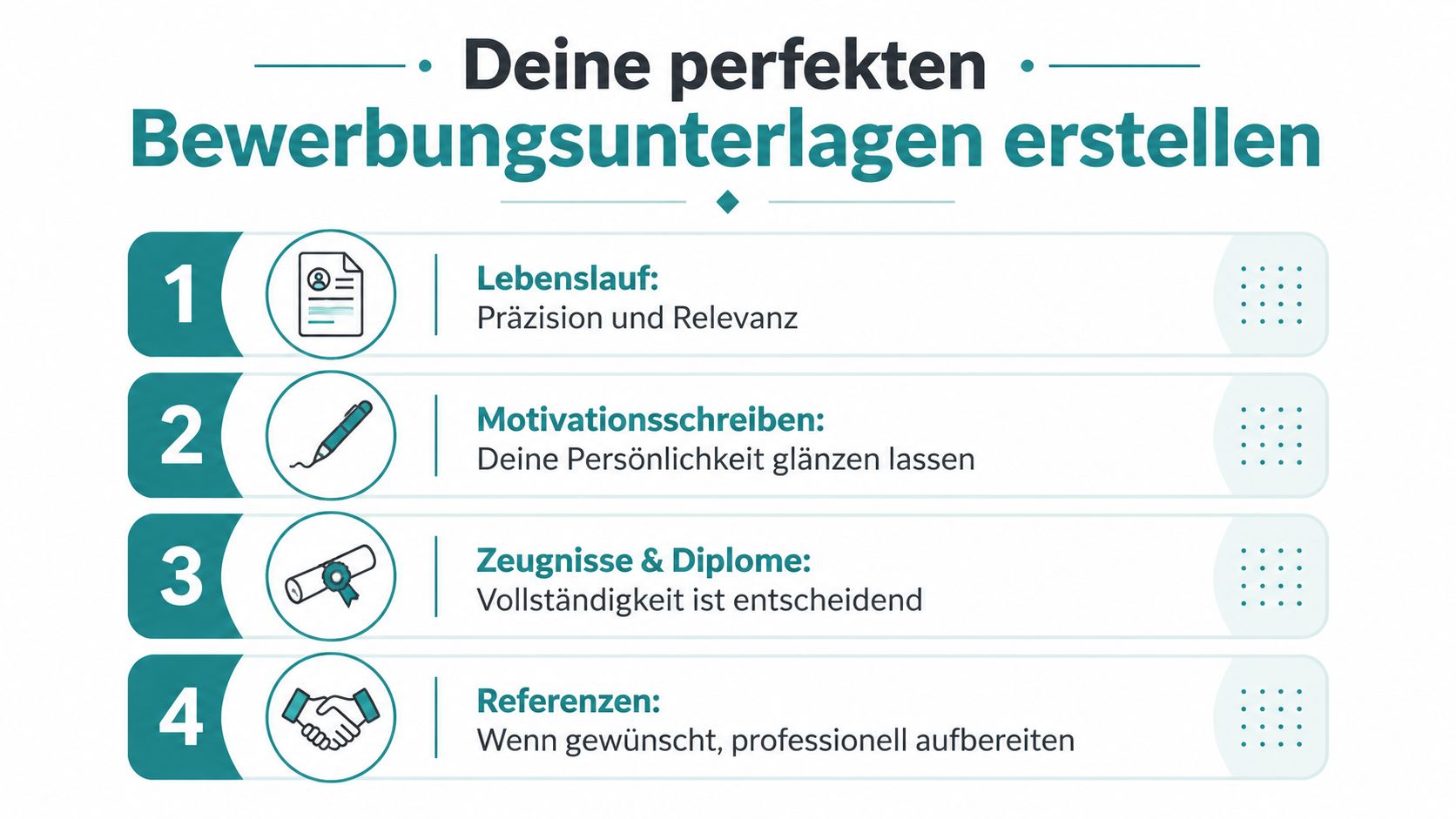
Completeness also counts in luxury segment applications. Missing a reference or having a certificate but nowhere visible quickly looks careless. And exactly this carelessness stands out faster in a hotel with such clear standards than in an anonymous large company.
The Application Process from Start to Finish
At the Dolder Grand, the work on the application doesn’t end with clicking “Send.” A clear process starts afterward, and the first feedback comes within five working days according to the career page. This short response time shows that documents are not just filed away but quickly reviewed, and applicants can expect clear communication.
The Sequence You Should Keep in Mind
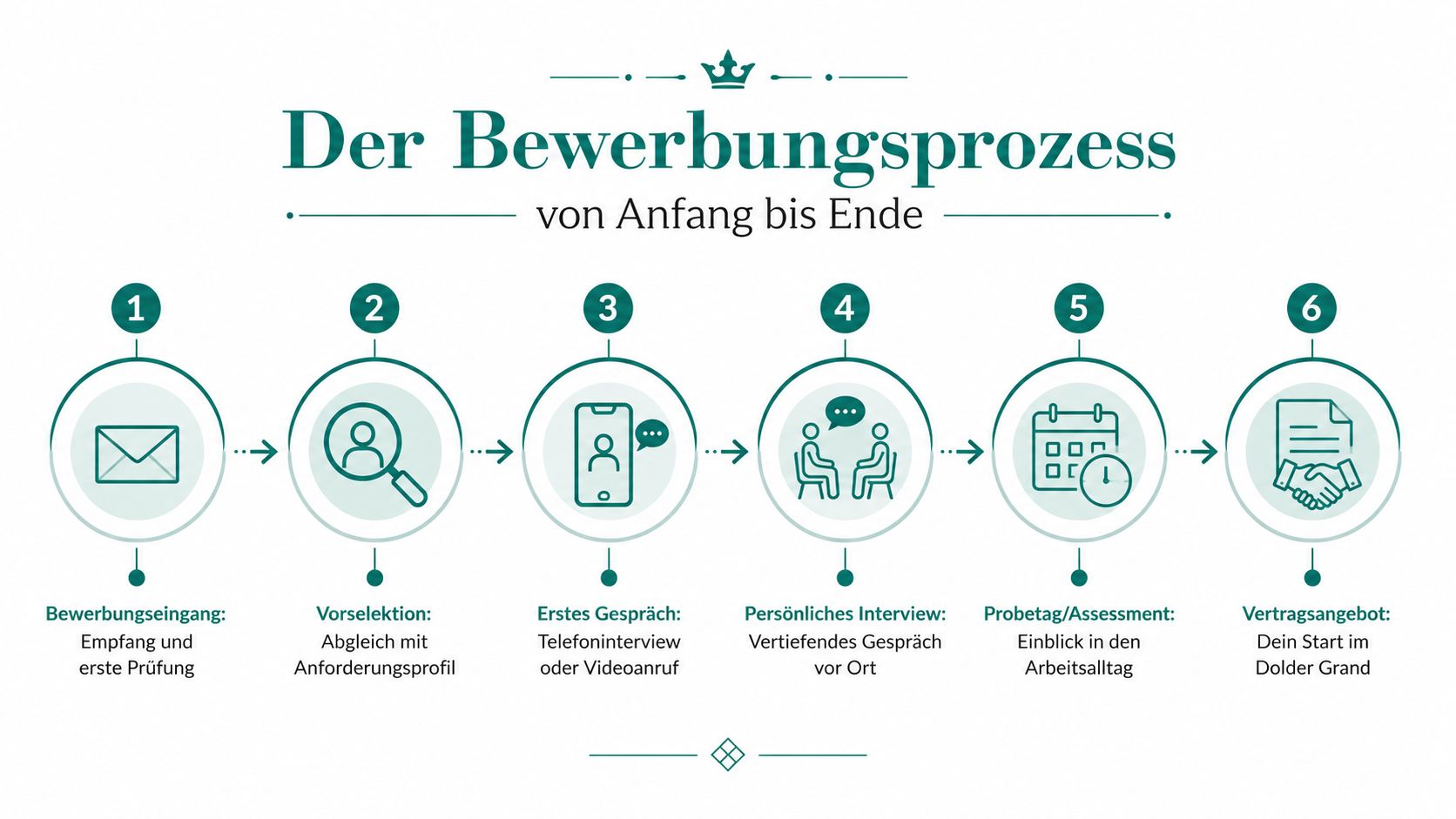
First comes the initial screening. Then the preselection, i.e., matching your profile with the position. Depending on the role, a first conversation follows, then a personal interview, a trial day, or an assessment. If both sides fit, the contract offer follows at the end.
Much is decided between these steps about the impression you make. Those who just wait after sending lose rhythm quickly. Those who promptly respond to feedback, submit missing documents without delay, and clearly confirm appointments show exactly the reliability expected in a hotel with high standards. In modern recruitment, the type of contact also matters, so it’s worth looking at How AI contacts applicants if you want to understand how communication can be organized today.
How to Stay Strong in Every Phase
Speed alone doesn’t help if documents are incomplete. A candidate who bundles everything neatly and stays brief, precise, and polite in emails makes a better impression. This mix of pace and care fits a demanding selection process better than hectic follow-ups.
The order behind the process is also understandable. A look at applicant management software in Switzerland helps you understand why complete information, clear documents, and a coherent structure carry so much weight. It’s not the technology itself but the consistency with which a hotel checks entries and prepares decisions.
The hotel checks not only your CV but also whether you fit into an orderly process.
Convincing in the Interview

The interview in a 5-star hotel is not an interrogation but a test of your attitude. You are usually already technically qualified; otherwise, you wouldn’t have been invited. Now it counts whether your facial expressions, language, and reaction speed make you someone they would assign to a demanding guest case.
Questions often revolve around real situations. How do you react to an angry guest? How do you stay calm in the team when multiple issues arise simultaneously? What does luxury mean to you if it’s not defined by price or status but by experience?
A useful answer to a complaint question doesn’t sound scripted but like action. You can say you calmly listen to the concern, repeat the core, check a solution, and only let the person go when they know what happens next. This calmness is worth more in luxury hospitality than any perfect sentence.
Dress Code and Appearance
You don’t have to look like you’re in costume, but you must appear trustworthy to guests immediately. Clean clothes, polished shoes, neat hands, and an open gaze matter more than fashion experiments. In the interview, it also counts whether you attentively read the room or just wait for the next question.
Those who overemphasize how much they “love every challenge” quickly seem interchangeable. Those who describe one or two precise situations show they have really worked. This is the point where good candidates separate themselves from nice applicants.
Salary, Benefits, and Active Job Search
It’s better to talk about money in the application process with a clear head than wishful thinking. In Zurich’s luxury hotel industry, conditions depend heavily on function, experience, and responsibility, and this also applies at the Dolder Grand. Those taking on leadership roles have different expectations than someone in service or back office.
Benefits in hotels of this class usually lie not only in salary but in the overall package. Depending on the role, this often includes things like meals at work, structured processes, insights into different hotel areas, and an environment where you learn a lot quickly. What really matters to you depends on whether you are currently focused on development, security, or a career change.
Where to Find Open Positions
The official career page remains the first route. In parallel, searching job portals is worthwhile because multiple roles are often visible simultaneously. On StepStone, there are currently 19 open jobs for Dolder Hotel AG in Zurich, showing ongoing demand for qualified staff StepStone. On jobs.ch, the company at Kurhausstrasse 65, 8032 Zurich is listed, and it is mentioned that positions in hospitality, IT, and administration are regularly posted jobs.ch. For the regional labor market, the SECO remains the official Swiss data source SECO Labor Market Statistics.
How to Approach Your Search
- Check the official career page: There you find positions directly from the employer and see which documents are required.
- Compare job portals: If several portals show multiple positions, you don’t just check one vacancy but several possible entries.
- Sort roles by function: Front Office, Service, Administration, and Leadership require very different profiles.
- Have your documents ready in advance: So you can react quickly when a suitable position appears.
Practical rule: Don’t just search by the hotel name; also search by the function you really want to perform. This way, you avoid the trap of applying for the wrong role.
To align your own expectations, calculate your net salary as it helps you compare your personal picture with the real net effect. In the end, it’s not only about whether a job sounds good but whether it fits your next step.
If you want to get serious about Dolder Grand jobs now, carefully review the career page, check your documents today, and prepare an application package that really fits the hotel. Then apply specifically for a role that matches your profile, language, and appearance. For further guidance on modern application processes and workforce planning, visit job.rocks.