
Employment contract L-GAV: Your guide simply explained
An employment contract in accordance with L-GAV (national collective employment contract for personnel leasing) is your foundation for fair and clear working conditions in Swiss temporary work. Don't think of it like a normal contract, but more like a protective shield. It sets out clear rules for you and thousands of other temporary employees...
A Employment contract according to L-GAV (National Collective Employment Agreement for Personnel Leasing) is your foundation for fair and clear working conditions in Swiss temporary work. Don't think of it like a normal contract, but more like a protective shield. It sets clear minimum standards for wages, working hours and termination for you and thousands of other temporary employees. This ensures that your rights are always protected.
What an L-GAV employment contract means for you
The L-GAV is essentially the general rule book for personnel leasing. It was negotiated by the social partners - i.e. the employers' and employees' associations - and declared binding for the whole of Switzerland by the Federal Council. This means: Almost every staff leasing company has to adhere to these rules.
Your employment contract is not just based on an individual agreement between you and the company you use. It stands on a much stronger, higher foundation. The main goal is to protect you from unfair conditions and to create a stable, secure basis for your employment - even if your assignments are short or change frequently.
Core areas that the L-GAV regulates
The following graphic shows you at a glance the three central pillars that the L-GAV cements in your employment contract.
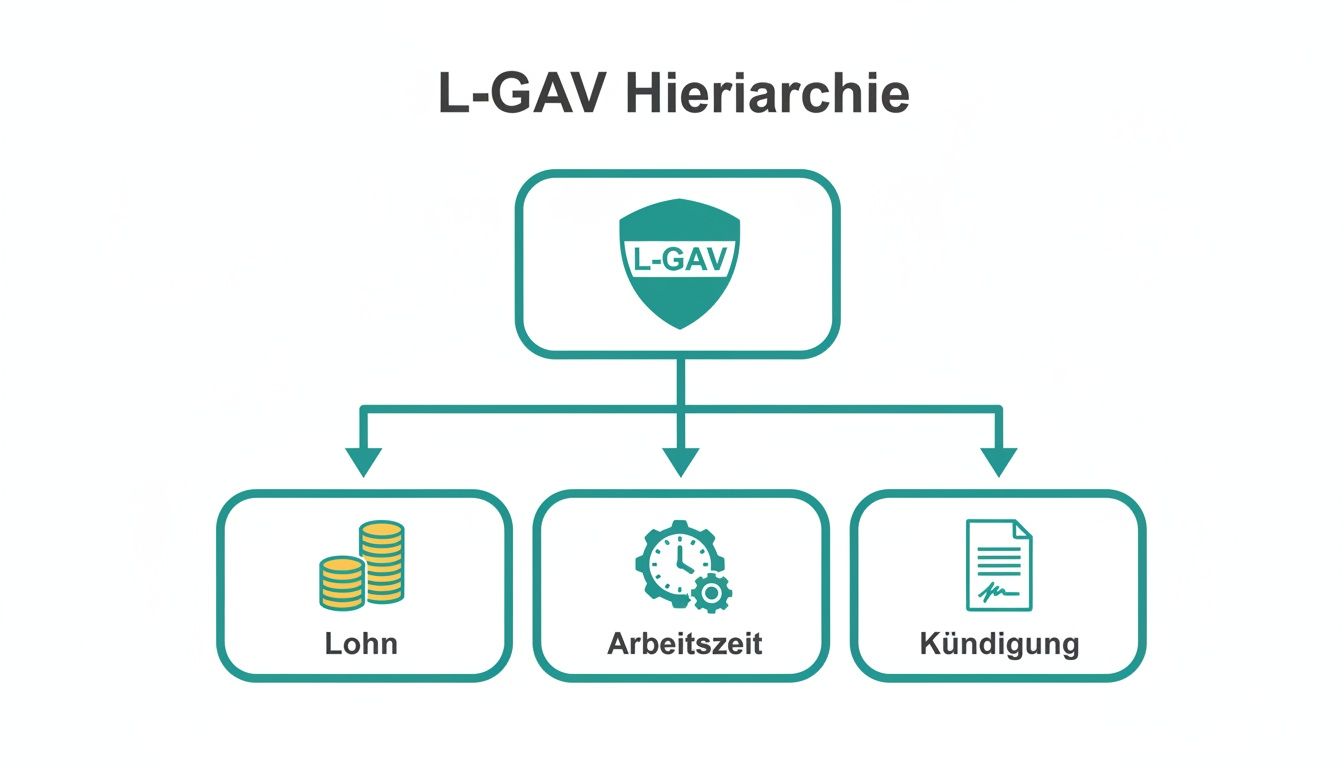
You can see straight away: The L-GAV specifically protects the most important aspects of your job. This is what makes fair and transparent collaboration possible.
The difference to the normal individual employment contract
A standard individual employment contract (EAV) often gives you more leeway for negotiations, but in return also offers less protection. If no overarching collective employment agreement applies, the conditions are based solely on the code of obligations and what you personally negotiate. A Employment contract according to L-GAV On the other hand, it sets clear minimum standards that must not be fallen below.
An L-GAV contract is like a safety net. While an EAV allows you to determine the mesh size yourself, the L-GAV guarantees that the mesh is never too big to drop.
To better understand the special features of your L-GAV contract, take a look different types of employment contracts on. This will help you to recognize the special advantages of your employment in the temporary employment agency even more clearly.
Direct comparison between L-GAV and individual employment contract (EAV)
The table shows you the key differences between a contract according to the L-GAV and a normal individual employment contract without being subject to the GAV.
| feature | Employment contract according to L-GAV | Individual employment contract (EAV) without CBA |
|---|---|---|
| Minimum wage | Mandatory, depending on qualifications and region. | No statutory minimum wage, freely negotiable (except cantonal regulations). |
| Working time | Clear rules for maximum working hours, breaks and overtime bonuses. | Regulations are based only on labor law, often less specific. |
| Notice periods | Fixed, often shorter deadlines that are linked to the duration of the assignment. | Longer statutory periods that increase with years of service. |
| Social benefits | Mandatory pension fund from the first day and daily sickness benefit insurance. | Pension fund obligation only applies from a certain income and length of employment. |
| Further training | Entitlement to financial support for job-related further training. | No general entitlement, completely dependent on the employer. |
This comparison makes it clear how the L-GAV is specifically tailored to the needs of temporary workers. It offers protection exactly where a normal contract could leave gaps. You can also find additional information in our articles on L-GAV in Switzerland.
Check the most important clauses in your contract
An employment contract is more than just a piece of paper – it is the foundation of your employment. At one Employment contract according to L-GAV This foundation is particularly robust because the collective employment contract protects you with clear, binding rules.
Let's take a look at which points in your contract are crucial and what you should definitely pay attention to. With this knowledge, you can confidently check whether everything is arranged fairly and correctly for you.
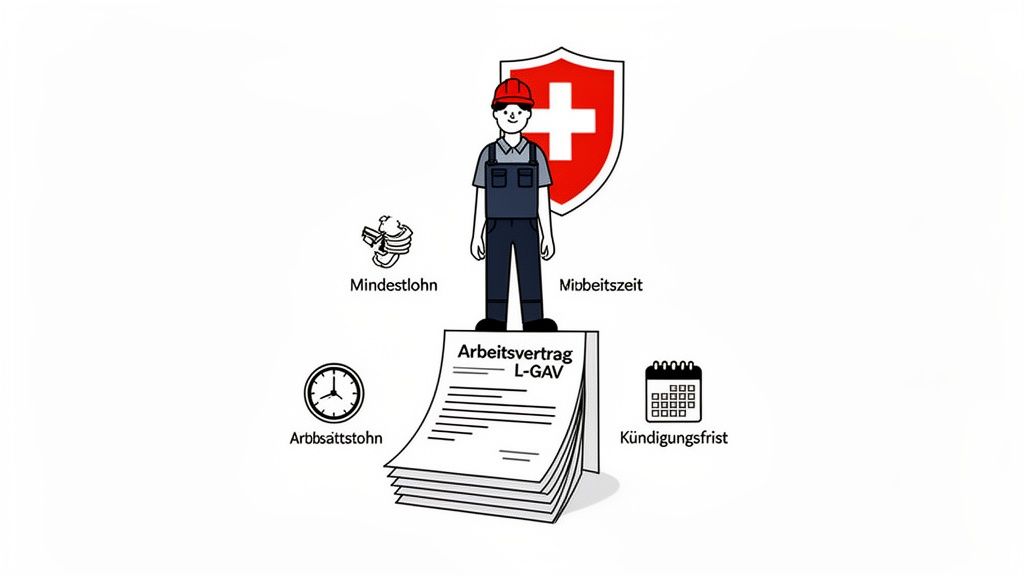
Wages and wage supplements
Your wages are of course the heart of the contract. The L-GAV ensures that there is no arbitrary action here because it prescribes binding minimum wages. These are staggered depending on the region and your qualifications and must not be undercut under any circumstances.
- A practical example of a wage clause: "The gross hourly wage is CHF 28.50 and is based on the applicable minimum wage of the L-GAV personnel leasing for qualified employees in the Zurich region."
Such a formulation is transparent and creates clarity. It confirms that your wages meet the GAV requirements. So always check whether you have been classified correctly.
But that's not all. The L-GAV also regulates surcharges for special working hours. For night work (usually between 11 p.m. and 6 a.m.) there is a surcharge of 20%. If you work on Sunday, there are even 50% extra.
Working hours and overtime
Flexibility, yes, but not at your expense. The maximum weekly working hours are clearly regulated in the L-GAV and are usually between 42 and 45 hours, depending on the company. Every minute you work beyond that counts as overtime.
Your contract must clearly reflect these regulations. Overtime is paid either with a wage supplement of 25% remunerated or must be compensated for by free time of the same duration. In most cases, a flat-rate compensation in wages is not permitted.
Very important: The L-GAV is very strict here. A clause like “All overtime is paid with wages” would almost always be invalid under the L-GAV and should set off alarm bells for you.
Holiday entitlement calculated correctly
Relaxation is not a luxury, it is your right. If you are employed on an hourly basis, your holiday entitlement will be added to your salary as a percentage. This means you get your vacation days paid out with every payslip.
Make sure that the calculation on your payslip looks like this:
- Up to the age of 20: You are entitled to 5 weeks of vacation. This corresponds to a surcharge of 10.64% on your gross wages.
- From the age of 20: The entitlement is 4 weeks of vacation, which is a surcharge of 8.33% corresponds to the gross wage.
Take a close look at your payslip. The vacation share must be shown as a separate item. This is the only way you can be sure that your claim will be paid correctly.
Notice periods in detail
In the temporary sector, sometimes things have to happen quickly. That's why the notice periods in the L-GAV are shorter than in normal labor law and depend on how long you have been working continuously in the same company.
- 1st to 3rd month: 2 working days
- 4th to 6th month: 7 days
- From the 7th month: 1 month
These deadlines apply to both sides – you and your employer. This gives you the flexibility to react quickly to a new job offer, but also offers the company the flexibility it needs.
Social security through pension provision and insurance
This is where the L-GAV shows its full strength. Your social security is strengthened by regulations that go far beyond the legal minimum. These are two of the biggest advantages of an L-GAV contract.
1. Occupational pension provision (pension fund): Normally there are waiting periods, but not here. You are from very first day of work You are subject to a pension fund as long as your assignment lasts longer than three months or is indefinite. This is a huge advantage for your retirement planning.
2. Daily sickness benefit insurance: Your employer is obliged to take out daily sickness benefit insurance for you. This protects you for up to 720 days in the event of illness 80% your wages. An important protection where the employer has to pay at least half of the premium.
- A clause could look like this: "The employee is insured through a collective daily sickness benefit insurance, which pays a daily benefit of 80% of the salary for 720 days within 900 days in the event of illness. The premium is divided equally between the employer and the employee."
These clauses are your safety net. If you have these points in your Employment contract according to L-GAV Check to ensure you get all the powerful benefits you're entitled to.
This is how industries affect your L-GAV contract
The L-GAV for staff leasing is a set of rules for the whole of Switzerland, but the world of work is anything but uniform. Depending on which industry you end up in, the general requirements of the Employment contract L-GAV supplemented with your own rules of the game or interpreted differently. And that is crucial, because a job at a festival has completely different requirements than a job in construction.
Let’s take a look at how these industry-specific rules specifically affect your everyday work. This way you know exactly what you should pay special attention to in your area of operation.
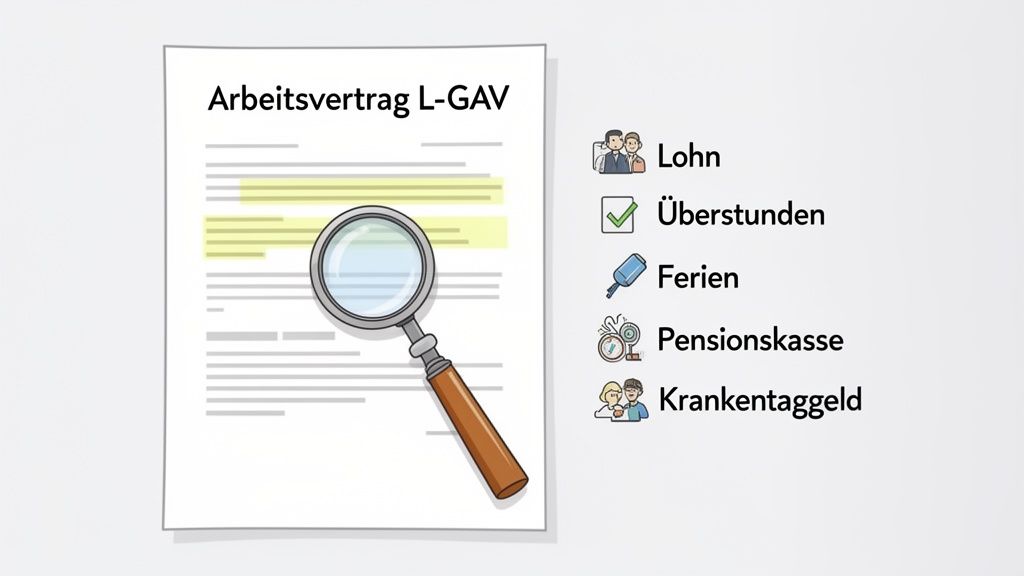
Event industry: When working hours are irregular
In the event industry, a classic 9 a.m. to 5 p.m. job is the absolute exception. Your assignments often take place in the evenings, at night or on weekends. Your L-GAV contract must fairly reflect this enormous flexibility.
- Practical example: Imagine helping to set up a large music festival as a stagehand. Your shift runs from 6:00 p.m. to 3:00 a.m.
Several L-GAV rules apply here at once. Working hours after 11 p.m. count as night work and are subject to a wage supplement of 20% be remunerated. If this assignment falls on a Sunday, there will be an additional surcharge of 50%.
Another important point is the breaks. The L-GAV prescribes clear break regulations that apply even in the most hustle and bustle of events. Your employer has a responsibility to ensure that you get your breaks, no matter how tight the schedule is.
Construction industry: Clear rules for wages and expenses
In construction, more specific collective employment contracts often apply, which even take precedence over L-GAV personnel leasing. If that is not the case, the L-GAV sets the financial guardrails.
The minimum wages here are particularly finely graded according to qualifications and experience. An unskilled worker has a different wage claim than a trained bricklayer with a federal certificate of competency (EFZ). Your salary must correspond exactly to this classification.
A typical point of contention in construction is expenses. The L-GAV clearly states that you will receive compensation for meals outside if you cannot go home at lunchtime. Make sure that this point is clearly formulated in your contract.
A concrete scenario could look like this:
- Location: You work on a construction site that is 45 minutes away from your home.
- Food: Spending your lunch break at home is impossible in terms of time.
- Claim: Your employer must pay you compensation for lunch expenses as set out in the L-GAV or other applicable construction industry GAV.
Gastronomy: tips and work clothes
Gastronomy is a classic field for temporary work. Here the L-GAV for staff leasing often overlaps with the L-GAV for the hospitality industry. The rule that is more advantageous for you always takes precedence.
A hot topic is how to handle tips. Basically, the tip belongs to you or the team. Under no circumstances may it be misused to achieve the GAV minimum wage. Your basic wage must always meet the requirements, completely independent of tips.
- Example of an unacceptable practice: An employer pays you a wage below the minimum wage and thinks you can make up the difference with tips. This is simply forbidden under the L-GAV.
Work clothing is also an issue. If a special uniform or uniform is required, the employer must cover the costs or pay you appropriate compensation. These costs cannot simply be deducted from your salary.
Cleaning and security industry: surcharges as the norm
In the cleaning and security industry, assignments outside of normal office hours are standard. Early shifts, night shifts and weekend shifts are part of everyday working life here.
- Security service: You monitor a company premises at night from 10 p.m. to 6 a.m. Here your employer is obliged to pay you the night supplement for the entire shift.
- Building cleaning: Your assignment in an office complex will take place on Saturday. In this case, you are entitled to the corresponding weekend supplements.
These examples make it clear: Although the... Employment contract according to L-GAV To create a nationwide foundation, it is crucial to know the specifics of your industry. This is the only way you can be sure that all specific rules are applied correctly and that you are ultimately paid and treated fairly.
Typical errors in the L-GAV contract – and how to uncover them
Unfortunately, where clear rules exist, mistakes also happen. A Employment contract according to L-GAV Although it creates a strong protective net for you, this net is only as good as its attachment. Not every mistake is made with malicious intent; Often it is simply ignorance or unclean templates that lead to problems later.
So that you don't fall into a trap, I'll show you the most common stumbling blocks here. With this knowledge, you can check your contract specifically and identify warning signs early on, before they become a real nuisance. This way you can ensure that your rights are really protected.
Incorrect payroll and missing bonuses
One of the most common problems is incorrect payroll. Do you work on weekends or late into the night, but this isn't reflected on your pay slip? This is a clear alarm signal. The L-GAV prescribes mandatory wage supplements that are absolutely non-negotiable.
- Practical example of incorrect billing: Imagine you worked 8 hours each on two Sundays last month. Your hourly wage is CHF 30.–. A payout of would be correct CHF 720.– (16 hours x CHF 30 + 50% Sunday surcharge). However, if your statement only shows CHF 480, the surcharge is completely missing.
Take the time to carefully review each payslip. If bonuses for night or Sunday work are systematically missing, you should address this immediately.
The collective employment contracts (GAV) in Switzerland regulate wages for almost 600,000 employees. An average increase in effective wages was set for 2025 1.2 percent agreed, which underlines the importance of correct wage regulations. You can find out more about these developments directly on the SRF website.
Unclear regulations regarding overtime and holidays
Another classic is vague or even illegal overtime clauses. Phrases such as “Any overtime is paid as a flat rate with the salary” are almost always invalid within the scope of the L-GAV. Each individual overtime must either be accompanied by a surcharge of 25% be paid or compensated with free time.
An L-GAV contract without a clear and correct overtime regulation is like a car without a speedometer. You only realize something is wrong when it's too late.
Calculating your vacation entitlement is just as critical. If you are employed on an hourly basis, the vacation portion must be shown separately on each payslip - these are 8.33% for 4 weeks vacation or 10.64% for 5 weeks. A blanket integration into the hourly wage without you seeing it is not permitted.
Unauthorized deductions and incorrect notice periods
Sometimes there are items in the contract that have absolutely no place there. Unjustified wage deductions are a clear no-go and a sign of a dubious employer.
Common disallowed deductions to watch out for:
- Costs for work clothing: If a uniform is required, the employer must cover the costs. Point.
- Processing fees: Administrative flat rates for contract creation or payroll processing are prohibited.
- Compensation: In most cases, a deduction for minor, unintentional damage (such as broken glass) is not legal.
The notice periods are also sometimes cheated. If your contract states a shorter period than provided for in the L-GAV, this clause is invalid. The regulation that is more favorable for you as an employee always applies - and that is the one from the GAV.
Checklist for quick contract review
Use this short list to make your... Employment contract L GAV to examine the most important sources of error. If you have even the slightest bad gut feeling about something, ask.
- Minimum wage: Does your wage correspond to the correct wage class according to the L-GAV?
- Surcharges: Are the supplements for night and Sunday work clearly mentioned in the contract?
- Overtime: Is there a fair regulation (25% surcharge or compensation)?
- Holidays: Is your vacation share shown correctly and separately on the payslip?
- Notice periods: Do the deadlines match your length of employment according to the L-GAV?
- Deductions: Do you find unclear or questionable deductions in your contract or on your payslip?
Keeping a close eye on these points will protect you from unpleasant surprises and ensure you receive the fair treatment you deserve.
Understanding data protection in staff leasing
In personnel leasing it is hardly possible without the exchange of personal data. Your name, your qualifications, your working hours – all of this is shared between you, the lender and the company you use. But what information is really necessary? They play here Employment contract L‑GAV and the Swiss Data Protection Act (DSG) work closely together to protect your privacy.
Your employer may only collect the data that is absolutely necessary for the processing of the employment relationship. This Principle of data minimization is the crucial point here. It's about only processing what is essential for a very specific purpose.
What your employer is allowed to know - and what not
The boundary is often clearer than you might think. Certain information is essential for correct payroll and deployment planning. Other, very personal information has absolutely no place in the work context.
A practical example:
You will be booked for a catering assignment.
- Necessary data: Your name, your contact details for scheduling, your AHV number for payroll and your bank details. Information about your qualifications (e.g. a hygiene certificate) is also absolutely relevant.
- Unnecessary data: Questions about your marital status, your religious affiliation or your political views are taboo. This information is simply not relevant to the job and should not be collected.
Your employer acts like an archivist, collecting only the files needed for a specific task. Everything else remains your private property and does not belong in your personnel file.
This distinction is not a friendly request, but a clear legal requirement. It ensures that your personal information remains protected.
Checklist for your data protection
With this simple checklist you can quickly check whether your employer is strictly complying with the data protection rules as part of your L-GAV contract.
- Consent: Have you been clearly informed about which of your data will be used for what purpose? A blanket approval is not enough here.
- Transparency: Do you know who has access to your data (e.g. the operating company or payroll)?
- Security: Are your documents, whether digital or paper, stored securely? Are they protected from access by unauthorized persons?
- Right to information: Has it been explained to you that you have the right to request information about the data you have stored at any time?
- Deletion: Is there a clear process for deleting your data after your employment relationship has ended and the statutory retention periods have expired?
Communication is a very important point here. Your employer should also let you know how they will contact you. You can find out more about what is permitted in workplace communication in our Guide to SMS text messaging in the workplace.
Your rights after the end of your assignment
Your employment relationship has ended - but what happens to your data now? Your former employer cannot simply keep your personnel file forever. Statutory retention periods apply, for example for wage-related documents, which are usually ten years must be kept.
After these deadlines, you have this Right to be forgotten. This means you can request the deletion of your personal data. Your former employer must comply with this request as long as there are no legal obligations against it. Aside from the specific provisions for staff leasing, it is always a good idea to also find out about general ones Privacy Policy to inform. This will help you increase your awareness of your rights in the digital world.
How digital tools simplify managing your contract
Honestly: the administration of L-GAV contracts, time recording and payroll can be a real nightmare. Especially if you have frequently changing assignments. Luckily, modern digital helpers relieve you and your employer of a lot of work and finally create the transparency you want.
Just imagine entering your working hours directly via an app on your cell phone. That's it for you. In the background, the system automatically compares your entries with your complex rules Employment contract according to L‑GAV off. Supplements for night or Sunday work? Are calculated immediately and without errors.
Automated correctness and crystal-clear overview
Such tools are essentially a guarantee that your payroll is always accurate. They know every single GAV requirement and apply them correctly - this reduces human errors to a minimum. For you this means one thing above all: the certainty that you will always be paid fairly and on time.
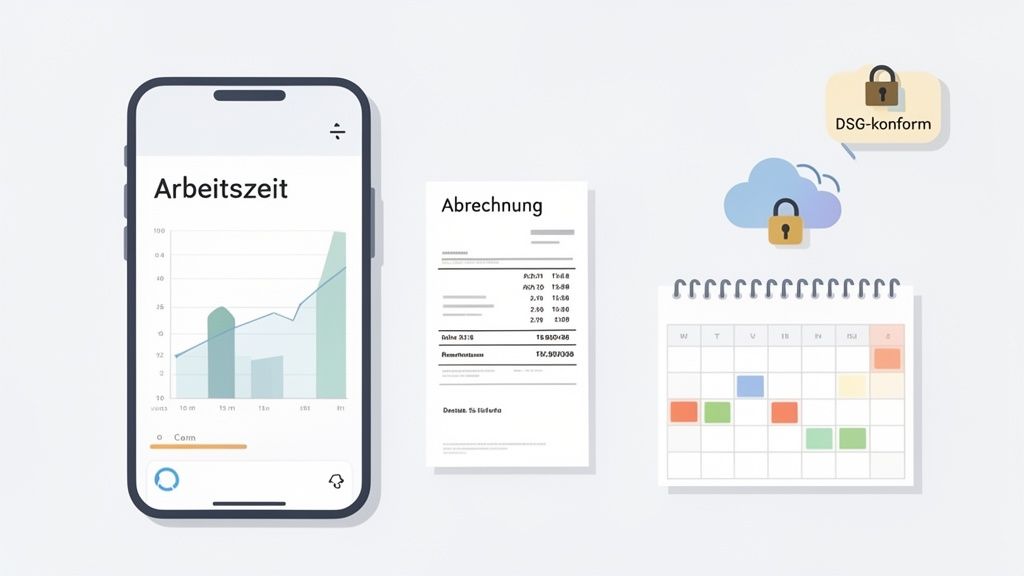
Digital platforms finally bring order to your operational planning. You can see at a glance when and where your next job is. All important documents, from your contract to payslips, are stored securely and in a DSG-compliant manner in one central location. No more searching in any folders.
This is what it looks like when a modern platform like job.rocks takes over personnel planning and management for companies:
This clear dashboard gives employers full control over all deployments and employee data. The result for you as an employee? A smooth organization where nothing gets lost.
A digital workforce tool is like a personal assistant for your employment contract. In the background, it ensures that all rules are adhered to so that you can concentrate fully on your work - without any paperwork.
More time for what really matters
What does that mean specifically for you? Less administrative effort and much more clarity. You no longer have to laboriously fill out timesheets or recalculate your payslips manually. Everything runs digitally, quickly and can be traced at any time. This not only gives you time, but also a great deal of security.
Accurate time recording is the foundation for fair billing. If you want to go deeper into how this works, read our article on Working time recording according to L-GAV. There we explain in detail how digital solutions guarantee compliance with all regulations.
L-GAV employment contract: The most frequently asked questions from practice
Anyone who has to do with the state collective labor agreement for staff leasing often comes across the same questions. We have the answers for you – short, clear and to the point so that you know exactly what is important.
Does the L-GAV really apply to all temporary workers in Switzerland?
Yes, that is the clear answer. The Federal Council has declared the L-GAV to be generally binding. This means that it is the essential set of rules for all rental companies and their temporary workers.
There is a small exception: If there is another GAV for your industry that offers you at least equivalent or even better conditions, it can replace the L-GAV. But normally the L-GAV is the basis for your employment contract.
What can I do if my wage is below the GAV minimum wage?
The legal situation here is clear: your employer is obliged to provide you with the im L-GAV employment contract to pay the fixed minimum wage. Point. If you find a number in your contract that is lower than this, this clause is simply invalid.
In such a case, you are entitled to additional payment of the entire difference. The best thing to do is to contact the L-GAV joint commission or a trade union directly. There you will receive professional support to enforce your rights.
How is overtime regulated in the L-GAV?
Anything you do beyond your contractually agreed working hours is considered overtime. The L-GAV leaves little leeway here and protects you from unpaid overtime.
- Compensation: The standard case is payment with a wage supplement of 25%.
- Compensation: But you can also agree to balance the overtime 1:1 with free time. It is important that both sides agree to this.
Incidentally, a flat-rate compensation for overtime in the monthly salary is not permitted in the vast majority of cases.
Am I entitled to a pension fund even for short assignments?
Yes, absolutely! This is one of the greatest social achievements of the L-GAV. Temporary workers must... very first working day be insured in a pension fund.
This regulation applies as soon as your employment relationship is planned for more than three months or if it is open-ended from the outset. The L-GAV has thus closed a huge gap in social security for temporary workers.
This regulation ensures that you save completely for your retirement provision, even with flexible employment. This is not a small detail, but a crucial protection mechanism for your financial future.
Would you like to simplify the management of your flexible employee pool and ensure that all L-GAV rules are automatically applied correctly? job.rocks offers you the perfect digital solution for deployment planning, time recording and wage preparation. Book a demo now https://job.rocks and discover how easy workforce management can be.