
Personnel planning for events: Successful strategies for your planning
Good personnel planning is the foundation for every event. It's about having the right people with the right skills in the right place at the right time. Sounds simple, but this is exactly where it decides whether your event runs smoothly, the guests are happy and the team stays motivated - or whether...
Good personnel planning is the foundation for every event. It's about the right people with the appropriate skills to be in the right place at the right time. Sounds simple, but this is exactly where it decides whether your event runs smoothly, the guests are happy and the team stays motivated - or whether there is chaos in the end and your budget is blown.
How to lay the foundation for your event
Every great event stands or falls with its team. The first step to building this team is an honest needs analysis. Here you ask yourself the crucial questions: How many people do I really need? And which skills are absolutely indispensable? This means you can avoid staff shortages right from the start and keep costs firmly under control.
Determine actual staffing needs
Start by mentally breaking down your event into its individual parts - i.e. into areas and time phases. A music festival works completely differently than an elegant company party.
Imagine you are planning a medium-sized open-air concert. Your analysis could then look something like this:
- Structure (Day -2 to -1): What you need above all here is hands that can get hands on. Stage technicians, helpers for the barriers and logisticians who pull up the entire infrastructure.
- Event day (12:00 p.m. – 2:00 a.m.): Now things are getting serious. You need staff for admission control, cloakroom, at the bars, for security and of course paramedics.
- Dismantling (day +1): After the party is before cleaning up. A smaller but capable team is required for quick dismantling and cleaning of the site.
This simple division makes it immediately clear: you don't need the same number of people all day long. The number of staff varies greatly depending on the phase of the event.
A precise needs analysis is not an unnecessary additional expense, but rather your insurance against chaos on the day of the event. It uncovers hidden staffing needs and prevents you from ending up paying for staff you didn't need.
The temporary employment industry plays a huge role, especially in Switzerland. At large events such as stadiums or festivals, temporary workers ensure the necessary flexibility to be able to react quickly to short-term cancellations. With 87,140 placements The last reporting year shows how important this flexibility is for the industry.
Create precise requirement profiles
As soon as you know how many People you need, you have to define, What these must be able to. Vague advertisements such as “bar staff wanted” are a guarantee for inappropriate applications and frustration on both sides. Be as specific as possible.
A sharp requirements profile is your best filter. It helps you separate the wheat from the chaff and ensures that you only spend your time with truly suitable candidates. In our guide we will show you step by step how to do one Create a detailed requirements profile can make your work noticeably easier.
For our concert example, the profiles could look like this:
- Role: Bar manager
- Tasks: Cash accounting, team management, keeping an eye on inventory.
- Necessary skills: Initial management experience, fit with common cash register systems, stress-resistant.
- Role: Security personnel (entrance)
- Tasks: Ticket and bag checks, age verification.
- Necessary skills: Valid security certificate, fluent in German and English, de-escalating demeanor.
- Role: Stage technician
- Tasks: Setting up and dismantling the lighting and sound technology.
- Necessary skills: Proven experience with certain mixing consoles (e.g. Midas, DiGiCo), height capability.
These clear profiles not only help you with your search. Later, when planning shifts, they are worth their weight in gold. You know exactly which person can take on which task, thus avoiding unpleasant surprises and skills gaps in the team.
Ok, the staffing requirements are there. Now the exciting part begins: finding the right people for your event and planning them cleverly. This is where the wheat is separated from the chaff, because now it's about putting together your team - be it through agencies, online platforms or your own talent pool that you've built up over the years.
A key point that is often underestimated is this Availability query. Anyone who relies on countless emails or WhatsApp groups will quickly lose track and lose valuable time. Modern tools are not a luxury here, but rather a necessity in order to record availability quickly and cleanly without getting lost in detailed manual work.
The following graphic shows the basic process that precedes your search – and why the preliminary work is so crucial.
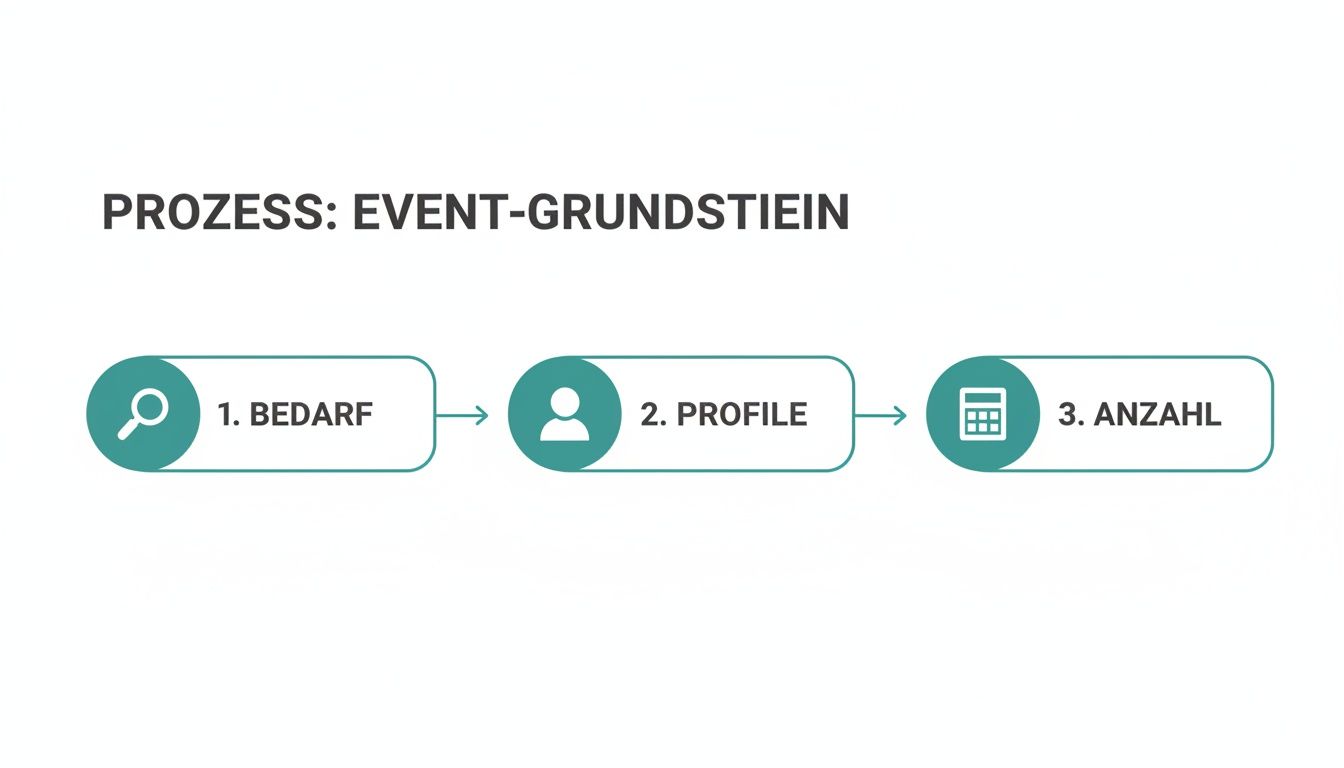
You can see straight away: a crystal-clear determination of needs and clearly defined requirement profiles are the foundation. Without this basis, recruiting becomes a game of chance.
The best channels for your event staff
Where can you find the suitable employees you need? Choosing the right channel depends heavily on the type of event you have and the skills you are looking for. Here is a brief overview of when which channel makes sense.
A comparison of the advantages and disadvantages of common methods for finding the right staff for events.
Comparison of personnel search methods
| method | Advantages | Disadvantages | Ideal for… |
|---|---|---|---|
| Recruitment agencies | Take over the entire selection process, guarantee qualifications, and often offer replacements in the event of failures. | Higher costs, less direct contact with candidates before selection. | Specialized professionals such as security personnel, technicians or experienced catering managers. |
| Online platforms | Wide reach, often cost-effective, direct access to a broad pool of candidates. | A lot of filtering effort is required and the quality of the applications can vary greatly. | More general roles such as service staff, promoters, hostesses or construction helpers. |
| Own talent pool | Fast, cost-effective, you already know the people and their strengths, high reliability. | Limited selection, requires continuous maintenance and administration of contacts. | Proven forces for key positions and recurring events where trust is placed. |
In the end it is often a mix that leads to success. But no matter which channel you use, a well-maintained, dedicated talent pool is and remains your most valuable asset.
The art of clever shift planning
Once you know who is available, the real thing begins Personnel planning for your event. Well-thought-out shift planning is much more than just filling gaps in the schedule. It is a strategic tool that brings together fairness, legal requirements and your budget.
A classic mistake from practice: planning too tightly. Imagine a bartender calling in sick an hour before the start of his shift. Without a buffer, chaos quickly breaks out at the counter. So always plan at least 10-15% buffer staff for critical areas, especially at large events. These “jumpers” are worth their weight in gold and can be used flexibly wherever there is a fire.
A good shift plan is your strategic tool. He ensures that all positions are well filled, that the statutory break regulations are adhered to and that costs do not get out of hand.
Never forget the legal framework in Switzerland, such as maximum working hours and mandatory rest breaks. Automated planning tools are a big help here as they warn you if you accidentally violate a rule. This protects you from legal problems and ensures satisfied employees. Many event managers therefore rely on digital Temporary work with just-in-time planning and procurementin order to be able to react flexibly to unforeseen changes at any time.
Bringing qualifications and availability together
The last step before the big finale – the publication of the plan – is “matching”. This is where you bring everything together: You assign the right staff to open shifts based on their qualifications and reported availability.
A concrete example: You need staff for the VIP lounge with fluent English skills and experience in upscale service. A good planning tool makes this step child's play by allowing you to specifically filter your personnel pool.
- Filter 1: Availability on event day from 6:00 p.m. to 2:00 a.m.
- Filter 2: Qualification “Service experience (higher)”.
- Filter 3: Language skills “English (business fluent)”.
The system then only shows you the people who meet all three criteria. You can then simply assign these to the corresponding layer using drag-and-drop.
Once the entire plan is in place, you can send it to the entire team with a single click. Everyone receives their personal working times directly on their smartphone - clear, concise and, above all, binding.
How to coordinate your team before and during the event
The personnel planning for your event has been completed, the shifts have been distributed - now it's getting serious. Good planning is only half the battle. Whether everything runs smoothly in the end depends on the coordination and communication directly before and of course during the event. It's about everyone in the team knowing exactly what to do, when and where.
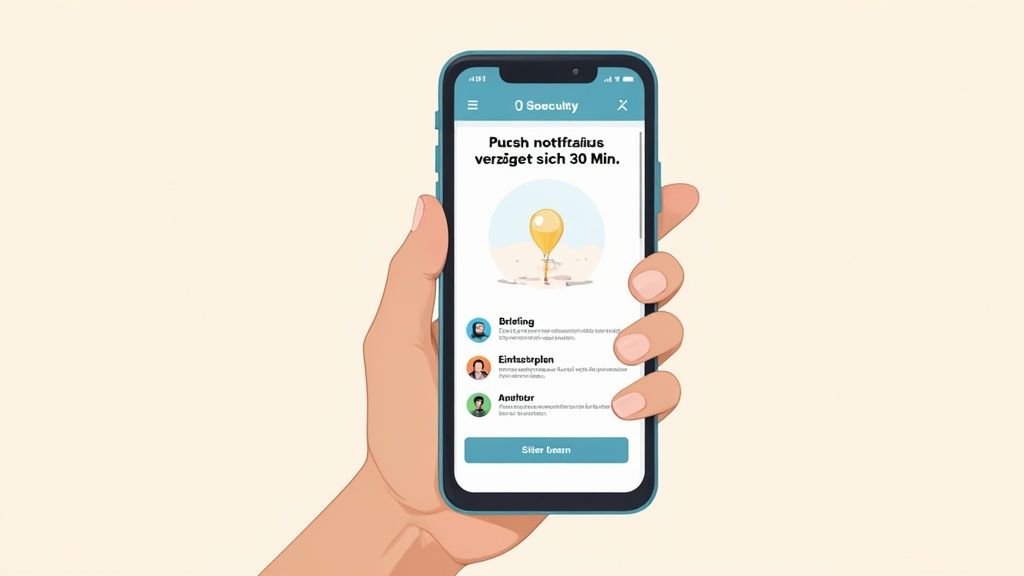
In this hot phase, the focus is clearly on getting all the information quickly, understandably and absolutely GDPR compliant to bring to the crew. This includes detailed briefings as well as current operational plans, directions and the dress code. The ultimate goal: eliminate misunderstandings from the outset.
Central information distribution without chaos
This used to mean a flood of emails, countless WhatsApp groups in which no one had an overview, and endless telephone chains. Honestly, who has the time and nerve for that? Today, mobile apps are the standard in the world Personnel planning for events, and for good reason. They put all relevant information in a single, central location - directly on each employee's smartphone.
Imagine this in practical terms: You have to change the meeting point for the service team at short notice. Instead of calling everyone in a panic, send a targeted push message to the “Service” group. Within seconds, everyone is on the same page. This not only saves a tremendous amount of time, but also noticeably reduces the error rate.
A great example is the matter with the documents. Simply upload the detailed briefing, the location's house rules or a route map to the app. This means everyone in the team has access to the latest version at all times. The excuse “Sorry, I didn’t see the email” simply no longer works.
The digital briefing: getting everyone on the same page
A good briefing is the be-all and end-all. It's about much more than just the shift schedule. It must all Contain details that are crucial for smooth operation. With a digital solution, you can be sure that this information arrives consistently and comprehensibly for everyone.
What absolutely belongs in your digital briefing:
- Mission details: Exact times, the assigned position (e.g. "Bar Nord", "Entrance VIP") and who the direct contact person is on site.
- Directions & meeting point: A linked address for the navigation app, information about the staff entrance and where you can park or which public transport stop is the next.
- Clothing regulations: Clear statements about clothing, preferably with example photos. This saves you unnecessary discussions on the day of the event.
- Special Instructions: How are the breaks regulated? Is there a food supply? What special rules of conduct apply in the location?
Communication on the day of the event must function like a well-oiled machine. Clear channels and defined contact persons are not a luxury, but rather the basis for quick and effective problem solving when it matters.
This central approach ensures that all team members start the event with exactly the same level of knowledge. This creates security and a professional appearance from the first minute.
Clear communication channels for the day of the event
On day X, communication is everything. It must be crystal clear to every employee who he or she should turn to if they have questions or problems. Establish this communication hierarchy in advance.
A classic scenario: A cloakroom employee notices that cloakroom tokens are running out. Instead of randomly approaching someone, he knows exactly that his contact person is the team leader for the entrance area. They can then report the problem specifically to event management or logistics.
Modern personnel planning tools such as job.rocks support you with integrated chat functions. It's best to set up targeted group chats for the different areas:
- A channel just for everyone Team leader.
- One channel for everything Bar staff.
- A channel for them Logistics crew.
This way you ensure that information only reaches the people for whom it is really relevant. This prevents unnecessary distraction and ensures that important messages are not lost in the noise. This structured communication is a crucial building block for a successful and professional event Personnel planning for events.
This is how you master time recording and billing
The event is history, the lights are out – but your work is far from over for you. Now comes the part that many find annoying, but which determines your professionalism and the satisfaction of your team: correct billing. Clean time recording is the be-all and end-all for a payroll that doesn't trigger any discussions later.
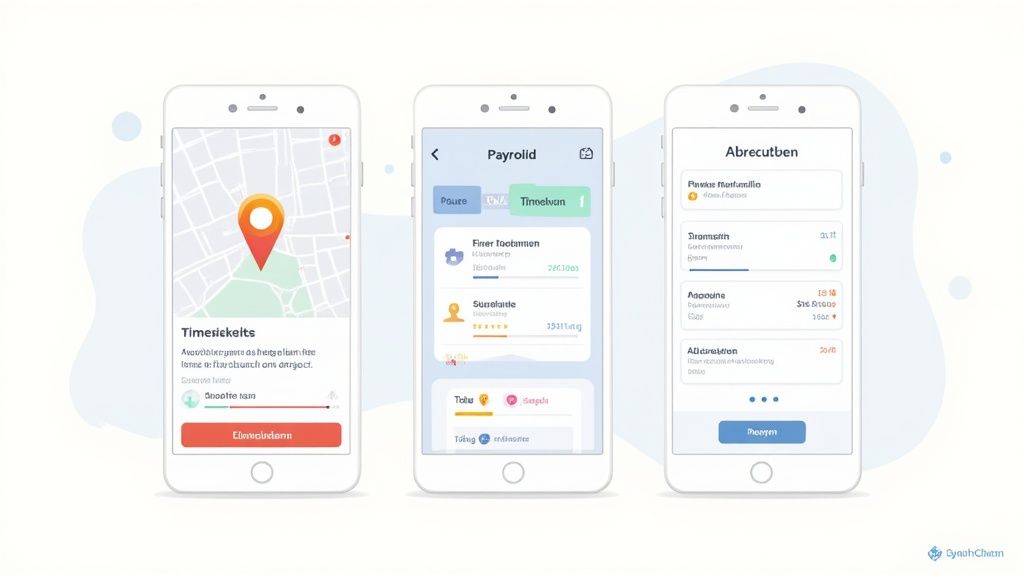
Let's take a look at how you can complete this process without any headaches. Because if everyone is paid fairly and on time, it not only strengthens trust, but also motivates your team for the next assignment.
Modern time recording instead of endless discussions
Handwritten timesheets and illegible Excel lists? Fortunately, those days are over. These methods are not only a huge waste of time, but also a huge source of errors. Let's be honest: who can remember exactly their break time at the end of a 12-hour shift? This inevitably leads to ambiguities and disputes when billing.
The solution lies in digital time recording directly via the smartphone. Imagine your staff simply checking in via the app when they arrive at the venue. Thanks to GPS geofencing The system ensures that clocking in and out only works within a defined area - for example directly at the festival's staff entrance.
When you leave the premises, you can check out just as easily, and breaks can also be recorded with just one click. The result is up-to-the-minute, absolutely reliable time stamps that prevent any debate about working hours from the outset.
Precise, digital time recording is your best insurance against billing errors. It creates transparency for you and your team and forms the complete basis for correct payroll.
The advantages are obvious:
- No manual errors: Inverted numbers or forgotten entries are a thing of the past.
- Absolute transparency: You and your employees can view the recorded times at any time.
- Minimal administrative effort: No more deciphering and typing up pieces of paper.
From recorded hours to the finished payroll
Once all working hours are recorded digitally, the real magic begins. A good tool for that Personnel planning at events automatically prepares this data for payroll. All you have to do is briefly check the recorded times and approve them.
Imagine the difference: you have 50 people on duty. Transferring and calculating hours manually would cost you hours, if not days. Software does this in just a few minutes. It even automatically takes into account flat rates, night surcharges or contractually agreed break deductions.
Efficiency is crucial, especially in Switzerland, where personnel costs in the service sector have been rising steadily since 2012 and the labor shortage is a real challenge. Tools that are already used by over 100 Swiss companies promise up to 50% time savings in exactly these processes.
Seamless handover to accounting
The last step is handing over the prepared data to your accounting department or trustee. Instead of sending complicated lists, you simply export a finished, clean report.
Most professional systems offer interfaces to common payroll accounting programs. With just a few clicks, all relevant data is transferred – from hours worked to expenses to employee master data.
A practical example: An event agency organizes a nationwide roadshow in which the staff changes at each location. Billing used to be a nightmare of collected timesheets. Today the agency uses an app. Staff will clock in and out of each venue. At the end of the week, the project manager generates a collective export with three clicks and sends it to payroll. The whole process takes time less than 15 minutes.
Integrated solutions provide you with a comprehensive Overview of digital time recording and time tracking methodsso that you can find the perfect path for you. Not only do you save valuable time, but you also show your team appreciation through punctual and correct payment - a factor that pays off in motivation and loyalty in the long term.
How to optimize your personnel planning for the future
Every event is a valuable lesson. About yours Personnel planning for events To continually improve, honest, data-based analysis after the event is essential. Here you take a look at what went really well and where there is still room for improvement.
It's about learning from experiences and recognizing patterns. This is the only way you can continue to refine your planning, reduce costs and at the same time increase the satisfaction of your team.
Which metrics really count?
After the event is before the event. Instead of getting lost in the data jungle, it's best to concentrate on a few but really meaningful key performance indicators (KPIs). They show you in black and white how successful your staff deployment was.
These data are not dry numbers, but the basis for smart decisions in the future.
- On-time rate: How many employees were on site on time for the start of the shift? A low rate may indicate unclear directions or unrealistic schedules.
- No-show rate (failure rate): The proportion of people who did not show up despite being promised. If this value is high, you should urgently reconsider your communication and confirmation processes.
- Planned-actual hourly comparison: How many hours were actually worked compared to planned? Regular overtime in an area is a clear sign that staffing levels are too tight.
Imagine: You realize that your bar team has been together for the last three events over 40 hours of overtime has accomplished. This is a clear indication that your original calculation for this area was too optimistic. Next time, plan extra energy for rush hours in advance. Problem identified, problem averted.
Good software provides you with these evaluations at the push of a button. Instead of laboriously collecting data by hand, you can immediately recognize recurring patterns and react to them directly.
Important key figures for event staff planning
The right KPIs help you objectively measure the success of your personnel deployment and derive targeted improvements for future events. This table gives you an overview of the most important key figures.
| Key figure (KPI) | What it measures | Why it is important |
|---|---|---|
| On-time rate | The percentage of employees who arrive on time for their shift. | Provides information about the quality of the deployment information (journey, time) and the reliability of the staff. |
| No-show rate | The percentage of employees who do not show up for their shift despite being promised. | A high rate indicates problems in the confirmation process or staff retention. |
| Planned actual hours | Comparison of planned working hours with actual hours worked. | If recurring deviations (especially overtime) reveal that staff planning is too tight. |
| Staff turnover | The rate at which employees leave your staffing pool. | High turnover is an indicator of a lack of satisfaction or poor working conditions. |
| Feedback score | Average evaluation of employees by team leaders or customers after the event. | Measures qualitative performance and helps identify and promote top performers. |
By consistently monitoring these numbers, you turn gut feelings into informed decisions and make your workforce planning more effective from event to event.
From data to concrete measures
Data alone is of no use – you have to draw the right conclusions from it. Each KPI tells a story from which you can derive concrete action steps.
Successful event organizations use this data to improve their processes. In Switzerland, SBB manages over 300 events annually with a core team of just three people by bundling all processes on one platform. Such tools enable data-driven decisions about staffing distribution by incorporating registration numbers and guest activity in real time. Discover how Centralized event platforms are revolutionizing planning.
The improvement of yours Personnel planning for events but goes beyond pure numbers. Satisfied and motivated employees are your most valuable asset because they are more reliable and committed. So don't forget that incentives like Corporate benefits and company social benefits Play an important role in retaining your best people in the long term.
Personnel planning as a learning process
Don't see your workforce planning as a one-time task, but rather as a continuous cycle of planning, executing, measuring and adjusting.
Each event provides you with new insights that flow directly into the planning of the next one. This way you will become better, more capable and more professional with every event. Your planning develops from a static plan into a dynamic, learning system that adapts perfectly to the respective requirements.
Frequently asked questions about staff planning for events
Here I have collected the answers to the most frequently asked questions that I come across again and again in practice. Think of it as a cheat sheet to help you navigate the common pitfalls of event staffing planning.
What do I do if there are short-term outages?
A call, an hour before the start of the shift: the most important bar employee is sick. This is every event planner's nightmare, but unfortunately it's also part of the job. The important thing now is not to panic, but rather to have a plan B that is already in the drawer.
By far the best solution for this is a Standby pool. Maintain a list of trusted people you can count on in an emergency. A little tip from practice: Define clear conditions for such “fire brigade operations” in advance, for example a slightly higher hourly rate. This does wonders for motivation.
Here's how you can approach the whole thing even smarter:
- Plan for jumpers: I always plan for big events 1–2 “jumpers” firmly included. These people do not have a fixed task, but are there to step in wherever there is a fire. This eases the situation enormously.
- Digital alarm chain: Instead of making dozens of calls, use an app. With one click you send a push notification to your standby pool. Whoever agrees first gets the shift. It couldn't be more efficient.
How do I deal with breaks and working hours?
To be honest: Adhering to statutory working and break times is not an optional extra, but a requirement. Not only can violations be expensive, they can also severely damage your reputation as a good employer. The rules are clear, especially in Switzerland, but they quickly get lost in the hectic everyday life of events.
Imagine a long event day from 2 p.m. to 2 a.m. Breaks must be carefully planned and, above all, documented. With a large team, manual monitoring is virtually impossible and is a huge source of errors.
My advice: Use a digital system that automatically warns you if you plan a shift that violates legal requirements. This is your legal protection and also ensures a fair working atmosphere.
A good planning tool knows the legal requirements in your country. If you try to work a 10-hour shift without the required break, the system should immediately complain. This way you avoid costly mistakes right from the start.
Which software best supports my personnel planning?
The market for planning tools is huge and confusing. Which software is right for you depends on the size of your events, the complexity of your processes and of course your budget. An Excel list might still work for a small company party with ten people, but at a festival 200 employees this is the direct path to chaos.
What you should really pay attention to when choosing:
- Central personnel pool: You need to be able to manage all your people with their skills, contact details and availability in a single place.
- Mobile app for employees: An app that your team uses to apply for shifts, report availability and clock working hours is simply standard today. Everything else is complicated.
- Automated communication: The tool should do the work for you and automatically send shift plans, briefings or short-term changes to the right people.
- Integrated time tracking: If shift planning and time recording intertwine seamlessly, you will save an incredible amount of administrative effort later on when it comes to payroll accounting.
Imagine you are looking for a hostess for a trade fair who speaks fluent French. Instead of sending a circular email to everyone, you filter by qualification in your software "Language: French" and only send the request to the right candidates. This saves time and nerves – on both sides.
How do I ensure GDPR-compliant communication?
Personal data such as telephone numbers, addresses or bank details are extremely sensitive. Sharing shift schedules with all contact details in open WhatsApp groups is not only unprofessional, but a clear violation of the General Data Protection Regulation (GDPR).
The only clean solution is a closed platform on which each employee only sees what he or she really needs to see.
- Role-based access rights: A team leader can see the contact details of his crew, but a normal employee cannot see those of the entire team.
- Secure document storage: Upload sensitive documents such as employment contracts or briefings directly to the employee's personal profile instead of sending them via email.
- Integrated messenger: Use a chat function within your planning software. This means that all communication remains in a protected area and does not mix with private messages.
This approach not only protects your staff's data, but also protects you from severe penalties. You also show your team that you take their privacy seriously - a huge plus point for trust.
Are you ready, yours Personnel planning for events to finally simplify it and raise it to a professional level? job.rocks offers you exactly the tools you need - from smart shift planning to mobile time recording to automated billing. Discover now how you can save time, avoid mistakes and inspire your team. Visit us https://job.rocks and request a non-binding demo.