
Event Staffing: Your practical guide to personnel planning
Event staffing is the linchpin that separates a good event from an unforgettable experience. It's about a lot more than just booking people. It's about having the right team in the right place at the right time - that's the only way your event runs smoothly and inspires...
Event staffing is the linchpin that separates a good event from an unforgettable experience. It's about a lot more than just booking people. It's about that right team Being in the right place at the right time – this is the only way your event runs smoothly and delights the guests.
A professional team is the flagship of your event and shapes the first and last impression that your visitors take home with them.
Your staff is the face of your event
Are you in the middle of planning your next big thing and wondering what will determine success or failure in the end? Quite often it is the staff. Good event staffing isn't just something you do on the side. It is a strategic task that directly shapes the visitor experience - from the friendly hostess at reception to the highly focused technician behind the stage.
Imagine an international conference where unprepared staff leaves arriving guests out in the rain because no one thought to bring umbrellas. What happens? Frustrated participants and a damaged brand image before the event has even started.
And now the same scenario, but with a team that thinks for itself. The crew recognizes the situation, distributes umbrellas quickly and guides the guests to dry land with a smile. This small but subtle difference turns a potential annoyance into a positive wow moment.
Every single employee becomes a brand ambassador. Their professionalism, friendliness and problem-solving skills reflect your brand's values and create an atmosphere in which everyone feels comfortable.
The typical mistakes in personnel planning – and how to avoid them
Many organizers underestimate how complex event staffing really is. This leads to mistakes that could have easily been avoided and that jeopardize overall success. Anyone who knows the classic pitfalls has already taken the first step towards perfect planning.
The most common problems include:
- Staffing levels too tight: Planning is often too optimistic. If there are unforeseen peaks or failures, chaos quickly breaks out and the remaining team is completely overwhelmed.
- Lack of qualifications: It's easy to overlook the fact that certain roles - like technical support or a multilingual receptionist - require very specific skills. Simply putting anyone here will be wrong.
- Missing or too short briefing: If staff are not crystal clear about what is expected of them - from dress code to emergency procedures - mistakes and uncertainty are inevitable.
- Unclear communication channels: Without a permanent contact person on site, employees do not know who to turn to if they have problems. This costs valuable time and nerves.
By eliminating these typical mistakes from the outset, you are laying the foundation for an event where your guests feel valued and well looked after. A well-thought-out personnel strategy is not a cost factor, but rather a direct investment in the success of your event.
Develop your personnel planning from A to Z
Every event is different, and your personnel planning must be just as individual. A top event doesn't just start with construction on site, but with a razor-sharp needs analysis. Here you lay the foundation for a team that fits your event like a tailor-made suit.
Imagine a company anniversary with 500 guests in a chic location. The success of the evening depends on how smoothly every single moment goes for the guests. This is exactly where detailed planning separates the wheat from the chaff.
Needs analysis: Define roles and numbers
First of all, we have to clearly identify the roles required. The trick: Go through the entire process from a guest's perspective, from arrival to farewell.
For our company anniversary 500 guests the whole thing could look like this:
- Reception & cloakroom: We need at least 4 people here to prevent the typical traffic jams when arriving and leaving.
- Service & Catering: A tried and tested rule of thumb is one service person for every 20 guests in the banquet area - so do it 25 people. There are also 3 bartenders and 2 logisticians who keep the buffet under control.
- Technology: A senior technician and an assistant for lighting, sound and presentations are the minimum.
- Security: Depending on the location and mood of the event, 2 to 4 security guards should keep an eye on the entrances and exits.
- Project management on site: An event manager as the central contact where everything comes together.
This rough estimate is our basis. The next step is to carve out a clear requirements profile for each of these positions. What does a person have to be able to do and what charisma do they need for the respective role?
A requirements profile is much more than a simple task list. It describes the desired candidate, including the soft skills that ultimately determine the mood. A genuine smile at reception is just as valuable as the sound engineer's expertise.
Create in-depth requirement profiles
A well-thought-out requirements profile is the best insurance against wrong appointments. Don't just ask yourself, what the person should do, but above all, like she should do it.
- For the reception: You're not looking for someone who's just checking off names on a list. You need a communicative, confident personality who keeps a cool head even in the most stressful situations and is perhaps even bilingual.
- For service: This requires resilience and a keen eye for details. The person must proactively recognize where something is missing and be calm even in hectic phases. Experience in fine dining is a clear plus here.
One point in your planning is the continuous training of the staff. Aspects such as security and professionalism come through professional training for event staff massively increase the legal basics and practical steps.
The following infographic gets to the heart of the process – from planning to the team to success.
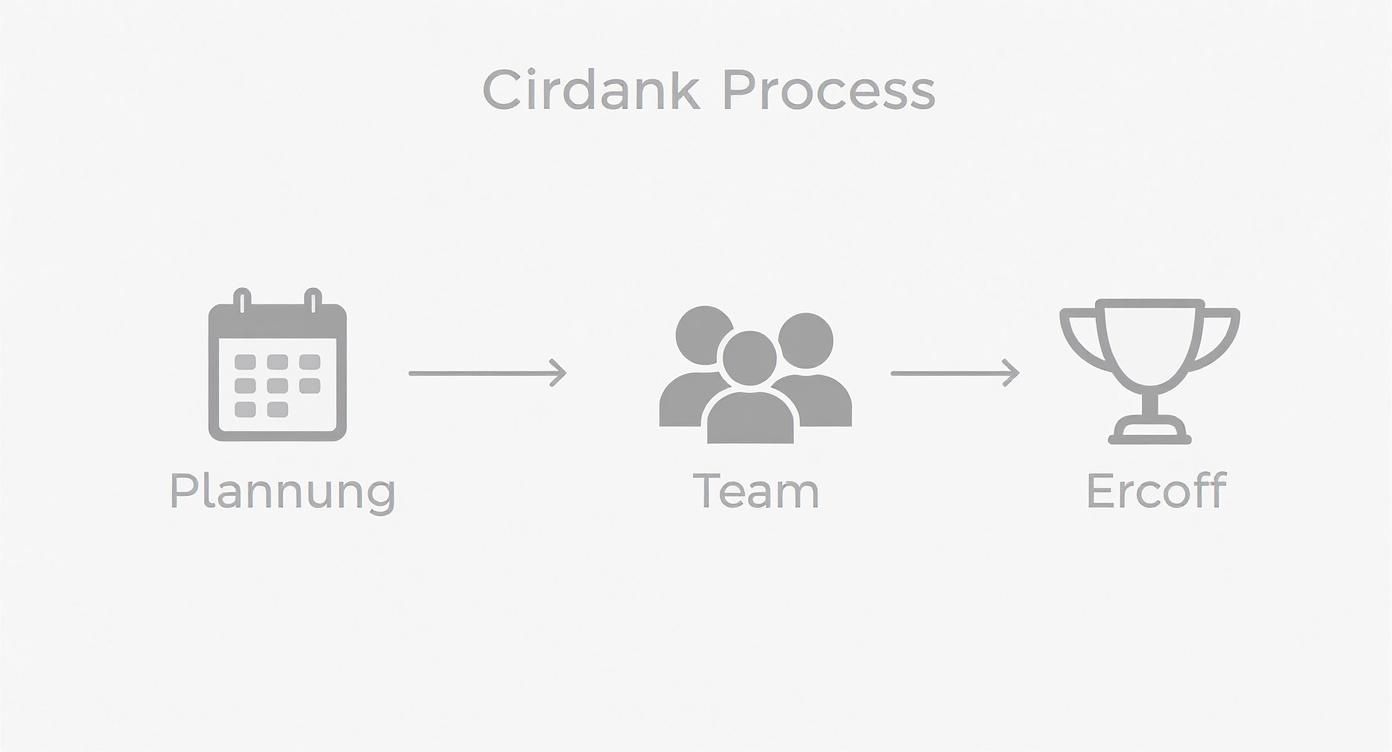
You can see straight away: A great event experience always rests on two strong legs: solid planning and a team that works in perfect harmony.
Budget planning without unpleasant surprises
Personnel costs are often the largest chunk of the event budget, so a realistic calculation is mandatory. Don't just think about the hourly wage. Additional costs such as social security contributions, meals, possible travel costs and agency fees must also be included.
There are a few smart levers to keep costs under control without compromising on quality. Rely on a core team of experienced professionals and fill it with well-trained temporary staff for the simpler tasks. Plan the operating times in such a way that idle time is avoided, but there is always enough buffer for the unexpected.
Precise planning of the roles and the necessary qualifications is the key to any successful event staffing. This way you make sure that you not only have enough, but above all thecorrect have people on board.
Find the right people for your event
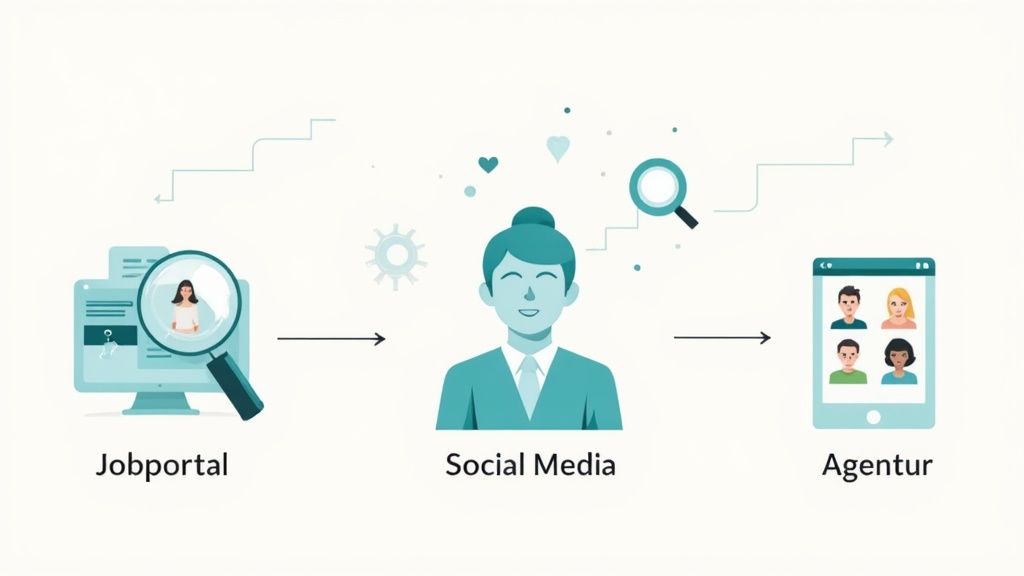
Finding good staff is one of the biggest hurdles in event staffing. You have completed your needs analysis and know exactly who you need. Now comes the crucial question: Where do you find these people?
The search for the right talent needs a clear strategy. Ultimately, the success of your event depends on the reliability and competence of your team. It's about using the right channels and addressing applicants in such a way that they immediately identify with your event.
The best channels for staff recruitment
There is no one perfect channel for event staffing. A clever combination of different paths almost always leads to the goal. Each platform has its own strengths and appeals to completely different target groups.
- Specialized event staffing agencies: The big advantage here is direct access to a verified pool of experienced employees. The agencies take care of the entire recruiting process for you, check qualifications and take care of the administrative paperwork. This saves you a huge amount of time, but it comes at a price.
- Classic online job portals: Portals like Indeed or Jobs.ch are a solid choice for reaching a wide audience. They are good if you are looking for staff for longer-term projects or specific specialists such as event technicians.
- Social media: Platforms like LinkedIn, but also Instagram or Facebook groups, are valuable for reaching a younger target group. Here you can show the culture of your event and address people who are really passionate about the cause. A well-worded post in a local event community can sometimes work wonders.
- Your own personnel pool: Never underestimate the power of your network. Employees who have already worked for you before and were satisfied will be happy to come back. A platform like job.rocks helps you to actively manage this pool, query availability and reactivate your proven team with just a few clicks.
The current situation on the job market doesn't make the search any easier. The Swiss labor market is facing challenges, despite a continued low unemployment rate 2,8%. There is a shift in vacancies in particular: while the number in the first quarter compared to the previous quarter increased 2% rose, it still lies 9% below the previous year's level. For you as an organizer, this means: the pool of available skilled workers is becoming smaller, which makes recruiting more difficult.
Formulate the perfect job advertisement
Your job advertisement is the first handshake. Your first point of contact with potential candidates. It has to be more than just a dry list of tasks – it has to inspire and attract exactly the people you are looking for.
A good job advertisement doesn't just sell a job, but an experience. She answers the applicant's question: “Why exactly should I this one Want to be part of the event?”
Let's take a practical example: You are looking for multilingual hosts for an international technology trade fair. Your ad must clearly communicate what you offer and what you expect in return.
What has to go in?
- A gripping title: Instead of “Host/Hostess wanted” try “Become the face of our international tech trade fair in Zurich! (DE/EN)”. Sounds a lot better, right?
- Who you are: Briefly describe the event and the atmosphere. Is it an exclusive congress or a relaxed start-up festival? Give people a feel for it.
- What the role is:Describe the tasks specifically. Instead of “guest relations,” write: “You welcome international CEOs, answer questions about our program and make sure every guest feels welcome.”
- What you expect: Clearly list the must-haves (e.g. fluent German and English) and the nice-to-haves (e.g. other foreign languages, experience with registration systems).
- What you offer: Be transparent about your pay, state the exact dates of deployment and don't forget the small benefits such as food, a cool team or exclusive insights into an exciting industry.
The selection process that convinces
As soon as the applications arrive, the selection begins. When it comes to event jobs, one thing counts most: speed. Nobody here can afford long, bloated application processes.
A short, 15 minute video interview is often good for making a first impression. Here you will quickly notice whether the chemistry is right and whether the person has the necessary charisma.
Ask situational questions that show how someone reacts under pressure:
- "An important guest is unhappy because his name isn't on the list. What do you do?"
- "You see a long line forming at the entrance. How do you react?"
The answers to questions like these tell you more about a person's problem-solving skills and service orientation than any resume. Make sure you have a positive attitude and a noticeable motivation to really want to be part of the team.
By the way, a diverse team enriches every event. Different backgrounds and perspectives help address the diverse needs of your guests and create an inclusive atmosphere. Ultimately, your staff represents your brand. In order to ensure a professional and uniform appearance, it is also important to consider appropriate clothing for the staff. Find out about Finishing techniques for event textiles and advertising materialsto equip your team perfectly.
Operations planning and briefing for a smooth process
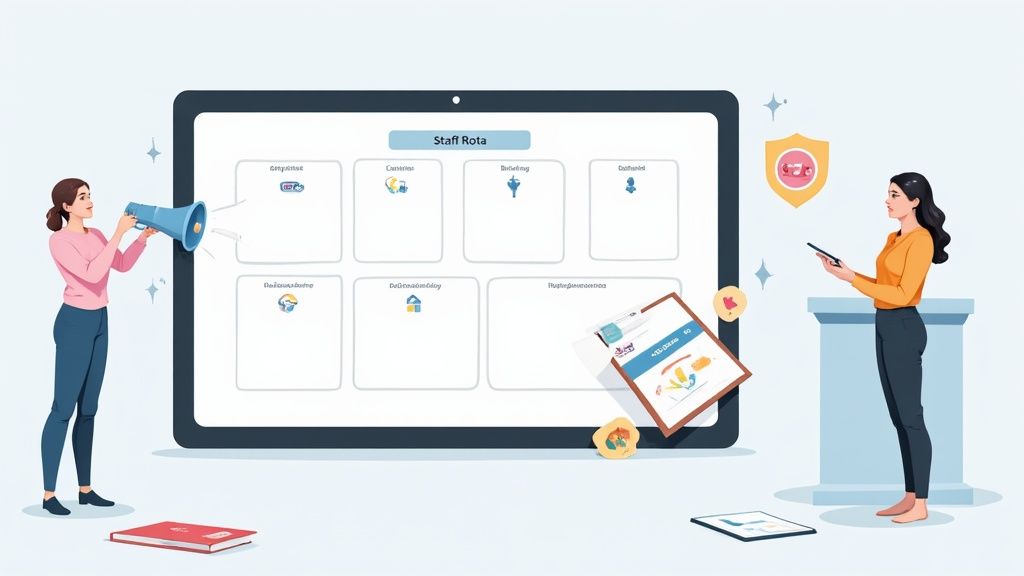
You found the best people for your event – great! But even the most talented team is of little use if the internal organization is not right. Precise operational planning and a crystal-clear briefing are the foundation on which a smooth process is possible.
Without a well-thought-out structure, you risk overloaded employees, unclear responsibilities and ultimately a chaotic experience for your guests. It's about giving each team member exactly the information and tools they need to carry out their tasks confidently and professionally.
The digital operations plan as a command center
Forget confusing Excel tables or the paperwork of the past. Modern deployment planning for your event staff takes place digitally. Tools like job.rocks help you keep an overview and react quickly to spontaneous changes.
A digital plan is your command center. Here you define shifts, assign zones and set break times. The big advantage: Everyone in the team has access to their current plan at any time via a mobile app. If someone is unavailable at short notice, you can react immediately, find a replacement and update the plan for everyone in real time.
What really matters when planning your operations:
- Clear shift times: Define exact start and end times for each position and plan enough buffers for handovers. Nothing is worse than an unfilled position during a hot phase.
- Responsibilities and zones:Who is responsible for which area? A plan that visually clearly shows who is in charge of the VIP area and who is at the entrance prevents misunderstandings from the start.
- Smart break regulation: There must be legally required breaks. Ensure staggered planning so that important positions are never left behind.
- Central contact persons: Designate a team leader for each team or zone. He or she is the first point of contact for questions and takes a lot of the workload off of you as the person responsible.
A good deployment plan is more than just a list of names and times. It is a dynamic tool that gives your team security and ensures you control over what is happening on site.
The current development of the event market in Switzerland was assessed positively years ago. Although the market fundamentally continues to grow, it is very dynamic. Current statistics show a certain slowdown, influenced by global economic factors. The number of permanent placements in the temporary segment is up 28,9 % liked, which directly influences the availability of qualified personnel for event staffing. This is where new approaches such as crowd recruiting are gaining in importance.
The briefing as the key to motivation
A thorough briefing is your most important investment right before the event. This isn't just about regurgitating facts. It's about getting the entire team committed to a common goal and conveying all the necessary information. A good briefing motivates, creates clarity and prepares staff for possible challenges.
Imagine a large music festival. The staff at the entrances must be able to do more than just scan tickets. It must know which items are prohibited, where the first aid station is and how escape routes are communicated in an emergency.
An effective briefing covers all of these points. It's the moment when you turn lone fighters into a real team.
The following table shows you how you can structure a comprehensive briefing to optimally prepare your staff.
Building an effective staff briefing
This table shows the central components of a comprehensive briefing to optimally prepare your event staff.
| Briefing component | Content and goal | Practical example |
|---|---|---|
| Event Vision & Goals | Gather the team emotionally and get them excited about the event. | "Today we want to offer 10,000 fans the best concert experience of their lives. Your friendliness at the entrance is the first impression!" |
| Roles & Responsibilities | Clear definition of who does what and who to contact if you have questions. | "Team A is responsible for the main entrance, team leader is Alex. Team B secures the backstage area, contact person is Sarah." |
| Process & Schedule | Discuss important program points and time-critical moments. | "The main act begins at 8:00 p.m. We expect the biggest crowds at the concession stands from 7:30 p.m. - be prepared." |
| Dress code & behavior | Ensure a consistent and professional appearance. | "Please everyone wear the official festival shirt. Stay friendly and de-escalate, even in long lines." |
| Emergency procedures | Review security protocols for different scenarios. | “In the event of a medical emergency, you immediately inform security via radio on channel 3. The meeting point is the large tower.” |
Crystal clear communication throughout the entire event is crucial. Set up a simple communication channel, such as a WhatsApp group or a radio connection, so that your team leader can quickly reach you or other key people at any time. This way you can ensure that small problems are solved before they grow into major crises.
Understand legal aspects in Switzerland
Your event staffing also has a legal side that you should definitely not ignore. As soon as you employ staff, you are operating in a field with clear rules. Anyone who has an overview will protect themselves and their team from unpleasant surprises.
In Switzerland, the correct handling of employment contracts, social insurance and working hours is the be-all and end-all. Even a small mistake in administration can quickly become expensive. But don't worry, with the right knowledge you can stay on the safe side.
Employment contracts for temporary staff
For short-term assignments in event staffing, there are mainly two contract forms that you need to know. The distinction is not just a formality, but has a direct impact on taxes and insurance.
- Fixed-term employment contract: This is the most common and safest form for event staff. You hire a person for a clearly defined period of time, for example for the duration of a three-day festival. In this case, you are the employer with all obligations, such as registration with AHV/IV/EO and accident insurance.
- Work on demand: This option is ideal if you need staff regularly but unpredictably. The employees are in your personnel pool and you ask them if necessary. Here, too, an employment relationship is created as soon as an assignment is agreed and confirmed.
The clean contractual regulation is your protection. A simple written contract that states the duration of the assignment, wages and the most important tasks creates clarity for both parties and prevents later discussions.
Imagine you are organizing a large open-air concert at the weekend. You need 20 People serving drinks. The safest way is to conclude a fixed-term individual employment contract with each person for exactly these two days. So the conditions are crystal clear from the start.
Social insurance and working time law
As soon as you pay wages, you are obliged to correctly account for social security contributions. This is strictly regulated in Switzerland and also applies to short-term assignments without exception.
The most important points on your checklist:
- AHV/IV/EO registration: Every employee must be registered with the compensation fund. The contributions are deducted directly from your salary.
- Accident insurance (UVG): You must protect your staff against occupational and non-occupational accidents (from 8 hours per week). If something happens, your team is protected.
- Working time recording: The law requires precise recording of the hours worked and breaks. A digital time recording like her job.rocks offers, makes this process simple and completely understandable.
The Working Hours Act is a hot potato, especially in the event sector with its long working days and night work. Be sure to ensure compliance with the maximum working hours and the prescribed rest breaks. This not only protects your staff from overload, but also protects you from legal consequences.
The role of the temporary employment industry in Switzerland
Event staffing is an important part of the temporary employment industry, which plays a major role in the flexibility of the Swiss labor market. According to swissstaffing there were around180’000Temporary workers, for example 4 % of employed people in Switzerland. These numbers show how crucial flexible forces are for project-related operations. You can find out more about this in the Industry statistics on temporary work.
Important insurance for you as an organizer
In addition to the mandatory personal insurance, you should also insure your own risk as an organizer. Two insurance policies are particularly important.
One Business liability insurance covers damage caused by your staff or infrastructure to third parties. For example, if a headlight falls over and damages a guest's property, this insurance will cover you.
Additionally there is one Event cancellation insurance worth considering. It protects you from financial loss if your event has to be canceled due to unforeseen events such as extreme weather or government orders. This way you don't end up empty-handed.
The most burning questions about event staffing
In the hustle and bustle of event planning, the same questions about staff keep cropping up. Here are clear answers to what event planners are really concerned about - so that you can confidently avoid the typical stumbling blocks right from the start.
How much does event staff really cost me?
The cost of good staff is more than just the hourly wage. Many organizers make the mistake of only budgeting this amount and then have a nasty surprise when they look at the billing. An honest calculation is the key to success here.
For watertight planning, these items must be included in your budget:
- The basic wage: So the agreed hourly or daily rate.
- Social security contributions: Contributions for AHV, IV, EO and unemployment insurance are required by law and non-negotiable.
- Insurance: The mandatory accident insurance (UVG) must be covered for every employee.
- Possible surcharges: Those who work at night, on Sundays or on public holidays are often entitled to a supplement.
- Expenses: There may be costs for travel, a meal allowance or special equipment.
- The agency fee: If you work with an agency, their margin for recruiting, planning and administration comes on top.
A small example: A promoter might cost you on paper 35 CHF per hour. However, you should include all additional costs 45 to 50 CHF calculate. This is the only way you can really be on the safe side and avoid additional calculations.
How do I react to short-term staff absences?
Every event manager's nightmare: On the morning of the big day, a key person calls in sick. As annoying as it is, short-term failures are unfortunately part of business. But panic is the wrong advice - a plan B in the drawer is the solution.
The best strategy against such no-shows is to act with foresight. Set up a small standby pool right from the start. These are 1-2 flexible people, which you can activate immediately in an emergency. At large events with over 50 employees It's actually compulsory, not just a free choice.
Your backup plan is not a question of “if,” but rather “when.” Your ability to react quickly to failures determines whether everything runs smoothly and the mood in the rest of the team.
Modern tools are an enormous help here. Through a platform likejob.rocks You can send a push notification to your entire staff pool and close the gap, often within minutes. Just as important: send reminders shortly before the event and have your attendance actively confirmed.
How do I ensure fair pay?
Fair and punctual payment is much more than just a legal obligation - it is a clear sign of appreciation. It is the decisive lever for motivating your team and directly influences your reputation as a client. Satisfied employees are loyal employees who would like to work for you again.
What you should definitely pay attention to:
- Transparency from the start: Communicate the salary and payment terms clearly and put everything in writing in the contract.
- Absolute punctuality: Adhere to the agreed payment deadlines meticulously. Nothing is more demotivating than having to wait for your money.
- Correct billing: Ensure complete and legally compliant payroll including all social security contributions. Tools for digital time recording and salary preparation can relieve you of a huge amount of work.
Investing in fair pay pays off twice in the end. You build up a pool of reliable people who will be fully committed to your next event.
How do I evaluate my team's performance after the event?
As you know, after the event is before the event. A structured and honest evaluation of team performance is valuable in order to sharpen your personnel planning from time to time. This way you can find out who your top performers are and where there might still be some training needed.
To do this, collect feedback from different perspectives. Ask your team leaders for their assessment: Who was particularly proactive? Who might need a little more support? Direct feedback from guests or customers can also provide valuable information that you would otherwise miss.
A simple but clear evaluation system helps you objectively assess performance. Criteria could be:
- Reliability and punctuality
- Friendliness and service orientation
- Ability to work in a team and be flexible
- Initiative and competence in problem solving
It is best to maintain these reviews directly in your personnel pool management system. This way, next time you'll know with just one click who you should definitely book again. This knowledge is a real competitive advantage in event staffing.
Are you ready to take your scheduling to the next level and manage your event staffing effortlessly? job.rocks offers you the right tools to plan, book and manage your staff efficiently. Discover now how you can save time and ensure smooth processes: https://job.rocks