
Logistics Workforce Scheduling: A Guide for Flexible Teams
Logistics workforce scheduling. Learn how scheduling in logistics works with skills, shifts, and peaks – including practical examples and KPIs.
Monday morning, 5:30 a.m., a distribution center in Switzerland. The forklift operator with a SUVA-recognized license calls in sick. The available temporary worker knows order picking but is not allowed to operate a forklift. While the dispatcher is on the phone, he edits the Excel file, sends a message to the early shift, and simultaneously tries to handle the order peak.
This is exactly where logistics workforce scheduling comes into play. You don’t just assign names to time slots. You have to combine qualifications, permissible working hours, actual availability, order volume, and risk of absences. This guide is aimed at dispatchers, shift supervisors, and HR teams in freight forwarding, warehousing, fulfillment, and delivery who need to reliably deploy flexible teams.
Table of Contents
- Why Logistics Workforce Scheduling Depends on Qualification and Availability
- Definition and Objectives of Workforce Scheduling in Logistics
- Typical Challenges in Swiss Logistics Practice
- Practical Example and Process Template for a Logistics Shift
- Technical Requirements for Modern Scheduling Software
- Implementation Checklist and the Role of a SaaS Solution like job.rocks
- Frequently Asked Questions about Workforce Scheduling in Logistics and HR Context
Why Logistics Workforce Scheduling Depends on Qualification and Availability
The first question is not: “Who is free today?” It is: Who is allowed to perform this task, is available at this time, and fits the expected volume? An available employee without a forklift license won’t help you fill a forklift position. A qualified driver who has already worked an illegal shift sequence is also not a reliable assignment.
With manual planning, this information is often scattered across different places. Qualification certificates are in personnel files, availability comes via WhatsApp, and the last shift change is in an Excel copy. This can lead to the same qualified person being scheduled twice while a gap appears elsewhere. Short-term absences lead to phone chains, unclear commitments, and involuntary work on Sundays or holidays.

Three Data Layers for Every Shift
A workable plan connects three layers:
- Qualification: Forklift license, CZV certificate, hazardous goods experience, language skills, or training at a specific workstation.
- Working Hours: Night work, Sunday work, rest periods, and internal guidelines must comply with labor laws and SECO recommendations. The SECO overview of working and rest times describes the rules for night work and related limits.
- Availability: Absences, part-time, vacations, confirmed assignments, and last-minute changes must be visible on the same data level.
The goal is a forward-looking matching of skill, shift, and shipment volume. You don’t just plan against today’s absence but recognize early which positions will become scarce during a peak and where a backup person needs to be trained.
The situation remains tense. In Switzerland, 593,000 people worked in shifts in 2022, representing 15.9% of all employees excluding apprentices. 8.6% worked with changing schedules; high shares of rotating shifts exist in transport and warehousing, hospitality, and health and social services, as shown by the Swiss Logistics Market Study.
Practical rule: A shift is only considered staffed when every task is covered by a permissible and actually available person.
Definition and Objectives of Workforce Scheduling in Logistics
Logistics workforce scheduling is the operational assignment of employees to working hours, tasks, and workplaces within a defined planning period. You link the expected order volume with available qualifications and permissible working hours. The planning must balance order processing, quality, and personnel costs sustainably.
Distinguishing it from adjacent systems prevents false expectations. A TMS mainly manages transports, shipments, and vehicles. A WMS controls goods movements, warehouse processes, and inventories. Route planning calculates trips and routes. Workforce scheduling answers a different question: Who works when, with what qualification, and at which workplace?
| Domain | Core Question | Typical Tool | Interaction with Workforce Scheduling |
|---|---|---|---|
| Workforce Scheduling | Who works when, where, and with which qualification? | Personnel Scheduling | Provides shifts, roles, and availability |
| TMS | Which shipment is handled with which transport? | Transport Management System | Reports personnel needs for drivers or handling |
| WMS | How do goods flow through warehouse and picking? | Warehouse Management System | Provides workload and required roles |
| Route Planning | Which trip follows which route? | Route or Tour Planning | Transfers time windows and driver needs |
| Payroll and Time Tracking | Which hours are billed? | Time Tracking and Payroll System | Takes over confirmed working hours |
Measurable Goals You Can Track
Common goals can be translated into operational KPIs. These include shift fulfillment rate, qualification coverage per shift, average overtime per employee per month, absence rate, and short-term cancellations. You should not use generic target values for these KPIs. Night operations with many legal restrictions require different thresholds than a day warehouse with stable working hours.
It makes sense to separate planning from results:
- Before the shift: Are all roles staffed, and is the required certification valid?
- During the shift: Who actually arrived, who is missing, and which position remains open?
- After the shift: Do planned and recorded hours match, and what changes must be documented?
A good solution neither replaces the TMS nor the WMS. It takes their volumes, time windows, and task requirements and translates this information into a staffed shift. The route remains the responsibility of transport control, and goods flow remains the responsibility of the warehouse management system.
Typical Challenges in Swiss Logistics Practice
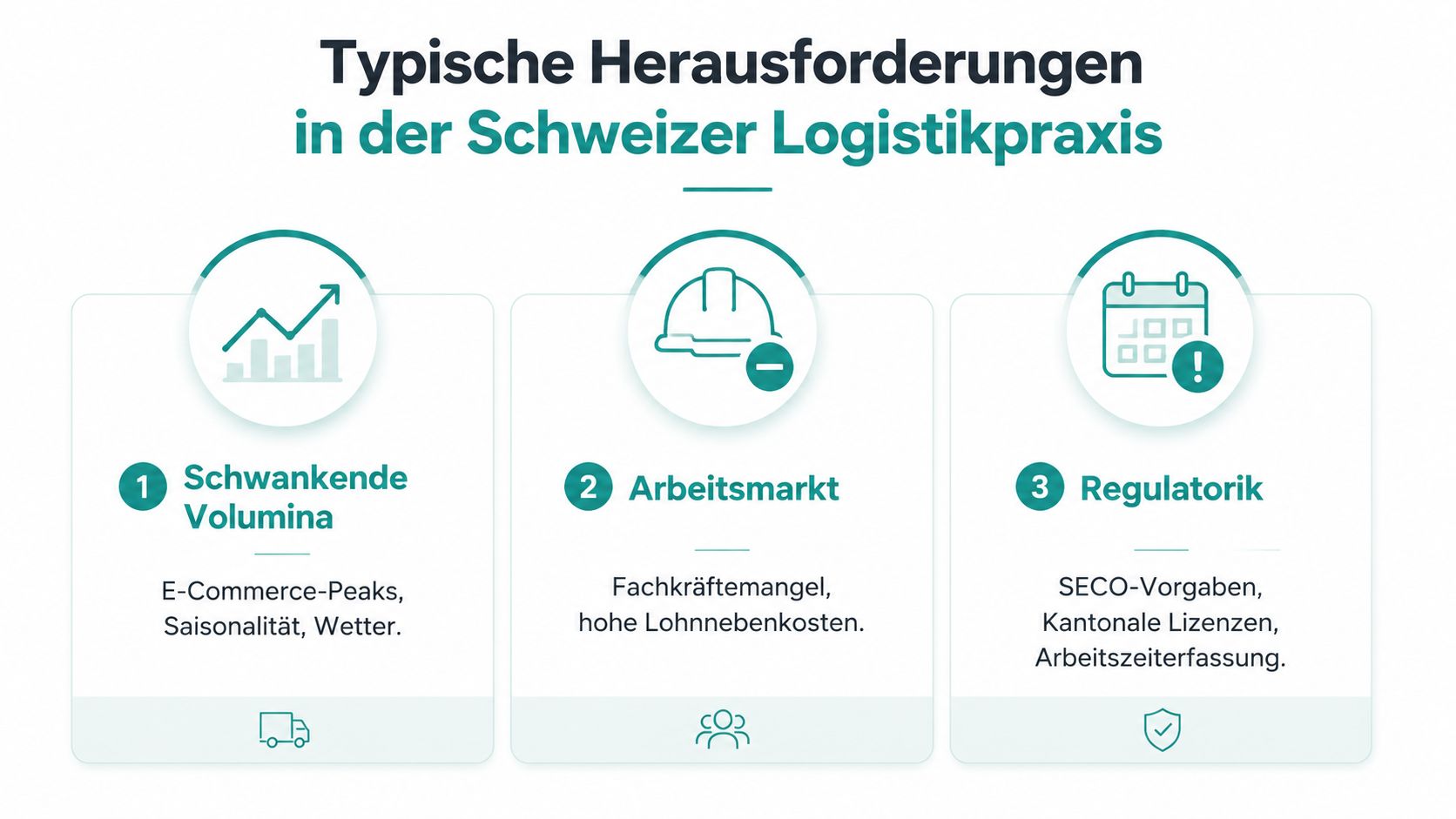
Swiss logistics plans under three simultaneously acting conditions: fluctuating volume, scarce skilled workers, and binding working time regulations. Each condition creates friction. Together, they mean that a plan that worked yesterday may no longer suffice today.
Volume and Traffic Meet Limited Staff Resources
An online order surge, holiday traffic, or weather-related handling can shift demand at short notice. If planning only uses fixed shift patterns, you react too late. It becomes even more difficult if a route returns late and the team for the next processing is already scheduled.
Traffic conditions exacerbate this problem. On the Swiss national highway network, 55,569 hours of traffic jams were recorded in 2024, seven times more than in 2000, as Logistik Online citing traffic data reports. For workforce scheduling, this means arrival times, handovers, and reserve staffing must not rely on purely static assumptions.
Skills Shortage Makes Qualification Data Valuable
The supply industry reports over 36,000 unfilled positions. Without countermeasures, this could rise to up to 80,000 by 2032, according to the Federal Statistical Office on the labor situation. A study supported by HSG also reports around 36,561 missing skilled workers and cites an 11.4% dropout rate for logistics apprentices, see Logistics Market Study 2026.
You cannot simply replace open positions with additional names on a list. Planning must make visible who is allowed to perform which task, which junior staff need supervision, and where an absence immediately creates a bottleneck.
Manual Lists Worsen the Situation
Excel works for a small, stable operation. With multiple locations, changing teams, and many last-minute changes, multiple versions of the same plan quickly arise. Phone chains, missing feedback, and manual overtime calculation make the actual status hard to verify.
For night and Sunday work, spontaneous shifting is not enough. You must check whether a permit is required, whether rest periods are observed, and whether the change was communicated transparently. Planning that only considers staffing leaves these questions open.
Practical Example and Process Template for a Logistics Shift
Let’s take an early shift in a Bern distribution center. On Monday morning, volume rises, three forklift drivers are needed, two order pickers must understand German, and a truck driver requires a CZV certificate. The dispatcher first plans the demand, then the people. This sequence prevents available employees from determining the actual requirement.
Skill Matrix for the Example Shift
The hourly rates in the table are deliberately shown as internal planning fields. You enter the contractually or operationally valid values here instead of working with an invented benchmark.
| Role | Required Skills | Available Persons | Hourly Rate CHF |
|---|---|---|---|
| Forklift Driver | SUVA-recognized forklift license, training at the center | Person A, Person B, Person C | according to contract |
| Order Picker | German language skills, experience in the respective warehouse area | Person D, Person E | according to contract |
| Truck Driver | Valid CZV certificate, appropriate vehicle category | Person F | according to contract |
Four Steps from Demand to Handover
1. Derive shift demand. Break down the expected volume into workstations. For the early shift, three forklift positions, two picking positions, and one driver position are fixed. Demand should come from orders, WMS data, and management guidelines, not from the dispatcher’s gut feeling.
2. Match skills. Check every certificate before assignment. A substitute with picking experience can take over picking but not automatically the forklift. Expiry dates belong in master data so that an expired license doesn’t only become apparent at the gate.
3. Set absence reserve. Plan a reachable backup person or a clearly defined escalation. You don’t need full backup for every position. You need a realistic answer to who is contacted first in case of illness, delay, or no-show.
4. Document handover. Record who is assigned, what changes occurred, and which position remains open. This facilitates the next shift and creates a traceable basis for time tracking.
Core principle: The TMS plans transport, the WMS the goods flow. Your workforce scheduling staffs the people who execute these processes.
If you represent different rotations, a template for a 4-shift model can serve as a starting point. Transfer it first into your operational rules before using it for forklift, picking, or drivers.
Technical Requirements for Modern Scheduling Software
Scheduling software must reflect daily warehouse operations, not just display a finished monthly plan. In case of short-term absences, it matters whether the affected person reliably receives the change and whether you can trace the status later.
Four Evaluation Areas for Selection
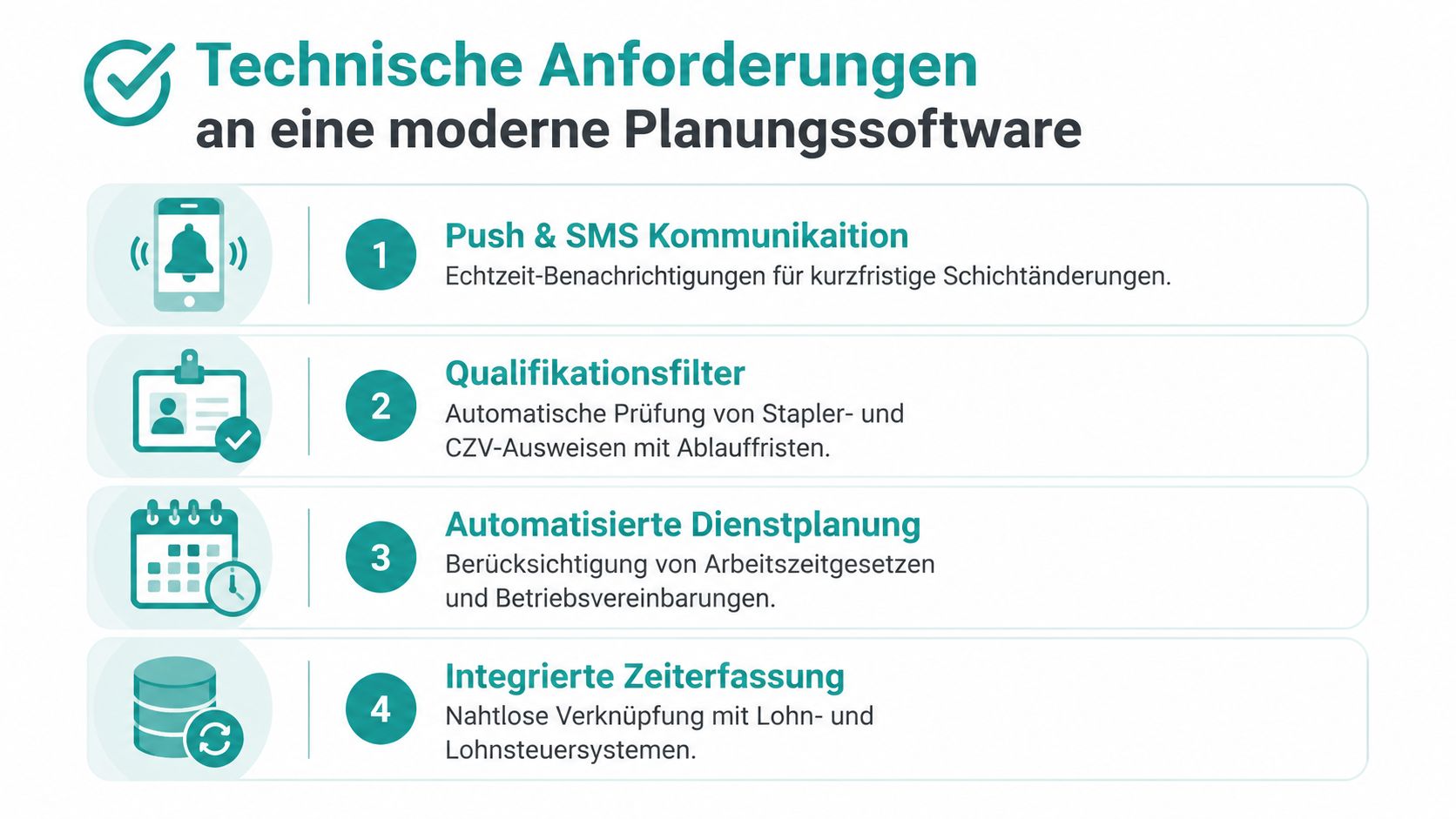
Push and SMS: A change should arrive via a defined channel. Check whether employees can see shift start, location, role, and changes on mobile devices. A message without feedback leaves you uncertain.
Qualification Filter: The system must filter by role and certificate. For a forklift assignment, “warehouse experience” alone is not enough. A CZV certificate or internal training should be managed with expiry date, status, and responsible verifier.
Data Protection and Storage Location: Clarify which personnel data is stored, who has access, and where data is processed. For Swiss companies, data protection requirements, retention, and access rights must be checked before purchase. Promises of legal certainty should depend on the specific setup and contractual conditions.
Time Tracking and Payroll: Planned time and actually recorded time are not the same. Integration with time tracking and payroll preparation reduces transfer errors. Check whether the provider supports the standards and payroll processes your company needs, rather than deriving an interface only from a product list.
To classify different approaches, you can also look at the workforce scheduling software from BREKSTAR Medical GmbH. It comes from another industry but shows which questions you should ask about roles, communication, and shift assignment.
job.rocks can be evaluated as a SaaS solution for shifts, roles, qualifications, availability, mobile information, and time tracking. The platform is not a TMS, WMS, or route planner. A factual guide to digitalizing workforce scheduling helps you organize requirements before selection.
Implementation Checklist and the Role of a SaaS Solution like job.rocks
A system change rarely fails because of the calendar view. Usually, clean master data, clear responsibilities, or a coordinated approach to last-minute changes are missing. Therefore, proceed in a fixed order and separate personnel scheduling from warehouse and transport control.
Seven Points for Rollout
-
Record demand per location. Note shift types, workplaces, peak times, absence paths, and responsible persons. TMS and WMS provide volumes or transport data but do not replace this personnel survey.
-
Build skill matrix. Record certificates, training, language skills, and expiry dates. HR remains responsible for personnel data accuracy; planning uses this information for staffing.
-
Coordinate shift models. Involve works council or employee representatives and check ArG and SECO requirements. The SECO document on working time models states that a shift plan should be definitively set at least four weeks in advance, as explained in the SECO working time models document.
-
Define communication channels. Decide whether to use app, push, SMS, email, or a display. A documented receipt and feedback path is crucial.
-
Start pilot with one shift group. Choose a location or shift where planning problems are visible. Test real cases like illness, late arrival, and role changes.
-
Monitor KPIs. Measure shift fulfillment, qualification coverage, overtime, short-term cancellations, and deviations between planned and actual time. Target values must be derived from your operation.
-
Test payroll interface. Check a complete process from assignment through clock-in to payroll preparation. TMS and WMS remain responsible for their own processes.
job.rocks can be considered a platform for availability, shift assignment, qualification filtering, mobile deployment information, and time tracking. For teams with changing or temporary staff, find more information on software for flexible employees and appropriate organizational integration.
Frequently Asked Questions about Workforce Scheduling in Logistics and HR Context
How Do You React Quickly to Order Peaks?
First, check qualification, availability, and permissible working hours. An additional shift must not create too short a recovery time between two assignments. Special limits apply to night work: Night work is generally prohibited in Switzerland; night time is usually defined as 11:00 p.m. to 6:00 a.m., and approved night work may comprise a maximum of 9 hours of pure work within 10 hours including breaks, see SECO on night work.
The SECO guideline specifies a daily rest period of 12 hours for night work and once per week a continuous rest period of 48 hours, as described in the working and rest times guideline. Plan first within these limits, then look for additional capacity.
What Applies to Night and Sunday Work?
Sunday work is generally prohibited in Switzerland. Therefore, you cannot simply schedule a goods delivery on Sunday morning but must clarify whether an exception requiring approval exists. Night and Sunday shifts involve cantonal permits and industry-specific regulations.
Job rotation can distribute the workload but does not replace a permit or rest period checks. Document assignments so you can later explain when and why a change occurred.
How Does Workforce Scheduling Differ from Route Planning?
Workforce scheduling manages people. Route planning manages trips, stops, vehicles, and time windows. The interface is with the route manager: He reports when and with which driver qualification personnel are needed, while personnel scheduling provides the permissible staffing.
How Do You Properly Integrate Temporary Staff?
Include temporary employees in the same skill matrix as permanent staff but clearly mark lender, deployment approval, training, and deployment duration. Picking experience is not automatically a forklift license. Try-and-hire must not bypass qualification, working time, and time tracking checks.
For requirements around software for staffing agencies, check how availability, deployment confirmations, and payroll information are separated between the staffing agency and the client company.
job.rocks supports you in central planning of shifts, roles, availability, qualifications, mobile deployment information, and working hours. Visit job.rocks if you want to review your logistics planning and set up a suitable process for warehousing, fulfillment, or transport.