
Social Work Staffing: Step-by-Step Guide
Master social work staffing: assess needs, plan shifts, filter qualifications, and use digital tools – with practical examples.
Monday morning, 7:30 a.m. in social services: a specialist calls in sick, two appointments in supported living are already scheduled, and a case in mobile youth work is just tipping over. It is on days like these that your social work staffing shows whether it merely fills shifts or also considers qualifications, availability, changes of assignment locations, and professional fit. Planning in this field means juggling not just calendar blocks but responsibilities, handovers, short reaction times, and the question of who can truly handle the situation professionally.
Table of Contents
- Why Social Work Staffing Is More Than Just a Duty Roster
- Systematically Assess Needs and Sharpen Assignment Profiles
- Combine Shift Types, Qualification Filters, and Availabilities
- Substitution Rules and Short-Term Rescheduling Without Quality Loss
- Link Staffing with Care Planning and Impact Management
- Digital Tools for Availability Queries, Mobile Assignment Info, and Hour Validation
- Staff Shortages, Participation, and the Limits of Digital Planning
Why Social Work Staffing Is More Than Just a Duty Roster
When a colleague is absent on Monday morning, it is not enough to simply assign any available person. In social work, it matters not only that someone is present but whether that person can professionally handle the situation, knows the location, has the appropriate role, and receives a clean handover from the team about what is already underway.
Quantity and Fit Are Not the Same
A filled plan can still be poor. An assignment in outpatient services often requires something different than a substitution in supported living because the target group, time of day, environment, and expectations of the specialist differ. Those who only look at coverage realize too late that the wrong staffing consumes more time later due to follow-up questions, repeated contacts, and unnecessary rescheduling.
Modern social work in Switzerland is historically relatively young; according to professional literature, it developed only from the 1960s onward in the context of state social welfare laws, whereas before, church, charitable, and municipal poor relief shaped what practice could achieve (History of Social Work as a Profession and Discipline). That is why today’s planning carries so much formality, roles are clearer, responsibilities more tightly defined, and the work must remain documentable.
Those who plan in social services plan not only time but also professionalism.
Changing Assignment Locations Make the Plan Vulnerable
Mobile assignments add a second point. The specialist does not work at a fixed location but moves between families, residential groups, counseling centers, or home visits. This increases the need for clear information in advance because each address, setting, and time of day brings different requirements.
Additionally, there is the history of social planning as a professional precursor. Its roots lie in the late 19th century, the term appears in 1930s and 1940s North American literature according to research, and after the war, planning practice shifted from reactive poor relief to coordinated management of social services (Social Planning). For your practice, this means staffing does not come from gut feeling but from a line of need, responsibility, and plannable help.
A Monday with an absence therefore raises three tough questions: Who is available? Who is professionally suitable? And who can take over the assignment so that nothing has to be redone afterward?
Systematically Assess Needs and Sharpen Assignment Profiles
Before you assign a shift, you must know what the assignment professionally requires. Otherwise, you plan people into gaps instead of needs. In social work, this is the point where many plans remain too coarse because they only see times and not the work behind them.
From Situation to Assignment Profile
Professionally reliable planning follows a cycle of situation assessment, situation analysis, intervention planning, implementation, and evaluation (Methodical Core Model). You can adopt exactly this sequence for your staffing. First, describe what is happening, then check what help is needed, then determine who does what and when, and only then assign the person.
For a general social service, this means, for example, that with a new case you do not start with an available colleague but ask whether it is about counseling, clarification, accompaniment, or crisis intervention. In supported living, you check whether the assignment takes place in the morning, evening, or night because this influences the required qualification and the specialist’s workload. In mobile youth work, access to the environment often plays a bigger role than the pure number of hours.
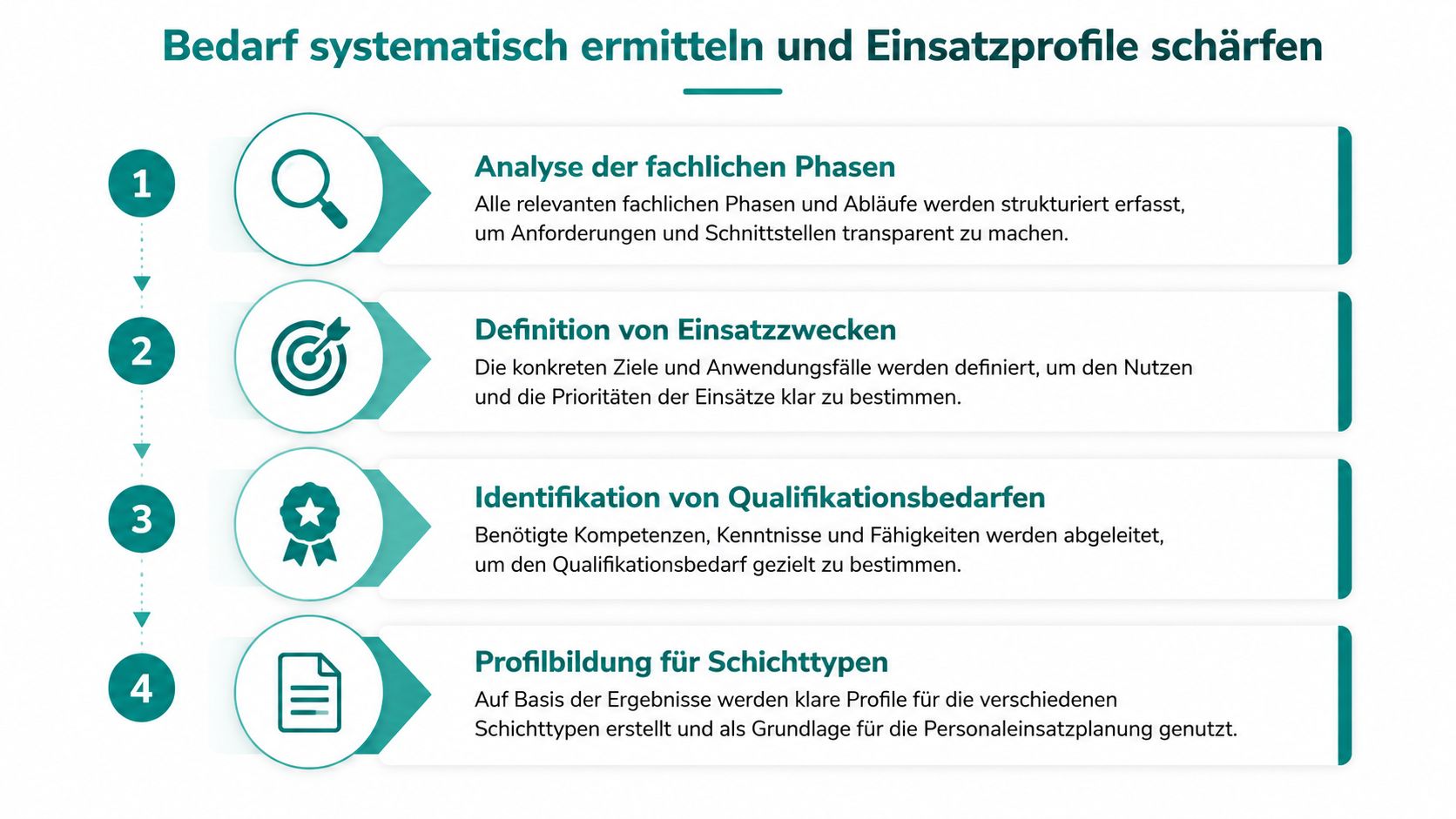
What a Clean Assignment Profile Should Include
A good profile names not only the task but also the professional framework. This includes the type of assignment, required qualification, location, time window, and form of cooperation. If you want to build an internal framework, a clean requirement profile as described in this overview on Creating a Requirement Profile will help you.
Practically, you can think of it like this:
- Clarify the task: Is it accompaniment, counseling, control, crisis reaction, or presence?
- Record the location: Does the assignment take place at a fixed site, mobile, or alternating?
- Check roles: Is a specialist needed, a two-person team, or someone with substitution authority?
- Determine time needs: Is a short visit enough, does the case need multiple contact windows, or is night coverage necessary?
A mistake I see repeatedly is assigning too early based on availability. Then the wrong person sits in the right slot. It is better to sharpen the need first and then define the form of assignment.
Combine Shift Types, Qualification Filters, and Availabilities
Once the assignment profile is set, you need a planning framework that really works in everyday life. In social work, a simple daily plan rarely suffices because day, evening, night, and on-call shifts differ and not every specialist covers every situation. Those who separate this cleanly save themselves hectic phone chains later.
Clearly Name Shift Types
A social service often needs more than a classic early or late shift. Useful shift types include day shift, evening shift, night shift, and on-call duty, plus mobile assignments with a fixed start point and open return time. This is especially tangible for supported living because an assistance hour in the morning demands something different than a night home visit.
In the practical part of planning, it helps to assign a few fixed rules to each shift type. This way, the team knows what to consider for each assignment, and you can check the assignment faster.
| Shift Type | Suitable For | What You Should Watch For |
|---|---|---|
| Day Shift | Counseling, accompaniment, appointments | Presence times, contact points, mobile changes |
| Evening Shift | Handovers, home visits, crisis windows | Availability, travel times, reporting structure |
| Night Shift | Protection, supervision, emergencies | Alertness, clear escalation paths |
| On-Call Duty | Short-term intervention | Reaction time, responsibility, substitution |
Don’t Ask for Availability Every Time
You should not collect availabilities loosely by email. Better is a fixed rhythm where employees maintain their times, preferred windows, and blackout periods so that you don’t start from scratch with every short-term need. Especially with changing assignment locations, you need this basis because the planning question is not only who can but also who can be at the right place.
In Swiss training, care planning is often thought of as a multi-stage process that explicitly includes participation of clients, relatives, and involved institutions. You can transfer exactly this thinking to staffing if you separate the personnel side cleanly from the professional role. This is also important where personal circumstances, language skills, or dealing with certain target groups play a role.
A good plan knows not only names but also limits, competencies, and blackout periods.
When a Qualification Filter Really Helps
Qualification filters make sense when you keep them tight enough. For an outpatient assignment, this might be proof of crisis intervention skills; in supported living, experience with assistance settings; in youth work, perhaps specific method training. The goal is not bureaucracy but quick verification of professional fit.
A helpful filter therefore asks not only about availability but also about role, language, experience, and assignment location. This turns a loose list into a planning tool that connects mobile information and shift types.
A short video visually explains the idea behind combined planning once again.
Substitution Rules and Short-Term Rescheduling Without Quality Loss
Illness comes unannounced. A crisis assignment can also disrupt your plan in a morning. That is why you need rules that are set before the emergency and truly known in the team.
What a Substitution Rule Must Deliver
A good substitution rule immediately answers three questions: Who steps in? Who informs the affected unit? And who takes professional responsibility for handover and follow-up? If one of these points is missing, a gap quickly arises that becomes visible only late.
Staff shortages in social work often lead to services being available later, more standardized, and participation becoming harder. For your substitution logic, this means an open absence is not just an organizational problem but directly affects accessibility and quality.
A Practical Setup for Absences
I work with three levels. First, a small pool of floaters who know the field. Second, an on-call chain that works also in the evening and night. Third, an escalation level if the first replacement does not fit or the situation becomes professionally more delicate.
- Define floater pools: Only include people who know the key processes.
- Keep call chains written down: Not in the head but in the system or team document.
- Define escalation: At what point must team leadership intervene?
- Enforce handover: No substitution without a brief situation report and clear task.
This is exactly where Excel often fails. The list is quickly made, but with short-term changes, no one knows for sure if the qualification fits, if the person is already on the way, or if the assignment has already been given to someone else. Digital entries help only if they keep the current status clean, especially when short-term shift staffing at events is used as an example of fast assignment and clean information.
The Most Common Mistakes in Spontaneous Rescheduling
The first mistake is an incomplete qualification check. Then the free person is taken even though they lack the necessary experience. The second mistake is too late informing those affected, which harms handover and relationship continuity.
A third mistake is missing documentation of the change. If later no one knows who took over when, traceability becomes thin. A fourth mistake is assuming the substitute already knows everything. That is almost never true.
Link Staffing with Care Planning and Impact Management
Duty planning becomes professionally strong only when it contributes to care goals. An assignment is not just a calendar appointment but part of the intervention. If you keep this in mind in daily work, shifts become more comprehensible and case progress clearer.
The Plan Needs a Checkpoint
In child and youth welfare, care planning is often divided into three parts: clarification of need, planning of help, and review, continuation, or termination (Care Planning according to § 36 SGB VIII). This checkpoint is gold for your staffing because it prevents assignments from continuing for months even though the need looks different.
A simple example: A specialist is assigned for home visits because initially it is about stabilization. After a few weeks, it must be checked whether it is still the same type of help or if accompaniment, counseling, or another setting is needed. Without this appointment, the plan blindly continues.
What Should Be Available Before Each Assignment
Before assigning a person, need, objectives, type of help, and necessary services should be clear. This applies not only at the case level but also for shift allocation. If you know what should be professionally achieved, you can better decide who takes the assignment and how much time is needed.
Care plan documentation must contain findings on need, objectives, type of help to be provided, and necessary services according to professional recommendations (Care Plan Diagnosis Table). Practically, this means you do not just assign a specialist but a role with a clear purpose.
If the purpose remains unclear, every shift becomes improvisation.
Impact Management Without Bureaucratic Traps
Many teams already record results but hardly use them for management. That is exactly where the gap lies. If you link staffing with care goals, you can make clearer which assignments only secure presence and which also aim for progress.
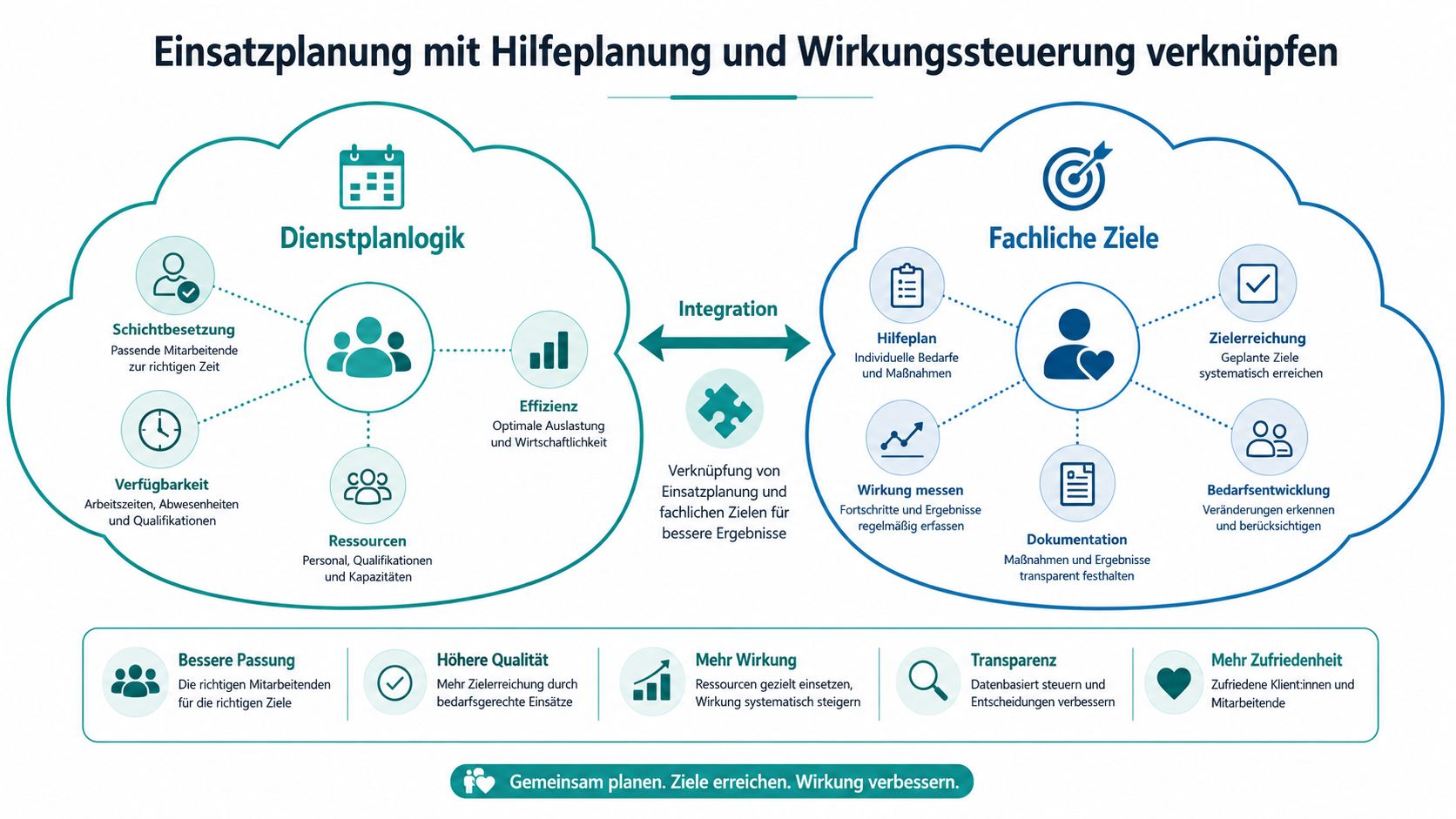
This way, planning does not stop at coverage but connects to professional impact. This is not an extra to add later but part of the assignment itself.
Digital Tools for Availability Queries, Mobile Assignment Info, and Hour Validation
Digital tools help where everyday life becomes confusing. They do not replace professional decisions but save you search work, keep current availabilities ready, and make mobile assignments more traceable. Especially with changing assignment locations, this makes a real difference because information must not stay stuck at the desk.
Which Features Really Matter in Daily Work
For social work teams, clear availability queries, mobile shift information, short-term swap options, and clean time tracking on the go are especially relevant. A platform like job.rocks for temporary workers can map such processes because it combines availabilities, assignments, and mobile data. I would not see it as a substitute for professionalism but as a tool for the planning side.
Helpful features include:
- Personalized invitations: So only suitable people see an assignment.
- Automatic notifications: So absences and changes arrive immediately.
- Shift swapping: So swaps happen orderly instead of chat chaos.
- Clocking in and out on the go: So mobile assignments are recorded cleanly.
- Change logs: So later inquiries do not go unanswered.
- Payroll integration: So times go neatly to payroll preparation.
How to Set Up the Mobile Side Properly
Mobile information needs more than a time for each shift. The specialist should know where the assignment starts, what special features the location has, who is reachable, and what task is in focus. This sounds simple but saves many last-minute questions.
Hour validation is also not a luxury. If a colleague works in the field, start, end, and scope of service should be traceable; otherwise, later evaluation becomes tedious. A good system records this information directly where the assignment is documented instead of reconstructing it later from notes.
Why Excel Reaches Its Limits Here
Excel is suitable for simple lists but becomes sluggish with short-term replacements. You see the old status but not always the latest click. Mobile teams need current data; otherwise, planning turns into rework.
It matters less whether a tool shines. What matters is whether it connects availabilities, mobile assignment info, and time tracking so your team does not have to type twice.
Staff Shortages, Participation, and the Limits of Digital Planning
The biggest trap is assuming software solves staff shortages. It does not. If too few people are available, even good plans remain fragile, and quality quickly comes under constant stress.
What Scarce Resources Really Cause
Short staffing shows immediately in daily work. Waiting times get longer, services become harder to use, formats become more schematic, and participation shrinks. This is exactly what the analysis of staff shortages and de-professionalization in social work describes. For your planning, this is not theory but a clear message that scarce resources directly affect help quality.
Therefore, you need reliable processes, not buzzwords. Those who leave responsibilities unclear cut participation. Those who plan assignments too tightly lose time on follow-ups and handovers. Those who only look at coverage overlook professional fit and ultimately also the impact in the help process.
What You Should Measure Instead
Don’t just look at whether a shift was staffed. Also ask whether the right qualification was there, whether handovers took place, whether participation remained possible, and whether the assignment matched the help goal. These questions tell you more about quality than a full list.
The team’s workload also belongs here. When there is hardly any breathing room in daily work, planning quality drops, and then it is worth looking at prevention in home office because recovery, clear work boundaries, and good working conditions do not start only at the desk. Good planning in social services also depends on whether employees remain able to work long-term.
What Digital Planning Can and Cannot Do
Digital tools help with transparency, speed, and traceability. They do not help with too few staff, unclear mandates, or a team culture where questions are seen as disruptions. When you introduce digital planning, you must simultaneously regulate roles, substitution paths, and checkpoints cleanly.
Only then does duty roster logic hold under pressure. Then it not only holds shifts together but also supports qualification requirements, impact goals, and participatory processes, even when staffing is thin.