
Average working days per month: understand and calculate correctly
How to calculate average working days per month in Switzerland and use the value for payroll, staffing and capacity planning.
How many days do you actually work per month? In Switzerland, the average for a five-day week is 21.75 days. This figure is more than a statistic: it is the basis for fair payroll, reliable holiday planning and smooth workforce organisation.
The planning basis in brief
The calculation is simple: start with all days in a year and subtract the days that are normally free.
- Starting point: 365 calendar days.
- Weekends: 52 weeks equal 104 weekend days.
- Result: 261 potential working days.
Dividing 261 by 12 months gives 21.75. This average is widely used in Switzerland for payroll and capacity planning.
The average of 21.75 days creates predictability. It balances short and long months and provides a stable basis for daily rates and staffing.
Overview of the calculation
| Component | Days | Step |
|---|---|---|
| Total days | 365 | Standard calendar year |
| Weekend days | 104 | 52 × 2 |
| Annual working days | 261 | 365 minus 104 |
| Average per month | 21.75 | 261 divided by 12 |
The formula step by step
(Total days per year - weekend days - public holidays) / 12 months
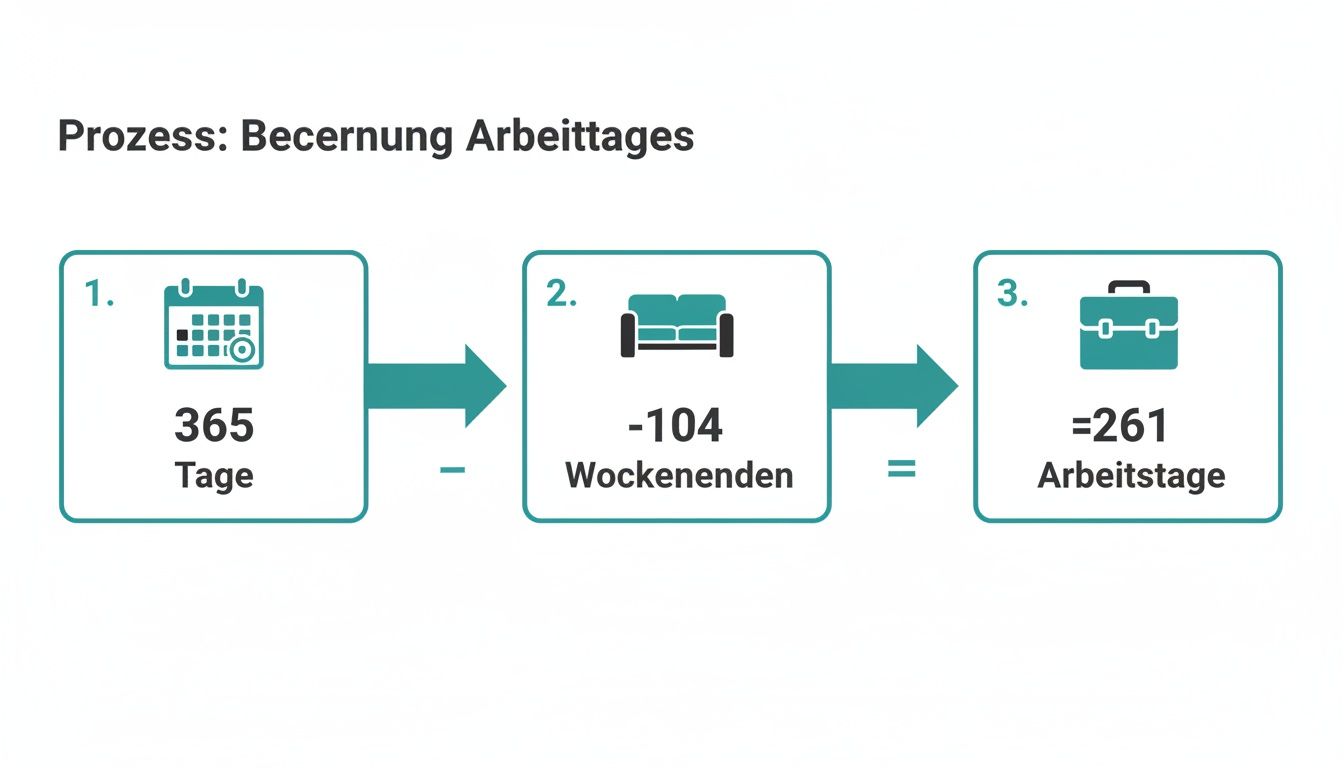
For a standard year without public holidays: 365 - 104 = 261; 261 / 12 = 21.75. If your team works Saturdays, you adjust the weekend deduction accordingly. For spreadsheet planning, our guide to workforce planning with Excel helps avoid common errors.
How leap years and public holidays change the result

A leap year has 366 days. If the additional day falls on a weekday, the potential working days rise to 262, and the monthly average becomes 21.83.
| Feature | Normal year | Leap year |
|---|---|---|
| Total days | 365 | 366 |
| Weekend days | 104 | 104 |
| Working days before holidays | 261 | 262 |
| Average per month | 21.75 | 21.83 |
Public holidays in Switzerland
Holidays are the biggest variable. Zurich has around 9 legal holidays, Bern 9 to 10 depending on region, and Ticino up to 15. Only holidays that fall on a normal working day are deducted. For more detail, see our article on working days per year.
Why this number matters for your company
The average working days per month influence staffing, time tracking and payroll preparation. Without a reliable value, you risk overstaffing, understaffing, wrong budgets and frustrated employees.
Precise planning improves profitability
If an event logistics company needs 15 crew members every day for three months, one wrong assumption about working days can affect the whole budget. Accurate calculation is not an administrative detail; it directly influences project success.
Managing resources intelligently
Knowing the real available person-days helps distribute tasks, projects and holidays fairly. Trends such as decreasing weekly working time in Switzerland, described by watson.ch, make precise planning even more important.
How software prevents errors and saves time

- Central data: cantonal holidays, company rules and contracts in one place.
- Automatic application: the system applies the correct rules for each plan.
- Consistent results: every calculation follows the same logic.
Good staff scheduling software uses the average as a starting point and then calculates the real monthly capacity, including part-time workload, holidays and absences.
Frequently asked questions
Which value is correct: 21.67 or 21.75?
Both can be used. 21.75 comes from 365 minus 104 weekends divided by 12. 21.67 comes from 52 weeks × 5 working days divided by 12. The key is consistency.
How do I calculate part-time employees?
Adapt the formula to the agreed workload. Three days per week equal roughly 13 working days per month, or 21.75 × 0.6 = 13.05.
Do I consider holidays month by month?
For annual strategy, use the average. For a concrete monthly roster, count the real working days and public holidays of that month.
What if a holiday falls on a weekend?
In most Swiss cantons there is no replacement day. Do not deduct it again because it is already counted as a weekend.
job.rocks automates workforce planning from availability requests to payroll preparation, so you plan with correct data. Learn more at https://job.rocks.