
Calculate average working days per month quickly and correctly
How many working days are in a month? Switzerland expects this value: 21.75 days. This is the magic number that is considered the recognized standard throughout Switzerland. It is the foundation for fair payroll and reliable personnel planning because it compensates for the fluctuating length...
How many working days are in a month? Switzerland expects this value: 21.75 days. This is the magic number that is considered the recognized standard throughout Switzerland. It is the foundation for fair payroll and reliable personnel planning because it compensates for the fluctuating length of the months.
Why the 21.75 days are more than just a number
Have you ever wondered how you calculate salaries fairly when February only has 20 working days and August has a whopping 23? This is where this simple but very powerful average comes into play. It creates a stable and reliable basis for your entire personnel administration.
Without such an average, you would have to recalculate every month. That would not only be a huge effort, but also a constant source of errors. The average number of working days per month smooths out these fluctuations and serves as an agreed standard that everyone can rely on.
The pivotal point for payroll accounting and planning
This key figure is much more than just a statistical quantity. It is a central tool that is used every day in various areas of your company:
- Fair payroll: You can precisely break down monthly wages into daily or even hourly rates. This is absolutely crucial when it comes to deductions for unpaid vacation or you have to compensate for additional assignments. Imagine an employee takes an unpaid day off. With the average value you can calculate the deduction fairly and comprehensibly for everyone.
- Correct vacation management: The average value helps you to evaluate and convert vacation entitlements consistently - regardless of the month in which the vacation is actually taken.
- Simplified personnel planning: You get a constant size that you can use to plan your capacities. This makes it much easier to estimate how many working hours you really have available to you per month.
This Swiss-wide recognized average for a 5-day week is not just a mere statistic, but the backbone for fair payroll and a smart human resources organization.
Such a standard value is indispensable, especially in industries with flexible working models – just think of catering, events or security services. It creates the necessary transparency and fairness from which you and your employees benefit equally.
Overview of common calculation methods
There are basically two standard ways to access the average working days per month to come. The following table shows you both ways. You will see: The results are very close to each other, but are based on slightly different assumptions.
Overview of common calculation methods
This table shows the two standard methods for calculating average working days per month.
| method | Calculation formula | Result (days per month) |
|---|---|---|
| Standard method (annual) | (365 days – 104 weekend days) / 12 months | 21.75 days |
| Weekly method | 5 working days/week * 52 weeks / 12 months | 21.67 days |
Both values are absolutely common in practice. The 21.75 days However, they have established themselves as the most common value in Switzerland because they reflect the annual perspective most accurately. In the next section we'll look at when which method makes more sense and how you can use the whole thing for your purposes.
So, now it's time to get down to business. How do you actually calculate the average working days per month? Don't worry, this is easier than it sounds at first glance. There are basically two common methods, both of which lead to an almost identical result - just the way to get there is different. We look at both and clarify when which method is the best choice for you.
The concept map below shows why this value is so crucial. It's about much more than just a number: fair payroll, clean planning and equal treatment of all employees depend on it.
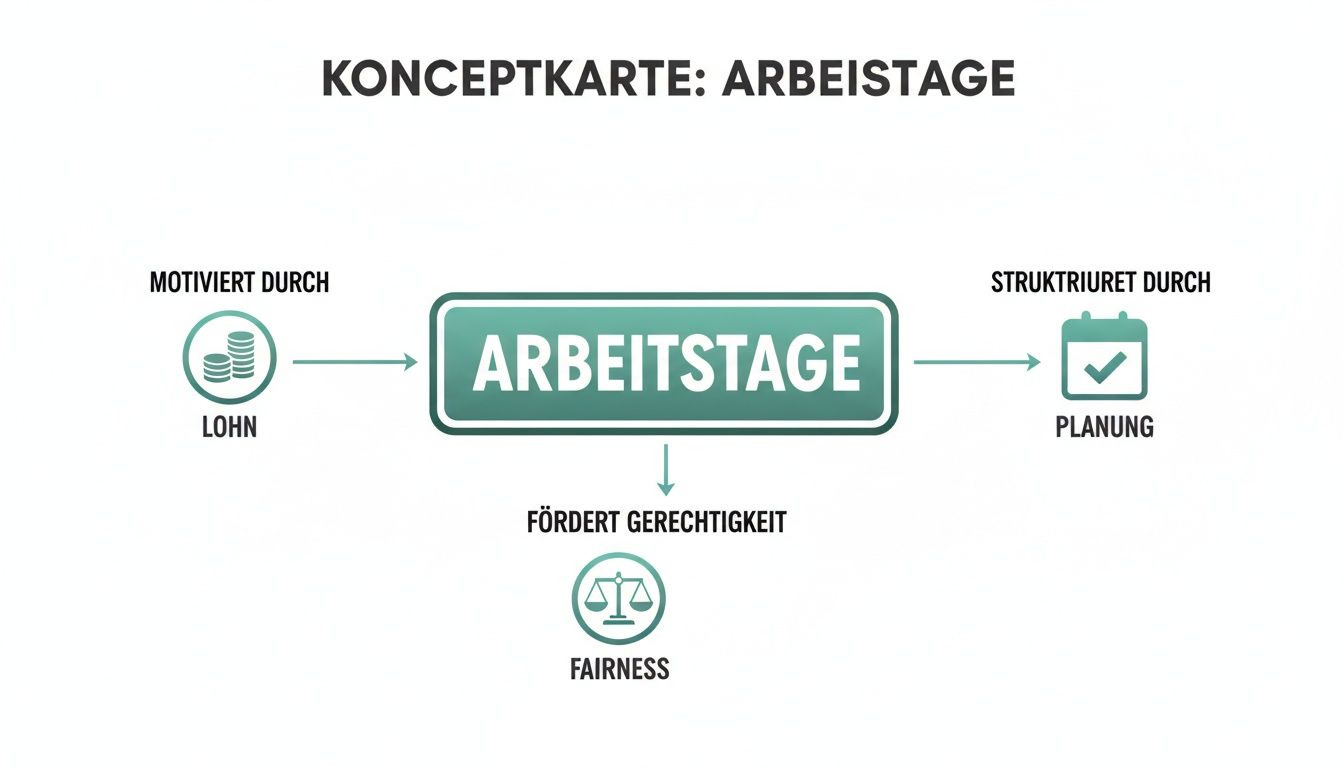
The graphic makes it clear: This value is not about dry mathematics, but rather about the cornerstones of transparent and fair personnel management.
The annual method: the default value of 21.75 days
In Switzerland, calculation on an annual basis has become established. It is considered particularly accurate because it takes the entire year as a basis and derives the average for a month. This smoothes out the fluctuations between short and long months.
The calculation is simple:
- Take the days of the year: Has a normal year 365 days.
- Subtract all weekends: A year has 52 weeks, so 104 weekend days (52 Saturdays and 52 Sundays).
- Determine the net working days: 365 days – 104 weekend days = 261 working days per year.
- Divide by 12 months: 261 working days / 12 months = 21.75 average working days per month.
This value is the standard in many industries and collective employment agreements. The big advantage? It ignores leap years and provides a constant value that everyone can rely on - perfect for higher-level planning.
The weekly method: the alternative with 21.67 days
A slightly different approach is the weekly method. It is less common, but produces an almost identical result and is easier to argue in some contexts.
Why the small difference? A year does not consist of exactly 52 weeks (52 × 7 = 364 days). The weekly method virtually rounds off this factor, resulting in a slightly lower average value.
The formula for this looks like this:
- (5 working days per week × 52 weeks) / 12 months = 21.67 days per month
Although the difference may seem tiny, it is important that you advocate for it in your business one You decide on the method and apply it consistently. This avoids questions and ensures clarity in payroll accounting.
Formulas for Excel and Google Sheets: the helpers in everyday life
Of course, you don't have to calculate this by hand every time. For the determination of the actual Working days of a specific month have programs like Microsoft Excel or Google Sheets a built-in solution: the function NETTOARBEITSTAGE.
This feature is extremely useful because it not only takes into account start and end dates, but can also include a list of holidays. In this way the calculation is brought precisely to the point.
If you want to calculate the effective working days for January 2024 in Zurich, simply enter this formula in a cell, defining New Year's Day and Berchtold's Day as public holidays:
=NETTOARBEITSTAGE("01.01.2024"; "31.01.2024"; {"01.01.2024";"02.01.2024"})
These formulas are worth their weight in gold if you need real, billable days for a specific period. For strategic planning and general calculations, the average value remains 21.75 days however, the most reliable size.
How holidays and absences turn the calculation upside down
The standard formula with 21.75 days is a great guideline for rough planning. But the reality in your company is usually different. Holidays, vacation and sick days of your employees reshuffle the cards every month - and the number of available working days is no longer correct.
If you simply ignore these factors, problems will quickly arise. Incorrectly calculated wages and unrealistic deployment plans are just the tip of the iceberg. For truly precise planning, you definitely need to take these absences into account.
The influence of cantonal holidays
In Switzerland there is another special hurdle: the cantonal holidays. While August 1st is celebrated nationally, each canton cooks its own soup with additional holidays.
A company in Zurich has completely different public holidays than one in Geneva or Ticino. These small differences have a direct impact average working days per month and thus to the entire annual working time.
Let's take a look at this with an example:
In the canton of Zurich, nine public holidays will fall on a weekday (Monday to Friday) in 2024. You must subtract these nine days from the annual working days (261) before recalculating the monthly average.
- 261 working days – 9 cantonal holidays = 252 actual working days per year
- 252 / 12 months = 21 working days per month
You can see straight away that the average value drops noticeably. For precise planning, it is crucial that you have your canton's holiday regulations on your radar.
The formula that works in real everyday work
To get a really realistic number, you have to expand the formula to include individual absences. This includes planned vacations as well as unforeseen absences due to illness.
The key to accurate personnel planning is to deduct all foreseeable and unforeseeable absences from the gross working days in a month. Only then will you know your actual net capacity.
The really practical calculation for a specific month looks like this:
Total number of weekdays in the month
– Weekends
– Holidays that fall on a weekday
– Planned vacation days for employees
– Average sick days (based on experience)
= Actual available working days
This detailed consideration becomes particularly important if you work with many part-time employees or a flexible employee pool. An accurate knowledge of the actual working days per month is the basis for fair payroll and reliable deployment planning.
With this level of accuracy, you can avoid staff shortages and ensure that your projects and orders are always sufficiently staffed.
This is how you master part-time, shift work and flexible models
What happens if your employees don't have the classic 5-day week? As soon as part-time, shift work or flexible models come into play, the flat rate of 21.75 days quickly reaches its limits. But don't worry, there are clear and fair solutions for these cases too.
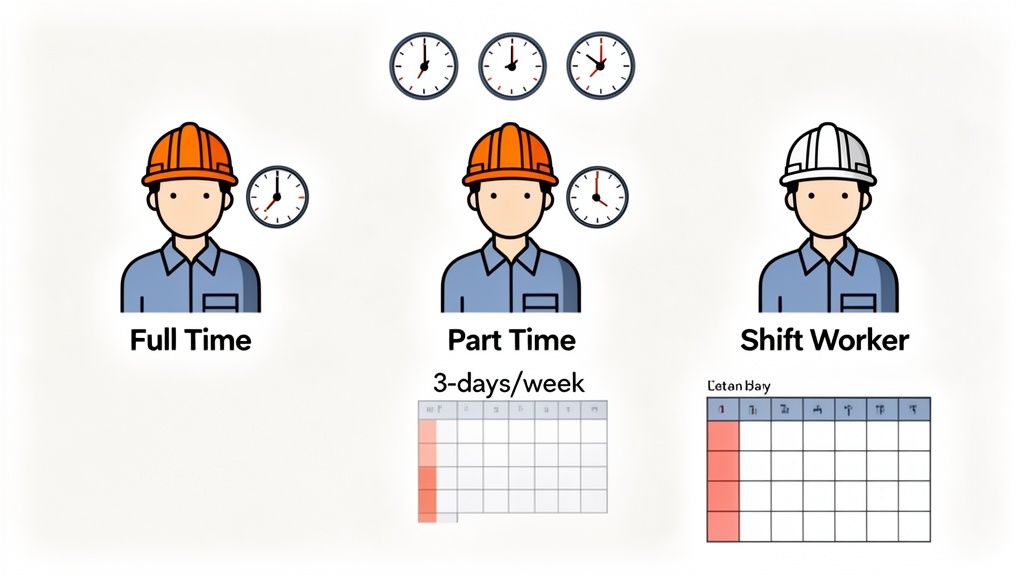
The key is to change your perspective: away from a day-based view and towards an hour-based view. This way you can reflect the work performance fairly, no matter how irregularly the assignments are distributed.
Pay part-time workers fairly
The calculation for part-time employees is easier than you think. Instead of assuming full working days, you simply calculate the average value down to the respective workload.
Imagine an employee works three days a week, i.e. one 60% workload. The formula to which average working days per month Adjusting it is very simple:
- 21.75 days (full-time average) × 0.60 (part-time factor) = 13.05 average working days per month
This number now serves as a new, fair basis for payroll accounting and planning vacation days. This ensures that everything remains proportionally correct and comprehensible for everyone.
When it comes to shift work etc., every hour counts
In industries such as catering, logistics or events, the 5-day week is often a rarity. Here, long working days alternate with longer free phases. An employee might work 12 hours straight on the weekend and have the week off.
In such cases, a daily calculation is not only inaccurate but simply misleading. The contractually agreed ones are much more precise and fair monthly hours to be taken as a basis.
The switch to hourly-based billing ensures maximum transparency. Every minute worked is recorded and compensated - this creates trust and prevents discussions about unequal workloads.
Swiss full-time employees work on average 40 hours and 12 minutes per week (As of 2023), which for a 5-day week is approximately 8.03 hours per day corresponds. A high proportion of part-time work requires smart solutions to plan staff according to needs. You can find further details about working hours in Switzerland in this article on watson.ch.
Practical example: This is how an event agency plans
An event agency employs a core team full-time and part-time as well as a large pool of freelancers who work on a project-based hourly basis. How does the planner keep track here?
- Full-time employees: Included as a flat rate 21.75 days planned to ensure the basic capacity of the company.
- Part-time workers: Your monthly target hours (e.g. 84 hours at 50%) are stored in the system and form the basis for planning.
- Freelancers: Are used and billed purely based on booked hours for specific events. Pure flexibility.
The agency uses software for this digital shift planning, which can easily display all three models. The system automatically adds up the hours worked in the background and ensures that the contractual agreements are adhered to for each individual. This ensures fair and absolutely transparent billing for the entire team.
Use the average value correctly in payroll accounting and planning
The correct number of working days is much more than just a dry number - it is the foundation for two of the most important processes in your company: payroll and workforce planning. Once you know how to use this value skillfully, you can noticeably simplify many processes and ensure more fairness in the team.
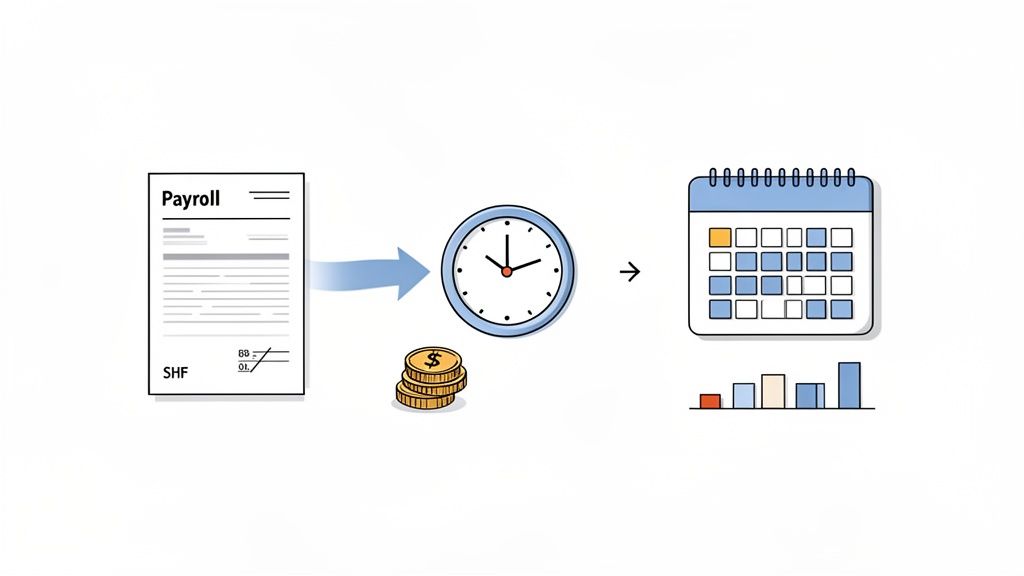
The average value helps you to distribute salaries fairly and to realistically assess your human resources. This creates transparency and stability, even if each month has its own pitfalls.
From the monthly wage to the daily rate: This is how you calculate fairly
One of the most common tasks in payroll accounting is to break down a fixed monthly salary into a single working day. You always need this when employees take unpaid leave, join or leave in the middle of the month or you have to pay for additional assignments.
Here comes the average value of 21.75 days into the game. The calculation is extremely simple and creates a uniform, reliable basis for everyone.
Practical example:
An employee has a gross monthly salary of CHF 4,500. He takes two days of unpaid leave.
- Calculation of the daily rate: CHF 4,500 / 21.75 days = CHF 206.89 per day
- Deduction for vacation: 2 days × CHF 206.89 = CHF 413.78
The salary to be paid for this month therefore drops to CHF 4,086.22. This method is fair, understandable for everyone and protects you from having to make complicated individual calculations every month.
Plan capacities realistically
The average value is also an enormous help in personnel deployment planning. It allows you to quickly estimate available human resources for a month or even an entire quarter. This is the first but crucial step for a solid shift plan.
Imagine you lead a team of ten full-time employees. Here's how to easily estimate capacity for the next month:
- Available man-days: 10 employees × 21.75 working days = 217.5 man-days
- Available staff hours (at 8h/day): 217.5 man-days × 8 hours = 1,740 hours
This number gives you a clear idea of how many working hours you have available to you. This allows you to plan projects, fill shifts and recognize early on whether you might need additional temporary help for a peak in orders. The exact calculation of the working hours per month is a key factor for smooth operations.
No more Excel chaos: How job.rocks takes care of your planning and billing
Honestly: Manual calculations in Excel are not only a huge waste of time, they are also one of the biggest sources of errors in operational business. Imagine if you could do all this work with one click. This is exactly where smart software like job.rocks comes into play and simply does the tedious calculation work for you.
Determining average working days is one of those typical, repetitive tasks. She is made for them Digitalization of processesto finally gain time for the important things again. Instead of constantly checking and updating formulas, the system does everything automatically in the background.
From clever planning to the finished payroll
The tool thinks for you right from the start. It knows them average working days per month and the contractually agreed working hours of your employees and takes these into account directly when planning deployment. With just a few clicks you can query availability and create shifts, while the software checks in the background whether the target hours are being met.
A central system that combines planning, time recording and payroll preparation is the fastest way to fewer errors and more time for your core business.
Here you can see how easily you can invite employees for open shifts - of course based on their qualifications and current availability.
This way you can ensure that the right people are always in the right place at the right time, without having to fight your way through confusing lists.
Exact data thanks to mobile time recording – no more timesheets!
Another huge advantage is mobile time recording, which is integrated directly into the system. Your employees simply clock in and out of their working hours via the app. This creates an absolutely accurate data basis and finally makes handwritten timesheets unnecessary.
The recorded hours are then seamlessly incorporated into wage preparation. At the end of the month, you export the checked data with just one click and transfer it to your payroll department. Especially for industries with flexible teams, this means: significantly less administrative effort, a minimized error rate and ultimately happier employees.
Frequently asked questions about working days per month
Here are a few more answers to the typical questions that keep coming up in everyday life. This means you are prepared for every situation.
Which number is correct: 21.75 or 21.67?
Both numbers are basically correct, they just appear from different perspectives. The value 21,75 is the standard in Swiss payroll accounting and is obtained when you divide the annual working days by 12. He looks at the big picture.
The value 21,67 comes from the weekly perspective (5 days × 52 weeks / 12). In practice, the most important thing is that you are committed to your company one You decide on the method and follow through consistently. This creates clarity and prevents discussions.
Do I have to pay special attention to leap years?
No, you can safely ignore leap years for the general average calculation. The common formulas, regardless of whether with 21,75 or 21,67, are deliberately simplified. They create a reliable and uniform basis that works over several years without you having to recalculate every time.
What happens if you change jobs in the middle of the month?
It's simple: Billing is done on a daily basis. You take the agreed monthly salary and divide it by the standard value of 21.75 daysto determine the wage for a single working day.
You then multiply this daily rate by the number of days the employee actually worked in that month. This is the fairest and most transparent method for both sides - regardless of whether someone is starting or leaving the company.
Take the guesswork out of scheduling and payroll. JOBROCK FIRE automates these calculations for you so you can concentrate on your core business. Discover now https://job.rockshow to simplify your human resources management.
Frequently asked questions about working days per month in Switzerland
How many working days are there on average in a month in Switzerland?
In Switzerland the average value is: 21.75 working days per month as a standard for a 5-day week. This value is calculated from (365 days − 104 weekend days) ÷ 12 months = 21.75 days. It serves as the basis for fair payroll and personnel planning throughout the year.
How to calculate the actual working days of a specific month?
For a specific month, you count all the days of the week (Monday to Friday) and then deduct the public holidays that fall on a day of the week. You can use the function in Excel or Google Sheets =NETTOARBEITSTAGE(Startdatum; Enddatum; Feiertage) use to calculate this automatically.
What is the difference between working days and working days?
working days are the days on which people actually work - in Switzerland usually Monday to Friday (5-day week). working days also include Saturday (Monday to Saturday = 6 working days). Pure working days (excluding Saturday) are relevant for most payroll accounting and planning.
How do you take cantonal holidays into account in the calculation?
Each canton in Switzerland has its own public holidays in addition to national holidays. You have to deduct this from the 261 working days per year. Example Canton Zurich (9 public holidays on weekdays): 261 − 9 = 252 actual working days per year, which corresponds to 21 working days per month. For precise personnel planning, it is important to know the specific holiday regulations in your canton.
Which Excel formula do I use to calculate working days per month?
The Excel function =NETTOARBEITSTAGE("01.01.2026"; "31.01.2026"; Liste_der_Feiertage) automatically calculates the working days of a period taking weekends and holidays into account. For the average value you use: =(365-104)/12 which gives 21.75 days.
How do you calculate part-time work correctly?
For part-time work, multiply the full-time average by the part-time factor. Example: An employee with a 60% workload works an average of 21.75 days × 0.60 = 13.05 working days per month. This serves as a fair basis for payroll and vacation calculation. For precise billing, one is recommended digital time tracking software, which automatically records all hours.
Which software helps manage working days and scheduling?
Modernity Operations planning software like job.rocks automatically calculates the available working days taking into account public holidays, vacation and sick days. The pay-per-use model (from CHF 1.20/use) makes digital planning affordable for SMEs too. This means you can always keep track of your actual staff capacity.
How do vacation and sick days affect monthly working days?
The 21.75 days are an average value without absences. For realistic capacity planning, you need to deduct planned vacation days and average sick days (based on empirical values). A professional personnel planning tool automatically records these absences and shows you the actually available net working days.