
Digital employment contracts: Hire faster – Accelerate your recruiting in 2026
Meta Title: Digital employment contracts: Hire faster | Your GuideMeta Description: Imagine finding top candidates but losing them to the competition because your paperwork is too slow. Learn how to use digital employment contracts to shorten the hiring process from weeks to hours and...
Meta title: Digital employment contracts: Hire faster | Your guide
Meta description: Imagine finding top candidates but losing them to the competition because your paperwork is too slow. Learn how to use digital employment contracts to shorten the hiring process from weeks to hours and secure the best talent.
Imagine you have to attend a big event at short notice 50 people set. A nightmare of administration, postal routes and waiting times for paper contracts? Not necessarily. With digital employment contracts You shorten the process from acceptance to the first day of work from weeks to just a few hours.
Why digital employment contracts make the difference
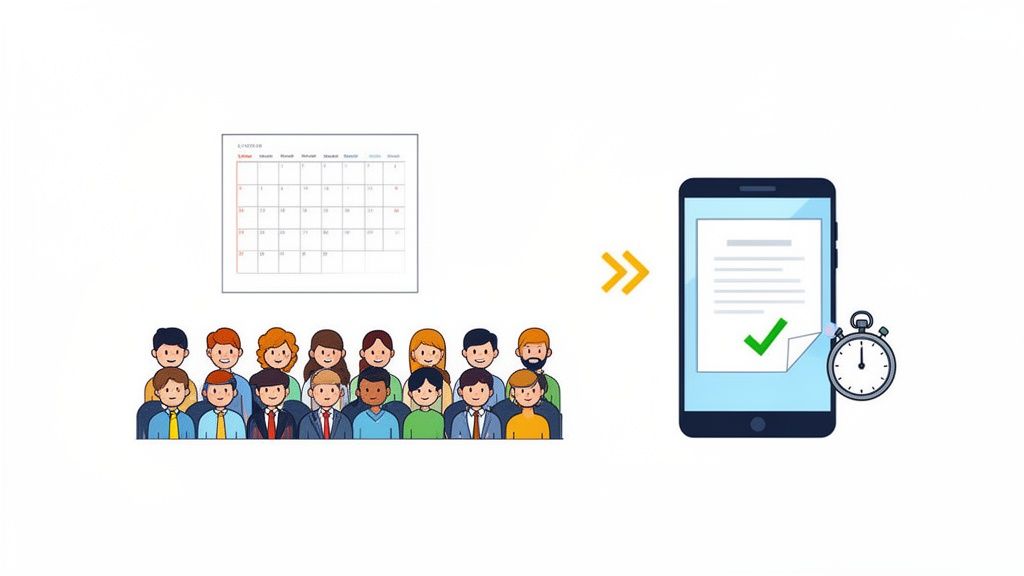
In industries such as event organization, catering or logistics, speed is everything. Long hiring cycles are not only cumbersome, but they also cost you the best talent - they have long been under contract with the faster competition. The traditional route – print the contract, send it by post, wait for it to be returned, scan it and file it – is a relic from another time.
Digital employment contracts are much more than just a simple PDF file via email. These are legally valid documents that are created, sent, signed and archived in a completely digital workflow. The entire process takes place online, without a single printout or postmark.
The speed advantage in practice
Imagine you run an event agency: On Friday you receive a request for a big promotion the following Monday. 50 promoters are needed. With paper contracts? Impossible to create.
With a digital system, however, the process looks like this:
- Availability query: You broadcast via a platform like job.rocks a request to your personnel pool.
- Promises: Interested employees can report back directly via the app.
- Contract shipping: You select the right people and send the prepared digital contracts with just one click.
- Signature: Employees receive a notification, check the contract on their smartphone and immediately sign digitally.
- Confirmation: Within minutes, the contracts are signed and stored securely in the system. The promoters are booked for the operation.
This entire process doesn't take days, but often less than an hour. This means you can react quickly to short-term customer requests and increase your flexibility enormously.
The following table illustrates the difference in time required and the individual steps between the traditional and digital contract conclusion. You can immediately see where the big time wasters are in the old process.
Comparison between traditional and digital contract processes
| Process step | Traditional process (duration) | Digital process with job.rocks (duration) |
|---|---|---|
| Contract creation | Manually, 15-30 minutes per contract | Automated from template, < 1 min. |
| Shipment | Postal service, 1-3 working days | Immediately with a click, < 1 minute. |
| Processing time employees | days to weeks | Minutes to hours |
| Return shipping | Postal service, 1-3 working days | Immediately after signature, < 1 minute. |
| Archiving | Manual scanning & filing, 5-10 min. | Automatically and immediately |
| Total duration (approx.) | 3-7+ working days | < 1 hour |
The digital process not only eliminates postal waiting times, but also automates time-consuming manual steps, drastically speeding up your workflow.
More than just being fast
But it's not just about speed. The lack of qualified personnel is one of the biggest hurdles in today's job market. In Switzerland, companies are increasingly struggling with a shortage of skilled workers, especially in dynamic sectors. Digital employment contracts offer a concrete answer here by allowing hiring in hours instead of weeks. You can find out more about the Swiss labor market and the forecasts in this analysis on specialized skills.
By digitizing the contract process, you not only save time, but also create a modern experience for your new employees. A quick, uncomplicated conclusion of a contract shows that you are a modern employer.
A well-thought-out digital process, supported by tools like job.rocks, automates tedious administrative tasks. Not only do you save valuable time and nerves, but you also minimize sources of error and ensure clean, comprehensible documentation from the first contact.
Understand the legal basis for digital signatures
Digital contracts are fast, no question about it. But are they really safe and legally valid? This is often the first concern we hear. To cut a long story short: Yes, they are. And in this section I will show you exactly what you need to know about the legal framework in Switzerland in order to use digital employment contracts with absolute confidence.
The best news right at the beginning: employment contracts in Switzerland are generally free of formalities. This is what it says in the Code of Obligations (OR). This means you can close it verbally, in writing or even digitally. So it's not a question of "if", but rather "how" of the electronic signature.
The three levels of electronic signature
Not every digital signature is equivalent. There are three different types depending on the level of security, and this knowledge is crucial to making the right choice for your employment contracts.
-
Simple Electronic Signature (EES): This is the most basic form. Imagine a scanned signature that you copy into a document, or simply your typed name under an email. The evidence here is of course low because the person's identity can hardly be verified.
-
Advanced Electronic Signature (FES): This level is significantly safer. A FES is clearly linked to you as the person signing and is firmly tied to the document. This means that any subsequent changes are immediately visible. For most employment contracts this is the case best standard – the perfect balance of safety and ease of use.
-
Qualified Electronic Signature (QES): This is the highest level of security and is legally equivalent to a handwritten signature. It requires a complex identity check by a certified provider. It is only really necessary for a few special cases, for example in the case of an apprenticeship contract or a staff leasing contract.
For over 95 % This is sufficient for all employment contracts in sectors such as catering, events or logistics Advanced Electronic Signature (FES) completely out. It offers the necessary legal certainty without unnecessarily complicating the process.
An example from the catering industry
Imagine you run a seasonal hotel and urgently need to hire a chef shortly before the start of winter. With a FES-based digital contract, it works like this:
- You create the contract in a platform like job.rocks and send it to the chef with one click.
- The chef opens the link on his cell phone, checks the conditions and is guided through a secure process to the signature - often simply via an SMS code.
- Once digitally signed, the contract is immediately valid and is archived in a tamper-proof manner. The entire process? Maybe it will take time 15 minutes.
Especially in the Swiss labor market, where there is also a shortage of skilled workers 2026 will still be noticeable, electronic signatures and digital contracts are a crucial component in remaining flexible.
A central point when introducing digital processes is compliance with the strict ones Privacy Policy. Modern platforms like job.rocks are designed from the ground up to meet the requirements of the GDPR. Every single step is documented and can be traced at any time - in the end this gives you even more security than a loose paper document in a file folder.
Are you looking for a secure platform? Find out more about GDPR-compliant deployment planning in our comparison of the most secure cloud platforms.
Design your process for quick hiring
A digital tool alone is not a guarantee of success. Only a cleverly thought-out process will really make you faster in recruiting. I'll show you how to set up a clever workflow for your digital contracts that relieves you of the administrative burden and eliminates sources of error.
The basis for everything that follows is the first step: the creation of reusable contract templates. Instead of writing every contract from scratch, you define a master version for each job role.
You can use these templates placeholders out of. These are dynamic fields like [Vorname], [Strasse] or [Stundenlohn], which are automatically filled with the new employee's data each time they are hired. This ensures that all legal clauses are consistent and correct, while only personal data needs to be customized.
Automate shipping and save time
Once your templates are in place, the real magic of the digital process begins. This is not just about speeding up shipping, but also making it smarter.
Imagine a typical scenario: You run a security service and need to expand your team at short notice for a major event. Your digital process could then look like this:
- Personal invitation: Immediately after the verbal confirmation, you trigger the contract dispatch. Your system, for example job.rocks, immediately sends the candidate an email or a push message to the employee app.
- Easy access: The candidate clicks on the link and sees the contract personalized for him directly on his smartphone. No cumbersome printing, no searching for a scanner.
- Automatic reminders: Has the candidate not signed after 24 hours? No problem. The system automatically sends a friendly reminder without you having to think about it.
This lean process shows how a digital contract can be processed in a legally secure manner from creation to signing.
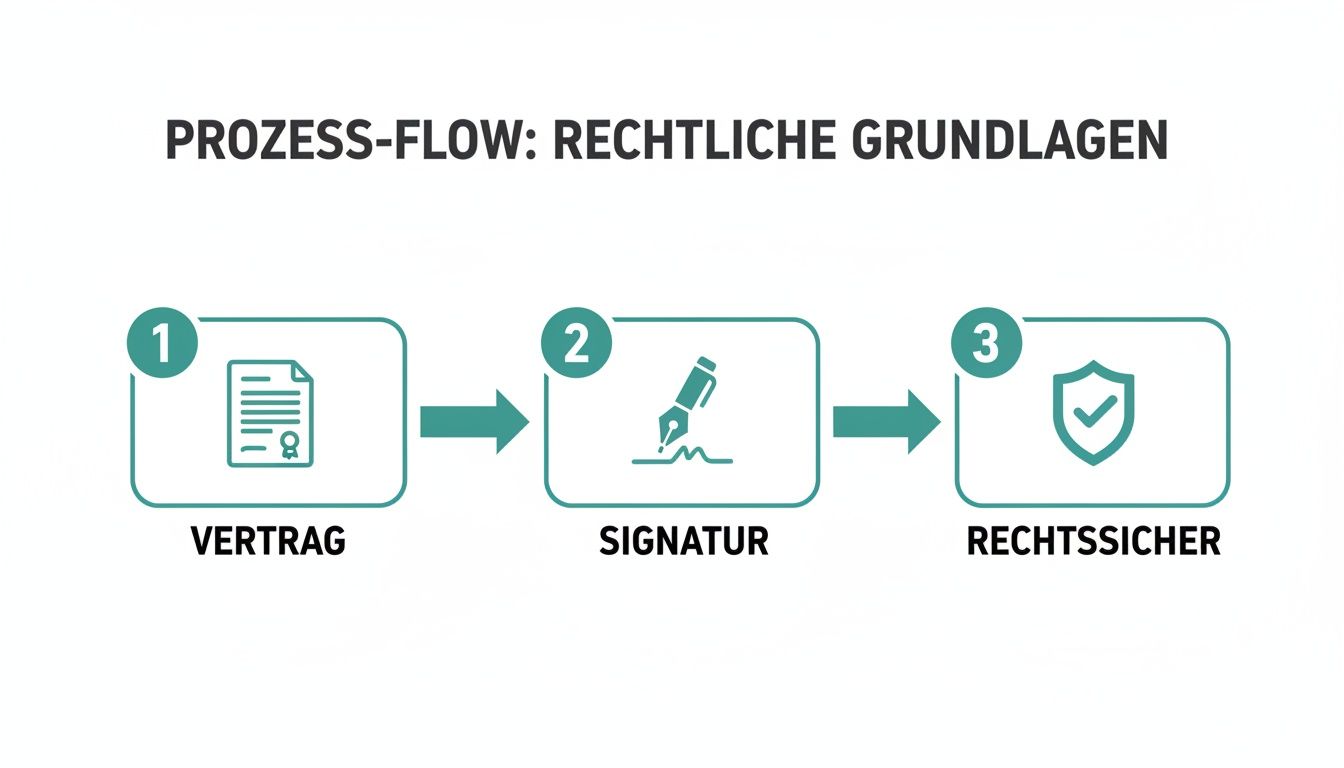
The visualization makes it clear: the entire process – from creating the document to signing it to legally compliant archiving – becomes a seamless digital cycle.
In our example with the security service, the time span from the confirmation via the digital signature to the employee's inclusion in the operational planning can often vary less than an hour be. This would simply be unthinkable with paper processes.
Track status and connect processes
One of the biggest advantages of digital systems is transparency. You can see in real time at any time who has already opened, read and signed the contract. No more guessing as to whether the mail has already arrived or the contract is in a pending pile.
However, the true strength only unfolds when you seamlessly link the contract process with the rest of your HR management. Once the signature is provided, a platform like job.rocks can automatically trigger the next steps:
- The employee profile is completed.
- The person is activated for operational planning.
- Necessary onboarding documents and training are provided.
This seamless connection of systems reduces administrative effort to a minimum. A reduction of up to 80 percent is absolutely realistic here. This is much more than just a nice way to speed up your work; it's a key competitive advantage, especially when it comes to attracting in-demand talent in the gig economy.
By your Digitize HR processes, you create the foundation for agile and scalable human resources management that keeps pace with the demands of the modern job market.
Connect systems for end-to-end human resources management
A digital employment contract is a powerful first step, but its true power comes when it is not isolated. Imagine juggling different tools that don't communicate with each other: one for contracts, another for scheduling, and a third for payroll. Every single data transfer becomes a manual task - an unnecessary source of errors and a real time waster.
Such isolated solutions slow you down exactly where you actually wanted to gain speed. A networked platform, on the other hand, creates a seamless flow of information. The data from the newly signed digital contract automatically flows to where it is needed.
From contract to deployment planning in minutes
Let's take an example of a personnel service provider that constantly places temporary workers with various customers. For him the process is after the signing of the contract is absolutely crucial to success.
Once a new employee has digitally signed the contract, a networked system like job.rocks get started immediately:
- Automatic profile creation: The system automatically creates a new employee profile. Master data such as name, address and qualifications are taken directly from the contract - without any typing.
- Check availability: The new employee receives a notification directly via their app to enter their availability for the coming weeks.
- Assignment to appropriate shifts: Based on the qualifications stored in the contract and the reported availability, the person is immediately suggested for suitable, open shifts.
A process that could take hours manually - typing out data, writing emails, comparing availabilities in an Excel spreadsheet - takes care of itself. This means you can schedule new employees for work on the same day.
A continuous data flow is not a technical luxury, but the basis for agile human resources management. It transforms a concluded contract directly into productive working time.
Understand the role of interfaces
In order for your different tools to communicate with each other, you need so-called Interfaces (APIs). An API works like a universal translator between two different software applications. It ensures that data flows from one system to another in a structured and secure manner.
When selecting your HR tools, you should therefore make sure that they offer open and well-documented interfaces. This is the only way to ensure that you can connect your contract system with your human resources management and payroll software.
A platform like job.rocks is designed from the outset to function as a central nervous system. It has its own functions for planning and at the same time can be seamlessly connected to other specialized programs. In this way, you create an ecosystem in which all parts of your human resources management work together perfectly and you achieve your actual goal: with to set up digital employment contracts more quickly.
Use the digital contract as a start to successful onboarding
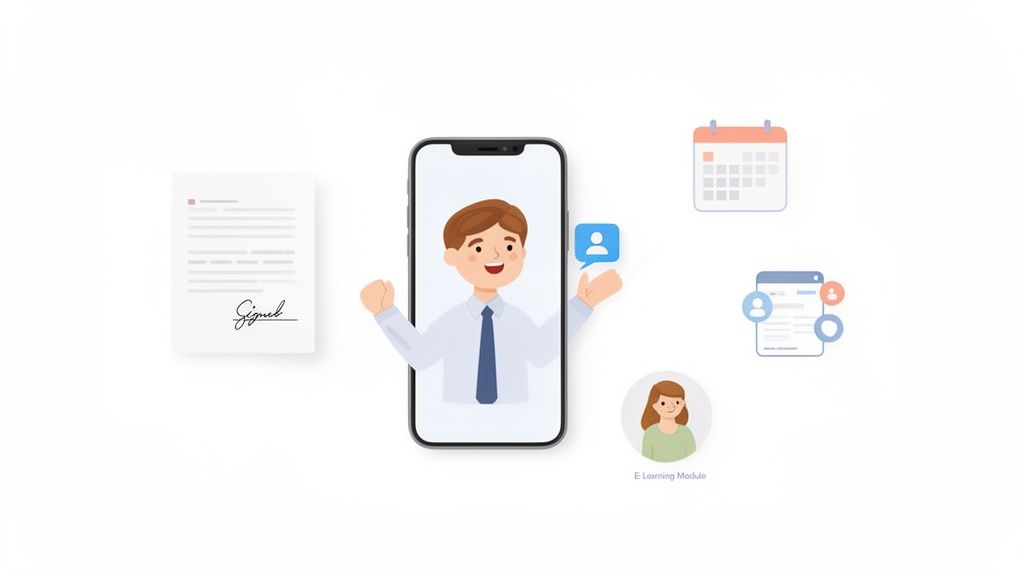
A quick adjustment is great, but the real success only comes afterwards. A positive introduction to the company binds new employees from the very first moment and has been proven to reduce fluctuation during the probationary period. This is exactly where it will be digital employment contract to the perfect starting point. It is much more than just a signature - it is the trigger for an automated and, above all, appreciative onboarding process.
As soon as the contract is signed digitally, you can take the next steps immediately. Instead of leaving the person in the dark until the first day of work, you proactively provide them with all the important information. This turns passive waiting into an active and productive preparation phase.
From contract to preparation in one click
Imagine a wedding venue that hires a dozen new servers at short notice for the summer season. This used to mean pure stress on the first day of work: everyone arrived at the same time, had to be briefed and knew neither the processes nor the contact person.
With a digital workflow, this picture changes completely:
- Immediate information activation: Immediately after signing the contract, the new service worker receives information via an employee app like the one from job.rocks Access to a protected onboarding area.
- Important initial information: Here she will find initial operational details, a short welcome video from the team leader and the contact details of her direct contact person.
- Knowledge transfer in advance: The service standards of the location or the most important processes at an event are explained via links to short e-learning modules.
By giving new team members valuable information before their first day, you show appreciation and give them a confident start. They don't come as clueless newcomers, but as prepared colleagues.
The new waitress already knows who will be welcoming her on the first day, knows the dress code and perhaps even has an overview of the wine list. She feels welcome and taken seriously. This feeling is priceless and lays the foundation for long-term, motivated collaboration.
The benefits of automated onboarding
This automated start has clear advantages. You ensure that all new employees have a uniform and high level of information. Nothing gets lost anymore because a manager, in a stressful situation, forgot to pass on important information.
In addition, you relieve your managers on their first day of work. Instead of having to explain basic things over and over again, they can fully concentrate on getting to know each other personally and familiarizing themselves with the specific tasks. This way you don't just win digital employment contracts for faster hiring, but also create a smooth transition into the team. If you would like to learn more about how to create a structured If you're designing an onboarding process for new employees, read our detailed guide.
Digital employment contracts: The most frequently asked questions from practice
When it comes to switching to digital employment contracts, the same questions arise again and again in practice. Here I will give you clear and direct answers, based on our experience, so that you can start the digitalization of your HR processes with confidence.
What type of electronic signature do I really need?
One is enough for the vast majority of employment contracts in Switzerland Advanced Electronic Signature (FES) completely out. The law does not prescribe any special form for the normal employment contract. This means: A FES is secure, legally enforceable and offers the perfect balance between security and ease of use - for you and your new employees.
A qualified electronic signature (QES) is only required by law for very few exceptions. These include, for example:
- Apprenticeship contracts
- Staff leasing contracts
- Post-contractual non-competition clauses
Modern platforms like job.rocks integrate established signature services that meet these standards as standard. This means you don't have to worry about the technology and you're always on the safe side legally.
How quickly can I introduce digital employment contracts?
The purely technical introduction often goes surprisingly quickly. If you rely on an integrated platform like job.rocks, the basic setup is common within a single day completed.
Most of the work usually lies in adapting your own internal processes. You have to digitize your existing contract templates once and define the new, faster process for your team. But don't worry: with the right support and clear templates, you can often send your first digital employment contracts within a week.
Is my data and that of my employees safe?
Yes, absolutely. Security and data protection (GDPR) are top priorities for professional providers. Make sure that the platform of your choice operates its servers in Switzerland or the EU and that all data transfers are fully encrypted.
Reputable tools like job.rocks are not only GDPR-compliant, they also document every single step of the signature process. In the end, this digital protocol gives you even more security and evidentiary value than a classic paper document in a filing cabinet.
The contracts are not only stored securely, but the entire process can be traced at any time. Everyone can see who opened and signed the document and when. This transparency protects you and your employees alike. The times when important documents were lost or couldn't be found are finally over. With the right solution for digital employment contracts, you can concentrate fully on what’s important: set faster.
Ready to speed up your hiring and scheduling processes? job.rocks offers you the integrated platform to control everything from a single source, from the availability query to the digital contract to deployment planning. Find out more now at job.rocks.