
Employment Contract Template Switzerland: Your Sample for 2026
Download our employment contract template Switzerland. Customize the free 2026 sample with instructions for OR obligations, probation period, working hours & termination.
You might be sitting right now in front of an open Word document, holding a confirmation from a new employee, and want to send out the contract today. At the same time, you don’t want to be arguing in two months about holidays, working hours, or salary components just because the template was too brief or too general.
This is exactly where a useful employment contract template Switzerland differs from a document that will cause you trouble later. Especially for temporary assignments, freelancer-like models, shift work, or on-call work, a standard template often isn’t enough. You need a contract that fits real everyday work. That means adapting to changing work locations, digital time tracking, last-minute schedule changes, and clean salary preparation.
Table of Contents
- Your Path to a Legally Secure Employment Contract in Switzerland
- The Cornerstones of Your Employment Contract According to OR
- Correctly Regulating Probation Period, Working Hours, and Termination
- Fairly Defining Salary, Social Insurances, and Holidays
- Special Cases and Important Additional Clauses
- Avoiding Common Mistakes and Downloading the Template
Your Path to a Legally Secure Employment Contract in Switzerland
In Switzerland, oral employment contracts are valid. However, written form is clearly recommended because it avoids legal uncertainties. This follows from Art. 319 OR on the SECO website.
In everyday practice, I see the same trap repeatedly. Employers quickly discuss workload, work location, and salary over the phone, then send some template afterwards and believe everything is settled. Later it turns out that the workplace was unclear, allowances are missing, or nobody knows if overtime is paid out or compensated.
With flexible work models, this happens even faster. An event worker sometimes works in Zurich, sometimes in Bern. A cleaner steps in at short notice. A freelancer is practically integrated into the company like an employee. When such constellations are regulated with a general template, gaps arise.
Practical rule: Everything you want to manage cleanly later in the schedule, payroll, or employee app should be clearly named in the contract beforehand.
A good employment contract template Switzerland therefore achieves three things at once:
- It creates clarity about role, assignment, salary, and holidays.
- It protects you better in case of conflict than oral promises or chat histories.
- It fits the company instead of just a fixed-office job.
Practical example: You hire a service employee for a wedding venue. If the contract only says “service staff,” too much is missing. You need a clear description of the role, possible assignments at changing locations, workload, rules for weekend shifts, and the type of salary payment. Otherwise, you’ll be renegotiating almost every point later.
The right way is simple. Start with a solid template, then check every clause against your real workday and remove everything you can’t actually implement. Contracts rarely fail due to missing text. They fail due to unclear or incorrect wording.
The Cornerstones of Your Employment Contract According to OR
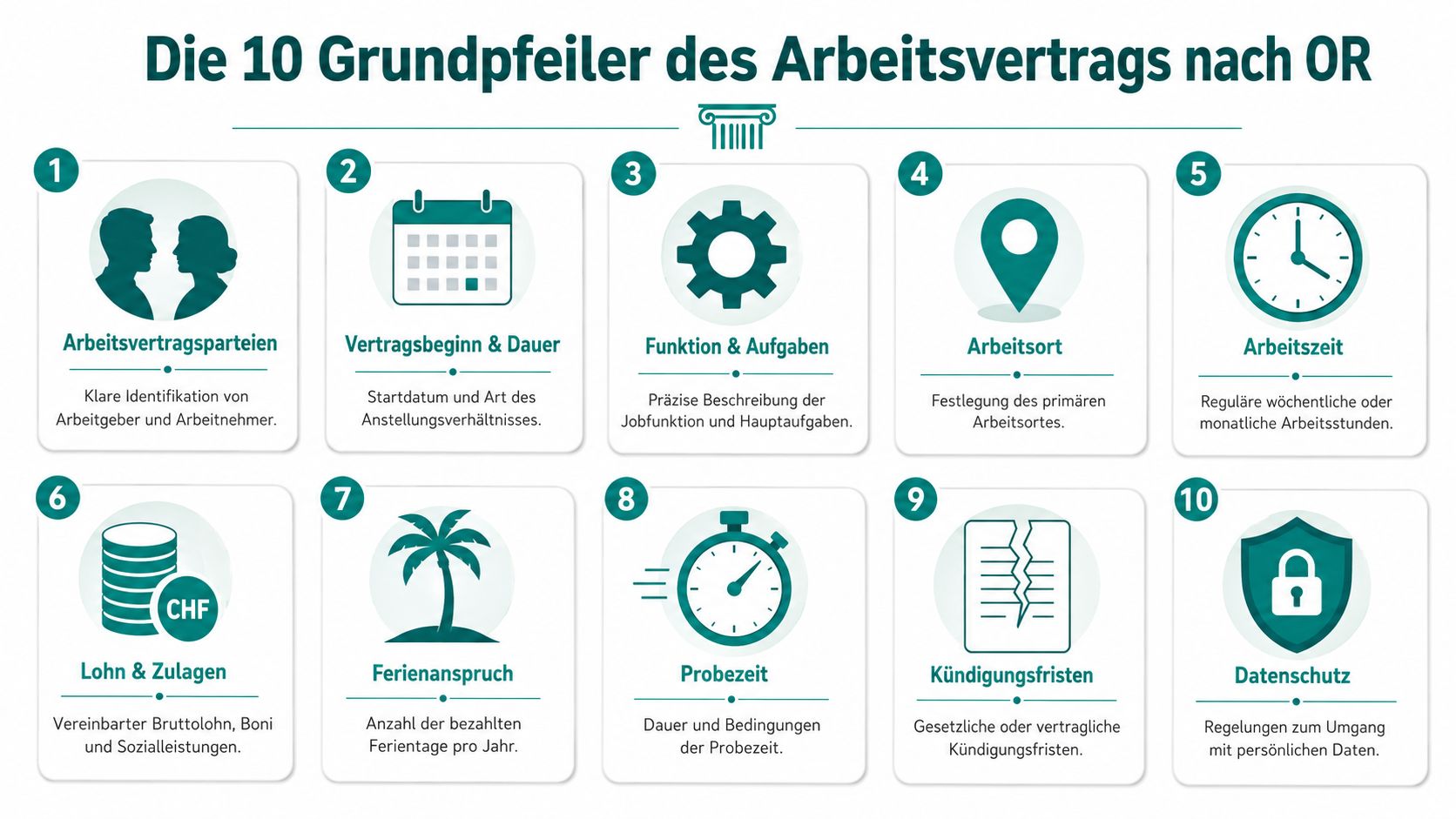
A legally secure contract doesn’t live from nice wording but from complete information. According to Alpinum Accounting, the success rate of legally secure contracts is 98% when 10 core points are explicitly regulated.
What Belongs in Every Template
The following points belong in every employment contract template Switzerland. Not as a formality, but with real content.
-
Contracting Parties
Names and addresses of both sides must be correct. Sounds trivial but is often handled carelessly with group companies or branch structures. -
Start and Duration
Is the contract fixed-term or indefinite? For project work, you must state this clearly. “From now until further notice” is not a good idea for fixed-term assignments. -
Role and Scope of Duties
Don’t just write “event staff.” Better is, for example: support with setup, guest care, teardown, and simple logistics tasks. This leaves enough room without becoming arbitrary. -
Workplace
Especially for agencies, gastronomy, or security services, this is sensitive. If changing work locations are possible, this must be stated in the contract. -
Working Hours or Workload
A fixed workload, a range, or an hourly model must be clearly identifiable. If missing, disputes arise about expectations and availability. -
Gross Salary with Allowances and Deductions
The gross amount belongs here. Night allowances, hourly wages, flat rates, or other salary components must also be clearly regulated. -
Holiday Entitlement
Holiday entitlement must be explicitly included in the contract. Adding it later is unnecessarily risky. -
Probation Period
Many templates mention it but without a clear duration or termination rule. Then what you may have assumed internally does not apply. -
Notice Periods
This clause often decides peace or drama only in case of conflict. Therefore, it must be cleanly and understandably formulated. -
Final Provisions and Data Protection
This covers applicable law, jurisdiction, written form for changes, and handling of personnel data in the company.
Where Standard Templates Fail
Poor templates are usually too general. They look complete but leave open exactly the points that become relevant in everyday work.
Typical example from shift work: The contract states “workplace is company headquarters.” In reality, the person works almost exclusively externally at event locations. Then the template is not wrong but unusable.
If your company works with changing assignments, the contract must reflect this mobility. Otherwise, the paper does not fit reality.
Another example: You hire someone part-time for cleaning and care services. If the contract only says “part-time as needed,” that’s too little. You need at least a clear description of the activity, possible working times, and salary logic. Otherwise, you’ll be renegotiating with every last-minute schedule change.
A good template doesn’t save you time at the start by being brief. It saves you time later by preventing misunderstandings.
Correctly Regulating Probation Period, Working Hours, and Termination
When a contract later fails, it’s often due to three areas: probation period, working hours, and termination. You must formulate these clearly because these topics come up regularly in everyday work.

When It Doesn’t Work Out in the First Weeks
You hire an employee for event logistics. After two assignments, you notice that although motivated, they seem overwhelmed by pace, material handling, and team coordination. If the probation period is correctly regulated in the contract, you can react quickly and cleanly.
According to Vitamin B with sample employment contracts, the probation period may last a maximum of 3 months. If no regulation exists, 1 month applies automatically. During this time, both sides have a 7-day notice period.
This is no small matter. Many employers believe their internal practice applies if no explicit clause exists. That’s not true. What’s not regulated follows the law.
If you want to delve deeper into termination during this phase, see the article on Termination During the Probation Period.
Never write the probation period only as a heading in the template. Always state duration and notice period explicitly.
Working Hours in Shift Work and Changing Assignments
This quickly becomes unclear in flexible companies. A contract says “working hours according to schedule.” Done. That is often not enough.
Better is a combination of a fixed base and operational flexibility. An example from a catering agency:
- Clearly state workload as a monthly or weekly range
- Specify assignment windows such as weekdays, evenings, or weekends
- Regulate overtime by payment, compensation, or mixed model
- Define time tracking via app, punch system, or timesheet
If you organize shift work, the contract should also state that start and end times of assignments may vary depending on the order. This prevents disputes if an assignment starts earlier or lasts longer due to teardown.
Practical example: A hostess is hired for trade fairs. The contract only states “working hours 40%.” Later, the company expects early shifts and weekends. The employee feels overwhelmed because this flexibility was never documented. The conflict could have been avoided with two precise sentences.
Termination After the Probation Period Without Chaos
After the probation period, you need a different logic. Then not only flexibility but predictability counts.
Notice periods are graduated in the OR. After at least one month of employment, the period is 1 month, after 2 years 2 months, and after 9 years 3 months, unless otherwise regulated. These details come from the verified contract requirements for Switzerland mentioned above.
For you, this means: write the contractual termination rule clearly and without contradictions. If you refer to a collective labor agreement, that reference must also be clean. Half-adopted templates from the internet are especially dangerous here because they often include notice periods that don’t fit your company.
A good formulation principle is simple:
- Regulate probation period separately
- Regulate notice periods after separately
- Only include deviations if you have really checked them
Practical example from a security service: An employee with changing night shifts resigns. The contract lacks clear information on notice period and last assignment day. The dispatcher continues scheduling them; the employee assumes only a few shifts remain. Such friction almost always arises from imprecise contract clauses, not bad will.
Fairly Defining Salary, Social Insurances, and Holidays
Salary immediately reveals whether a contract is professionally made. As soon as unclear amounts, missing allowances, or incorrect holiday rules appear in the document, payroll becomes tedious. And tedious quickly becomes expensive.
Gross Salary Belongs in the Contract, Not Net
The contract must state the gross salary, not the net salary. This is especially important for part-time, hourly wages, and on-call assignments because deductions vary by person and situation.
A clean formulation includes at least these points:
| Criterion | Regulation |
|---|---|
| Gross Salary | Explicitly state as monthly or hourly wage |
| Payment | Specify timing and method of salary payment |
| Allowances and Deductions | Clearly name components |
| Holidays | Properly reflect statutory entitlement |
For calculation, an external view on realistic hourly rates often helps. For example, when comparing in private household or cleaning environments, the overview on Cleaning Lady Hourly Wage Switzerland is useful because it helps you better classify typical market logics.
For concrete salary views at employee level, a calculator is useful. With the article on Calculating Net Salary, you can check how gross, deductions, and payout amount relate.
Practical example: You verbally agree with a service worker on “CHF X net per hour” and only enter the same net amount in the contract. Later deductions or insurance issues change, and suddenly you argue about the real salary basis. With a gross salary, the matter would have been clear from the start.
Properly Reflecting BVG, Illness, Accident, and Holidays
For the pension fund, you don’t need an estimate but a clear threshold. According to SECO on registering employment and payroll, from 2026 onwards mandatory BVG registration is required if the annual gross salary exceeds 22,680 francs and the employment is indefinite or lasts longer than three months. If the salary is below this, no mandatory registration exists.
This is relevant for small service providers. A temporary helper for individual assignments is often treated differently than a regularly employed part-time worker.
Holiday entitlement must also be clearly included in the contract. By law, 4 weeks of holiday apply from age 20 and 5 weeks until age 20. You don’t have to elaborate on continued salary payment during illness and accident but must consider it correctly. Verified data states that in case of illness, continuation of payment occurs for at least 3 months after 1 year of employment and in case of accident for at least 12 months.
When it comes to money, a simple rule applies. If payroll needs to know something, it belongs in the contract beforehand.
Practical example with hourly wage: A young helper under 20 works in a gelateria. If you don’t properly reflect the statutory holiday entitlement, you either calculate incorrectly or pay later. Both are unnecessary.
Special Cases and Important Additional Clauses
As soon as you don’t write just a classic office contract, a standard template quickly reaches its limits. Temporary assignments, on-call work, freelancers closely linked to the company, or shift work with digital time tracking require additional clauses that really fit the work.
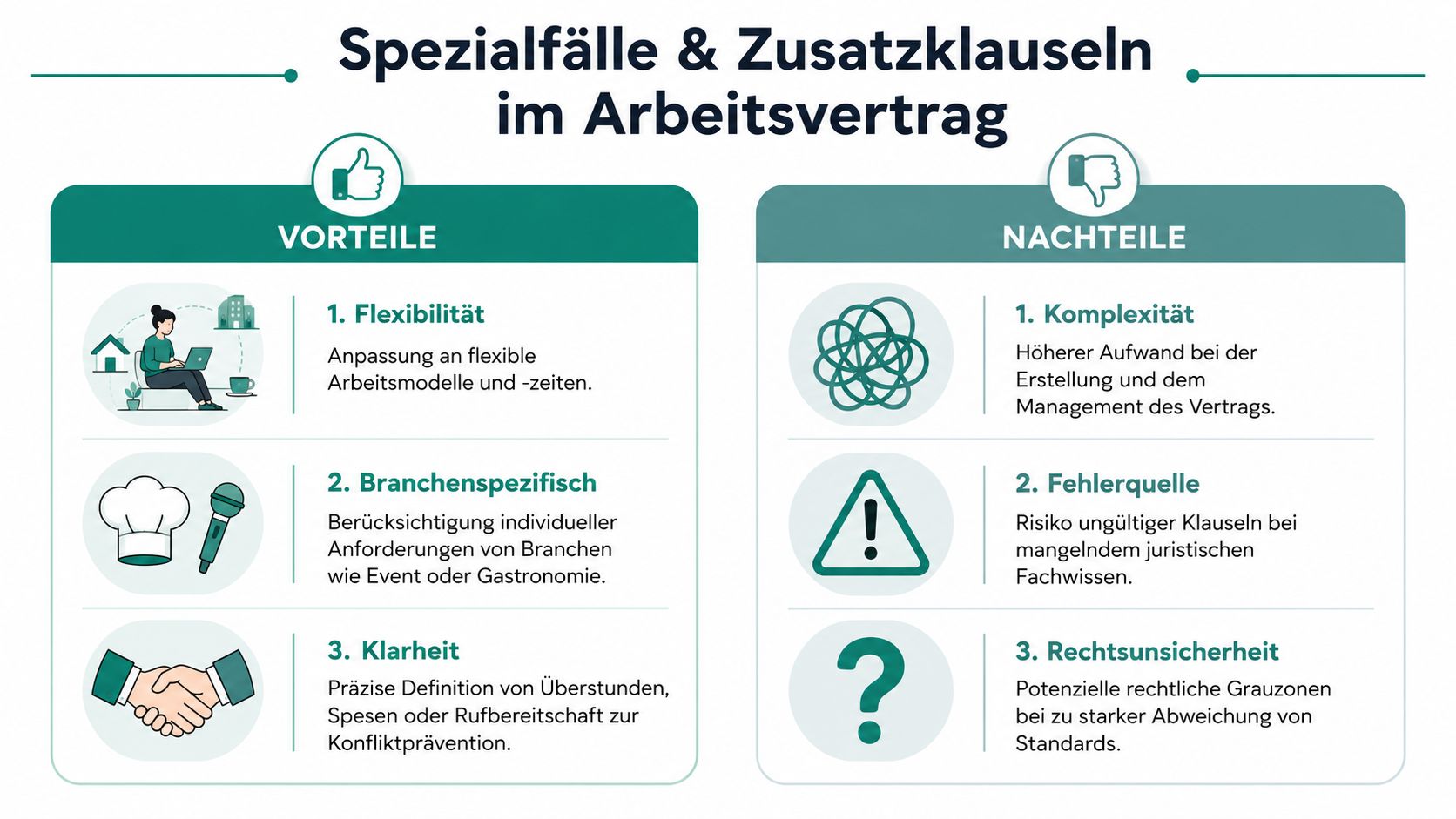
On-Call Contract, Temporary or Freelancer
These three models are often mixed up, although they mean something different in everyday life.
| Model | Fits When | Sensitive Clause in Contract |
|---|---|---|
| On-Call Contract | Assignments occur irregularly | Holiday compensation, assignment logic, minimum guarantee |
| Temporary Employment | Assignment is time-limited but as an employment relationship | Duration, workplace, termination logic |
| Freelancer | Person works independently and not like an employee | Distinction from real employment |
Holiday compensation is especially sensitive in on-call contracts. According to Treuhand Suche on on-call employment contracts, it must be documented as an ongoing surcharge, namely 8.33% for 4 weeks of holiday or 10.64% for 5 weeks of holiday. In 12% of standard templates in Switzerland, this is incorrectly or incompletely stated according to the same source. This later leads to salary claims.
Practical example: You employ trade fair staff on an hourly basis. If the contract only says “holidays included,” that’s not enough. The surcharge must be clearly stated. Otherwise, the clause is contestable.
If your company is subject to a collective labor agreement or you want to check which rules from an L-GAV apply to the contract, the overview on L-GAV Employment Contract helps you.
A freelancer contract does not replace an employment contract if you specify working hours, provide tools, and manage the person like a team member.
Additional Clauses for Digital HR Processes
Many companies today work with digital scheduling, time tracking, and employee apps. The contract should reflect these processes.
Useful are clear clauses on the following points:
- Digital time tracking via app, terminal, or web access
- Assignment communication via defined channels instead of private chats
- Data usage for scheduling, payroll preparation, and documentation
- Confidentiality regarding customer lists, event data, or internal processes
- Non-compete clause only where really necessary and enforceable
Practical example from care placement: Employees receive assignments via a digital system, report availability via mobile, and record hours immediately after the shift. Without a clean contractual basis, you’ll later argue whether an app notification was binding or handwritten reports take precedence.
In event agencies, I often see a second mistake. The contract is silent on expenses, on-call duty, or last-minute reassignments between locations. Then people try to solve such rules via PDF manuals or group chats. That only works as long as nobody objects.
Avoiding Common Mistakes and Downloading the Template
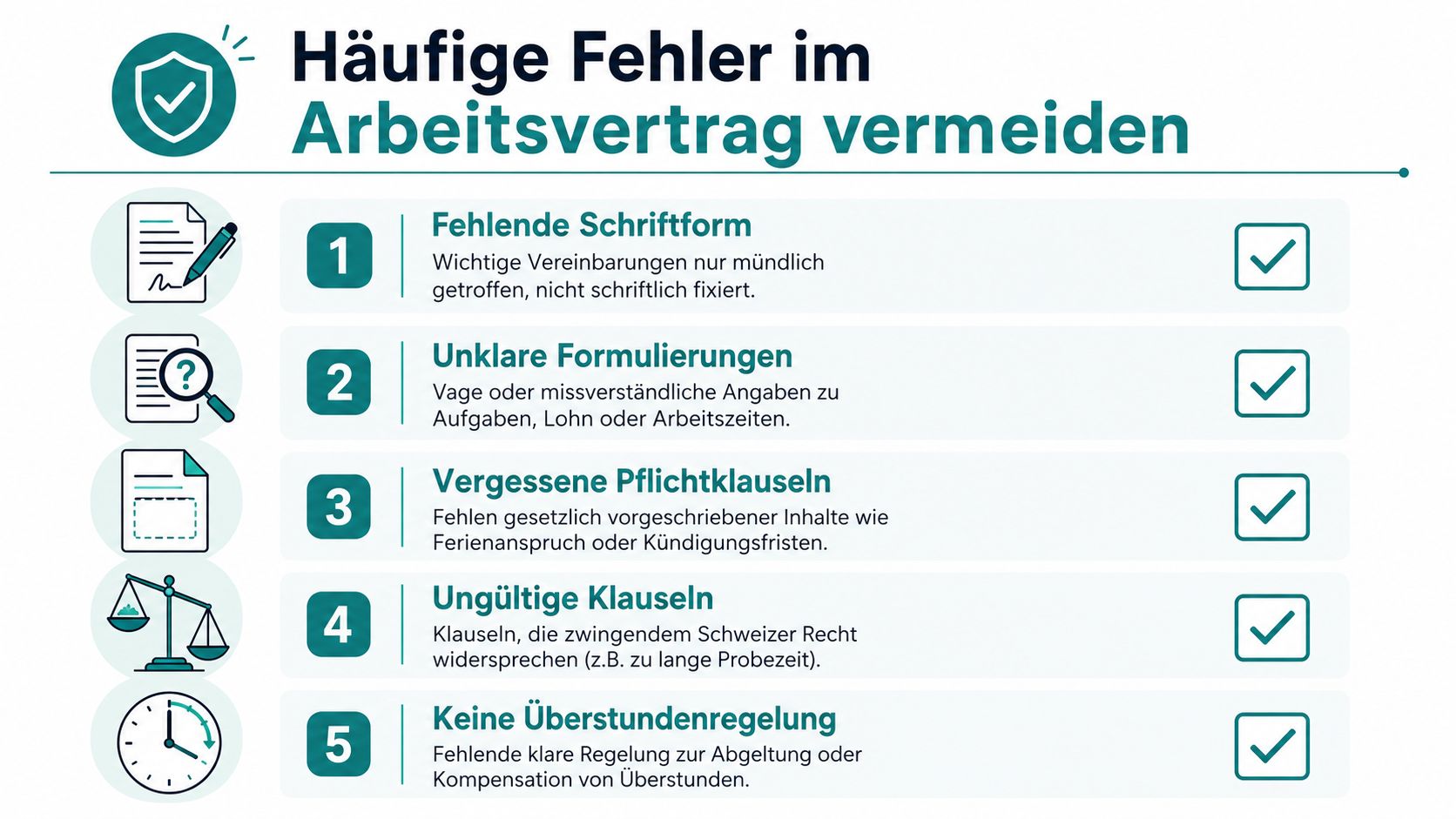
Most costly contract mistakes are not complicated legal questions. They are carelessness. A half sentence is missing, a net salary is entered, holidays for hourly wages are mentioned vaguely, or oral promises remain outside the contract.
Final Checks Before Signing
Before sending out an employment contract template Switzerland, quickly go through these points:
- Is everything written really in the contract and not just in emails or chats?
- Is the salary regulated as gross and are allowances clearly named?
- Are role, workplace, and working hours concrete enough for your real company?
- Is it clear for flexible assignments how on-calls, shifts, or hours are recorded?
- Do additional clauses really fit practice or were they just copied from another template?
Practical example: An agency adopts a template from the internet and leaves the clause “workplace is company headquarters.” In reality, all promoters work almost exclusively externally. The problem only becomes apparent when someone interprets travel times, assignment shifts, or availability differently than dispatch.
This video shows you additional points to watch for when drafting contracts:
Why a Clean Template Saves Money
A good template is not office formalism. It saves queries, reduces corrections in payroll, and creates a fair basis for both sides.
If you deploy employees flexibly, the contract must have the same clarity as your schedule. Otherwise, every schedule change becomes a special case. That makes personnel management unnecessarily difficult.
Take time once for a clean version. Remove empty phrases, add operational reality, and check every clause against everyday life. Then a simple template becomes a contract you can really work with.
If you want to not only regulate flexible teams, shift work, or changing work locations cleanly in contracts but also manage them better in everyday life, take a look at job.rocks. The platform helps you bring availability, scheduling, time tracking, and payroll preparation together in one system so that contract and practice finally fit together.