
Event Jobs Switzerland: Find, Earn, and Plan
Event Jobs Switzerland. Here you find all event jobs in Switzerland: typical roles, hourly wages, contracts, platforms, and tips for your application.
You are looking for a side job at a festival, trade fair, or catering assignment but don’t want to find out only shortly before your shift where you need to show up and how your wage is calculated. This is exactly where good event jobs in Switzerland differ from last-minute assignments without clear procedures. You need a suitable role, a clear contract, reliable information about working hours and pay, and an application process that fits your availability.
The demand is visible nationwide. On jobs.ch, there were recently 3,050 open event jobs reported for Switzerland, including 796 in Zurich, 352 in Bern, and 122 in St. Gallen. These numbers are search results, not a guarantee for a single assignment, but they show that event staff is sought in several regions (jobs.ch Event Jobs Switzerland). As an additional marketplace for flexible assignments, you can register early on job.rocks, complete your profile, and enter your available days.
Table of Contents
- What a Typical Event Job in Switzerland Looks Like
- The Most Common Types of Event Jobs
- What Hourly Wage You Can Expect
- Contracts, Insurance, and Permits Under Control
- Where to Find Event Jobs in Switzerland
- How to Successfully Apply for Event Jobs
- How Agencies and Organizers Fill Positions Quickly
- Your Next Step with job.rocks
What a Typical Event Job in Switzerland Looks Like
Saturday evening at a festival: Hosts check tickets at the entrance, service staff hand out drinks in the catering area, and a stagehand brings materials to the right place behind the stage. A runner shuttles between the warehouse and the venue while the operations management handles last-minute questions. Your workday often doesn’t start with the first concert but with briefing, setup, or a security check.
An event job is usually temporary and assignment-based. You work on weekends, evenings, or specific weekdays. Some shifts last only a few hours; others combine setup, public operation, and teardown. Pay is often calculated hourly. Before accepting, you should clarify when working hours start, whether breaks are paid, and when payment will be made.

Practical rule: Never confirm only the event name. Have the location, meeting point, shift time, dress code, and contact person sent to you in writing.
For your first assignment, weatherproof clothing, sturdy shoes, and a charged smartphone are basic equipment. If you work at the entrance, you need a friendly demeanor and concentration. For setup, physical endurance, punctuality, and safe handling of materials are important. The following sections show you which roles are common, what wage information is actually published, and where to look closely at contracts and insurance.
The Most Common Types of Event Jobs
Event jobs in Switzerland are not only divided into project management and marketing. A large part of the assignments take place directly at the event location. You work there with guests, materials, technology, food, or security procedures.
| Job Type | Requirements | Typical Venue |
|---|---|---|
| Host, Hostess, and Entrance | Friendly demeanor, good language skills, careful ticket or guest control | Trade fair, congress, corporate event |
| Setup Helper, Runner, and Stagehand | Physical endurance, punctuality, safe handling of materials | Festival, concert, sports event |
| Service, Bar, and Catering | Experience in guest contact, hygienic work, resilience | Banquet, festival, hotel, catering |
| Promotion and Sampling | Open communication, neat appearance, independent work | Shopping center, trade fair, city center |
| Lighting, Sound, and AV | Technical experience, relevant expertise, safety awareness | Concert, conference, stage |
| Crowd Management and Medical Service | Depending on task, appropriate training or course certificate | Open air, sports event, large event |
At the entrance, an assignment may require German, French, Italian, or English. At a congress in Geneva, your multilingualism counts differently than at a festival setup in the German-speaking part of Switzerland. For technical roles or medical services, certificates may be required. For security tasks, ask before accepting who issued the contract and which permit is required.
The venue also changes daily work. Trade fairs in Basel and Geneva, corporate events in Zurich, open airs in the Romandie, and sports events in the mountains have different working hours and requirements. Therefore, read the job description completely. An ad for “event staff” can mean reception, service, logistics, or teardown.
What Hourly Wage You Can Expect
The hourly rates published on Swiss event job portals vary by role. Reported are CHF 28 to 34 for event helpers, CHF 32 to 42 for hosts and hostesses, CHF 36 to 48 for promotional staff, and CHF 48 to 65 for team leaders (Hourly wages for event staff). These values are guideline ranges, not automatic guarantees for your assignment.
| Role | Hourly Wage CHF | Influencing Factors |
|---|---|---|
| Event Helper | 28 to 34 | Tasks, physical work, experience |
| Host or Hostess | 32 to 42 | Language, reception experience, dress code |
| Promotional Staff | 36 to 48 | Product knowledge, communication, type of assignment |
| Team Leader | 48 to 65 | Responsibility, briefing, on-site leadership |
A higher rate can be linked to more responsibility. A team leader coordinates staff and reports absences, while an event helper moves materials or assists guests. For promotion jobs, it may also matter whether you report independently and implement client specifications correctly.
Always compare the gross wage with the expected payout amount. Vacation pay, social security deductions, withholding tax, and possible bonuses can change the net amount. Also ask about minimum duration, breaks, night work, and the timing of payment. A seemingly high hourly rate is of little use if working time and billing remain unclear.
Contracts, Insurance, and Permits Under Control
Before your first assignment, you should receive a written contract or a clear assignment confirmation. It should include the contracting parties, your task, the venue, date and duration, hourly wage, payment deadline, vacation entitlement, and any notice periods. Check whether the stated time includes only public operation or also briefing, setup, and teardown.
In Switzerland, on-call work is distinguished between genuine and non-genuine on-call work. For genuine on-call work, you must be available on call, and the employer owes a standby wage for the standby time. For non-genuine on-call work, each assignment is agreed upon anew without standby pay. If you are to remain available for a trade fair week, the contract must clearly answer this question (Event staff and costs in Switzerland).
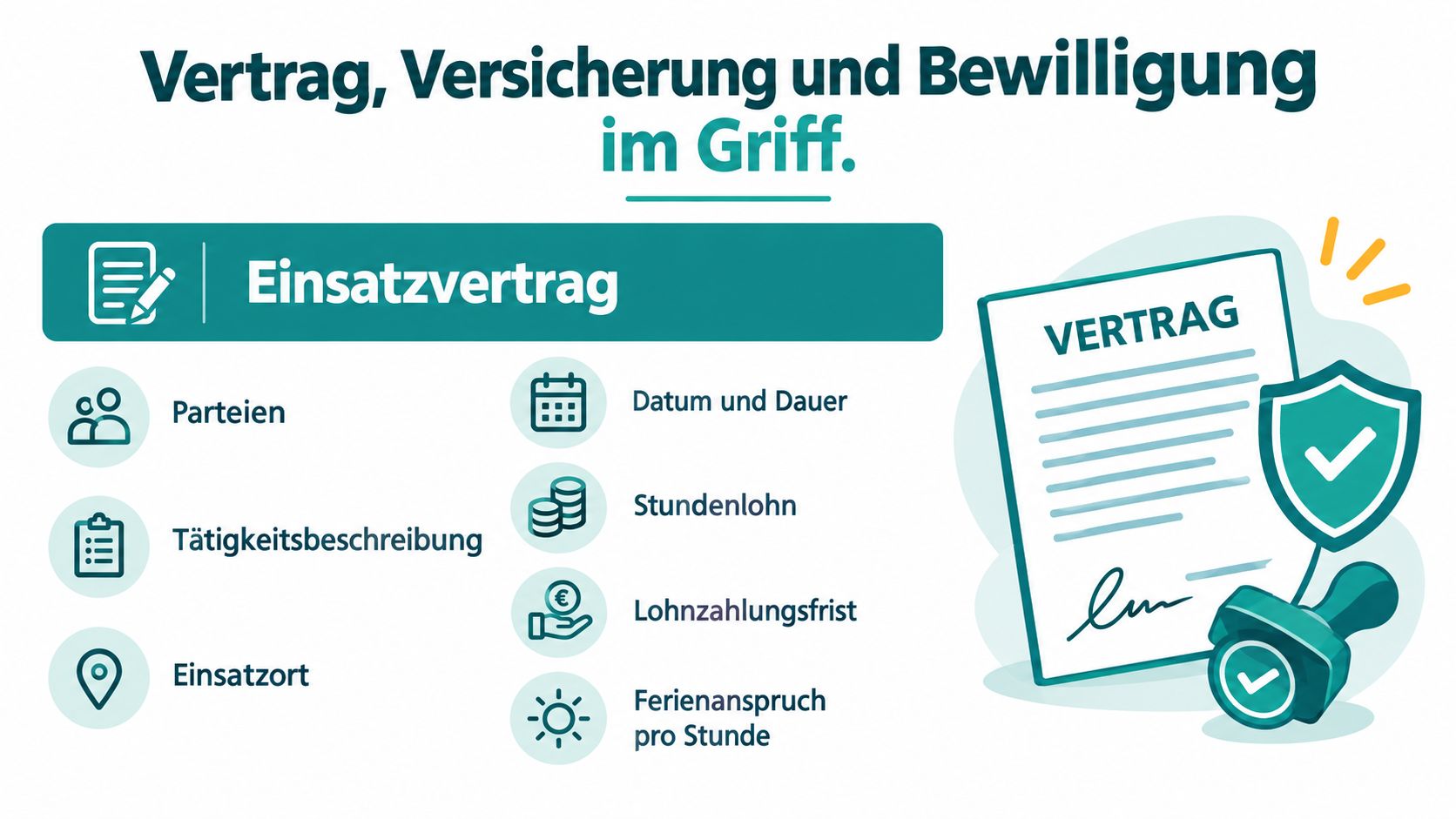
Points to Check Before Accepting
- Social insurances: AHV, IV, EO, and ALV should be correctly accounted for. Accident insurance according to UVG applies for work accidents via SUVA or a private insurer.
- Illness: Ask about daily sickness benefits insurance and the applicable rules for short-term employment.
- Pension fund: A BVG insurance may apply from the relevant minimum wage. Have it explained whether your assignment falls under this.
- Withholding tax: If you do not have a C permit, withholding tax may be deducted. Your rate depends on your personal situation.
- Foreign assignments: For multi-day assignments abroad, you usually need an A1 certificate.
- Event permits: Food stalls, alcohol sales, and noise protection at open-air events usually concern the organizer. You can still ask who is responsible.
A clear overview of labor law basics can be found in the L-GAV and Employment Contract. If the employer refuses to provide a written assignment confirmation or asks you for money for the application, you should keep your distance.
Where to Find Event Jobs in Switzerland
You have three reputable ways. Specialized platforms show individual assignments and can display availabilities, profiles, or direct inquiries. Staffing agencies often handle preselection, contracts, and payroll. Direct applications to organizers, caterers, congress centers, or stadiums can be worthwhile but require more initiative.
| Channel | Strengths | Limitations |
|---|---|---|
| Event Staffing Platform | Fast search, profile details, matching assignment dates | Check quality of ads and conditions |
| Staffing Agencies | Contract, social insurance, and payroll from one source | Selection may be limited, provider calculates costs |
| Direct Organizer | Direct contact, chance for recurring assignments | More administration and own search |
| Professional Groups and Networks | Tips on stagehand, catering, and promotion jobs | Carefully check identity and client |
For a first search, you can check Eventjob.ch, staff.events, crew-board.ch, LinkedIn, catering job portals, and regional groups. A profile on job.rocks for event workers can be another option if you want to combine flexible assignments with availability and role details. For general tips on entering the job market, the Guide to Entry-Level Salary with AI Recruiting can be supplementary reading. It does not replace Swiss wage or contract checks.
For direct contact, ask for the company name, venue, client, and payroll details. Use official event pages for dates, organizers, and application procedures. A general ad on a portal does not prove that the provider is an official recruiting partner of a specific festival.
How to Successfully Apply for Event Jobs
A complete profile saves follow-up questions. Upload a current photo, list your languages in German, French, Italian, and English, and state whether you can travel by car, train, or bike. Available days and regions should be placed prominently, not buried in a hard-to-find resume.
Your previous experience does not have to come from an event agency. Work in a bar, with a club, at a scout camp, or at a sports event can be described concretely. Write “guest contact and serving at club events” rather than just “service experience.” References from catering, security, or stage help for roles where the client relies on short training.
Your Preparation Before the Shift
- Clothing: Clarify the dress code. A black or black-and-white outfit, sturdy shoes, and weatherproof extra clothing cover many assignments.
- Documents: Take ID, social security number, and if necessary, withholding tax rate information.
- Travel: Plan the meeting point with a time buffer and notify the contact person immediately if delayed.
- Communication: Read briefing and assignment details completely before accepting.
- Follow-up: A short thank-you message with a note about your next available days keeps the contact open.
Availability must be accurate. Confirm only shifts you can actually reach. A reliable profile with clear information is usually more valuable to event teams than a long application without concrete assignment dates. Tips for good communication between applicants and employers can be found in the Recruiting Guide.
How Agencies and Organizers Fill Positions Quickly
A trade fair hall needs different staff than a concert. Still, staffing for both starts with the same information: role, date, location, language, qualification, and available time. If these fields are missing, operations management calls many people and still gets no reliable commitment.
A well-maintained personnel pool can filter profiles by region, role, and qualification. The agency then sees who is suitable for service, bar, logistics, entrance, or setup. The organizer creates shifts, sends requests, and consolidates rejections or swap requests in one place.
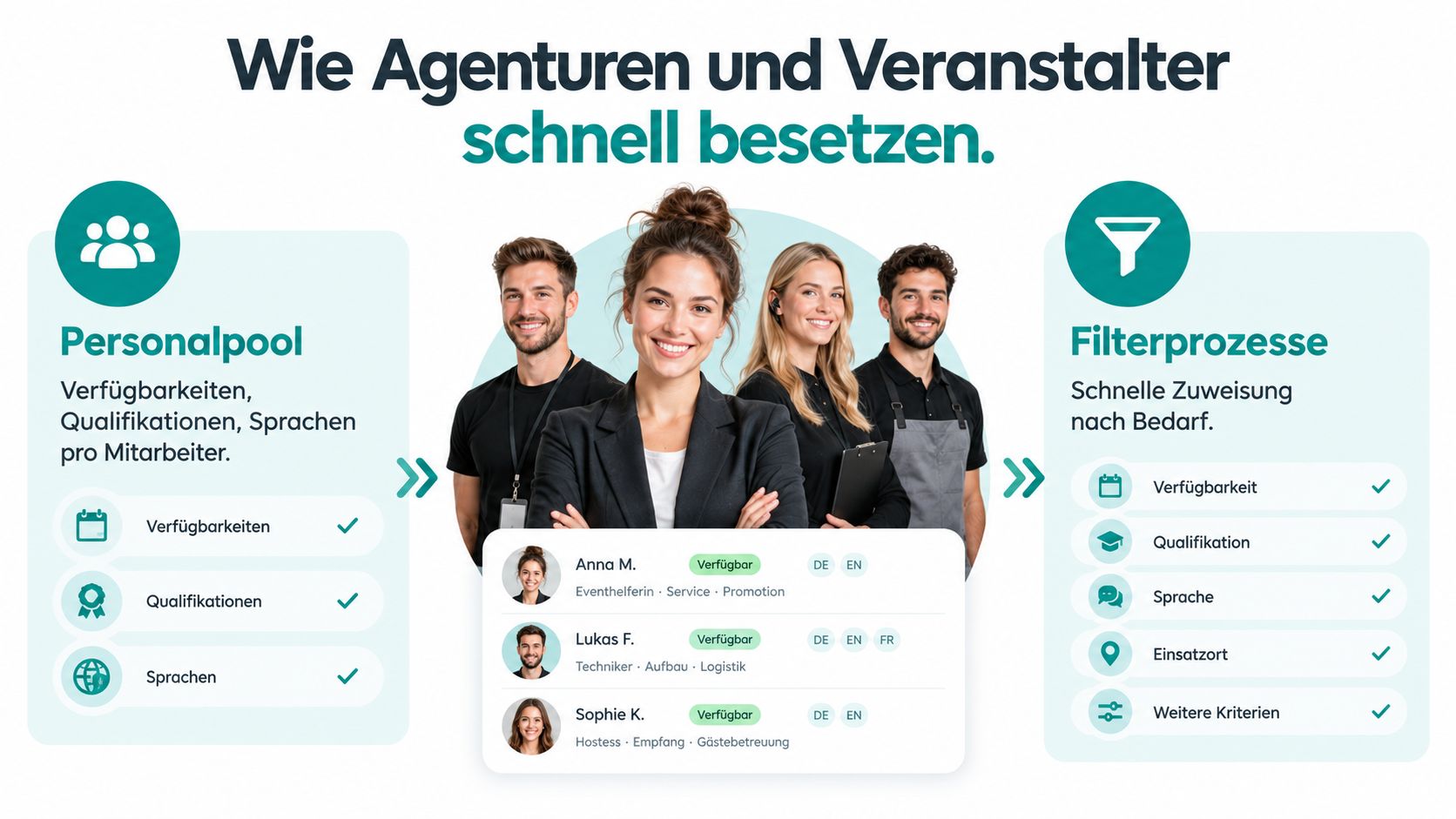
What Counts in Everyday Work
- Before the event: Define shifts, meeting points, clothing, and minimum requirements in writing.
- For last-minute absences: Maintain a separate replacement list instead of repeatedly contacting the same people simultaneously.
- During the assignment: Record clock-ins and outs as well as breaks promptly.
- After the event: Check hours and hand over data cleanly to payroll.
job.rocks can represent personnel pools, availability queries, role and qualification filters, shift planning, notifications, mobile assignment details, time tracking, and an export for payroll preparation as a platform for such processes. The specific use depends on the respective employer and their setup. More on handling shortages can be found at solving missing event staff.
Your Next Step with job.rocks
A good profile often decides whether a suitable request reaches you. Therefore, enter region, languages, desired roles, and your current availability. Document experience in security, technology, catering, or logistics with appropriate certificates.
Checklist for Your Profile
- Select role: Choose service, bar, entrance, promotion, logistics, setup, or teardown.
- Specify region: Enter cantons and locations you can reliably reach.
- Maintain time windows: Update free days and block unavailable dates.
- Add certificates: Upload certificates or references if they fit the desired role.
- Read assignment details: Check meeting point, shift, clothing, task, and contact person before accepting.
- Report hours: Verify recorded working times and report deviations early.
For agencies and organizers, personnel pool, shift planning, and time tracking belong together. Roles like service, bar, logistics, or setup can be managed separately. Employees update their availability, see assignment details on mobile, and depending on setup, process confirmations, rejections, or swap requests digitally. Qualifications and languages help employers filter suitable profiles before an inquiry.
Check before every acceptance who your employer is and what contract conditions apply. job.rocks supports workforce management and assignment planning but is not automatically the organizer of a festival and does not confirm any official partnership with a specific event.
Those who want to work short-term or build a fixed pool for recurring assignments can register via job.rocks. A complete profile increases the chance of suitable requests but does not replace checking assignment conditions.
With job.rocks you store profile, availabilities, and event roles in one place. Register, check the specific details, and use the platform as an additional way to flexible event jobs in Switzerland.