
Festival Jobs Switzerland: Your Guide to Providers
Festival Jobs Switzerland: Learn about the roles available, how to apply, and which Swiss platforms offer you flexible assignments.
You wake up on Thursday morning on the Gurten, the first delivery vans are arriving, and someone is still looking for a person for entrance control. Or you signed up for a bar shift in Locarno and wonder if the working hours, pay, and contract are really clearly regulated. These are exactly the points that determine whether a festival job in Switzerland is a good side income or an unnecessary risk.
Festival jobs Switzerland are more than just a list of short-term job postings. You will find assignments in setup, logistics, gastronomy, ticketing, promotion, backstage, and guest services. This guide shows you which roles suit you, where to search reliably, what documents you need, and which questions to clarify before accepting a job. You can find an additional marketplace for flexible assignments by registering at job.rocks.
Table of Contents
- Why Festival Jobs in Switzerland Are Especially Attractive Now
- How the Swiss Event Landscape Is Structured
- These Role Families Are Really Hiring Staff
- Where to Find Reliable Festival Assignments
- How to Apply and Prepare
- Labor Law, Night Shifts, and Insurance
- Two Examples from Festival Everyday Life
- Your Next Step and a Look at job.rocks
Why Festival Jobs in Switzerland Are Especially Attractive Now
Festival work suits people who don’t want to be tied to a fixed workplace all summer. You can take on individual shifts, plan several weeks in a season, or get a taste of a new industry through event assignments. Students, commuters, career changers, and people with experience in gastronomy or promotion find different entry opportunities.
The Swiss event and trade fair industry was hit hard by the crisis. In 2020, revenue dropped by around 57 percent to 2.37 billion Swiss francs, while the number of companies fell from 1,250 in 2019 to 1,030 in 2020. Employment decreased from 23,000 to 18,540 employees, with around 4,460 jobs lost, as shown by the industry survey on the Swiss event and trade fair sector.
Why Flexible Assignments Work Well
Festival teams rarely plan with just one fixed workforce. The demand changes depending on setup, opening, concert operation, teardown, and visitor numbers. For you, this means a selection of short assignments but also changing working hours and less planning security than with permanent employment.
Cultural statistics show the broad base of such events. In 2018, Swiss concert, show, and festival organizers held around 1,900 events with 5.5 million attendees. For this, 374 full-time employees and over 22,500 volunteers were deployed, with an industry turnover of 382 million Swiss francs, according to the cultural statistics of the Federal Office of Culture.
So you don’t just get paid for individual shifts. You learn processes, make contacts with agencies and organizers, and can later switch to production, hospitality, technology, or event management. Tips can be added for bar and gastronomy assignments but should not be assumed as a fixed part of the salary.
How the Swiss Event Landscape Is Structured
Switzerland does not have a single festival job market. A large open-air festival operates with a different personnel model than a city festival, a jazz event, or a corporate event. The larger the venue and the longer the operation runs, the more roles are advertised separately.
Four Typical Event Types
- Large multi-day festivals: OpenAir St. Gallen, Paléo Festival Nyon, Gurtenfestival, Frauenfeld, Greenfield, and Moon&Stars need staff for several operational areas and shifts.
- City and cantonal festivals: Caliente, Zurich Pride, and regional festivals combine gastronomy, sales booths, entrance control, promotion, and traffic management.
- Niche events: Jazz, classical, and street music festivals often work with smaller teams but look for people with suitable language or specialist knowledge.
- Corporate and public events: Product presentations, sports events, and public celebrations often have a festival character, even if not called that.
The season starts for many teams with setup work in spring. Most open-air assignments concentrate on the warm months, while indoor and winter events create additional work opportunities. Still, don’t rely on a fixed seasonal pattern. The specific demand depends on the organizer, location, and role.
Who Employs You
Behind a festival is a professional organizer, an association, a municipality, or an agency. A small core team handles planning and responsibility. For individual shifts, temporary employees, personnel leasing companies, and helper pools are added.
Practical rule: Ask before accepting who your contracting party is. The festival site, the logo on the T-shirt, and your employer do not have to be the same organization.
These Role Families Are Really Hiring Staff
Not every job posting uses the same terms. An ad may say “event helper,” “crew member,” “promotion staff,” or “temporary support,” even though the tasks are very similar. Always check the activities, shift times, and contract.
Overview of Role Families
| Role Family | Typical Tasks | Requirements | Pay Range CHF/h |
|---|---|---|---|
| Setup and Teardown | Carrying materials, setting up tents and barriers, arranging furniture, clearing the site | Physical resilience, safety shoes, early or late shifts | No verified range available |
| Logistics and Infrastructure | Warehouse, runner, parking, goods flow, backstage transport | Reliability, orientation on site, sometimes driver’s license | No verified range available |
| Gastronomy and Bars | Serving drinks, buffet, cashier, service, restocking, cleaning | Hygiene, resilience, guest contact, minimum age depending on task | No verified range available |
| Ticketing and Guest Services | Checking tickets, accreditation, info booth, guidance, hostess tasks | Friendly demeanor, language skills, calm work under pressure | No verified range available |
| Security and Medical | Entrance control, crowd management, awareness, medical aid, fire protection | Depending on role: training, course, permit, or assignment via a specialist company | No verified range available |
Setup and teardown often offer the easiest entry because practical experience is more important than a long resume. For ticketing and guest contact, German, French, Italian, or English help. Security and medical tasks should only be taken on if the required certificates and responsibilities are clear.
Artist relations and backstage are also in demand. You take care of catering, hospitality, accreditations, or transport for artists. Such roles require discretion, good communication, and the willingness to calmly handle last-minute changes.
If you are also interested in assignments outside Switzerland, the Work and Travel Guide for Event and Festival Jobs offers another perspective on irregular working hours and mobile event work. For Swiss assignments, contract, workplace, and local rules remain decisive.
Where to Find Reliable Festival Assignments
The safest way is through a channel where you have a clear contact person and written conditions before your first working day. The sources differ by lead time, roles, and binding nature.
| Channel | Typical Lead Time | Suitable For |
|---|---|---|
| Official Organizer Websites | Often early in the season, varies by festival | Applications directly to the festival or its crew organization |
| Swiss Job Platforms | From long-term planned to short notice | Comparison of several regions and roles |
| Temp Agencies and Personnel Leasing | Also for short-term needs | Setup, logistics, gastronomy, and promotion |
| Community Channels | Often short notice | Last-minute shifts, with increased need for verification |
| Marketplaces like job.rocks | Depends on published assignments | Flexible day and week jobs with profile and availability |
With official festival sources, check if the site really belongs to the organizer and if contact, role, location, and application process match. Job platforms make comparison easier but do not replace your employer check. Be especially cautious with Facebook, Reddit, or Telegram groups if only a username and no company are named.
Swiss job portals show how short such assignments can be. Postings mention “temporary” and a specific assignment window, for example at Zürich Openair. Other ads explicitly describe event work as temporary assignments within a staff pool without permanent employment, as the festival job overview for Switzerland shows.
Current search results can also include tight time windows, for example from July 1 to 18, 2026 for the Montreux Jazz Festival, as the Indeed search for festival jobs in Switzerland shows. You should verify such details directly with the ad and organizer because availability and postings can change. Another overview of event jobs in Switzerland is available on the Job.rocks page for event jobs.
How to Apply and Prepare
A good application answers three questions immediately: What can you do? When are you available? For which tasks are you applying? A long resume helps less than a clear profile with concrete details.
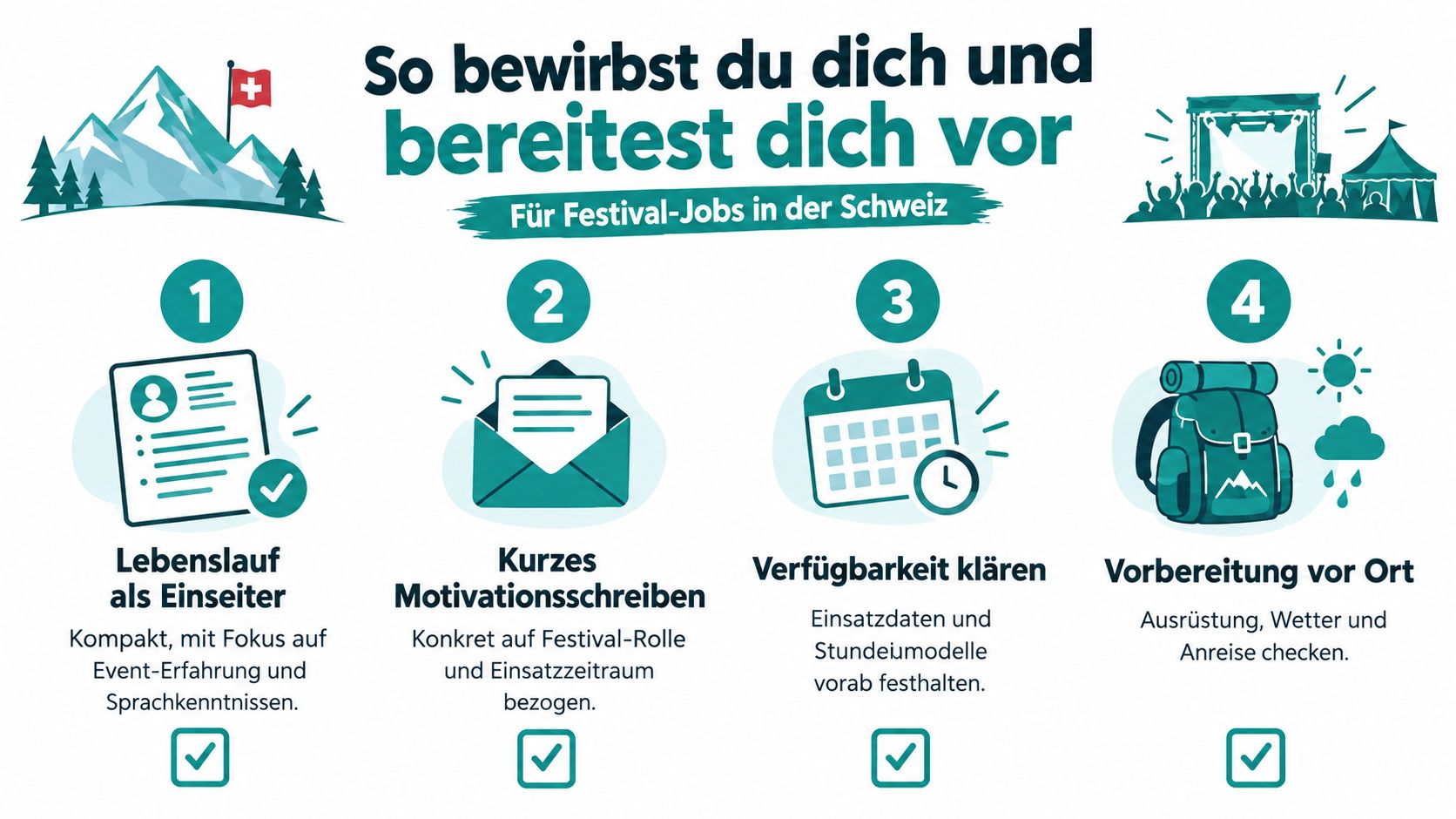
Your Application in Four Steps
- Create a resume: Keep your document compact. Mention event, gastronomy, warehouse, sales, or customer contact experience and list your languages. Adapt the language to the region; German, French, or English may be suitable depending on the assignment.
- Brief motivation: Write directly why you want to take the role and on which days you are available. A possible text is: “Hello, I am looking for a temporary festival assignment in bar or entrance control. I have experience in guest contact, work reliably in changing shifts, and am available from [date] to [date]. I look forward to hearing about open assignments.”
- Record availability: Mark date, time of day, possible shift length, and preferred role. Organizers and agencies often plan with tables or digital assignment lists. Unclear information quickly leads to you not being scheduled.
- Be prepared on site: Pack weatherproof clothing, closed safety shoes, dark clothes, ID, and an emergency contact. Have your bank details ready for payroll and check your travel arrangements the evening before.
On the day of assignment, the briefing counts. Arrive so you still have time to change and find the meeting point instead of standing late at the entrance. Ask about breaks, shift handover, contact person, and behavior in bad weather.
Your packing and check list:
- Documents: ID, employment contract or assignment confirmation, permit if necessary.
- Clothing: Rain jacket, spare shirt, closed shoes, and suitable clothing for night work.
- Communication: Phone number of the assignment management and exact meeting point.
- Payroll: Note hours, breaks, expenses, and any meals daily.
- Behavior: Follow briefing, no private photos in restricted areas, and report problems immediately.
Labor Law, Night Shifts, and Insurance
Festival work often takes place when others are off work. Swiss labor law has special rules for this. At events, companies can order night and Sunday work within the event framework without official permission, as the SECO guideline on event work explains.
This does not mean every shift can be planned without limits. Clarify start, end, breaks, rest periods, and your responsible assignment management in writing. For holidays that a canton equates with Sunday, a permit for Sunday work and additional cantonal police approvals may be required. The official overview of holidays in Switzerland explains why the rules differ by canton.
Contract and Cancellation
You can work with a fixed-term contract, through personnel leasing, or with a short-term temporary arrangement. The decisive factor is not the designation but that you know your employer, pay, working hours, tasks, and payment. Also read the notes on the L-GAV and employment contract for event and gastronomy assignments if your assignment falls into this area.
If a festival is smaller than expected or shifts are canceled, short-time work compensation for event companies can be an issue. The unemployment fund reimburses 80 percent of the assessable loss of earnings, and the employer usually must register short-time work at least 10 days before it starts with the cantonal authority, as the FAQ on short-time work compensation from arbeit.swiss states. This does not automatically affect your entire expected salary or the organizer’s revenue.
Two Examples from Festival Everyday Life
Lara applies several months before OpenAir St. Gallen through the official channel for bar help. She clarifies in advance who issues the contract, which shifts she will take, and which documents are needed for payroll. On arrival day, she has ID, dark clothes, rain jacket, and a confirmation of the meeting point with her.
At the briefing, Lara learns who is responsible for cash register, serving, and breaks. She records her working hours herself and reports a last-minute shift change immediately. If part of her assignment plan is canceled, she can track which hours were actually worked and whom to contact.
The Risky Quick Decision
Mehmet finds a call three days before the Paléo Festival in a social media group. A private person names a meeting point but neither company nor contracting party. Mehmet does not ask about pay, insurance, or payroll and works a Sunday shift longer than agreed on site.
In the end, he does not know if his hours were recorded, who is responsible for damages, and when payment will be made. The problem is not the short-term application itself. The problem is that he works without a verifiable organization and without written key data.
What you should take from both cases: You can find a good assignment at short notice. Still, never waive contracting parties, shift details, and reachable assignment management at short notice.
If you are interested in specific helper assignments at Gurten, check the details on the overview of Gurten Festival helpers and compare them with the official organizer communication. job.rocks is not a confirmation that you will be deployed for this festival.
Your Next Step and a Look at job.rocks
Before you send an application, go through these six points:
- Check the location: Does travel to Bern, St. Gallen, Nyon, Locarno, or another place fit your schedule?
- Clarify working hours: Do you know shift start, shift end, breaks, and possible night work?
- Match the task: Does your experience fit bar, entrance, logistics, setup, promotion, or backstage?
- Have documents ready: These include ID, social security card, and any necessary residence or work permit depending on the employer.
- Discuss money and accommodation: Clarify pay, expenses, meals, travel, and possible overnight stay before accepting. Don’t rely on verbal promises.
- Ask about insurance: Find out who is the contact in case of occupational accident, material damage, or cancellation.
Festival work remains project-based. Swiss job portals show fixed-term assignments for bar, logistics, hostess, and promotion, while newer postings also combine event management, social media, ticketing, merch, staff check-in, and logistics, as the current festival job search at JobScout24 reveals.
job.rocks is an additional Swiss online marketplace for flexible assignments. Third parties can advertise festival jobs, stagehand tasks, and hospitality positions there. The platform is not an official partner of individual festivals and does not guarantee you an assignment for a specific event. Therefore, always check each ad, contracting party, and working conditions yourself.
You can enhance your profile with a photo, availability, and references, use suitable filters for canton and assignment duration, and respond to inquiries via internal messaging. The actual contract and execution remain the responsibility of the respective provider.
On job.rocks you will find an additional marketplace for flexible festival, event, gastronomy, logistics, and promotion assignments from third-party providers. Create your profile now, enter your availability, and check each posting for role, working hours, contracting party, and payment before accepting.