
Generation X characteristics: your guide to success
Generation X at work: teams that deploy and lead these cohorts well gain reliability and calm. Practical tips for events, hospitality and logistics.
You may be sitting at the Shift planning for the weekend. Two people haven't responded yet, one came via WhatsApp, another via SMS, and with an experienced service person you at least know that she will show up when she has agreed.
Briefly explained: Generation X (born around 1965–1980) is characterized by independence, pragmatism and loyalty. These employees are particularly valuable in the work environment because they require little supervision, deliver reliably and act as stabilizers in the team. For companies in events, catering and logistics, this means: Those who use and manage Generation X correctly gain predictability and peace of mind.
This is exactly where a topic is often overlooked. Many companies talk about Gen Z or Millennials all the time. In everyday life, however, other people often carry the team. People who make little noise, rarely request special roles and still deliver reliably.
Who generation x features Treated only as a theory from the HR textbook, there is no substance. Especially in events, catering, logistics or security, you need employees who can deal with pressure, short-term changes and real problems without having to accompany you every step of the way. If you're planning incentives for your team, it's worth taking a look at suitable ones Ideas for employee gifts . For Generation X, it's less about show and more about whether a gesture is respectful and useful.
The invisible support in your team
In many companies, Generation X is only noticed when it is missing. Then you'll notice who else kept track of things, who calmly trained new temporary workers and who didn't lose their nerve even during hectic shifts.
This is no coincidence. These employees were often formed in working environments in which you first sorted out problems yourself before calling the manager. This is particularly evident in event operations. The Generation X person doesn't wait for you to explain every little thing. She checks whether there are enough glasses, rearranges the order in the service and at the end tells you briefly what worked and what didn't.
Practice rule:If your company thrives on quiet reliability, you are almost always working with the strengths of Generation X. But many people don't name it.
This group is often overlooked for one simple reason. She demands less visibly. She doesn't write long messages about questions about the meaning of the job, she rarely posts her successes internally and she usually doesn't expect long-term support. This seems undemanding to the outside world. But it's not.
Because Generation X definitely wants good conditions. Just different. She wants clear commitments, fair planning, respect for experience and enough freedom to do the job properly. This is worth its weight in gold in shift operations. If you mislead these people, you won't immediately lose staff loudly. He first loses stability.
How do you recognize this in everyday life?
- For short-term gaps It is precisely these employees who often step in when the situation is right.
- With recurring chaos They tend to withdraw quietly instead of dealing with every conflict openly.
- With new tools join in if the benefits are clear. They tend to reject games.
- With young teams They often provide orientation informally, even without an official title.
Many HR managers underestimate exactly this. They plan generations based on volume. It's better: you plan based on reliability, experience and feasibility in real operations.
Who is Generation X actually?
The Generation X usually includes the birth cohorts 1965 to 1980 . In Switzerland this is not a small fringe group. people of this generation do By 2025 around 28% of the working population out. The employment rate is 85% in men and 78% in women . At the same time, there is a lack of flexible models, especially in hospitality and healthcare, although the desire for balance is great, as the overview shows Haufe Academy for Generation X summarizes.

This generation grew up between two worlds. Childhood and youth were still largely analogous. Working life then became digital step by step. That's exactly what makes them a bridge generation. She knows the old logic of paper lists, telephone chains and personal voting. But she also learned to work with apps, digital planning and mobile processes.
Why this is relevant to your business
If you run an event business, a restaurant or a personnel service provider, you need people who not only use technology, but also bring old and new processes together. A shift plan is not just an app view. Behind this are availability, responsibility, qualifications, workload and often also private obligations.
Generation X usually understands this very well. She knows what structured work means. And she quickly recognizes whether a new process really makes everyday life better or just looks modern.
Anyone who has worked with fax, Excel, telephone and apps usually judges new tools more soberly than someone who only knows one world.
The imprint between insecurity and independence
Many typical Generation X characteristics can be traced back to this transition experience. These people have learned that you shouldn't rely on big promises. That's why they prefer to check whether an employer keeps what he promises.
In everyday HR life this means for you:
| situation | Generation X reaction |
|---|---|
| New shift software is introduced | First skepticism, then acceptance if it saves time |
| Roster changes constantly at short notice | Frustration because there is no ability to plan |
| Responsibility is transferred | Mostly positive reaction when goals are clear |
| Constant control by superiors | Is quickly read as distrust |
This generation is neither technologically distant nor stubborn. She is testing. If you misunderstand this, you mistake healthy skepticism for resistance. If you read it correctly, you will win people who support change as long as it remains comprehensible.
The typical Generation X features in detail
If you want to read generation x characteristics in the company clearly, you shouldn't stop at clichés. It's not just about age or stage of life. It's about a certain way of working, deciding and responding to leadership.
The data for Switzerland gives you a clear indication of this. 68% According to the BFS information summarized in the overview, Generation X have a tertiary level qualification. Their need for security and their technological transition skills help them quickly adopt automated tools such as availability queries and shift swapping in apps. In the hotel industry this can reduce administration time up to 35% lower, as the overview at Statista on Generation X in Switzerland describes.
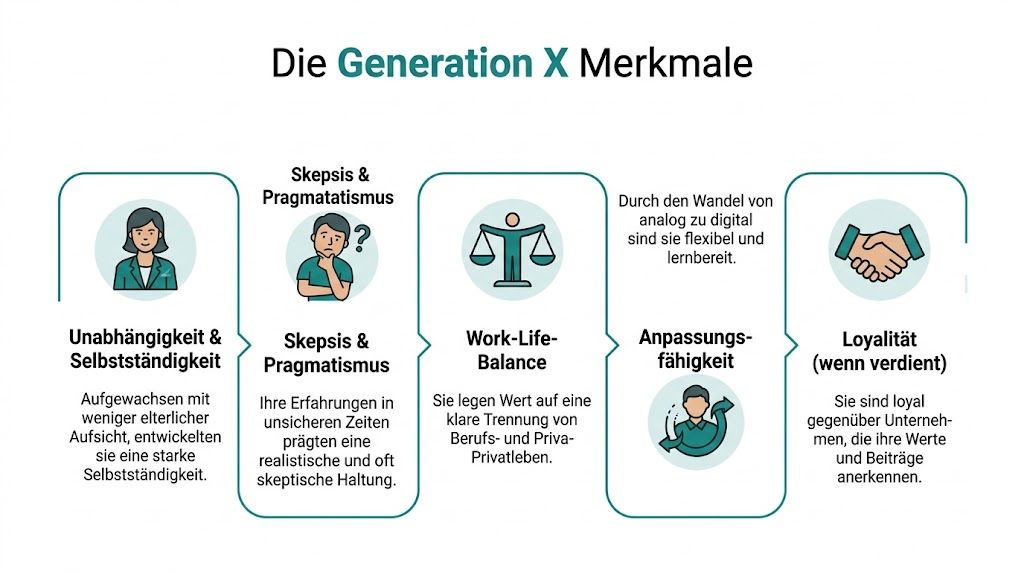
Values and attitude
Generation X is usually not looking for a job where everything is emotionally charged. She wants a company that functions reliably. Security is not just a contract detail. For this group, security also means that shifts are not distributed chaotically, agreements apply and performance is assessed fairly.
In everyday life it looks like this:
- Job security matters . Anyone who constantly offers unclear perspectives loses trust.
- Work-life balance is not a luxury . Many of this generation work hard, but don't want the business to take up their entire life.
- Recognition should be genuine . Empty motivational slogans rarely work.
Work ethic and collaboration
In shift work, many from Generation X value a clear mission. Not ten messages with half-finished information, but a clean allocation. They often work in a very solution-oriented manner and like it when the path is not dictated to them, as long as the goal is clear.
An example from the catering industry: If the evening is short on staff, an experienced employee from Generation X will hardly have a fundamental discussion. She prioritizes. First stabilize the running service, then relieve the cash, then secure supplies. This type of thinking is extremely valuable in day-to-day business.
From practice:It's better to give Generation X a clear result than five control steps. You often get better work and less friction.
Relationship to technology
Many people make a mistake in thinking here. Generation X is not against technology. She is against unnecessary detours. If an app makes shifts visible, clearly documents exchanges and saves queries, it will be accepted. If it is just another platform alongside chat, mail and Excel, it will be experienced as a burden.
That's why three things usually work when dealing with this group:
-
Show benefits first
Don't start with features, start with the problem that disappears. -
Keep the introduction brief
No endless training. It is better to have a short process with real examples from the company. -
Clearly map responsibility in the tool
Anyone who confirms shifts, swaps or enters availability wants clarity about what is binding.
Loyalty under conditions
Generation X is often seen as loyal. That's true, but not blindly. Loyalty arises when an employer is predictable, respects experience and doesn't start from scratch every season.
In event and logistics, this means in practical terms: If you only call the same experienced people when there is an emergency, you shouldn't be surprised at the distance. If you offer them assignments early on, pay attention to preferences and provide clear communication, you build loyalty.
Differences from Baby Boomers and Millennials
Generation X often sits exactly between two louder images of work. From above, the baby boomers' classic sense of duty. From below, the more visible demands and communication patterns of Millennials. When you know these differences, you lead more accurately and with fewer misunderstandings.

Three generations, three expectations
Baby boomers were often socialized with more hierarchy. Many of them accept leadership more through role and position. Millennials tend to respond more strongly to exchanges, development discussions and ongoing feedback. Generation X is in between, but not neutral.
She wants trust. Not distance for the sake of distance. But also not a manager who constantly follows up even though the work is ongoing.
| topic | Baby Boomers | Generation X | Millennials |
|---|---|---|---|
| Authority | More role-related | More performance related | More relational |
| Feedback | Less demanded | To the point, clear, factual | More frequent and dialogic |
| Work-life balance | Often secondary | Firm claim | Strongly demanded |
| Dealing with rules | More accepting | Probing and pragmatic | More questioning |
What that means for leadership
If you lead everyone the same, you will lose each generation at a different point.
For baby boomers, too much looseness can come across as lack of clarity. For Millennials, radio silence can come across as disinterest. For Generation X, micromanagement often creates the most friction. Experienced shift managers, service managers or team coordinators in particular do not want to obtain approval for every step.
A simple example from the event sector:
A baby boomer is more likely to accept the classic approach. A millennial may want more context and feedback. Above all, a person from Generation X wants to know what has to happen at the end, who is responsible and what boundaries apply.
Good leadership is not loud. Good leadership sets the right tone for the person standing in front of you.
Where HR managers often get it wrong
Many companies treat Generation X like an easy-care middle class. This is convenient, but wrong. Precisely because it does not constantly formulate demands, it is quickly fobbed off with standard processes.
Typical errors are:
- Too much control with experienced forces
- Too little planning in operational planning
- Too little respect for existing experiential knowledge
- Too many communication channels without a clear main line
When you read the differences between generations clearly, leadership becomes easier. Not because everything becomes harmonious. But because you are working on friction in the right place.
The importance of Generation X for your business
For many Swiss companies, Generation X is not a side group, but rather a supporting substance. 2018 she was with just over a third , so roughly 33 to 35% , the largest group on the Swiss labor market. Your employment rate in the core phase is 76 to 89% , as the BFS analysis of the different generations on the labor market shows.
If you plan events, gastronomy, logistics, security or health care, that means something very specific for you. This generation is active in precisely the years when experience, resilience and leadership come together. It's often the people who save an evening when a team is half new and still needs to function properly.
Why this group is so valuable in shift work
Day-to-day operations in flexible industries are rarely elegant. Operations shift, customers change requirements, employees are absent, and in the end it still matters whether operations run smoothly. Generation X often has the right profile for this. She is experienced, adaptable and at the same time concerned about stability.
This is particularly suitable for roles such as:
- Shift management in the catering business
- Coordination of an event team on site
- Experienced jumpers in logistics or security
- Employees who train new temporary workers on the job
These people usually know not only their job, but also the side effects of poor planning. You notice early on if a person is not a professional fit. You can see where a team falls. And they know when a friendly request is no longer enough and a clear decision is necessary.
What happens if you use them incorrectly
Many companies lose Generation X not because of a lack of benefits, but because of poor management in everyday life. This often starts inconspicuously. Shifts are confirmed too late. Tasks change constantly without consultation. Experienced people are supposed to absorb chaos without having any influence on the planning.
Then something happens that HR managers see too late. The person may still stay, but they give less. She steps in less often, no longer takes on informal leadership and keeps her knowledge more to herself.
If you want to delve deeper into the role of personnel management and structures, a clear look at it helps what human resources means . Especially with Generation X, it quickly becomes clear whether HR is just managing or really supporting operations.
How you recognize the value of Generation X
Not in big words. But in terms of effects in everyday life.
| Observation in the company | What's behind it |
|---|---|
| Shifts run smoothly even under pressure | Experience and prioritization |
| Fewer questions with clear planning | High level of independence |
| New employees find their way in more quickly | Informal guidance from experienced people |
| Conflicts are less likely to escalate | Factual, sober communication |
Generation X is often at its strongest when things get confusing. That's why it's not only useful for many companies, but also difficult to replace.
This is how you successfully attract and retain Generation X
If you know generation x characteristics, you have to translate them into concrete leadership. Otherwise it will all just be good knowledge with no effect. Especially in shift operations, what is in the mission statement doesn't count. How you recruit, plan, communicate and recognize matters.

In recruiting, clarity counts more than shine
Many job advertisements are linguistically aimed at young target groups. Loose, playful, full of cultural promise. Generation X often reacts more cautiously to this. Not because she is humorless, but because she wants to check what the job actually offers.
Better write clearly:
-
What is the task
Service management in the evening, work in set-up and dismantling, driver role with fixed time windows. -
How planable is the deployment?
Is there early planning, recurring shifts or reliable deployment patterns? -
How much personal responsibility does that entail?
Can the person on site have a say or do they have to have every little thing approved?
A practical example:
Instead of “You love a young, motivated team and have a passion for events,” it often works better: “You lead operations on site, coordinate service processes and are the first point of contact for short-term adjustments.”
When it comes to planning, this generation needs freedom with a framework
Generation X likes flexibility. But not as an excuse for chaos. Anyone who works in catering, events or logistics wants to know what they can prepare for. Good operational planning therefore does not just mean being open to changes. Good deployment planning means dealing with changes properly.
This works well in everyday life:
-
Check availability early
This is how you show respect for your private life and secondary obligations. -
Confirm shifts bindingly
Nothing frustrates experienced people more than half-open planning. -
Keep exchange rules clear
Who is allowed to exchange, what is documented and when an exchange applies must be clear.
If you want flexibility, you have to organize commitment. Otherwise freedom only becomes insecurity.
In leadership, trust comes before constant control
Experienced employees from Generation X don't want to be picked up on every little thing. You need orientation, access to information and a manager who is approachable. Often not anymore.
What doesn't work:
- Daily questions, even though the performance is good
- Instructive tone compared to many years of practice
- Changing instructions from multiple places
- Praise only in the form of empty phrases
What works better is sober recognition. Something like this:
"Yesterday's operation was difficult. You kept the team stable and managed the change at the bar cleanly." That is concrete. This shows that you have seen performance.
Bonding comes from respect, not show
Many of Generation X don't stay because of table football or loud team rituals. They stay if they can rely on the company. This affects money, planning, communication and the attitude of leadership.
Think about points like this:
| Lever | What works in everyday life |
|---|---|
| Plannability | Make layers visible early |
| Respect | Include experience in decisions |
| Development | Practical further training instead of empty titles |
| Autonomy | Giving responsibility in real tasks |
Especially in flexible working models, you have to be credible as an employer. If you want to know how to sharpen your employer brand for exactly such target groups, it's worth taking a look Employer branding for flexible workers .
What is actually going well in events, gastronomy and logistics
In these sectors, it is usually not large cultural programs that are effective, but rather small, clean standards.
A few examples:
- In the event area You retain experienced operations leaders when briefings are short, complete and timely.
- In the catering industry You retain strong service staff if rosters don't constantly change at the last minute.
- In logistics Experienced people are more likely to stay if scheduling, responsibilities and feedback lines are clearly regulated.
An often underestimated point is participation. Generation X doesn't want to democratize every decision. But she immediately notices that her experience is only needed when something goes wrong. Get input earlier. Before a major operation, not just after a breakdown.
Don't just ask experienced people about problems. Ask them about the order in which something goes really well.
The one leadership question that clarifies a lot
When you work with a person from Generation X, a simple question often helps more than any personality analysis:
“What do you need so you can clean your mission?”
The answers are usually surprisingly specific. Clear start time. Complete information. One contact person. Reliable confirmation. A fair amount of freedom. This is exactly how you build good leadership.
When Generation X makes the biggest difference in your company
| situation | What Generation X contributes | What happens without her? |
|---|---|---|
| Peak times with short-term changes | Calm coordination, doesn't improvise | Younger teams are prone to stress and rejections |
| Training new employees | Practical instructions without micromanagement | New people are left alone or overwhelmed |
| Conflicts in the team | Factual clarification, no drama | Small conflicts escalate |
| Representation in the event of failures | Reliable stand-ins without any ifs and buts | Gaps in the roster, dissatisfied guests |
Conclusion: The forgotten generation is your chance
Generation X is not the loudest group in many companies. It is often the most sustainable. If you understand how they work, you will not lead nicer, but more precisely. You plan more clearly, communicate more clearly and give responsibility where it has an impact.
This is a real advantage for events, catering, logistics and other shift industries. These people bring experience, calmness and a good sense of what is possible. Anyone who overlooks them loses stability. If you take them seriously, you will have a stronger team.
Sources and framework conditions checked: May 2026. Statista and Haufe-Akademie used as reference sources.
Related articles
- Employer branding for flexible workers
- Talent retention: This is how springers stay loyal
- Introduce performance tracking fairly in your own employee pool
- This is how you design the perfect onboarding process
- Termination during the probationary period: Your legal guide 2026
If you want to set up your deployment planning in such a way that experienced employees have more planning ability, independence and clear communication, take a look
job.rocks
on. The platform helps you
Availability and shifts
and
Control changes cleanly
so that your business runs smoothly even when everyday life becomes hectic.