
Guide to SMS & text messages in the workplace: DSGVO-compliant team communication
SMS & Text Messaging at Work: The Ultimate Guide Without clear rules for SMS and text messaging at work, you're navigating blindly. What is intended as a blessing for fast communication can quickly turn into a legal minefield or a real productivity killer without guardrails...
SMS & Text Messaging in the Workplace: The Ultimate Guide
Without clear rules for SMS and text messages at work, you're navigating blindly. What is intended as a blessing for fast communication can quickly turn into a legal minefield or a real productivity killer without guardrails. It's not about banning use, but rather finding a smart balance between the speed you need and the privacy protection your team deserves.
Why not have a clear SMS strategy? "Nice to have", but is a duty
SMS and messengers have become an integral part of your everyday life. It goes without saying that they have long since arrived at the job. They are an unbeatable tool, especially in vibrant industries such as event organization, catering or security services. A short-term roster change? An urgent instruction to the team on site? An SMS is often the most direct and quickest connection to your employees.
But it is precisely this speed that has its pitfalls. What happens when sensitive customer data is carelessly shared in a group chat? How do you ensure that your people's well-deserved free time actually remains free time? Without a well-thought-out strategy, you risk not only embarrassing misunderstandings, but also serious legal consequences.
The balancing act between accessibility and privacy
The smartphone in your pocket blurs the boundaries between work and after work. Use in Switzerland over 90% of adults own a cell phone, making texting and messaging services a ubiquitous tool. The crux of the matter is that many employees juggle professional and private messages on the same device. This immediately raises critical questions – about accessibility outside of working hours, data protection and reimbursement of costs. One provides more insights into this Study on the use of mobile phones in Switzerland on news.admin.ch.
A clear policy is not a vote of no confidence, but a protective shield - for you and your team. It creates commitment and ensures that everyone knows where they stand.
A clean SMS strategy is your compass in this complex environment. It ensures that communication remains professional, secure and legally flawless. This guide gives you everything you need to develop a strategy like this for your company - from the legal basics to tried-and-tested templates that you can use immediately.
Before we delve deep into the details, let's get a brief overview of the most important areas of action that await you.
Overview of key topics
This table summarizes the key areas that you need to master for successful SMS use in your company.
| Area | Most important task for you | Example |
|---|---|---|
| Legal framework (DSGVO) | Ensuring that the processing of personal data via SMS complies with data protection laws. | Obtain written consent before registering employees for SMS sending. |
| Corporate etiquette | Clear rules define what type of communication is desired and what is not. | Specify that SMS can only be used for urgent business information, not for small talk. |
| Security & Data protection | Ensure protection of sensitive information from unauthorized access. | Prohibits sending passwords, customer data or internal financial figures via SMS. |
| approval & Opt out | Create transparent processes for subscribing and unsubscribing from SMS communication. | Offer a simple one "STOP"-Reply to unsubscribe from the SMS distribution list at any time. |
Mastering these four pillars is the key to taking full advantage of the benefits of SMS communication without losing sight of the risks.
Understanding and implementing the legal basis for Switzerland
Anyone who uses text messages for work enters a playing field with crystal-clear rules. Without a solid understanding of the legal principles, you quickly risk data breaches and significant fines. But that doesn't have to be the case, because the core principles are much easier to understand than you might think.
At the center of everything is Swiss Data Protection Act (DSG). It regulates how personal data is handled and does not stop at communication via SMS or messenger. As soon as you send a message that refers to an identifiable person - basically any professional message to your team - this law applies.
What is personal data in an SMS?
Personal data is any information that can somehow be related to a specific person. In your everyday work, this is a lot more data than you think at first glance. It's not just about the name or the telephone number.
A few examples that will immediately sound familiar to you:
- Duty rosters: Who takes on which shift and when.
- Location data: "Meeting point is at 2:00 p.m. at entrance B."
- Performance reviews: A short feedback on an employee’s work.
- Sick notes: "Unfortunately I can't come today, I'm sick."
Things get really tricky with the so-called "particularly sensitive personal data". This includes information about health, religious views or biometric data. Such details have absolutely no place in a normal SMS, as the transmission is often unencrypted and therefore anything but secure.
Imagine if an SMS with an employee's sick note accidentally ends up at the wrong recipient. This is not only embarrassing, but a serious data breach. There is therefore no strict rule that such issues should only be clarified via secure channels "Can", but one "Must".
The golden rule: consent
The pivotal point for legally compliant SMS communication is the express and voluntary consent of your employees. You can't just add someone to a work text message list. Each person must actively consent and know exactly what their number will be used for.
It is best to get this consent in writing. This can be a passage in the employment contract or a separate form. It is important that it is clearly stated:
- Purpose: What type of messages the number is used for (for example, only for urgent roster changes, not for promotions).
- Voluntary: That consent can be revoked at any time and without any disadvantages.
- Right of withdrawal: How exactly one "No" can say (for example by a simple "STOP"-News).
This graphic shows how a well-thought-out SMS strategy elegantly combines legal security, privacy protection and productivity.
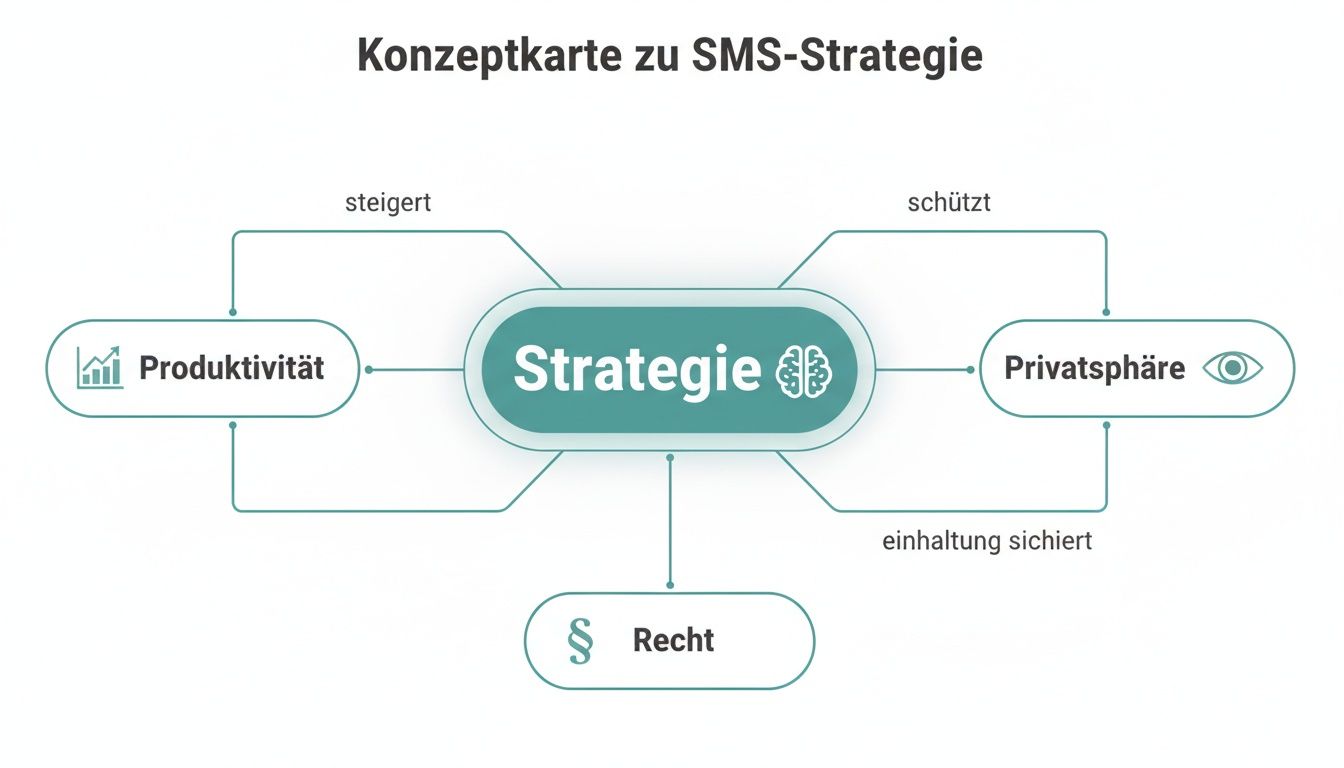
The visualization makes it clear: these three areas are not isolated islands. They depend on each other and only ensure a smooth process when they work together.
Retention and deletion of messages
Business communications – and yes, this includes SMS – are often subject to legal retention periods. At the same time, however, the Data Protection Act requires that you delete personal data as soon as it is no longer needed for its original purpose.
A contradiction? Only at first glance. With a clear policy you can solve this dilemma. Determine which messages need to be stored, how long, and who is responsible for deleting them. A clean separation of private and work devices or communication Apps is worth its weight in gold here. Anyone who deals with the legal basis should definitely also general data protection regulations have an eye on.
If you would like to delve deeper into the topic of data protection and find out how you can make it waterproof in your company, you will find valuable information in our article about it Protecting employee data on job.rocks. There we shed light on other aspects that are crucial for DSG-compliant personnel management. Adhering to these principles not only protects your employees, but also protects your company from expensive legal stumbling blocks.
Develop proper etiquette for professional text messaging
A message is typed quickly - and it is precisely this speed that can become a trap. An unclear wording here, a message at the wrong time, and misunderstandings and frustration are inevitable. Clear etiquette for professional text messages is therefore not a luxury, but rather the foundation for respectful and productive collaboration. She ensures that everyone in the team knows what is expected and how professional communication works.
The essence of good etiquette lies in choosing the appropriate channel for each concern. Not every piece of information is suitable for a short text message. Complex topics or negative feedback are completely out of place via SMS or chat and belong in a personal conversation or at least a phone call.
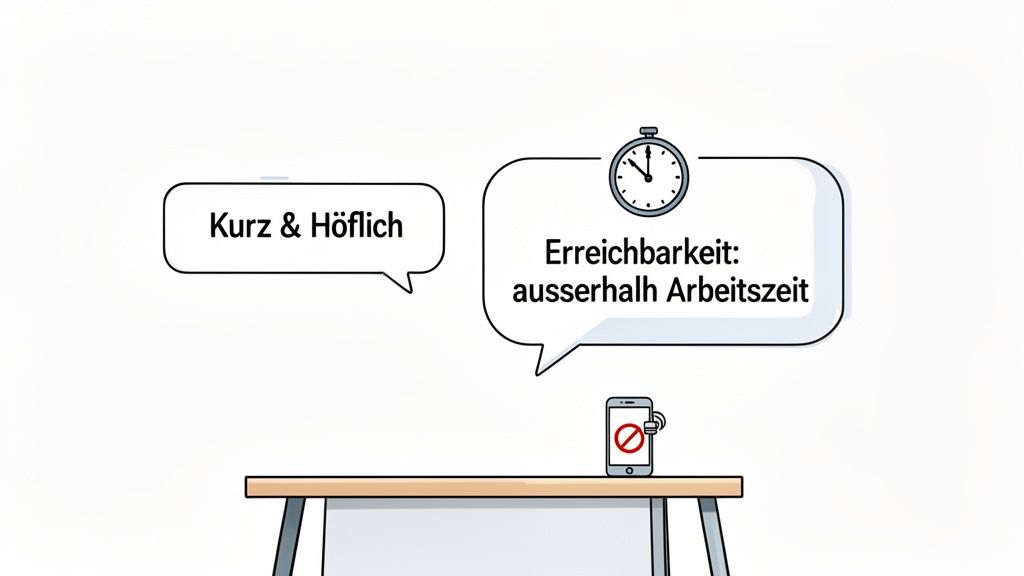
When is a text message the right choice?
Text messages are ideal for short, urgent and factual information that requires a quick response. They are perfect when an email would be too slow and a phone call would seem excessive.
Here are a few typical situations where an SMS or chat message makes perfect sense:
- Short-term roster changes: "Team update: The location for tomorrow has changed. The new meeting point is warehouse 3. Details will follow by email."
- Urgent reminders: "Important: The security check begins in 15 minutes. Please gather everyone at the main entrance."
- Quick yes/no questions: "Can you take on the extra shift on Saturday? A short yes/no is enough."
- Confirmations: "I received your sick note for today. Get well soon!"
For anything that requires a detailed explanation, discussion or emotional intelligence, other channels are simply better suited.
Formulate clearly and precisely
The limited space in a text message forces you to be brevity, but that should never come at the expense of clarity. Ambiguous wording or excessive use of abbreviations and emojis can quickly lead to confusion.
A good principle is: Write in such a way that even someone without context can understand the message straight away. And very important: Avoid irony and sarcasm - these are almost always misinterpreted in writing.
Bad example: "Meeting postponed. More later."
This news raises more questions than it answers: When? Where? What is called "later"?
Good example: "Short info: The team meeting at 2:00 p.m will open 3:30 p.m delay. The room remains the same. An updated invitation is on the way."
Everything you need to know is here. Unmistakable and clear.
Define limits for accessibility
One of the most important, but often ignored, aspects of texting etiquette is respect for the end of the day. A culture in which employees feel like they have to be available 24/7 directly leads to stress and burnout. Clear rules are essential here to protect your team’s work-life balance.
As a manager, you must determine when text messages outside of normal working hours are acceptable. In principle, this should only apply to absolute emergencies. A burst water pipe in the office is an emergency. There is no question about the status of a project that has until tomorrow.
Here are three concrete rules you can implement right away:
- Emergency marking: Agree on a clear signal word like "DRINGEND" at the beginning of a message if it is a real emergency. In this way, employees immediately learn to correctly assess the importance of a message.
- Define response time: Make it crystal clear that messages received after work do not require an immediate response. A next business day response is the norm, not the exception.
- Be a role model: Above all, stick to the rules yourself. If you, as a boss, constantly send messages after work, you signal that you expect exactly that from your team. Use that instead "Send later"feature that many tools offer today.
These simple but effective measures contribute enormously to a healthy working atmosphere. They ensure that text messaging remains a useful tool and doesn't become a burden. A well thought out one guide to sms & text messaging at work always takes the human side of communication into account.
Create a company text messaging policy
A vague handshake when making arrangements is simply not enough, especially not when communicating professionally via text message. A clear set of rules is the be-all and end-all in order to avoid misunderstandings, create legal certainty and make communication within the team really quick. Such a directive is not a rigid corset, but a living document that creates clarity for everyone.
The first step is always to determine the exact scope of application. Ask yourself: What should we use text messages for? The answer to this is the heart of your policy. Define clearly what type of information is allowed to flow via this fast channel - and what is not.
What your policy must necessarily contain
A good policy is like a building block. It consists of several important building blocks that together form a stable framework. Each of these points must be formulated so clearly and understandably that there can be no two opinions.
These elements are essential:
- Purpose and scope: Specify that the policy applies to all employees. Describe the permitted use cases specifically (e.g. short-term shift changes, urgent safety warnings, confirmation of deployment locations).
- Privacy and Security: Formulate a clear ban on sensitive data. Things like passwords, health information or confidential customer details have no place in a text message.
- Etiquette and professional tone: Give a few handy examples of good formulations. A short message must always remain respectful and professional - no room for too many emojis or colloquial language.
- Availability and working hours: Set clear boundaries. When can messages be sent? And very important: No immediate response is expected outside of working hours (except in clearly defined emergencies).
- Use of private devices (BYOD): When employees use their private smartphones, the rules of the game must be clear. Clarify aspects such as reimbursement of costs or the strict separation of private and business data.
- Consequences for violations: Describe objectively what happens if someone doesn't follow the rules - from a simple warning to legal action.
This structure will help you not to miss anything important and create a truly comprehensive foundation.
Formulate and communicate the policy in an understandable manner
The best directive is useless if no one reads or understands it. Leave out the legalese and write in simple, direct language. Use concrete examples from your everyday work to make the rules tangible.
Instead of writing: "The transmission of personal data from third parties is prohibited", better put it like this: "Never send customer names, addresses, or phone numbers via SMS. Always use our secured CRM system."
As soon as the draft is ready, communication begins. An email alone has no effect. Schedule a short training session or team meeting to introduce the policy and answer questions. This personal introduction shows that you care about the topic and increases acceptance enormously.
Training and anchoring in everyday life
A one-off training is a good start, but the real work begins afterwards: anchoring the rules in the hectic everyday life. Regular, short reminders can work wonders. Also, integrate the policy into the onboarding process for each new team member.
Managers have a key role here – they must lead by example. If the boss sends messages even on Sunday evening, it undermines even the most well-formulated policy. Integrating such processes into digital tools can also provide support. A modern one App for temporary workers can, for example, help structure communication flows and ensure that every message finds the right, secure channel.
At the end of the day, the whole thing is a continuous process. Get regular feedback from the team and be ready to adapt the document as workflows change. This is the only way to ensure that your... guide to sms & text messaging at work always up to date and, above all, practical.
Useful templates and examples for everyday life: this is how it works's
Theory is one thing, practice is quite another. A communication policy only comes to life when it simply works in everyday life. That's exactly what clear text message templates are for - they're like a trusty Swiss Army knife in your toolbox. Not only do you save valuable time in hectic everyday operations, but you also ensure that your messages are always professional, clear and in line with company rules.
The biggest win from assists? Fewer mistakes, fewer misunderstandings. If the structure of a message is familiar, everyone immediately knows what it is about. This creates uniform and, above all, reliable communication, regardless of whether it is about a quick roster change or a critical security warning.
Templates for the most common situations in everyday work
Of course, every industry and every team has its own requirements. The following patterns are tried and tested and you can adopt them directly or use them as a basis for your own, tailor-made templates. Simply adapt it to the circumstances of your business.
1. Short-term roster change
Every second counts here. The message must be short, concise and unambiguous. The recipient must immediately understand what is changing for them.
- Example of gastronomy: "Hi [Name], short-term change: Your shift starts at tomorrow 5:00 p.m instead of 6:00 p.m. due to a large reservation. Please join me for a moment 'OK' confirm. Thanks!"
- Example security service: "Team update: Night shift location changed. New meeting point: Musterstrasse 12 construction site, gate 3. The operations manager is [name]. Please confirm."
2. Urgent information to field staff
If your team is already on the move, all important details must be visible at first glance. Nobody reads long texts here.
- Example event agency: "WICHTIG: Customer has setup time for 'Summer festival' brought forward. New start for the construction is 1:00 p.m. All other details remain the same."
- Example healthcare (Spitex): "Info: A key safe was installed at patient [last name], Bergstrasse 5. Code: 1234. Please use it immediately."
3. Quick coordination or appointment confirmation
Sometimes all you need is a clear yes or no. Complicated formulations have no place here.
- Example for all industries: "Quick question: Are you available for the spontaneous team meeting tomorrow? 9:00 a.m available? Please just come with me 'Yes' or 'No' answer."
- Example appointment confirmation: "Reminder: Your shift interview with [Name] is over tomorrow 3:00 p.m in office 12. Please be on time."
A good one Guide to SMS & Text messaging at work lives from such concrete examples. They take the guesswork out of your team and ensure things run smoothly, even when things have to happen quickly.
Sample consent (opt-in and opt-out)
As you have seen in the legal section, clearly documented consent is the be-all and end-all. With these templates you can obtain consent professionally and at the same time offer an uncomplicated way to revoke it.
- Opt-in request: "Hello [Name], we would like to inform you about urgent roster changes via SMS in the future. Are you okay with that? Please respond with 'JA'to agree."
- Opt-out confirmation: "You have successfully unsubscribed from our SMS information service. From now on you will no longer receive any company messages on this number."
Such clear formulations are not only legally clean, they also create trust. You show your employees that you take their privacy seriously.
Templates as protection against loss of productivity
Constant interruptions caused by poorly worded or unstructured messages are poisonous for concentration. International studies, which are also relevant to the Swiss context, estimate that such disruptions affect the work performance of knowledge workers 15-25% can lower. And this is not a purely academic number: surveys among Swiss employers show that 30-40% of companies see the flood of news as a real risk to focused work. More about these You can find trends on the Swiss labor market at adeccogroup.com.
Well-thought-out templates are a powerful antidote here. By using clear signal words like "INFO" or "AKTION ERFORDERLICH" At the beginning, your team can immediately assess the urgency of a message - often without having to completely interrupt the actual workflow.
Integrate communication into workforce management systems
Manual processes are pure time wasters. Let's be honest: sending rosters by hand, calling everyone after short-term absences and then waiting for shift confirmations - that not only costs nerves, but also valuable working time. This is exactly where modern software comes in and links communication directly with personnel planning.
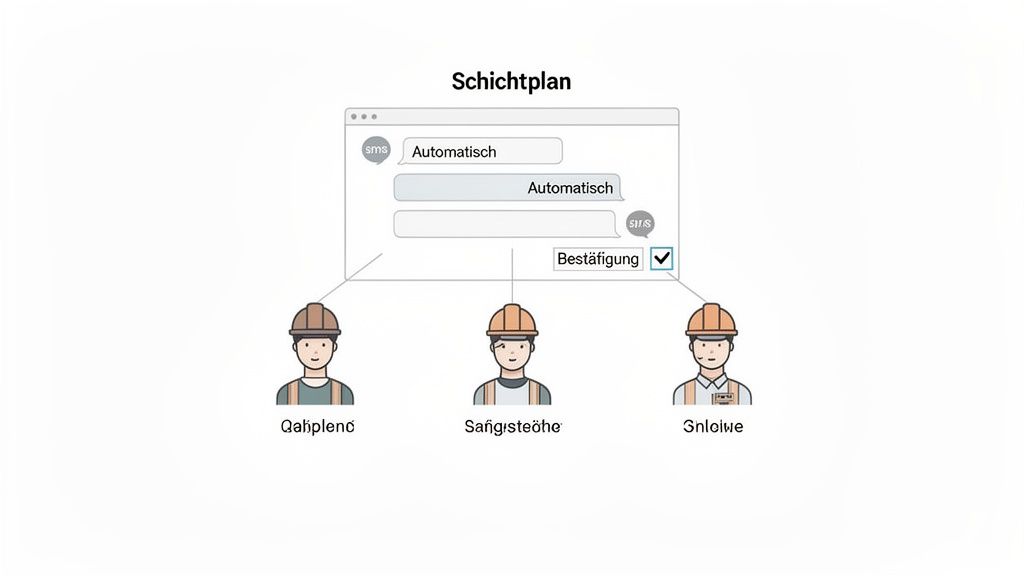
Think of your workforce management system as a central command center. Instead of laboriously typing individual messages, you trigger automated SMS notifications directly from the system. This not only saves time, but also eliminates the errors that are almost inevitable when entering data manually.
Save time with automated messages
The biggest advantage is obvious: you get your time back. Instead of contacting dozens of employees individually, the system sends notifications at the touch of a button - or even fully automatically, based on rules that you set once.
Here are a few examples that will immediately make your everyday life easier:
- Automatic shift offers: A shift becomes available unexpectedly? The system immediately sends an SMS to all qualified and available employees. Whoever answers “JA” first gets the service. Everything runs without you having to lift a finger.
- Reminders before starting work: A simple, automatic SMS 24 hours before the start of your shift can work wonders. It reduces missed services and delays to a minimum.
- Communication of changes: Has the location changed at short notice? A single message from the system informs the entire team at the same time. This way you can make sure that everyone is really on the same page.
Administrative tasks that previously took hours can be completed in just a few minutes.
One central platform for everything
If all communication runs through a central system, this brings with it another decisive advantage: everything is completely documented. Every message sent, every confirmation and every rejection is recorded in the system and can be traced at any time.
This not only creates transparency, but also gives you legal security. If there are any discrepancies about working hours or agreements, you have clear, digital evidence at hand. Communication is no longer scattered across countless private chat histories, but rather bundled in a single, secure location.
A good one Workforce management software offers exactly this seamless connection between planning and communication. It becomes the “single source of truth” and ensures that all information is consistent and only accessible to the right people.
Practical example: A large-scale event agency
Imagine an event agency for a huge festival 150 Must coordinate temporary staff. It used to be a nightmare of endless phone calls, countless emails and Excel lists.
Today it works like this:
- The dispatcher creates all shifts that need to be filled in the workforce management system.
- The system automatically sends SMS invitations to all suitable employees in the pool.
- Employees respond directly via SMS with “JA” or “NEIN”.
- Your answers flow immediately back into the system and the shift schedule fills itself. Confirmed employees receive a final SMS with all the details of their assignment.
The whole process only takes a fraction of the time. Much more important, however, is that the dispatcher always has a full overview of which shifts are already occupied. One like that guide to sms & text messaging at work impressively shows how cleverly used technology can massively reduce the complexity of everyday work.
Frequently asked questions about texting in the workplace
Do you still have a few specific questions about how text messages at work really work? No problem. Here you will find clear and quick answers to the typical ambiguities that arise again and again in everyday working life.
Can private cell phones be used for work?
Yes, that's possible - but only if it's crystal clear BYOD (Bring Your Own Device) Policy gives. This must regulate exactly how business and private data are clearly separated and who pays for which costs. Without such a written agreement, you will quickly find yourself in a legal gray area.
What happens if there is a data breach via SMS?
Imagine accidentally sending sensitive information – a customer name, health information – to the wrong recipient. This is a reportable data breach. In such a case, you must immediately document the incident internally and, depending on the severity, report it to the Federal Data Protection and Information Commissioner (EDÖB). Regular training is the best way to avoid such mistakes in the first place.
Do I have to respond to messages after work?
A clear no. Unless it is a clearly defined emergency and there is a corresponding agreement, such as with an on-call service. Your right to rest is enshrined in law. A good company policy ensures that no response is expected outside of working hours.
The expectation of being constantly available is not only unhealthy, but also legally problematic. Clear rules protect the work-life balance and prevent a culture of constant digital stress.
Are emojis and abbreviations okay in work text messages?
That depends a lot on your company culture. The rule of thumb is: When in doubt, leave it out. Abbreviations can quickly lead to misunderstandings, and emojis simply seem unprofessional in some situations. They may be fine for quick, informal coordination within a well-coordinated team, but absolutely unsuitable for official instructions or important messages.
How can I prove that a message was received?
Most modern smartphones show a delivery status, that's true. But SMS is not the safest channel for truly legally binding delivery. If you need irrefutable proof, such as important documents or deadlines, an email with a read receipt or good old registered mail is always a better and safer choice.
Would you like to consolidate all of your workforce planning and communication with your team in one central, secure location? With job.rocks you have the tools to manage rosters, availability and messages easily and in a DSGVO-compliant manner. Find out more about how you can finally get your processes under control: https://job.rocks