
How to Find and Get OLMA Jobs – A Guide for You
Looking for OLMA jobs? Discover roles, requirements, and application tips – plus flexible assignments via job.rocks.
You might be sitting on the train to St. Gallen right now, scrolling through job portals and typing OLMA jobs into your phone for the third time. Then old posts, forum comments, and vague social media hints appear. This is exactly where many waste time. Not because there are no assignments, but because official OLMA jobs, jobs around the event, and volunteer-like offers often get mixed up.
If you want to work around OLMA, you first need clarity: Who is posting the job, which role is paid, when do you need to be available, and how is your time tracked? If you’re also looking for other flexible assignments, you can register early on the marketplace: sign up at job.rocks.
Table of Contents
- What OLMA Jobs Mean for You and Where to Find Them
- Roles and Requirements You Can Expect at OLMA
- How to Apply Successfully and Start Well Prepared
- Legal and Organizational Aspects You Must Consider in Switzerland
- How to Plan Flexible Assignments Around Trade Fairs with job.rocks
- Your Next Step to Suitable OLMA Jobs
What OLMA Jobs Mean for You and Where to Find Them
In the morning, you see an OLMA job posting, in the afternoon an Instagram post for bar staff, and in the evening an ad for setup or teardown in St. Gallen. Three offers, three different senders. If you lump everything under “OLMA jobs,” you quickly apply blindly.
In practice, you need to clearly separate two categories. Official OLMA jobs come directly from Olma Messen. Flexible assignments around the fair often run through stand builders, catering companies, security firms, promotion agencies, or staffing services. This difference is not academic. It determines who instructs you, who confirms your assignment, and how your hours are tracked.
Check Official Positions First
The first check should always be the career page of Olma Messen: Job offers from Olma Messen. There you can see whether the position really belongs to the organization or if you are working around the fair.
This makes a big difference in assignment plans. Official roles usually have clearer processes, contacts, and locations. External assignments allow more flexibility, for example working only two evenings in catering or taking a single setup day.
A simple filter saves time: Who is the employer, on which days must you be definitely available, and how is time tracking handled?
This point is often underestimated. Anyone who has worked on Swiss trade fair grounds knows: good assignments are recognized not only by hourly wage but by whether shifts are well planned and times are correctly recorded. A realistic insight into such processes is provided by the page on Staff Planning and Time Tracking at Trade Fairs.
How to Recognize Reliable Opportunities
I would never take a trade fair job if three points remain unclear before starting: assignment management, time window, and report recording. If any of these are missing, there are almost always later questions about shifts, breaks, or pay.
Check postings briefly and strictly:
- Sender clearly named: OLMA itself or an external service provider with a verifiable presence
- Availability concrete: specific days, early or late shifts, setup, fair days, or teardown
- Qualifications visible: for example, experience in service, physical resilience, language skills, or safety instruction
- Time tracking regulated: app, timesheet, badge system, or report via assignment management
Especially for flexible marketplace assignments, this distinction gives you an advantage. You can enter availability early, see only suitable roles, and apply for jobs that fit your times and qualifications. For students, part-time workers, or people with irregular weekly schedules, this is often more practical than blindly reacting to individual fair posts.
The temporary work market in Switzerland is broad. The swissstaffing annual statistics show how firmly flexible assignments are anchored here. For you, this mainly means: good trade fair jobs are rarely found through rumors but through clear postings, clean filters, and an application process that works organizationally.
Roles and Requirements You Can Expect at OLMA
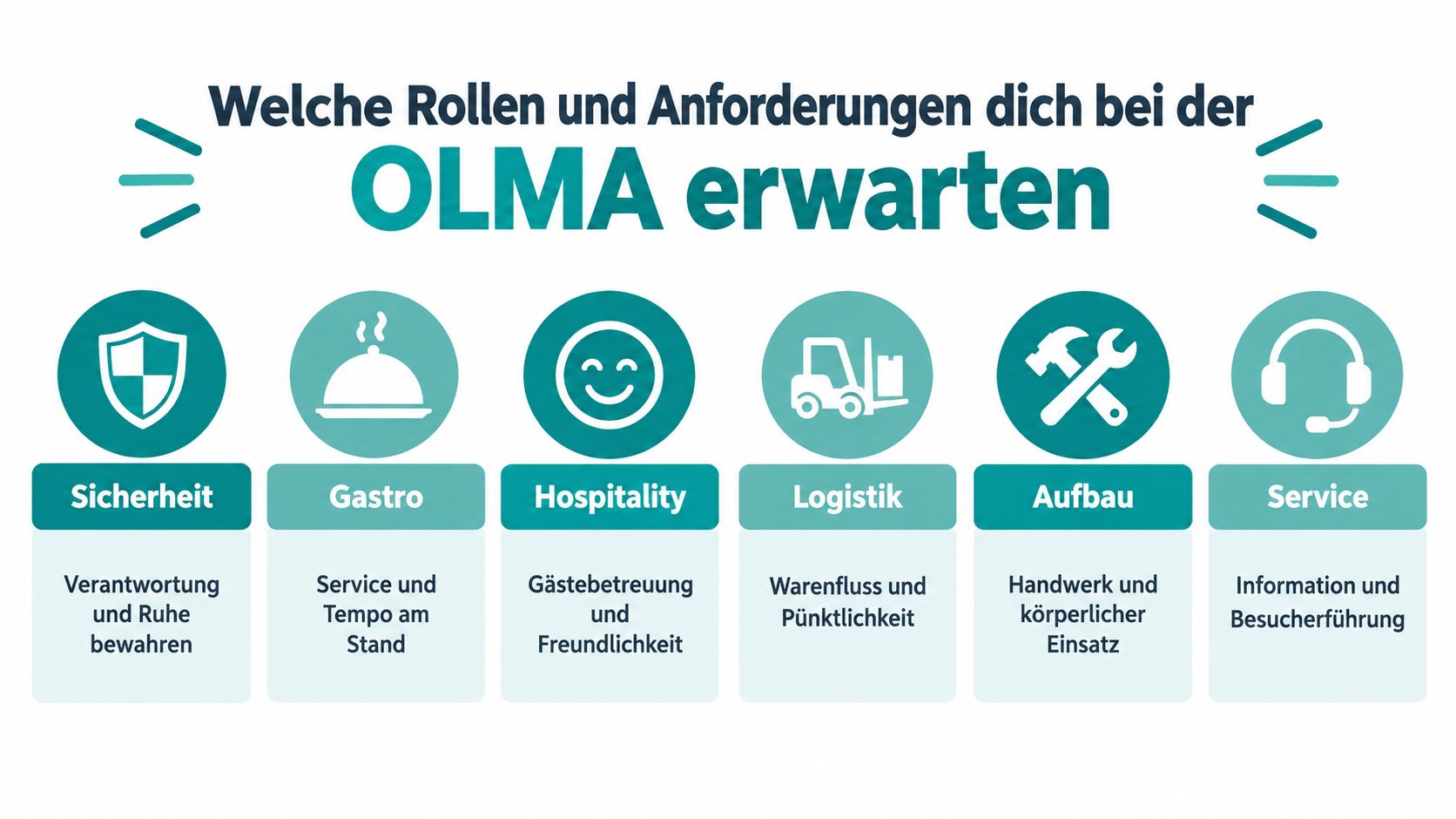
Similar roles appear at OLMA every year. The names change slightly, but the daily routine behind them less so. You stand at the entrance, carry boxes, check wristbands, assist guests at the booth, or restock goods in the evening. Those who classify this clearly beforehand apply more appropriately.
Paid Roles and Volunteer-Like Assignments
A frequently overlooked point: not everything that looks like a “job” in the event environment is a classic paid assignment. In the Swiss festival and event sector, there are also mixed forms with catering, tickets, or small benefits instead of regular pay. Paid roles are especially common in security, catering, hospitality, and logistics, as classification of festival jobs in Switzerland shows.
For OLMA itself, exactly these segments are relevant. Security jobs are offered temporarily according to the same classification, including mandatory instruction before the event. For you, this means: never ask only “What do I earn?” but always also “When is the briefing, how long does it last, and is it mandatory?”
How to Identify Suitable Roles
Here you see the differences compactly:
| Role | What You Often Do | What Usually Matters |
|---|---|---|
| Security | Check access, stay calm, enforce rules | neat appearance, resilience, instruction |
| Catering | Serving, cashier, service, restocking | speed, hygiene, German language |
| Hospitality | Welcome guests, provide information, escort | friendliness, language, presence |
| Logistics | Move goods, prepare materials | punctuality, willingness to help, overview |
| Setup | Prepare booths, materials, paths | physical effort, early hours |
| Admission or Service | Scan, direct, inform | reliability, patience, clear instructions |
If a position is very vaguely described, ask about the real shift routine. “Helping at the event” can mean anything from handing out flyers to heavy material transport.
A guest contact role is not the same as a service or hostess role. If you are unsure, the classification what a hostess does can help you. This way, you avoid applying for assignments that do not fit your profile.
Your Quick Self-Check Before Applying
- Can you cover evenings and weekends? This is often the key point at fairs.
- Do you have documents ready? ID, permit, certificates.
- Are you physically fit enough? Setup and logistics may sound easy but rarely are after eight hours.
- Is your German sufficient for direct contact? Uncertainty is immediately noticeable at admission and in service.
In Switzerland, 47.7% of employees used flexible working hours in 2023, and nearly two out of five occasionally worked from home, according to the Federal SME portal. For event jobs, this means: flexible planning is not an exception. Those who specify their time windows clearly appear more credible than those who just write “always available.”
How to Apply Successfully and Start Well Prepared
Monday, 2:30 p.m. An assignment manager still needs to fill three shifts at admission and two in catering for Friday. Two applications sound good but are immediately rejected because they only say “flexible availability.” The person with clear time windows, complete documents, and a reachable phone number goes on the list first.
This is exactly where many things separate in OLMA jobs. Official OLMA positions usually have a clear role, fixed schedule, and formal application. Flexible marketplace assignments around the fair are often filled at short notice. There, clean availability, suitable qualification filters, and quick feedback in daily business matter more than a long motivation letter.
What Your Application Really Needs
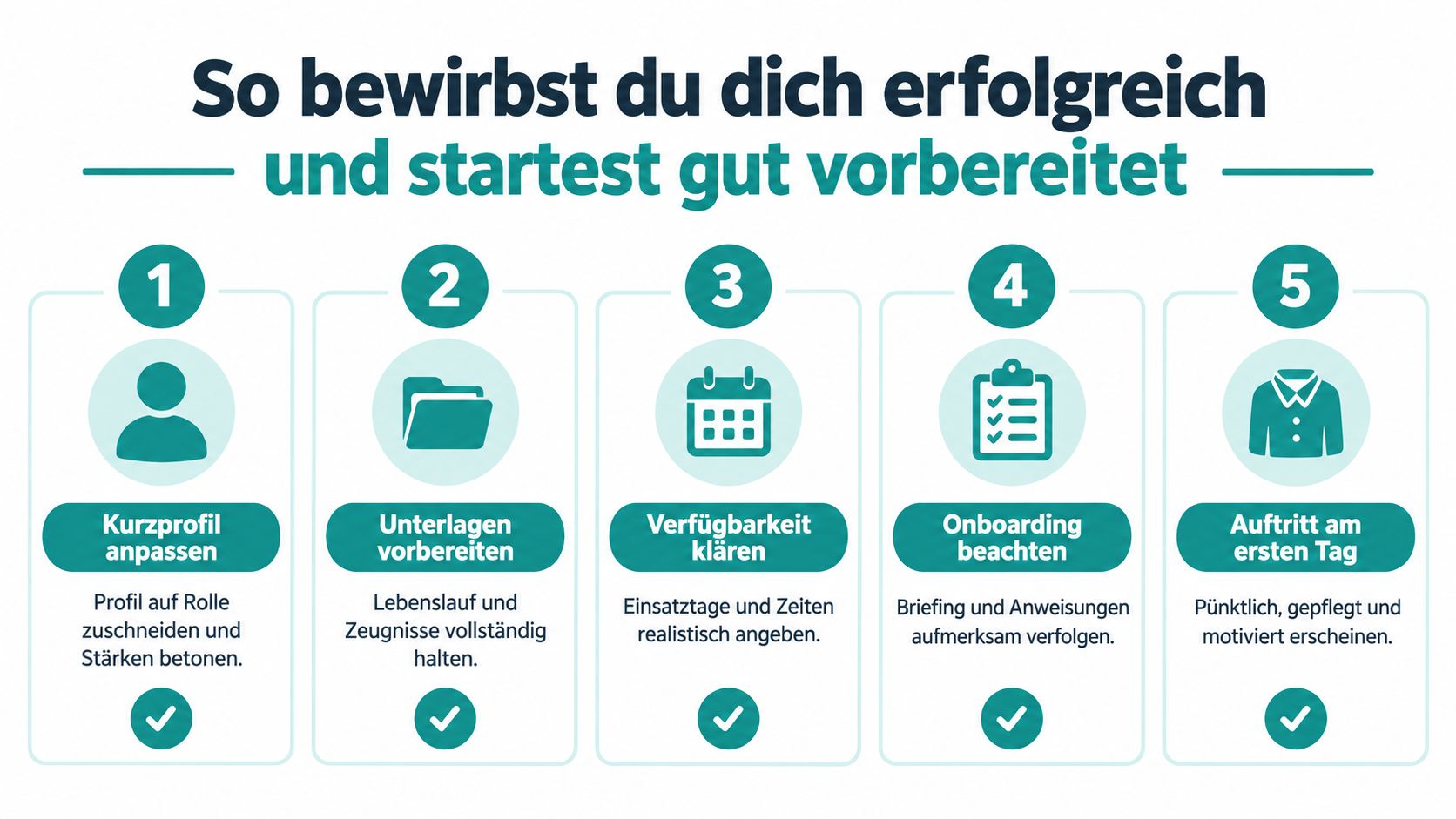
Adapt your profile to the specific role. Someone who applies simultaneously for cashier, setup, bar, and admission rarely appears broadly deployable but often unfocused.
These details really help with assignment:
- Role: Admission, service, logistics, cashier, or promotion
- Availability: with days and times, not just “immediately available”
- Assignment location: fixed in St. Gallen or also assignments around the fair
- Documents: CV, contact details, residency status, certificates
- Experience: what you have done, in 2 to 4 clear points
For flexible assignments, a well-maintained profile is especially worthwhile. If you work in a marketplace, you enter your availability directly, filter by suitable qualifications, and see faster whether an assignment fits your profile. This saves you blind applications for jobs where you end up missing an ID, permit, or simply the shift time.
How to Write a Message That Gets Read
In shift work, no one usually looks first at beautiful wording. Three things are sought: role, availability, reachability.
Write concretely. For example:
Hello. I am applying for assignments at admission or serving around OLMA in St. Gallen. I am available Friday from 3 p.m., all day Saturday, and Sunday until 8 p.m. I have experience in guest contact and during high visitor volume. I can send my documents immediately. You can reach me at [number].
Short is enough. Uncertainty costs you the assignment.
Preparing for Your First Day on Assignment
The first mistake often happens before the shift starts. Someone stands at the visitor entrance instead of the staff check-in, wears the wrong shoes, or hasn’t read the briefing. Then the shift starts with stress.
Check these points beforehand:
- Meeting point: exact entrance, time, name of contact person
- Clothing: black, neutral, or branded workwear
- Shoes: sturdy and suitable for shifts, not just neat
- Documents: ID, permit, possibly certificates
- Phone and battery: for questions, changes, or time tracking
If you start with official OLMA jobs, the organization is usually clear earlier. For flexible fair assignments, a shift can still change because visitor flow, setup, or team absence changes. That’s why it helps to check notifications, keep availability clean, and confirm changes immediately.
Quick reaction often makes the difference in practice. Not because someone wants to pressure you, but because trade fair operations are tightly scheduled and open shifts are quickly reassigned.
Legal and Organizational Aspects You Must Consider in Switzerland
On assignment, it’s not only important that you arrive on time. It also matters whether your working hours are properly recorded. This protects you if there are later questions about hours, breaks, or pay.
How Time Tracking Works in Daily Assignments
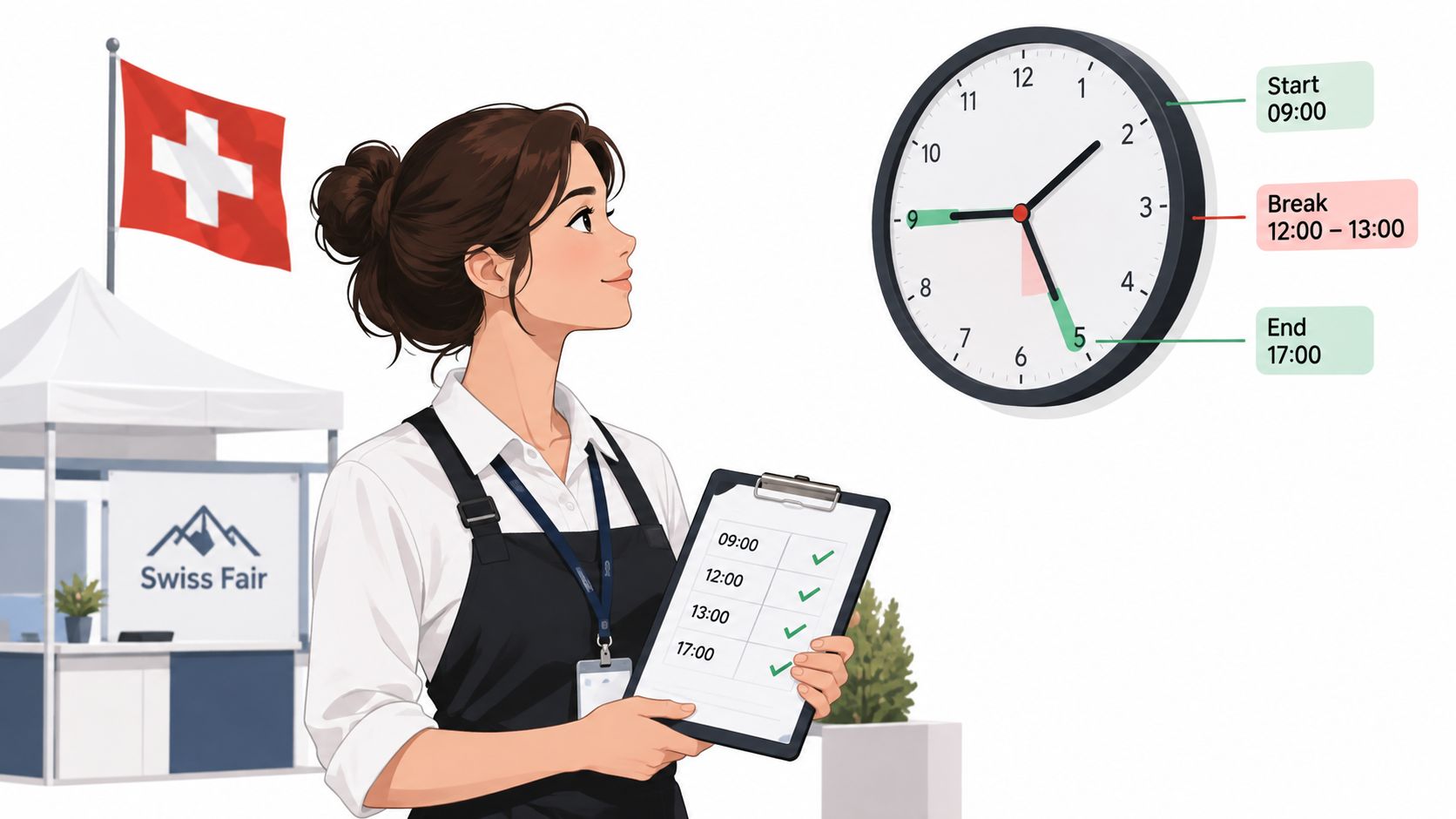
The SECO requires that start and end of daily and weekly working hours as well as compensatory and overtime work are documented. Breaks of 30 minutes or more must also be visible, as stated on the SECO page about time tracking.
This is not a paperwork detail. If you do a six-hour shift with a 45-minute break, “worked today” is not enough. Start, end, and break must be recorded.
What You Should Check On Site
A quick look at these points saves discussions:
- Shift start is correct: Were you really scheduled for the time you were told?
- Break is clear: Is it fixed, staggered, or depending on operational situation?
- Contact person is known: Who corrects times if you start earlier or stay longer?
Write down the start and end of each shift yourself briefly. If something is missing in the system, you have your own note.
Work time records must be kept for five years in Switzerland, according to SECO regulations on time tracking. This is relevant for you if questions about pay arise later.
Data Protection and Sensitive Documents
For event jobs, you often provide ID data, contact details, and sometimes permit documents. Never send more than necessary for the application. Ask if someone requests documents via private messengers without a clear purpose.
If you search cross-border or deal with recruiting specialists from abroad, the article on PandaNerds international IT recruitment gives you a good additional perspective on how strongly origin, permits, and clean processes matter in personnel matters. For trade fair jobs, this is on a smaller scale, but the basic question remains the same: who processes your data and for what?
How to Plan Flexible Assignments Around Trade Fairs with job.rocks
You see a free shift for Friday in St. Gallen on Tuesday evening. The assignment time fits, but only if travel, role, and check-in are clearly clarified. This is exactly where an official OLMA job differs from a flexible marketplace assignment.
For OLMA jobs, this distinction is worthwhile in daily life. Official positions run through the organizer or appointed partners. Flexible assignments around the fair, catering, promotion, or logistics often come in at short notice and require one thing above all: that your profile is up to date and your availability is correct.
What really saves you time is not another chat history but a clearly maintained system. You enter when you can work, set your assignment locations, store qualifications like bar experience, cashier, hostess, setup and teardown, or driving license, and respond only to requests that fit professionally and timewise. This avoids the classic back-and-forth with three message chains and two misunderstandings about shift times.
In practice, I pay attention to three points:
- Maintain availability cleanly: Not only release whole days. Also enter if you can only start at noon or are blocked in the evening.
- Set qualifications honestly: Catering with cash handling, admission with scanner, or logistics with early setup are different assignments. Those who specify too broadly are noticed during the shift.
- Record times directly: Shift start or end can shift quickly in trade fair jobs. If clocking in and out works well, there are fewer later disputes.
A marketplace does not replace an official application. It complements it. Especially around OLMA, this makes sense if you apply for concrete organizer roles on one hand and look for additional assignments around the event, such as side events, tastings, temporary catering areas, or promotion actions in the region.
job.rocks maps such processes in a mobile environment. This includes availability queries, qualification filters, shift invitations, confirmations, and time tracking. If you want to see how this is technically organized for event staff, check out the app for event staff with shift planning and time tracking.
A well-maintained profile brings you more in the trade fair business than many loose applications. If availability, assignment location, and qualifications are clearly stored, you will be considered faster for suitable shifts. This is especially true for short-term assignments around St. Gallen, where often the best application does not decide but whether you are suitable, punctual, and immediately assignable.
Your Next Step to Suitable OLMA Jobs
It’s Tuesday, 9:30 p.m. Someone cancels at admission for the next fair day, and then often not the longest applications matter but profiles that are well maintained and fit the shift, location, and task.
Your next step is therefore clear: first separate official OLMA jobs from flexible assignments around the event. Official roles run through the organizer’s site or named service providers. Additional shifts around the fair, catering, promotion, or side events are often found via a marketplace. Those who keep both clearly apart save time and apply more targeted.
Then check three points before sending anything:
- Role: Does the assignment really fit your routine on the shift? Admission, cashier, service, setup and teardown, or logistics require different processes and different resilience.
- Availability: Are your times recorded as you can really work them? For trade fair jobs in St. Gallen, half a free day is little if you don’t cover early setup.
- Qualification and documents: Do your details about cash handling, scanner, customer contact, or physical work match what you have done?
This is where most mistakes happen in practice. People agree to too many assignment types, block shifts too vaguely, or only realize the evening before that travel, start time, and assignment location don’t match.
If you want to work around OLMA, take a two-track approach. Apply directly for official positions and keep your profile up to date for flexible assignments in parallel. This way you are not dependent on a single posting and can also take short-term assignments if they fit professionally and timewise.
job.rocks maps such flexible processes objectively: availability, qualification filters, shift invitations, and time tracking in one place. For you, this means above all less back-and-forth and cleaner planning, especially when assignment times shift in trade fair jobs.
In the end, the most beautiful wording rarely counts in event daily life. What counts is whether you are suitably available, whether your details are correct, and whether your time can be properly recorded after the assignment. That’s how you get suitable OLMA jobs faster.