
How to use AI-based deployment planning in practice
Shift schedules that almost create themselves? This is no longer a dream of the future. Imagine a system planning your operations and not only taking into account who has time and what they can do, when, but also all legal requirements and the expected order situation. This is AI-based…
Shift schedules that almost create themselves? This is no longer a dream of the future. Imagine a system planning your operations and not only taking into account who has time and what they can do, when, but also all legal requirements and the expected order situation. That is AI-based deployment planning: not a simple digital calendar, but a clever tool that thinks ahead and detects bottlenecks before they even arise.
What AI-based deployment planning really means
Anyone who has ever planned staff knows this tough puzzle: you juggle the availability, qualifications and wishes of the employees, while at the same time having to adhere to statutory rest periods and cover the actual needs of the business. A small mistake, a last-minute call in sick – and the whole fragile house of cards collapses.
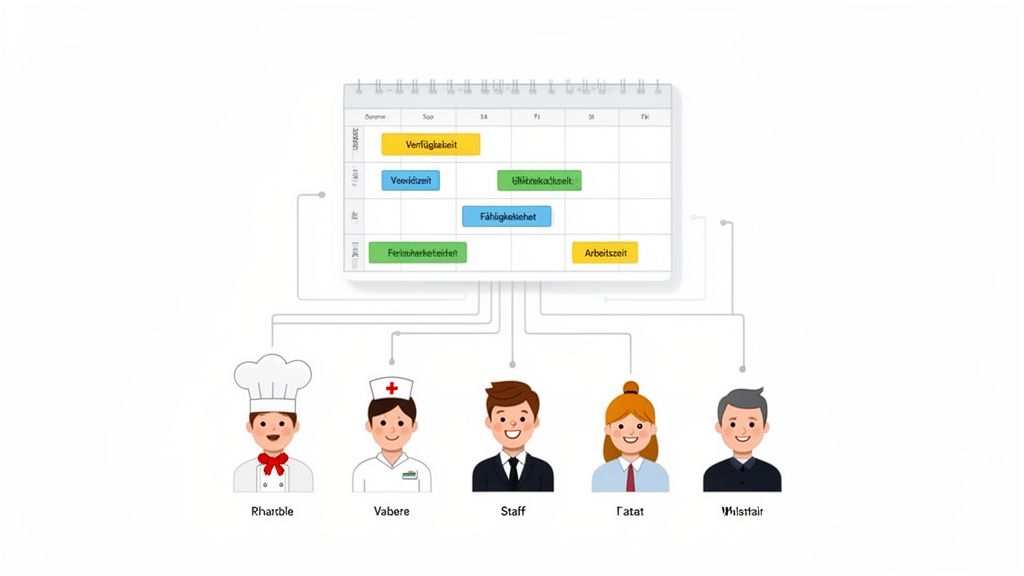
This is exactly where it comes in AI-based deployment planning on. Instead of you laboriously filling every single shift manually, an algorithm takes over this thankless task. He learns from past data and creates plan proposals that take all of these complex requirements into account at once.
Think of the AI as an extremely experienced planner that never gets tired and calculates every possible possibility. It finds the best solution in seconds that would take a person hours or even days.
This is essentially how the process works
An AI-powered platform analyzes tons of information to design the perfect plan. The system pulls data from very different sources and cleverly links them together.
The most important data points are:
- Employee data: Who has what skills? Who works full-time, part-time or as a temporary worker? What preferences were expressed?
- Historical order data: What was the capacity utilization on past holidays, at big events or on certain days of the week?
- Real-time information: Which employees are currently available? Are there short-term absences such as sick leave?
- Rules: Labor laws, maximum working hours and break regulations are stored as fixed guidelines in the system.
From this mass of information, the AI learns to recognize patterns. She knows that you need more staff for the restaurant terrace on a sunny Saturday in summer or that the most experienced logisticians have to be on hand at a large trade fair on Friday evening.
A practical example from the event industry
Let's say you're organizing a music festival. For the main evening you have to 150 security guards, 80 counter employees and 30 technicians plan – a logistical nightmare.
- Manual planning: You would spend weeks on the phone, sending emails and struggling through Excel spreadsheets. You would have to make sure that everyone has the right qualifications, that no one exceeds their working hours and that the teams on the different stages harmonize.
- AI-based deployment planning: You enter the requirement into the system. The AI immediately scans the availability and skills of your entire personnel pool. She suggests a ready-made deployment plan that mixes experienced team leaders with new staff, takes travel routes into account and even has suitable replacement personnel available in the event of an emergency. If someone calls in sick, the system automatically finds the best replacement and notifies the person directly via the app.
This approach not only saves an incredible amount of time. It also takes the quality of your planning to a whole new level. Your employees get fairer and more suitable shifts, which noticeably increases their satisfaction, and you can rely on your event to go off smoothly.
The noticeable benefit for your company
Smart personnel planning is much more than just a well-filled shift schedule. It is the decisive lever for whether your business runs smoothly, costs remain under control and your team comes to work motivated. One AI-based deployment planning is the tool that helps you bring exactly these three central areas into a perfect balance.
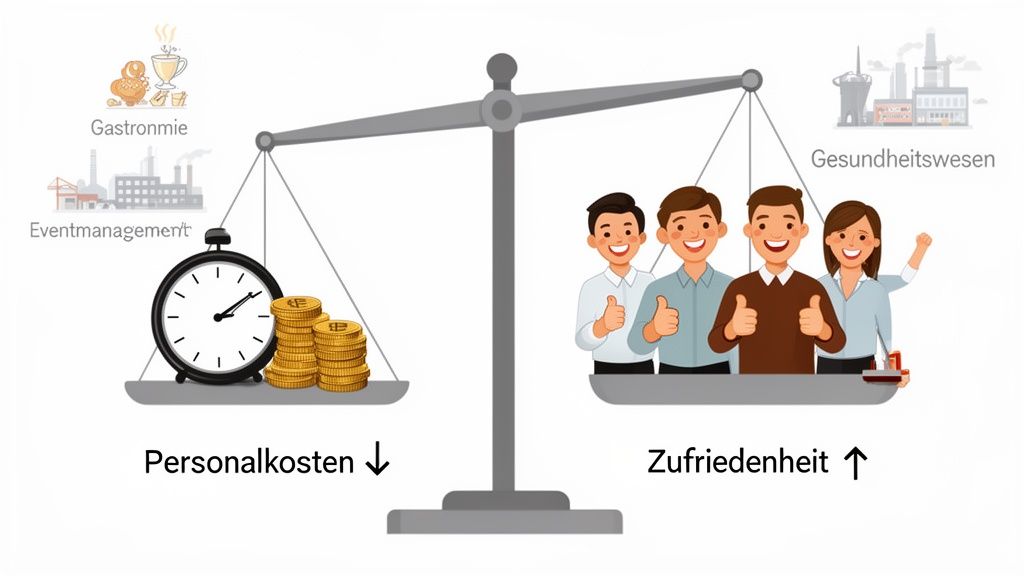
Switching from manual lists and Excel spreadsheets to a smart system often feels like a quantum leap. Instead of spending hours moving names back and forth in a spreadsheet, at the touch of a button you get a suggestion that not only works, but is also economically smart and fair for everyone.
Manage personnel costs wisely
One of the biggest levers you can use with AI-based deployment planning is the precise control of your personnel costs. The system helps you avoid costly mistakes that are almost inevitable when planning manually.
This is how you specifically save money:
- Avoiding overtime: The AI detects impending overtime early on and suggests clever alternatives before the costs even arise.
- Reduction of idling: Thanks to precise demand forecasts, you can only plan as many employees as you actually need. The result? Significantly fewer unproductive hours.
- Good utilization: Employees with part-time contracts are scheduled exactly according to their contractually agreed hours, which ensures fair and cost-effective planning.
A typical example from the catering industry makes this tangible: As a restaurant manager, you see the good weather forecast for the weekend. Instead of ordering more staff across the board, the AI analyzes the data from past sunny days and calculates the exact additional requirement for service and kitchen. This maximizes sales without unnecessarily increasing labor costs.
Noticeably increase satisfaction in the team
Satisfied employees are the foundation of every successful company. Fair and transparent planning is an often underestimated but absolutely crucial factor. One is playing right here AI-based deployment planning all their strength.
A fair plan is not a product of chance. It arises when a system takes into account the wishes of employees, operational needs and legal regulations objectively and without personal preferences.
The system ensures that unpopular shifts are distributed fairly and individual requests are automatically taken into account, if operationally possible. This traceability creates trust and noticeably reduces conflicts in the team. When employees feel that they are treated fairly, fluctuation decreases - and you save yourself the high costs and effort of constantly looking for new staff.
The Swiss hospitality industry is at a turning point here. An analysis shows that around 34% of hotels and restaurants in Switzerland use artificial intelligence for their personnel deployment planning. This development is being accelerated by the shortage of skilled workers and digitalization, as AI tools massively reduce the planning effort and guarantee good staffing levels. More about theYou can find AI trends in the Swiss hospitality industry at personal-schweiz.ch.
Respond to changes in real time
Your business is dynamic – your planning should be too. The true power of an AI-powered platform like job.rocks is revealed when the unexpected happens.
Imagine your hotel suddenly expecting a wave of new guests due to a short-term trade fair booking.
- Manual response: As a manager, you frantically call employee lists to somehow find additional staff for reception and housekeeping. Pure stress.
- AI-powered response: The booking system reports the higher utilization directly to the planning software. The AI immediately checks which qualified employees are available and automatically sends requests via the app. Within minutes, the plan is adjusted and the additional needs are met.
This ability to act at lightning speed and based on data gives you enormous security and flexibility in your everyday operations. You no longer just react to problems, but rather organize your operations proactively and confidently.
How the technology works behind the scenes
You don't have to be a tech pro to understand what makes AI-based scheduling so powerful. Think of it like a good recipe: only with the right ingredients will the dish taste good in the end. It's very similar with AI - the ingredients here are simply data.
The system works at its best when it can work on a broad, high-quality data set. The more suitable information you give the AI, the more accurate and useful the planning suggestions it makes for you.
What the AI is fed with
Smart planning software is hungry for information. It makes connections between countless data points to paint a complete picture of your operation and find patterns a human would never see.
The most important “ingredients” for success AI-based deployment planning are:
- Employee master data: Name, contact details, contract type (full-time, part-time, freelancer) and of course the current working time balance.
- Qualifications and Skills: Who is allowed to operate which machine? Who has the necessary driving license? Who speaks which languages?
- Availabilities and wishes: When can and want to work your employees? Are there vacation requests or times already blocked?
- Historical order and deployment data: How did previous missions go? How many staff were required for similar events or on certain days of the week?
- Legal and operational rules: Working time laws, break regulations, collective agreements and your internal rules.
You can think of the AI as a detective. She combs through all these clues and uncovers connections. This is how she notices that you on rainy days 20 % You need fewer staff for the outside area of your café or that a certain customer always requests the same three team members.
How AI recognizes patterns and learns
At the heart of all the magic are so-called machine learning models. These algorithms are trained to look for recurring patterns in the data. They learn from every single deployment in the past and become smarter over time.
Let's take your hotel, which struggles with seasonal fluctuations. Business is booming in summer, but quieter in winter. The AI analyzes booking data from the last few years and spits out a surprisingly accurate demand forecast for the coming season. She knows exactly when you should plan for more staff at the reception or in housekeeping.
This learning process never stops. When you plan a new job, the system quickly compares it with thousands of similar missions from the past. It then not only suggests the right number of employees, but also the best candidates - based on their skills and previous performance. The result is a planning process that becomes more accurate and reliable from month to month.
Why interfaces are the be-all and end-all
However, AI planning software only develops its full potential when it does not work as an isolated island. What is crucial is a seamless connection to the other systems in your company. This is the only way data can flow freely and always remain up to date.
Just imagine that your scheduling is directly linked to your time tracking app and payroll.
- An employee clocks in and out as normal via the app.
- The recorded hours are automatically incorporated into operational planning and the working time balance is updated in real time.
- At the end of the month, the validated hours are transmitted directly and without detours to payroll.
This closed cycle ensures that your planning is always based on correct, up-to-date data. Manual transmission errors? Belonging to the past. Your administrative effort is noticeably reduced. A well-connected system is simply the basis for truly smart personnel management. If you want to go deeper, read more about the importance of Interfaces for smooth operational planning in our further article.
Your introduction roadmap in six steps
The introduction of one AI-based deployment planning doesn't have to be a confusing large-scale project. With a clear plan, you can ensure that the solution ultimately delivers exactly what you hope for. Consider the following six steps as your personal roadmap - it will guide you safely from the first idea to a successful start throughout the entire company.
This process shows the core of AI deployment planning at a glance: from data entry through analysis to the finished plan.
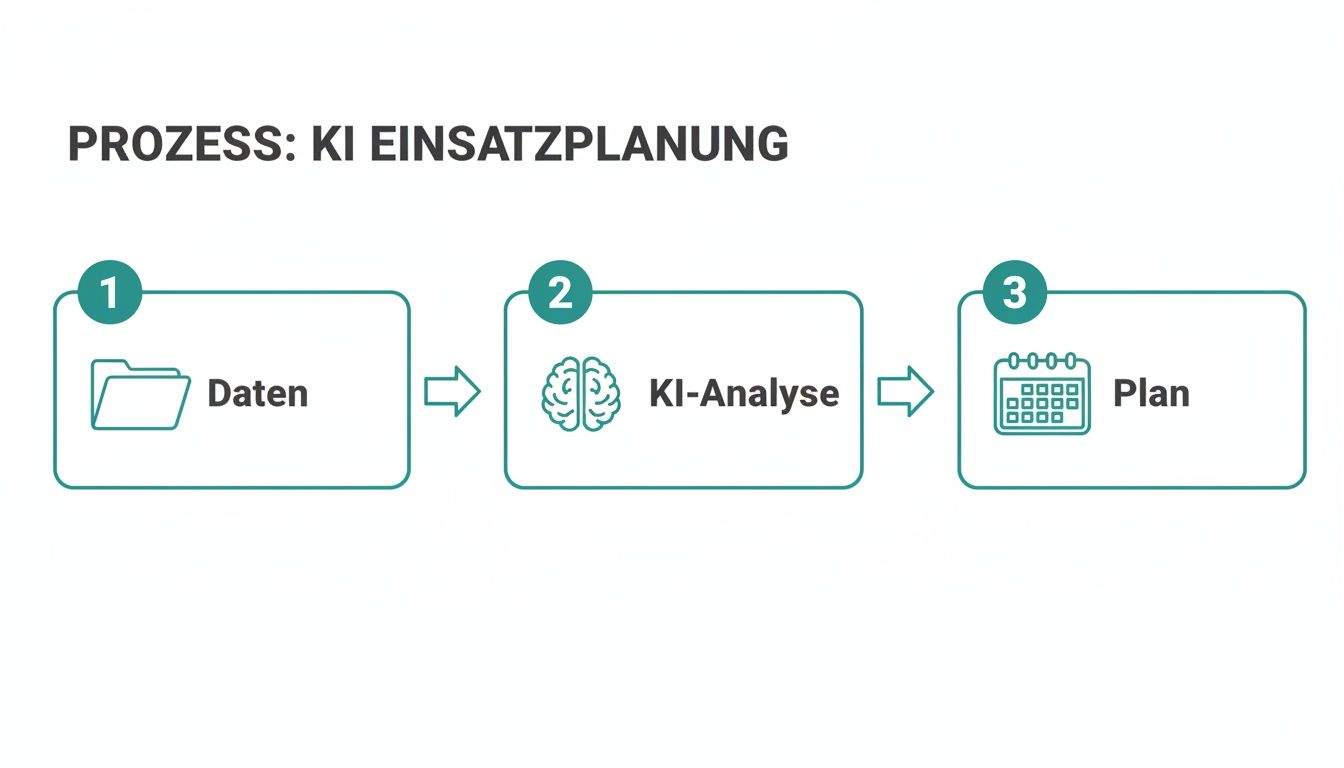
The graphic makes it clear: without high-quality data, AI cannot provide intelligent analysis, and without this analysis there is no good operational plan. Everything depends on the quality of the input.
Step 1: Clearly define goals
Before you even start looking for software, ask yourself honestly: What exactly should be improved? Do you primarily want to reduce administrative effort and reduce the planning cycle from days to minutes? Or is your focus on reducing personnel costs by avoiding expensive overtime?
Define measurable goals. A goal could be: "We want to save time for weekly shift planning 80 % reduce" or "We would like to fill the unfilled shifts within 24 hours 90 % decrease". Only with such clear key figures can you really measure success later.
Step 2: Choose the right partner
The market for software solutions is huge and confusing. When choosing, pay attention not only to stylish surfaces, but also to the functions that are really crucial for your defined goals. Check whether the software can reflect industry-specific requirements - planning for a hospital is very different from that of an event service provider.
Insist on a live demonstration and let us show you how a typical use case from your everyday life is depicted. A good partner takes the time to understand your processes and offers reliable support that is there for you even after the purchase.
Step 3: Involve the team from the start
The best software is of absolutely no use if it is not accepted. The biggest hurdle is often not the technology, but the people. Many employees have reservations or even fears when they hear the word “AI”.
Communicate openly and honestly the benefits that the new system will bring to each individual. These could be fairer plans, easier vacation applications via an app or simply more transparency. Involve key people from the team, such as experienced shift managers, early on in the selection and testing process. In this way, you turn those affected into participants and proactively reduce resistance.
A successful introduction depends on acceptance within the team. If your employees recognize the benefits for themselves, the project will become a sure-fire success.
There is still a certain level of reluctance on this topic, especially in Switzerland. A survey of Swiss SMEs showed that over half are not yet using AI applications and a majority are skeptical. The main obstacles are a lack of internal knowledge and fear of resistance from employees. Find out more about the Attitude of SMEs towards AI on statista.com.
Step 4: Prepare data and set up the system
Now it gets practical. Your data will be transferred to the new system together with your software provider. This includes employee master data, qualifications, working time models and existing regulations. This is the perfect time to clear out old data and critically examine dusty processes.
The software is then configured. The system learns your operational rules so that the AI-based deployment planning can make really tailored suggestions later.
Step 5: Test in a pilot phase
Under no circumstances should you start the entire company straight away. Select a department or team as a pilot group to put the software through its paces in real everyday work. This test phase is worth its weight in gold.
Here you can collect invaluable feedback, identify possible teething problems and fine-tune the configuration before things get serious. Your pilot group will later become important advocates when it comes to the company-wide launch.
Step 6: Company-wide start and success monitoring
After a successful test phase, it's time for the big start. Plan training for all users to ensure everyone knows the new features and can navigate the system.
Follow the start closely and offer a central point of contact for questions. After a few weeks, you will check whether you have achieved the goals defined in step 1. Celebrate the successes with your team and use the knowledge you gain to continuously improve the processes.
Compliance and data protection, but please understand
If you have one AI-based deployment planningAnchored in your company, you inevitably juggle with sensitive personnel data. That's exactly why the software you choose must fully meet the strict data protection regulations. This is not an option, but a duty. In Switzerland, the new Data Protection Act (DSG) sets the tone, and for many the European General Data Protection Regulation (GDPR) is also relevant.
These laws are not harassment, but rather the foundation for fair coexistence. They protect the basic rights of your employees and create clear rules for dealing with information such as names, qualifications or working hours. A violation can not only permanently undermine your team's trust, but can also result in severe fines.
The cornerstones of data protection
Two principles are the be-all and end-all when dealing with employee data: Data minimization and Earmarking. They are the basis for a trustworthy and legally compliant process.
- Data minimization: The system should only know what it really needs to know for operational planning. Private information that plays no role in shift allocation simply has no place in the software.
- Earmarking: The data collected is only there for the agreed purpose - i.e. personnel planning and directly related processes such as payroll. Sharing or using it for other purposes is taboo.
Well-thought-out software like job.rocks is built from the ground up to live these principles. It only requests appropriate information and ensures that it is used securely and exclusively for personnel management.
Transparency and fairness in AI decisions
If an algorithm decides who gets which shift, this process must be crystal clear for your employees. Non-transparent “black box” systems, in which no one understands why a decision was made one way and not another, sow distrust.
Your employees have the right to know which criteria the AI uses to make its suggestions. A good platform explains why a particular person was chosen for a shift - based on their qualifications, availability or the fair distribution of workload.
It is your responsibility to ensure this transparency. Communicate openly how the system works and what benefits it brings to everyone. Make sure the automated decisions are fair and do not discriminate against anyone. Only then will AI be perceived as what it should be: a supporting tool that creates objective and comprehensible plans.
Secure data storage and the rights of your employees
Where your employees’ data is located is also crucial. For Swiss companies there is one Server location in Switzerland a clear quality feature. This guarantees that the data is protected by strict Swiss legislation and does not flow abroad in an uncontrolled manner.
In addition, your employees have clearly defined rights that you must ensure at all times:
- Right to information: Any person can request to know what data is stored about them.
- Right to rectification: Incorrect data must be corrected immediately.
- Right to deletion: After leaving the company, the data must be deleted after the statutory retention periods have expired.
Professional software takes the work off your hands and helps you process these requests quickly and easily. You can find more details about how job.rocks implements these requirements in our explanation Data protection and data security.
How job.rocks specifically supports you
You have now seen what a AI-based deployment planning In theory everything can be done and how it reshuffles the rules of the game in personnel management. But how does that feel in everyday life? At job.rocks we have poured these concepts into a clear, intuitive platform that takes work off your hands instead of creating new ones.
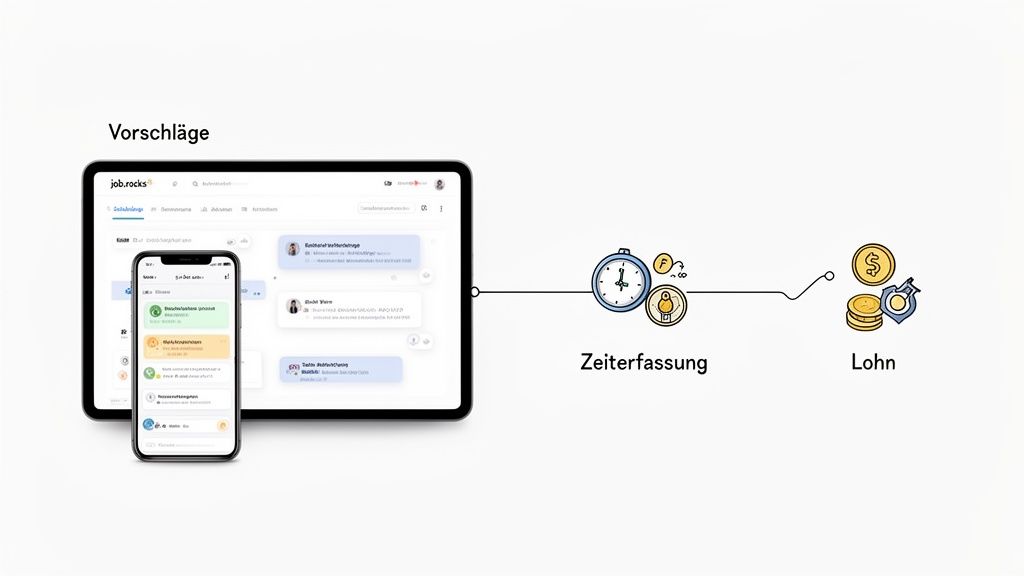
Our goal was to develop a tool that fits seamlessly into your workflow. One that gives you the freedom to concentrate on what's important: your team and your customers. Let's look together at how this works in practice.
Smart suggestions instead of endless searching
Imagine you have an open shift for a major event and you urgently need someone with specific security certification. Instead of manually sifting through Excel lists or making dozens of calls, job.rocks does it for you.
The platform automatically suggests a list of the most suitable and available employees. The AI takes into account not only formal qualifications, but also factors such as the current working time balance or previous deployment history. With one click you send a request to the top candidates – done.
Automated shift schedules that simply fit
Creating a complete weekly or monthly plan is often the most time-consuming task. With job.rocks you just define your needs and the system creates a clever draft plan.
The algorithm ensures a fair distribution of shifts and pays close attention to compliance with all legal requirements. You use this draft as a basis, make manual adjustments if necessary and release the finished plan directly to your team. More about how ours AI shift planner simplifies your planning, you can find it in our special article.
Everything in one place: from planning to payroll
Good planning is only half the battle. The real value only comes when the entire process runs smoothly from start to finish. This is exactly where our approach comes in.
- Planning: You create and publish the stakes with just a few clicks.
- Communication: Your team receives all information directly via the mobile app, can report availability and apply for shifts.
- Time recording: Employees clock in and out precisely via the app – to the minute.
- Billing: You check and validate the recorded hours, and the data flows neatly into your payroll accounting.
This closed loop eliminates manual transmission errors and reduces your administrative effort to a minimum. You have full control and transparency over the entire HR process at all times.
job.rocks is more than just planning software. It is your central cockpit for all personnel management, helping you to act faster, more fairly and more economically.
The use of such tools is not just a question of convenience, but has long been a crucial economic factor. An analysis by PwC shows that the increased use of AI in Switzerland creates value creation potential of around 28 billion Swiss francscan be lifted. About there 20% of all jobs have great potential for AI-supported improvements, smart planning tools play a central role in future competitiveness. The whole thing You can read the analysis of Switzerland’s AI ecosystem at PwC.
The most frequently asked questions about AI in operational planning
If you're thinking about introducing one AI-supported deployment planning When you think about it, questions naturally arise. This is completely normal. Here we give you clear and direct answers to the most common concerns so you can make an informed decision for your business.
Will AI replace my dispatchers?
No, quite the opposite. AI is not a replacement for human experience, but an extremely powerful tool for your planners. It relieves you of the tedious routine work - manually searching through lists or constantly comparing availability is a thing of the past.
This gives your dispatchers valuable time. Time that you can use to take care of complex tasks, have personal conversations with employees or respond to unexpected customer requests. The AI provides the data and suggestions, but humans make the final, strategic decision.
How quickly does the investment pay off?
Purchasing specialized software is an investment that often pays for itself faster than you think. The savings arise on several levels:
- Less planning effort: The time required to create shift schedules is drastically reduced. Often from several hours per week to just a few minutes.
- Lower personnel costs: Accurate demand forecasts help you avoid expensive overtime and costly idle time.
- Lower turnover: Fair and transparent plans increase employee satisfaction, which noticeably reduces the costs of recruiting new staff.
Many companies report that these direct and indirect savings pay off the costs within the first few months.
Is the introduction complicated and lengthy?
The fear of an endless IT project is understandable, but with modern solutions it is usually unfounded. Today's software like job.rocks is designed to ensure that the introduction goes as smoothly as possible. With a clear roadmap like the one we described before, you can proceed step by step.
A good provider will accompany you throughout the entire process – from data transfer to training your team. A pilot phase with a selected department also helps to identify teething problems at an early stage and to optimally adapt the system to your needs before the company-wide launch takes place. In practice, the entire process is often completed in just a few weeks.
What if my employees reject the technology?
This is one of the most common worries, but also one that you can actively control. The key is open communication. Explain to your team the benefits of the new system right from the start for you personally brings.
AI-based scheduling means fairer shifts for your employees, easier vacation planning via app and more transparency. It is not a control instrument, but a tool for a better everyday working life.
Involve your team early on, take concerns seriously and show how the software makes everyday life easier. When employees experience the benefits themselves, initial skepticism quickly gives way to acceptance.
Ready to take your deployment planning to the next level? Discover how job.rocks helps you plan faster, fairer and more economically. Request your personal demo now.