
Planning Pharmacy Duty Rosters – Your Step-by-Step Guide
Plan pharmacy duty rosters securely and GDPR-compliant: shift models, qualifications, on-call duty, and substitutions – with practical examples for Swiss teams.
Monday morning, 8:15 a.m., a neighborhood pharmacy in Zurich. The early shift is set, the holiday replacement hasn’t arrived yet, a part-time colleague calls in sick, and the pharmacist who approved the schedule cleanly on Friday evening is currently at the kindergarten school start. This is exactly when it becomes clear whether your pharmacy duty roster just sorts hours or truly supports the operation.
In the dispensary, it’s not enough to just put names into slots. You need opening hours, qualifications, on-call duty, vacations, and short-term substitutions in a schedule that works even under pressure. Anyone who has experienced a shift failing due to a missing pharmaceutical professional knows that a pharmacy roster must be structured differently than one for hospitality or office work.
Table of Contents
- Why the Pharmacy Duty Roster Is More Than Just Assigning Shifts
- Understanding Legal and Operational Frameworks
- Mapping Qualifications and Roles in the Shift Model
- Managing Substitutions, Vacations, and Emergencies
- Mobile Shift Communication and GDPR-Compliant Data Protection
- Excel, Classic Shift Software, or Workforce Platform
- Your Weekly Checklist for the Next Duty Roster
Why the Pharmacy Duty Roster Is More Than Just Assigning Shifts
A Monday in a Zurich neighborhood pharmacy rarely starts quietly. Three part-time employees are on site, one pharmacy technician (PTA) is on vacation, and the pharmacist has a school appointment at 7:30 a.m. The weekly schedule looked neat on Friday, but by 8:15 a.m., the first gap is already apparent.
The reason is simple but underestimated in many businesses. A pharmacy operates not only with working hours but with pharmaceutical presence, consultation needs, prescription peaks, and fringe times. In Germany, already in 2014, 1 billion patient contacts were counted across about 20,000 pharmacies, which well illustrates the rhythm of consultation, prescriptions, and on-call duty. This comparison is relevant for Switzerland as well, because operations here also run in waves rather than linearly.
The Four Building Blocks That Support Your Roster
A sustainable pharmacy duty roster requires four things simultaneously. First, a clear demand planning, meaning when you really need staff. Second, a qualification matrix so you don’t just schedule heads but the right functions. Third, a substitution logic for vacations, illness, and fringe times. Fourth, clear communication so the schedule doesn’t fall apart in the team chat.
Practical rule: A good pharmacy roster rarely fails due to the number of hours but almost always because of a gap in qualification or availability.
Regional supply in Switzerland is also unevenly distributed. According to data from the Federal Statistical Office (BFS) and pharmaSuisse, cantonal pharmacy densities vary significantly, so you need more local coverage for opening hours, on-call duty, and holiday replacements than a rigid standard network would provide. Anyone who simply copies a retail template here overlooks the dispensary’s role as a supply point.
A typical mistake is focusing only on working hours. In a pharmacy, it’s not enough that someone is “there.” The right person must be there, with the right authorization, at the right time. That’s why your schedule must first answer these questions before entering names: Which times are covered, who is authorized for what, and who steps in if someone is absent?
Understanding Legal and Operational Frameworks
Before you block out time in the calendar, you need the rules of the game. In Germany, pharmacy on-call duty is regulated in § 23 ApBetrO, with clear exemption times, for example Monday to Saturday from 0:00 to 8:00 a.m., Monday to Friday from 6:30 p.m. to midnight, Saturday from 2:00 p.m. to midnight, as well as Sundays and public holidays § 23 ApBetrO. For a weekly schedule, this means you must think about fringe times separately, not just “open” or “closed.”
In practice, a schedule often fails exactly at the boundary between opening hours and on-call duty. A pharmacy open until 7:00 p.m. needs a separate rule for the period starting at 6:30 p.m. Ignoring this boundary means the schedule looks clean on paper but is messy in daily operations.
Separating Hard and Soft Rules
Some requirements leave little room for maneuver. Others you must solve internally. This is the difference between a schedule that works in the team and one that must be rebuilt every Friday evening.
| Rule | Source | Hard or Soft | Planning Impact |
|---|---|---|---|
| Pharmaceutical staff during opening hours | Papershift Blog on Staff Scheduling for Pharmacies | hard | No shift approval without qualified staff |
| On-call duty and exemption times | § 23 ApBetrO | hard | Plan fringe times separately |
| On-call duty with rest period afterwards | Nostradamus on Pharmacy Duty Rostering | hard | Check rotation and follow-up shifts |
| Break and overtime arrangements | internal planning | soft | Set internally but coordinate with schedule |
Working time logic is not a side issue. For planning, it means rest periods, breaks, and overtime must be checked together with staffing. Covering only opening hours quickly leads to errors at transitions.
A weekly pharmacy roster is never just a list of rows. It is a sequence of checks where qualification, on-call duty, and rest periods must fit together.
For the Swiss context, opening hours and cantonal regulations vary by region. That’s why a rigid template from a single mold works poorly. If you want to work properly, first define the time windows and then check which roles are needed in each window. Those who approach staffing structurally will find additional ideas for practical deployment logic under Staff Scheduling in Healthcare.
Mapping Qualifications and Roles in the Shift Model
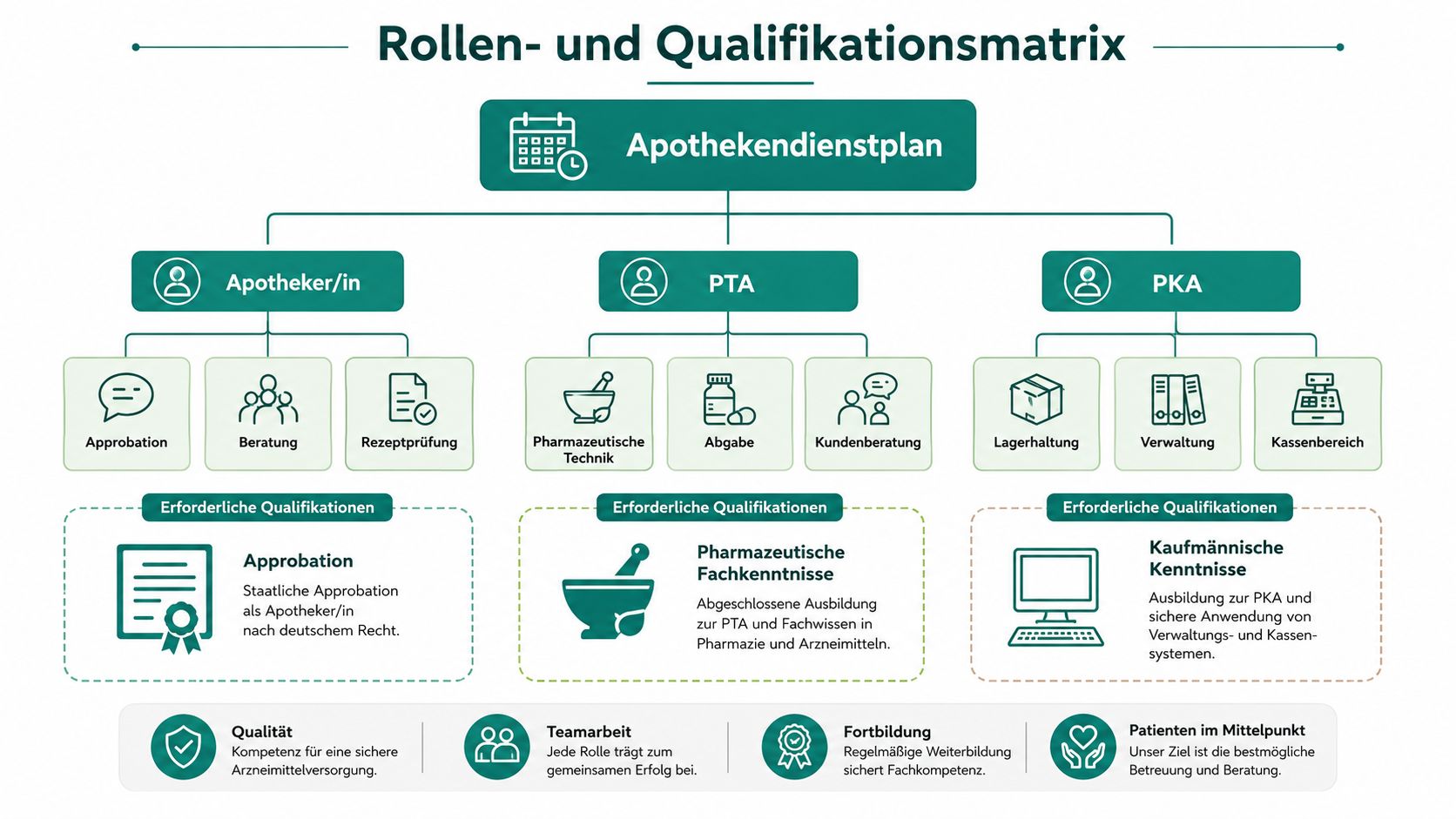
The most important part of the pharmacy duty roster is the role question. Not every person is allowed to take on every task, and this is where most misunderstandings arise in the dispensary. Pharmacists, PTAs, and PKAs have different responsibilities, and the schedule must reflect this before you look at hours.
Who Covers What
The pharmacist is responsible for consultation, prescription verification, and professional responsibility. The PTA covers pharmaceutical technology, dispensing, and customer consultation. The PKA manages the cash register area, administration, and inventory. Mixing these roles on the schedule may mean you have enough heads but the wrong mix in daily operations.
The pharmacy operating regulations require sufficiently qualified staff during opening hours, implemented through authorized pharmaceutical personnel. The on-call duty principle is also clear: a pharmacist takes it on. This means your weekly structure must build the early shift not only by hours but by function.
A Weekly Pattern from the Dispensary
A realistic pattern often looks like this: Monday to Friday, a pharmacist covers the professional line, supported by a PTA for consultation and dispensing. Saturdays usually require more team support because more things happen simultaneously. On-call duty rotates among pharmacists so that the same person doesn’t always cover fringe times.
This sounds simple but quickly becomes tight with part-time staff. The professional must not only be present but also keep breaks, cash register, and compounding in view. For example, if you schedule only one pharmaceutical-qualified person in the morning, their day immediately conflicts with breaks, cash register, and compounding.
Practical rule: Never schedule “one person per shift,” but always “a functioning role combination per time window.”
A clear skill matrix helps. It lists each person’s qualifications, languages, compounding experience, on-call capability, and fixed absences. This way, you can see for each shift who carries the professional responsibility and who supports operational tasks. This matrix is the basis for later automatic assignment, whether you work with Excel or a platform.
Managing Substitutions, Vacations, and Emergencies
Saturday morning, 6:30 a.m. A PTA calls to say she can’t come. The schedule is set, the sales area opens soon, and now the hectic search for a replacement begins. Anyone who has been in the back office at such a moment knows that substitutions don’t happen on the side.
First the Pool, Then the Emergency
A functioning substitution pool starts internally. Then partner pharmacies, then external temps. This order saves time because you don’t start from scratch with every absence. For a short-term sick call, you first check availability, then qualification, then shift details, and only then send the request.
Practice often fails for three reasons. First, there is no current overview of who can work when. Second, qualification and shift don’t match. Third, the request reaches the right person too late. If you send the mobile shift alert only at noon, the early coverage is already lost.
Vacations require the same attention. Anyone wanting time off in summer must block early, or planning collides with on-call duty and weekend load. For businesses with many part-time workers, the order is important: first collect vacation requests, then prioritize, then approve, then integrate into the schedule.
How the Emergency Process Runs Smoothly
A short, practical workflow helps in daily operations:
- Check availability. Who is reachable and deployable?
- Match qualifications. Who is authorized to cover the shift professionally?
- Request replacement. Preferably via a mobile channel with clear shift details.
- Check conflicts. No overlaps with rest periods, vacations, or on-call duty.
- Note handover. What remains open, what is already done?
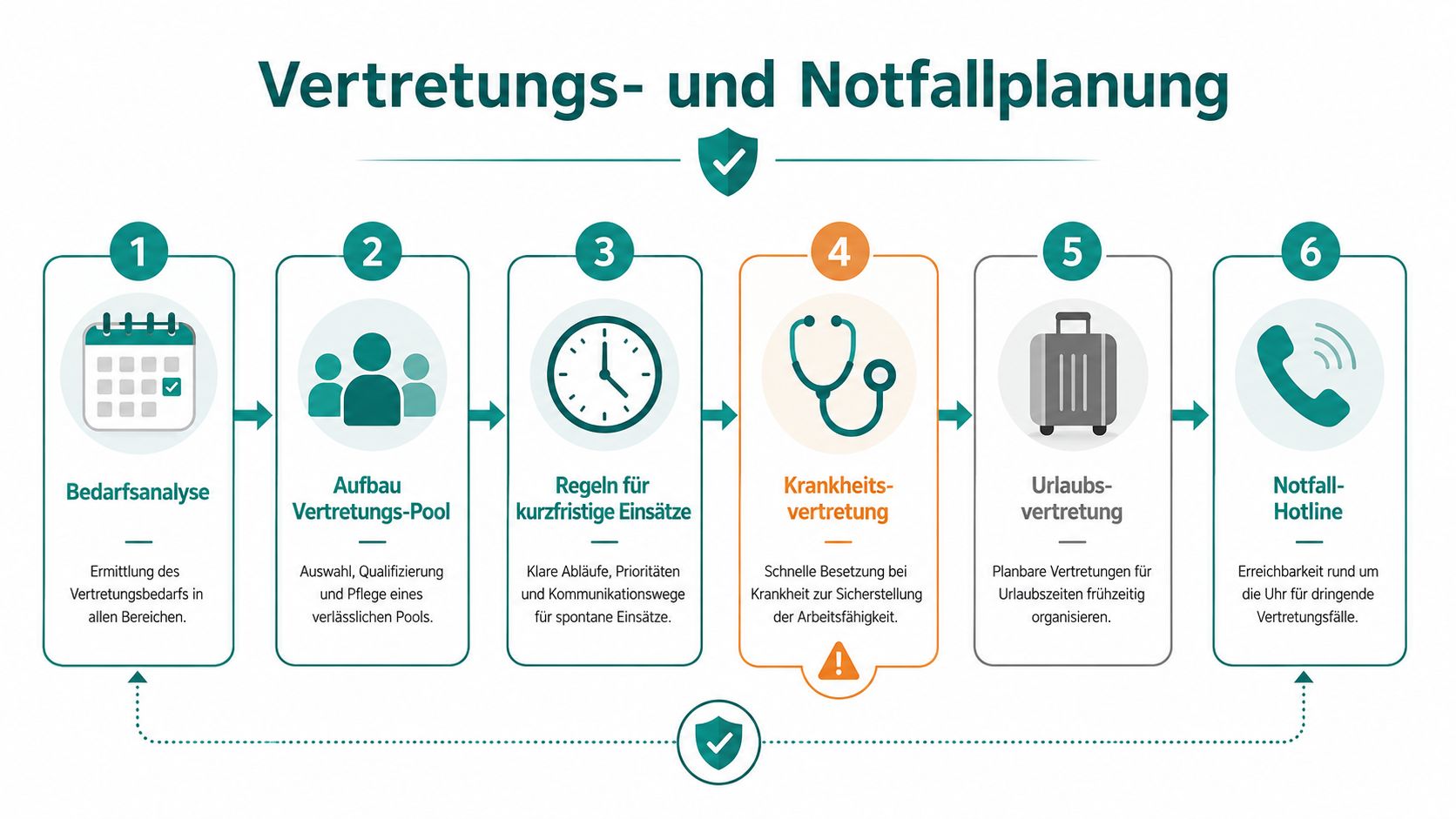
Mistakes usually happen where the replacement arrives but the role doesn’t fit. A well-intentioned double staffing doesn’t help if no one brings the required professional function. That’s why qualification checks must be part of every substitution process before confirmation.
Mobile Shift Communication and GDPR-Compliant Data Protection
A duty roster is of little use if the team doesn’t see it in time. The biggest mistakes today don’t happen in the calendar but in the shift chat. Private messengers with patient details, Excel files on private phones, and unclear access rights are unnecessary risks in pharmacy daily life.
How Secure Team Communication Works
A mobile employee app can clarify the process. Availability queries run centrally, shift details are visible only to the right person, shift swaps are documented, and reminders come directly to the device. Time tracking and changes should happen in a closed employee area, not in an open chat group.
Four simple rules help with data protection. First, data minimization—no health data in the shift chat. Second, a data processing agreement with the provider. Third, clearly regulated access to timesheets and schedule versions. Fourth, a documented deletion concept. For a compact practical reference, the Data Protection Guide for FMCG by Echt AG is worthwhile, as it clearly explains responsible data handling in daily business.
Swiss DSG and GDPR operate similarly in practice, although you must internally document your own rules clearly. Shift schedules belong in a protected area. Push notifications don’t need real names, and time verification belongs in an auditable trail.
Anyone digitizing the schedule must control access more strictly than with paper before. Otherwise, convenience quickly becomes a data protection problem.
Introducing this works better if you keep it small. First train PTAs and PKAs, then clarify access rights, then test closely for the first 30 days. Anyone who unlocks everything too early ends up with more questions than before.
For technical selection, you’ll find a suitable comparison in the Overview of GDPR-Compliant Scheduling Tools. If you don’t want to separate mobile approval, swaps, and time tracking clearly later, the schedule quickly becomes confusing.
Excel, Classic Shift Software, or Workforce Platform
The tool choice depends on how many roles you need to check simultaneously. In a pharmacy, it’s never just about hours but also qualifications, on-call duty, and availability. That’s why the cheapest solution isn’t always enough, even if it looks tempting at first glance. Anyone who has updated a weekly schedule with vacations, fringe times, and a short-term absence knows how quickly a small gap spreads through the whole plan.
Three Approaches, Three Strengths
Excel is flexible and quick to start. You can map a lot with it, but you must check qualifications, rest periods, and on-call duty manually. In a pharmacy with part-time, vacation rotation, and fringe times, this quickly becomes error-prone. A free Excel template for getting started is here: https://www.job.rocks/arbeitsplan-excel-vorlage/.
Classic shift software usually checks conflicts better than Excel. Many of these tools are built for uniform shift models and only partially fit the roles in a pharmacy. Once pharmacists, PTAs, and PKAs are deployed differently, the logic often becomes tight, especially when substitutions or on-call duties are added.
A workforce platform like job.rocks maps availability, qualification filters, automatic assignment, mobile communication, and time tracking in one workflow. This fits better for a pharmacy that must coordinate opening hours, on-call duty, and part-time work. The difference shows in daily life when not only a duty roster is created but it’s also clear who is professionally deployable and who takes over in substitutions.
| Criterion | Excel | Classic Shift Software | Workforce Platform |
|---|---|---|---|
| Qualification Check | manual | partially automated | systematic |
| On-call Duty Check | manual | often limited | rule-based |
| GDPR and Swiss DSG | depends on business | depends on provider | centralized with role rights |
| Mobile Communication | via email or chat | sometimes available | directly integrated |
Which Scenario Fits Which Tool
A small independent pharmacy with few permanent staff often manages well with Excel, as long as someone maintains the schedule very carefully. A pharmacy with mail order needs a system that cleanly manages availability and shift swaps. A branch network with three locations benefits most from a platform because role and location changes happen more frequently. This is exactly where it becomes clear whether the schedule just looks nice or really supports daily operations.
In the end, the choice is less a matter of belief and more a question of error sources. The more part-time, on-call duty, and vacation planning are involved, the more expensive manual checking becomes. Anyone who has experienced this in daily life knows: the problem is rarely the planning itself but the follow-up after every planning error.
Your Weekly Checklist for the Next Duty Roster
Start with demand planning. Opening hours, on-call duty times, and expected peaks belong on the table first. Then comes role distribution so you know who covers what professionally.
Next, check availability and the substitution pool. Vacations, fixed days off, and short-term absences must be clear before assigning shifts. Only then build the schedule and check rest periods, fringe times, and the presence of the right qualified person.
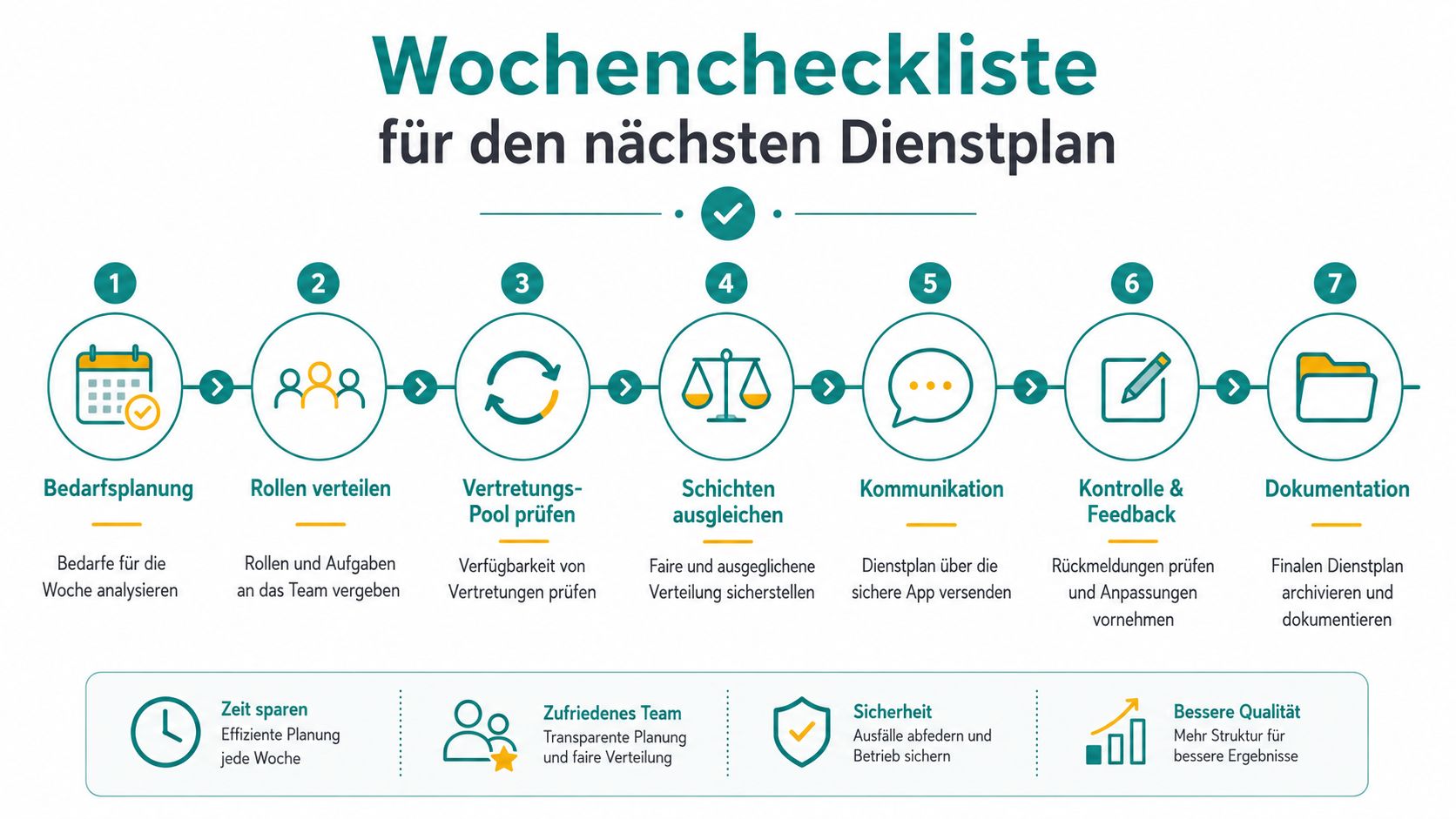
Communication runs through a secure channel, not private chats. Finally, check the clocked hours against the schedule and record conflicts so the next cycle runs more smoothly. Anyone who introduces this process properly quickly realizes that the pharmacy duty roster doesn’t get easier but becomes much more controllable.
job.rocks can help you manage availability, shift swaps, qualification filters, and mobile communication in one system. If you want to move your pharmacy duty roster away from paper chaos and private chats, see how job.rocks is built for flexible teams and whether it fits your business.