
Qualification Matrix for Workforce Scheduling: A Practical Guide
Qualification matrix for workforce scheduling. Learn how to build, maintain, and use a qualification matrix as a software criterion for workforce planning.
You are scheduling Friday evening shifts for a hotel, an event, or a ward service. The system shows enough people marked as available. But once you assign specific tasks, the real problem emerges: the evening service lacks the right experience, the night shift requires a valid certification, and the ward service needs the necessary specialization. A simple availability query only tells you who has time. It does not tell you who can safely and appropriately take on a task within the required time frame.
A qualification matrix in workforce scheduling connects exactly this information. It lets you see which employees are suitable for a role, which certifications are valid, and where there are coverage gaps. This guide shows you how to build, maintain, and evaluate the matrix for Swiss operational practice and how to use it as a criterion when selecting workforce scheduling software.
Table of Contents
- Why the Qualification Matrix Is Missing in Workforce Scheduling
- Step-by-Step Construction of a Qualification Matrix According to Swiss Practice
- Capturing Roles, Skills, Certifications, and Time Windows Practically
- Maintenance and Updating of the Matrix in Daily Operations
- Leveraging Integration with Workforce Management Software
- Qualification Matrix as a Selection Criterion for Workforce Scheduling Software
- Conclusion: The Three Most Important Levers for a Usable Qualification Matrix
Why the Qualification Matrix Is Missing in Workforce Scheduling
At an event, twelve people are available for setup. But for stage logistics, you don’t just need any twelve people. Some can only help with materials, others are allowed to handle technical tasks, and some know the local procedures. Without graded qualifications, the deployment management often decides based on memory or simply who performed well last time.
The situation is similar in a hotel. Several employees volunteer for the early shift, but only some know the breakfast service, cash register processes, or the desired language for guest contact. In healthcare, a free shift is not enough if the person lacks the necessary experience for a ward or a specific task. In security services, availability alone is insufficient; role, experience, location, and authorized tasks must also align.
Practical rule: Availability tells you when someone can work. The qualification matrix shows you which task that person can then take on.
In Switzerland, 15.9% of employees worked shifts in 2022, while 8.6% had changing working hours. This means that when planning, you must not only check free time slots but also suitability for night, weekend, and rotating shifts (Source on Swiss shift work).
A general skills list only helps to a limited extent. It may record that someone knows “service” or “first aid.” An operational matrix assigns this information to a role, a level, a certification, and a time window. This connection is what distinguishes a personnel development overview from a tool for daily staffing.
Step-by-Step Construction of a Qualification Matrix According to Swiss Practice
A useful matrix does not arise from collecting as much data as possible. You start with the work system and build the overview so that it supports a concrete staffing decision. The Swiss methodology describes six steps: define the work system, record functions, capture employees per shift, grade actual qualifications, define required qualifications including absence risk, and perform the target-actual comparison with appropriate measures (Swiss methodology for qualification matrix).
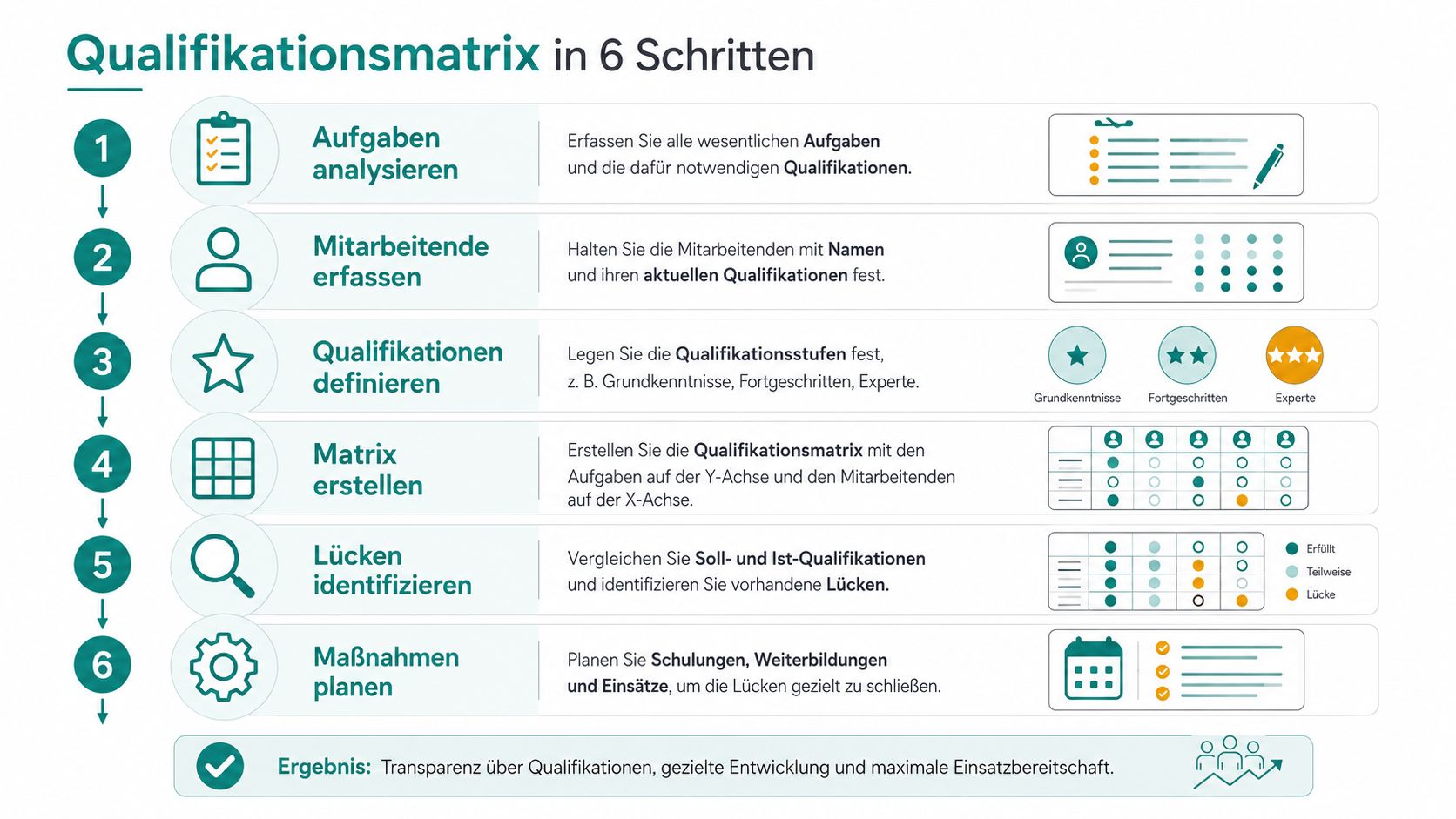
The Six Steps with Operational Goals
-
Define the work system: Specify the location, assignment, service area, and shifts. For an event hall, setup, admission, service, and teardown do not automatically belong in the same view.
-
Record functions: List each role with its actual task. “Service” is too vague if you distinguish between bar, cloakroom, and VIP support.
-
Capture employees per shift: Assign people to the relevant work system and possible time windows. This shows whether a qualification is available only during the day or also at night.
-
Grade actual qualifications: Avoid simple yes/no logic. A level can mean “not deployable,” “trained,” “independently deployable,” or “can train others.” Such a scale separates learning needs from immediate deployability.
-
Define required qualifications including absence risk: Determine the level a role requires and how many people must actually cover this task in the schedule. Illness or short-term cancellations must be considered.
-
Perform target-actual comparison: Compare the required levels with existing profiles. If there is a gap, decide between further training, reassignment, or temporary reinforcement.
For a nursing team, this might mean: the ward requires an independent level for a task. One person is trained, two are independently deployable, and another’s certification is no longer valid. The matrix shows not only the gap but also which shift rearrangement could still cover the service. For roles and tasks, developing precise requirement profiles helps to clearly formulate the target side.
When you maintain the first version in a table, ensure clear columns, fixed evaluation rules, and a separate view per shift or work system. A personnel planning with Excel can suffice initially, as long as responsibilities, validity, and changes are traceable.
Capturing Roles, Skills, Certifications, and Time Windows Practically
The quality of the matrix depends on separating its data. A role describes what someone does during deployment. A skill describes what the person can do for it. A certificate or other proof shows how this ability is verified. The time window indicates when the person can actually take on this role.
Swiss professional literature describes the competency matrix as a table with employees in rows and skills in columns. For Swiss organizations, besides formal qualifications, proofs, language skills, experience, and deployment windows also count because these details determine actual deployability (Building a competency matrix).
| Person | Role | Skill | Level | Certification | Validity | Deployment Window |
|---|---|---|---|---|---|---|
| Employee A | Evening Service | Cash Register Operation | Independent | Internal Certificate | Valid | Late and Weekend Shifts |
| Employee B | Admission | Guest Contact German/French | Independent | Experience Proof | Ongoing Review | Evening |
| Employee C | Setup | Material Logistics | Trained | Instruction | Valid | Early Shift |
| Employee D | Ward Service | Defined Ward Task | Not Deployable | Certification Missing | Open | Night Shift |
The table shows why a yes/no field is insufficient. Employee C can help with setup but cannot automatically lead material logistics alone. Employee D is available but may only be deployed for the selected task once the missing certification is checked and approved.
Also record who performed the evaluation and when it was last reviewed. Employees can self-report their experience, but approval should be done by a responsible person. This keeps visible whether information comes from self-assessment, instruction, a document, or observed activity.
For data protection, collect only information needed for selection, planning, and verification. Inform employees clearly about purpose, access, and storage. A matrix for workforce scheduling is not a complete personnel file nor a substitute for general qualification management.
Maintenance and Updating of the Matrix in Daily Operations
A matrix does not become outdated only after major staff changes. Even an expired certification, a new role, or changed availability can invalidate previous staffing assumptions. At a festival, a person may be suitable for admission after instruction but still only trained for teardown.
Therefore, establish a fixed maintenance process. The person receiving a certification does not necessarily update the entire matrix themselves. They report the change to the responsible unit, where the entry is reviewed and approved. Every change should remain traceable with date, reason, and responsible person.
A Maintenance Workflow for Everyday Use
- Check new certifications: Verify document, title, issuing authority, and validity before changing the level.
- Mark expired certifications: Do not simply remove the information. Mark that deployment approval must be reviewed.
- Record changes in deployability: A person may master a role but only be deployable in certain shifts due to availability, language skills, or shift preferences.
- Involve employees: Allow people to report missing or outdated information. Operational approval remains with responsible management.
- Check before short-term deployments: When a cancellation occurs, look not only for a replacement but for an approved replacement for exactly that role and shift.
The matrix should be linked with shift planning and availability queries without becoming an unwieldy registry. A small, well-maintained dataset helps you more than a large table with unclear evaluations.
Leveraging Integration with Workforce Management Software
A table shows you qualifications but does not automatically select the right person for deployment. With many roles, locations, and last-minute changes, manual searching quickly becomes confusing. You then have to check availability, role, qualification level, certification, and time window one after another.
| Table Logic | Planning Software with Matrix |
|---|---|
| You manually search names and qualifications. | You work with stored profiles and system criteria. |
| Validities are listed alongside other data. | Validity and approval status can be visible in profiles if software supports these fields. |
| Changes must be updated in multiple places. | Planning, availability, and employee profiles are closer together. |
| The table documents the status. | The matrix is used directly when staffing a shift. |
When selecting software, do not rely on general promises. Test with a real assignment whether you can staff an evening service with defined role, required level, and matching time window. Also see how the system handles a person with missing or expired certification. Software must transparently show which information led to the selection.
job.rocks describes workforce scheduling where employees can be found by availability, role, distance, and qualification. Profiles, skills, documents, and availabilities flow into shift and assignment staffing. Which fields, approvals, and processes fit your operation is best tested with your own roles and workforce management software.
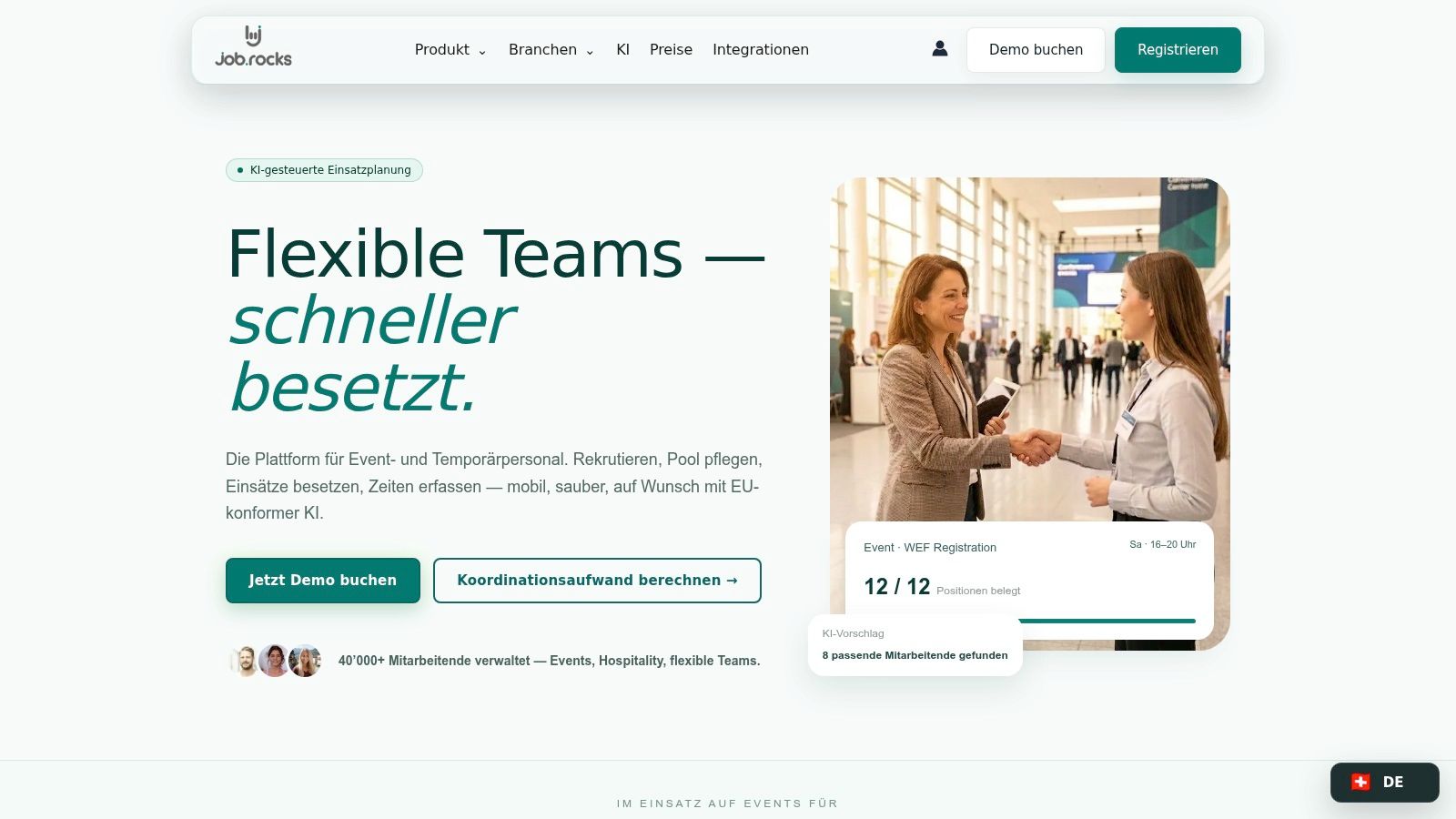
For an agency, this means: you don’t first search all available people and then compare skills. You define the deployment need and check which profiles fit the role, location, and time window. The decision remains yours, but the data is closer to the actual plan.
Qualification Matrix as a Selection Criterion for Workforce Scheduling Software
When selecting software, do not treat the qualification matrix as an add-on field. It determines whether the system merely manages employees or supports you in concrete staffing. An HR suite can manage profiles, positions, and personnel master data. A learning management system can document courses and learning progress. Neither replaces shift-based selection by role, level, validity, and availability.
Key Questions to Ask During the Demo
- Levels: Can you separately represent “trained,” “independent,” and “instructing”?
- Roles: Can multiple tasks with different requirements per deployment be defined?
- Certifications: Are documents, validity, and approval status visible?
- Shifts: Can you view early, late, night, or weekend shifts separately?
- Time windows: Are availability and qualification checked together?
- Employee access: Can employees submit or update information and certifications themselves?
- Traceability: Can you see who approved or changed a qualification?
- Bottlenecks: Can you identify before publishing a schedule if a required skill is barely available?
Test these points with a real scenario from your operation. Take a hotel staffing, a security role, or a ward service and deliberately use a profile with the right skill but missing validity. If the software does not clearly present this situation, the matrix will be of little help under stress.

Also pay attention to the distinction from general qualification management. There, development, training, and certifications are the focus. In workforce scheduling, you additionally need a quick, traceable decision for a specific shift. A comparison of workforce scheduling software should explicitly cover this operational perspective.
Conclusion: The Three Most Important Levers for a Usable Qualification Matrix
A qualification matrix only helps you in scheduling if it is tailored to real tasks. Three levers determine its usefulness.
First, you need a clear structure. Start with the work system, roles, and shifts. Separate skill, level, certification, validity, and time window. For a hotel, this means: “evening service” is a role, “cash register operation” a skill, instruction a certification, and late shift a time window. These details must not be lost in a single yes/no field.
Second, the matrix needs a fixed maintenance process. Check new certifications, changes in deployability, and approvals where they arise. Keep changes traceable and give employees a way to report outdated information. A neglected table builds no trust, even if it looks clean at first.
Third, the matrix must focus on staffing. A simple overview shows who can do what. An operational solution connects this information with availability, role, and shift. That is why the qualification matrix belongs on the checklist during software selection, not in a later add-on round.
Start with a small area, such as one location, a shift sequence, or a clearly defined event role. Formulate the required qualifications, transfer existing profiles, and then test a real bottleneck. If you maintain the matrix based on such cases, it remains a working tool for your deployment management and does not become a static personnel overview.
With job.rocks, you can manage qualifications, roles, certifications, and availabilities closer to shift planning and select employees for suitable assignments. Visit job.rocks if you want to use your qualification matrix not only for documentation but also in daily workforce deployment.