
Retail Duty Roster: Step-by-Step Planning
Easily create retail duty rosters: demand planning, shift models, availability, and mobile communication – practical for Swiss teams.
Saturday morning, 9:30 AM, in a Zurich neighborhood store. The queue at the checkout stretches all the way to the promotional shelf, a colleague has called in sick, and the temporary worker isn’t responding to messages because they’re still on their way. It’s moments like these that immediately reveal whether your retail duty roster is just correct on paper or if it truly supports the store.
According to the Swiss Federal Statistical Office (BFS), in 2023 52.1% of employees in Swiss retail worked part-time, compared to 38.6% across the entire economy. Retail thus stands clearly above the national average, which makes rigid monthly schedules unstable in daily practice, since a duty roster rarely consists solely of full-time staff but rather many small workloads, changing availabilities, and short-notice absences. Swiss retail generated around 104.8 billion CHF in revenue in 2023—enough volume that even small planning errors become noticeable. These figures and the structural context are clearly visible in Swiss labor market and retail data, which is why retail planning here works differently than in many general guides that still rely too heavily on static weekly schedules.

Table of Contents
- Why the Retail Duty Roster Is More Than a Weekly Schedule
- Determining Demand with Frequency, Sales, and Role Profiles
- Shift Models for Full-Time, Part-Time, and Temporary Staff
- Collecting Availabilities and Fair Shift Assignments
- Tools and Automation Beyond Excel
- Mobile Shift Communication and Conflict Management in Daily Life
- Your 14-Day Plan and Checklist for the Next Duty Roster
Why the Retail Duty Roster Is More Than a Weekly Schedule
A weekly schedule often looks neat on the screen—until the store tips over on Saturday morning. Three checkouts are open, two customers are waiting for returns, the delivery is still unopened in the stockroom, and suddenly you’re not just missing “one person,” but the right person in the right place. This is exactly where the retail duty roster shows it’s not a static overview but ongoing capacity management.
What Makes Swiss Retail Different
The high part-time rate changes every planning process. In retail, it’s normal that not all employees are available all day but only in clear windows, often with schools, second jobs, or family commitments in between. Added to this is the close connection to store opening hours, peak times, and team availability, as described in Swiss practical guides on workforce planning.
The second difference lies in demand. In-store, you must staff not only checkout and sales floor but also stockroom, fresh goods, returns, and often click-and-collect processes simultaneously. The shift between brick-and-mortar and online retail noticeably changes deployment logic because a plan today must cover more than just presence. A look at typical planning mistakes helps here, for example in this overview of the five most common errors in duty roster planning.
Practical rule: If you build the plan only by hourly blocks but not by frequency and role, you’re planning past the store’s needs.
What You Should Check First
Before opening any tool, you need three clarities. First, when customers really come. Second, which activities run in parallel. Third, who is allowed to perform which task at all. Without these three perspectives, a duty roster quickly becomes a pretty document with little effect.
For Swiss retail daily life, this means: don’t just plan people, plan workload points. A Monday morning in a neighborhood store requires something different than a Friday evening in a train station format, even if both stores have the same floor space. The first step is therefore not moving names around but reading the daily rhythm.
Determining Demand with Frequency, Sales, and Role Profiles
A clean demand calculation doesn’t start with the number of employees but with the question of what must happen in the store each hour. Those who plan by gut feeling alone quickly end up with overstaffing in quiet phases and too few staff exactly when the queue grows. In Swiss retail, a derivation using frequency profile, sales profile, and role profile has proven effective.
How to Read the Store Hour by Hour
The frequency profile shows when customers arrive. For this, use checkout data, visitor counters, and past days with similar patterns. The sales profile shows which hours actually generate revenue, and the role profile separates checkout, sales floor, stockroom, and management. In stores with many part-time workloads, this separation helps because not every person can cover every task equally well.
The practical sequence is clear:
- See frequency, i.e., check customer numbers per hour.
- Compare sales, i.e., identify strong and weak hours.
- Assign roles, i.e., determine who is needed at checkout, floor, stockroom, or management each hour.
- Incorporate absences before the plan is fixed.
- Check legal compliance before publishing.
For peak times, many planning approaches recommend as a guideline 1 employee per 10 to 15 customers and 2 people per checkout during busy periods. These are not rigid rules but a useful starting point in multi-store daily life if you want to handle strong fluctuations throughout the day properly. Especially in Swiss neighborhood stores and train station locations, it quickly becomes clear whether staffing matches real demand or just fits a convenient grid.
A good plan covers not only people but work.
Peak Times in Swiss Retail
| Time of Day | Customer Frequency | Focus Areas | Minimum Staffing |
|---|---|---|---|
| Morning before work starts | High | Checkout, quick sales, fresh goods | More presence at checkout and floor |
| Midday in neighborhood stores | High | Take-away, checkout, restocking | Additional help to reduce wait times |
| Before store closing | High | Final sales, returns, tidying | Multiple people at checkout and floor |
| Between peaks | Lower | Stockroom, replenishment, admin | Lean staffing with clear roles |
In practice, this is the difference between a plan on paper and a plan that truly supports the store. A store with heavy foot traffic needs different presence than a location with a quieter daily flow, even if both are similar in size. Those managing multiple stores should read the patterns per location separately; otherwise, good times at one place get confused with weaknesses at another.
Temporary workers should be treated like a flexible pool, especially when short-term fluctuations are frequent. You should therefore have a dedicated guide for coordinating temporary workers ready so that assignments aren’t laboriously pieced together only the night before. This doesn’t replace basic planning but smooths peaks when part-time and spontaneous absences coincide.
Once you set up this logic cleanly per store, the daily feeling becomes a readable matrix. This is especially useful if you manage multiple locations because frequency patterns often differ even though team size remains similar. For changing workloads, clearly defined shift models also help, as described in planning shifts for construction sites, since they think carefully about fixed time windows, roles, and handovers.
Shift Models for Full-Time, Part-Time, and Temporary Staff
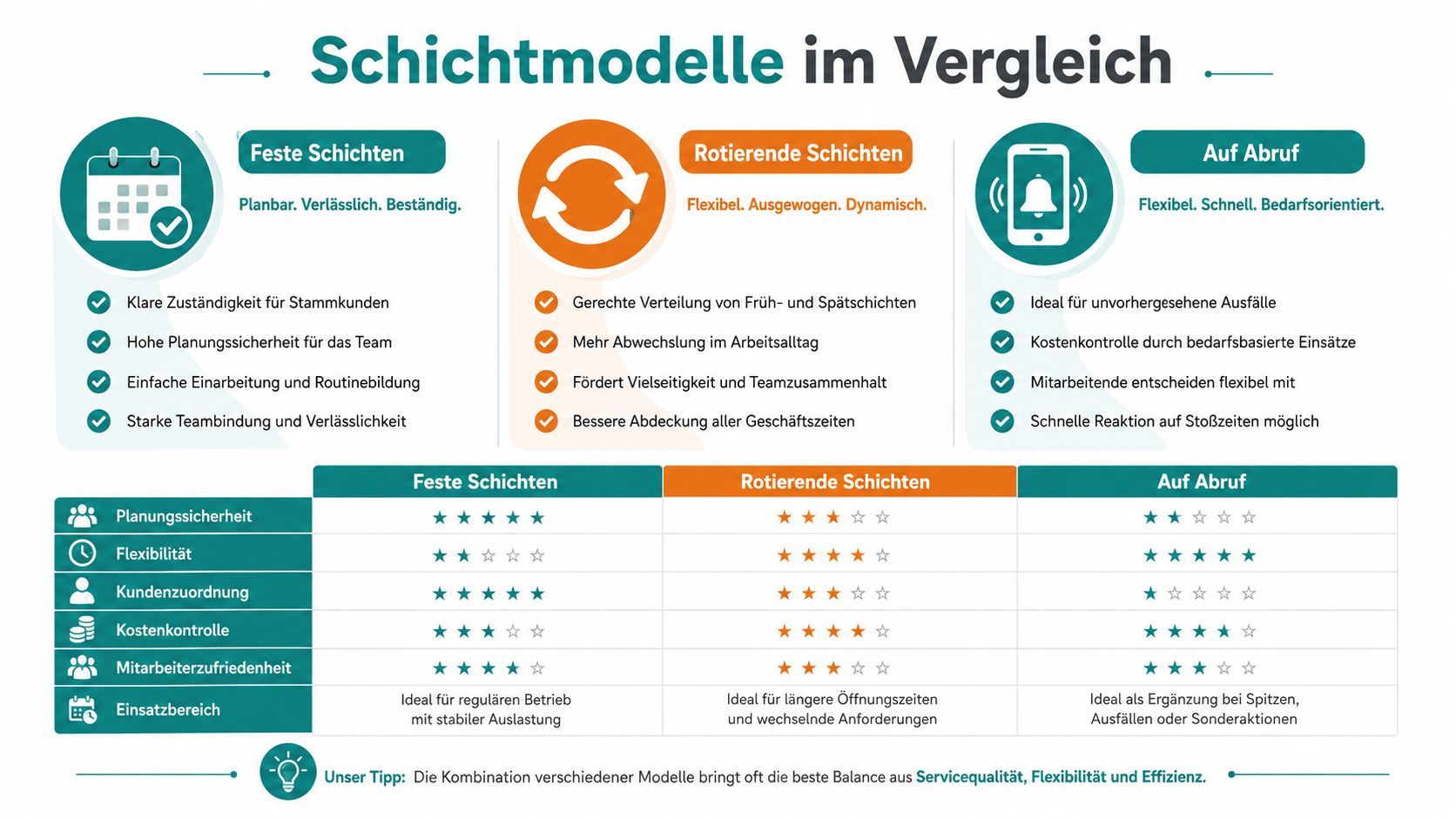
In daily store operations, the shift model often decides whether the day runs smoothly or if gaps, overlaps, and unnecessary handovers accumulate. A neighborhood store with stable regular customers usually gets by well with clear fixed shifts, while a location with fluctuating frequency needs more rotation throughout the day. In Switzerland, many teams consist largely of part-time and temporary staff. This is exactly where planning errors occur if the same rules apply to everyone.
Fixed, Rotating, or Split Shifts
Fixed shifts work well when the team is experienced and demand remains relatively even throughout the day. Responsibility is clear, processes stay calm, and regular customers often meet the same contacts. The downside appears quickly when frequency jumps strongly or absences become frequent. Then the plan is neat but no longer fits the operation.
Rotating shifts make sense when different loads occur in the morning, midday, and evening. This offers more flexibility but requires clear handovers and clean internal communication; otherwise, no one knows exactly who is responsible for what. Split shifts or mid-day shifts are often underestimated in many Swiss stores, although they often cover lunch and late peaks better than a rigid block. They are also good for deploying temporary workers specifically during hours when the store really needs support.
If you plan a multi-shift team, a look at planning shifts for construction sites helps. There, fixed time windows, roles, and handovers are thought through carefully. The principle is different, but the logic behind clear staffing blocks can be directly applied in retail.
A Pragmatic Example from Zurich
A neighborhood store with twelve employees can work well with a mix of full-time, several reduced workloads, and two temporary workers. Full-time staff usually take shifts with more responsibility, a 50% workload covers predictable fringe times, a 30% workload fills recurring gaps, and temporary workers step in where demand is not clearly predictable. This only works if you really separate roles per shift; otherwise, flexibility quickly becomes a catch-all for open issues.
Temporary workers should be treated as a flexible pool, especially when short-term fluctuations are frequent. There is also this guide for coordinating temporary workers. It helps especially when assignments are not only gathered the night before but run along with weekly planning. This does not replace basic planning but smooths peaks when part-time and spontaneous absences coincide.
The real question is not how many shifts there are but which shifts support the store without idle time and chaos. If two fixed blocks per day suffice, stick with that. As soon as loads clearly separate at midday and before closing, a third block is often the cleaner solution. You don’t check this by feeling but by frequency and role demand.
Collecting Availabilities and Fair Shift Assignments
Nice plans often fail not because of logic but because of feedback. If you collect availabilities via WhatsApp, you quickly get half information, double bookings, and the famous message “I thought that was next week.” In retail, you need a clear procedure; otherwise, fairness becomes a guessing game.
How to Ensure Clean Assignments
A store manager with 14 employees does well with a fixed sequence. First, collect availability windows, then compare them with hourly demand, then mark conflicts. Only then comes a proposal to the team, followed by change requests, then the final version.
Digital self-service queries or a short form are usually better than phone chains or unclear chat histories because questions decrease and everyone sees the same status. Temporary workers should be treated like a flexible pool, not as a spontaneous rescue shortly before the shift starts. For reduced workloads, it also matters that desired hours and actually planned hours don’t constantly diverge.
Typical Conflicts Before Publication
- Double booking: One person is scheduled for two shifts or two locations simultaneously.
- Exceeded desired workload: The planned workload no longer matches the contract or agreement.
- Missing qualification: The person is not allowed to take the role in the shift.
- Late entry: An absence or swap request comes after plan approval.
If a conflict is only noticed after publication, it costs double in retail: first time, then team calm.
Fair assignment doesn’t mean everyone always gets the same times. It means rules are visible and exceptions are justified. Especially with temporary workers and small workloads, a fixed pattern helps so no one feels like just a gap filler.
Tools and Automation Beyond Excel
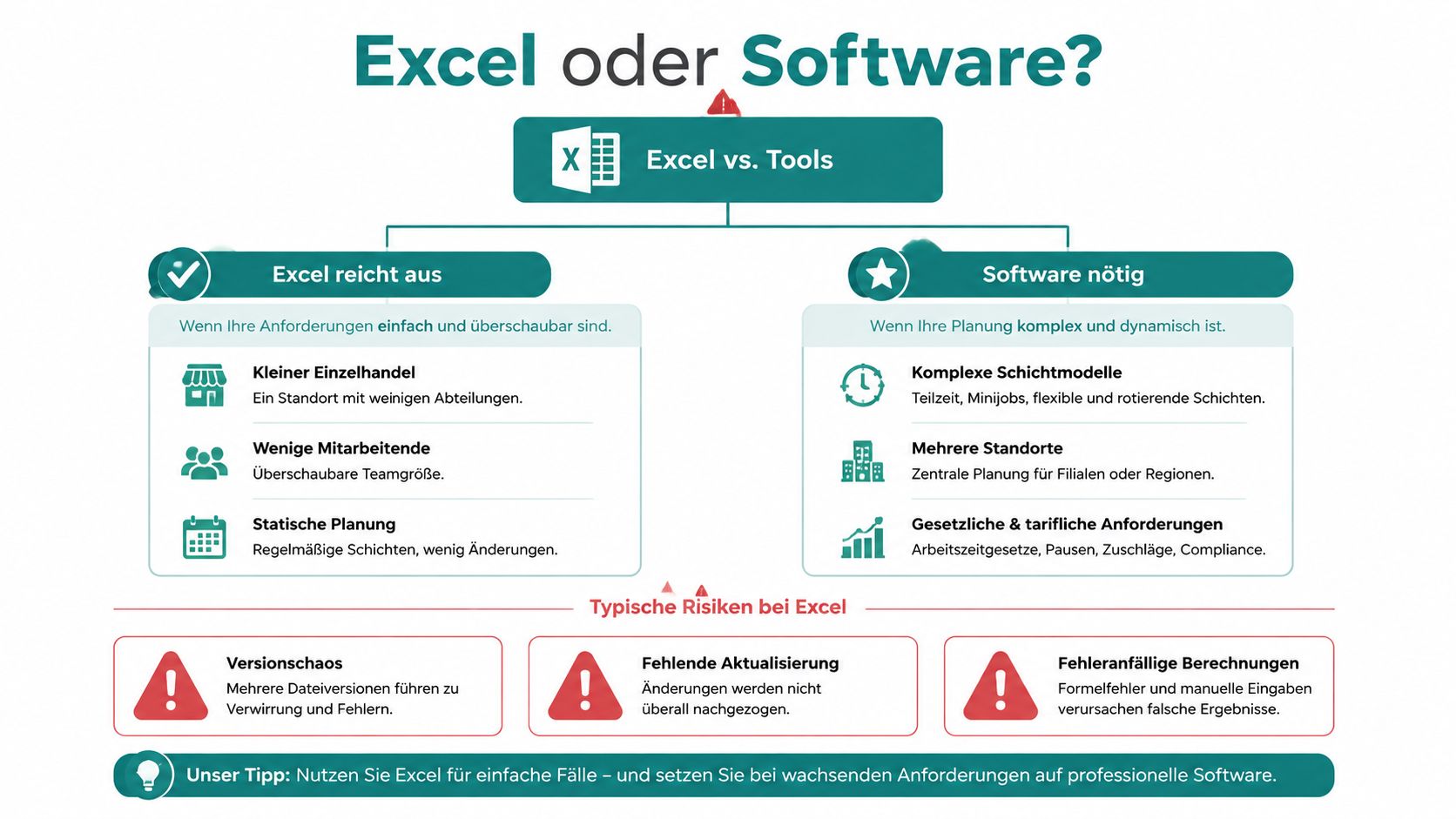
Excel is often the first step, and for small teams it can be enough. But as soon as multiple stores, many part-time workloads, spontaneous changes, and a mobile workforce come into play, the file quickly becomes a bottleneck. Version chaos, missing conflict checks, no mobile view, and no clean hour overview are typical pitfalls.
When Excel Is Still Enough
If your store is small, shifts rarely change, and the team is almost always equally available, a well-maintained spreadsheet still works. But as soon as you continuously collect availabilities or plan across multiple locations, you must check more than just names and times. Then every manual adjustment becomes a risk because corrections in one place are often forgotten elsewhere.
For exactly this threshold, the internal overview Duty Roster App for Teams and Stores is useful because digital feedback, shift info, and mobile communication can come together there. job.rocks itself is one option among several if you want to bundle availabilities, invitations, and time tracking in one process.
Different Tool Categories Explained
- Simple shift planner: Good for small teams and little plan movement.
- Workforce management suite: Useful when availabilities, qualifications, and times belong together.
- Integrated platform with app and payroll bridge: Sensible if you want to link planning, communication, and payroll preparation more closely.
Those looking for a general view on automation will find a good framework in mr. clean AG’s overview of advantages and disadvantages of automation to soberly weigh effort against benefit. For retail, the decisive factor is not the largest feature list but whether your most frequent bottleneck is really solved.
What to Watch for in Swiss Retail
Role-based qualification filters are gold when not everyone is allowed at every checkout or station. Shift swaps among employees, automatic reminders, and clean proof for payroll preparation help especially when many small workloads are involved. A tool is worthwhile not because of a nice dashboard but because it noticeably reduces questions, double work, and planning stress.
Mobile Shift Communication and Conflict Management in Daily Life
A Friday evening in a two-store chain in German-speaking Switzerland can decide the whole Saturday. If someone calls in sick at 6:40 PM and management only learns about it via private chat, stress starts immediately. If the same message goes to the temporary worker pool via an app, the search runs calmly, transparently, and above all visibly for everyone.
What Works in Practice
The most effective routine is simple: send the plan, request confirmation, mark open feedback, escalate to management if needed. Shift swaps only work cleanly if they don’t happen in the hallway but through a clear channel. For employees with little smartphone affinity, short SMS info or a fixed callback slot helps so no one is left out.
A few phrases that sound practical in store daily life:
- Plan dispatch: “Your plan for next week is now available. Please confirm by tonight.”
- Swap request: “Can someone cover Saturday 9:00 AM to 1:00 PM? Please respond directly in the app.”
- Escalation: “If no one agrees by 8:00 PM, store management will decide on the reassignment.”
Where the Limits Are
You can’t close every gap with the same person. Those who constantly fill in eventually lose reliability in private life, and that’s where motivation breaks down. Therefore, the escalation chain needs a clear order: first temporary workers, then internal swap proposals, only then manual interventions by management.
Good mobile communication doesn’t replace planning; it saves the plan when daily life goes sideways.
The crucial factor is not the app itself but the binding process. As soon as your team knows where feedback goes and who approves what, friction noticeably decreases. That’s the difference between hectic message chaos and a store that stays calm even during absences.
Your 14-Day Plan and Checklist for the Next Duty Roster
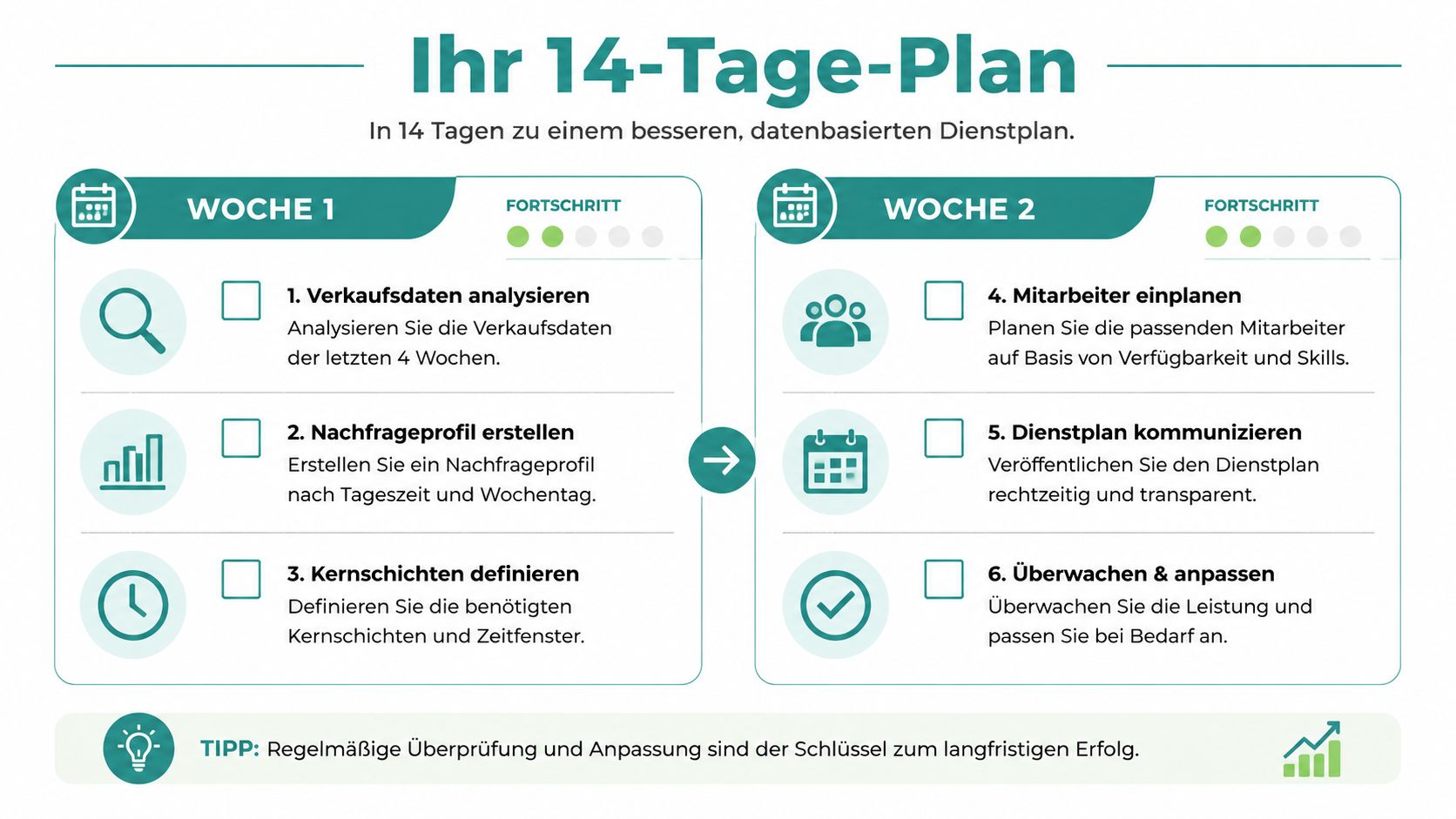
In two weeks, you can set up your retail duty roster so it relies less on guesswork and more on real patterns. You don’t have to overhaul everything. It’s enough to run through the next planning cycle cleanly once and then consistently stick to it.
Week 1 and Week 2
Week 1
- Collect data: Use the last four weeks as a basis and check frequency, sales, and absences.
- Mark peak times: Enter the hours when your store visibly carries more load.
- Define role profile: Separate checkout, floor, stockroom, and management.
- Set minimum staffing: Determine how many people you really need per hour.
Week 2
- Collect availabilities: Gather windows digitally or with a clear form.
- Build pilot plan: Test a shift with three employees before finalizing the whole week.
- Choose tool or spreadsheet: Decide on a system your team really uses.
- Fix communication: Define how planning, swapping, and confirmation work.
Checklist for Daily Operations
- Check frequency data before entering names.
- Record minimum staffing per hour, not just per day.
- Maintain a temporary worker pool so absences don’t cause chaos every time.
- Define shift swap rules before the first conflict arises.
- Choose one channel for feedback so not five channels run in parallel.
- Document escalation chain so no one has to improvise on weekends.
- Check labor law requirements, such as rest periods, breaks, and maximum weekly hours, always according to current Swiss Code of Obligations and applicable collective labor agreements.
If you no longer want to build your retail duty roster in Swiss retail by gut feeling, check out job.rocks at job.rocks. There you can combine availabilities, shift planning, mobile feedback, and time tracking in one process, perfectly suited for store teams with many small workloads and changing assignments.