
Shift Planning in Swiss Production: How to Successfully Roll Out Your Plan
Implement shift planning in Swiss production in a legally compliant and practical way. Get models, tools, KPIs, and checklists for your rollout.
Friday, just before the late shift: An order arrives earlier than planned, two employees call in sick, and suddenly the person with the forklift license is missing at the assembly line. In Excel, there are three different versions of the schedule, the handover from the early shift has not yet been confirmed, and someone in the group chat asks if the shift time was changed. This is exactly where your shift planning in Swiss production shows whether it supports daily operations or is just a calendar with names.
You need a plan that brings together demand, roles, qualifications, absences, handovers, and last-minute changes. It does not replace your production planning, ERP, MES, or machine scheduling software. It ensures that the right people are at the right workplace at the planned time and that changes are communicated transparently.
Table of Contents
- Why Shift Planning in Swiss Production Matters Now
- Understanding Legal Guardrails for Your Shift Planning
- Clarifying Demand and Choosing the Right Shift Model
- Implementing the Rollout Step by Step in Production
- Using Tools and Mobile Services Smartly
- Measuring KPIs and Improving Shift Planning Sustainably
Why Shift Planning in Swiss Production Matters Now
In a production line, it’s not enough to just enter four names in the “Late Shift” column. You need to know if a team leader is present, if someone is authorized to operate the equipment, if the forklift license is valid, and who can step in if someone is absent. In assembly with multiple variants, the question arises which employees are skilled in the respective tasks.
The scale of the topic is large in Switzerland. In 2022, 593,000 employees worked in shift work, corresponding to 15.9% of all employees excluding apprentices. Of these, 27.1% worked in rotating shifts including night work and 27.0% in rotating shifts without night work. These figures come from the Federal Statistical Office’s survey on shift work.
What the Planning Must Deliver
Your production planning answers what should be produced and when. Machine scheduling shows which equipment is assigned to which order. A MES typically tracks processes and feedback at the machine, while an ERP manages orders, materials, purchasing, or master data.
Shift planning answers a different question: Who can execute the order under the given conditions? This includes available personnel, roles, authorizations, working time regulations, absences, and a clean handover between teams.
Practical rule: Don’t just plan heads. Plan the minimum staffing per role and specify which qualification is needed at which position.
Take a production with two lines. The machines run according to the production plan, but the assigned line manager is missing on the late shift. A substitute is present but not authorized to approve a format change. The plan looks staffed, but operationally a gap remains.
Before Choosing a Tool
First clarify which data is currently missing and where changes occur. Ask yourself if your shift leadership collects availabilities by phone, if qualifications are listed separately, and if the night shift depends on the short-term availability of individual employees.
A good starting point is a small, real production week. Take one line, a typical order, one absence, and one handover. Document who plans, who approves, who reports changes, and how employees are informed. More basics on the role of workforce planning can be found in the Workforce Management Guide 2026.
Understanding Legal Guardrails for Your Shift Planning
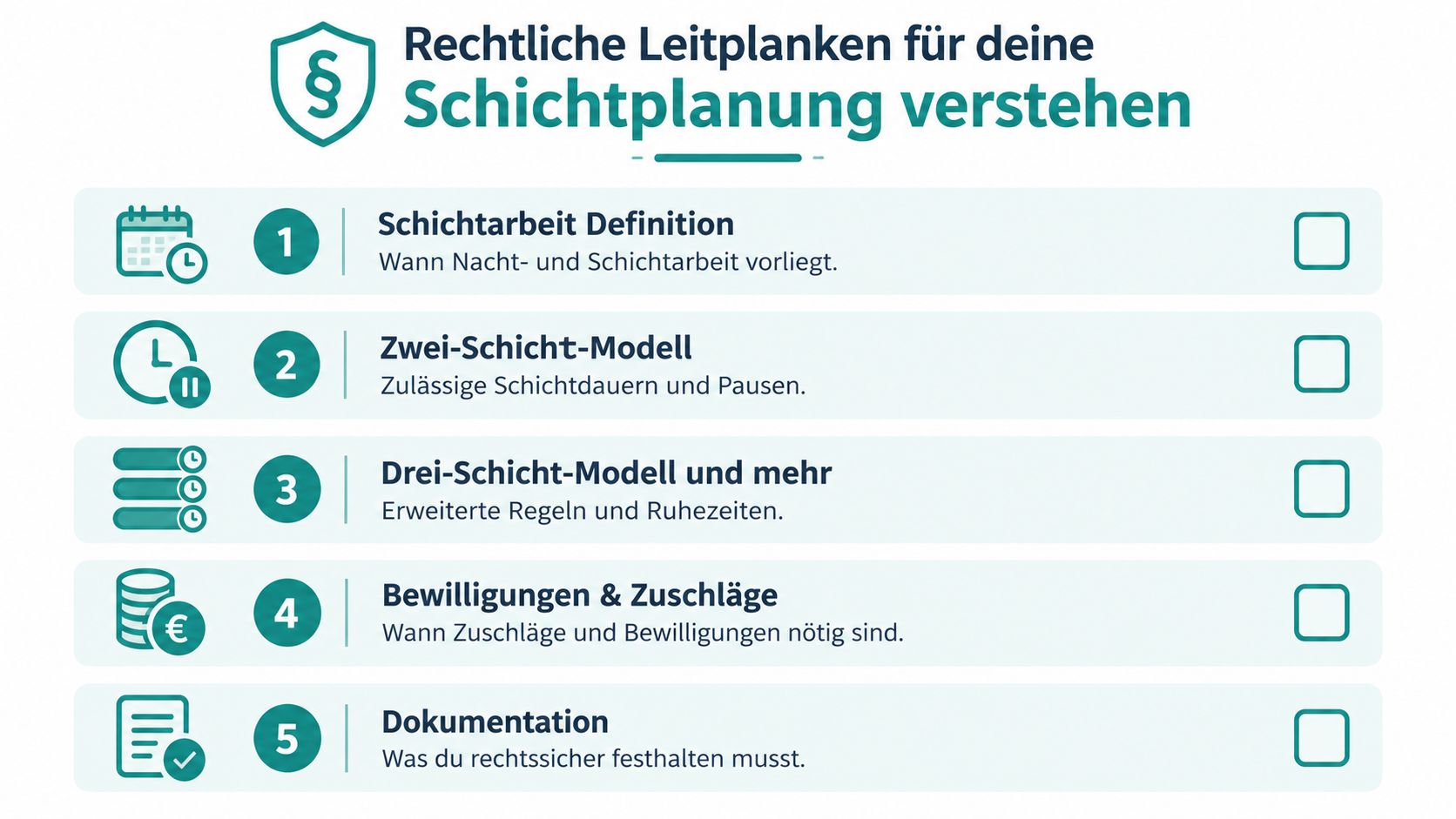
Swiss regulations belong in your planning logic, not just in the review after the plan is sent. SECO defines shift work as the deployment of two or more groups of employees according to a specific schedule at the same workplace. For two-shift day work, the individual shift including breaks must not exceed 11 hours. For three or more shifts, generally 10 hours are allowed. These details are in the SECO brochure on night and shift work.
Checking Shift Duration Directly in the Plan
With a two-shift model (early and late), first check the actual duration including breaks. A plan with a long early shift may work on paper but falls outside the allowed limits if breaks are miscalculated. For three or more shifts, a separate check is needed because the shorter limit applies.
SECO describes two-shift day work within a 17-hour day and evening period as possible without a permit. The individual shift must still not exceed 11 hours. Night work and other constellations may trigger additional rules or permits. The SECO overview on night, shift, and Sunday work should therefore be part of your planning documents.
Rotation and Night Windows
For multi-shift systems, the regulation generally requires a forward rotation, i.e., switching from early to late to night shift. A pattern where a person switches directly from night to early shift does not comply with this guardrail and must be legally reviewed.
Night work is generally defined in the labor law as between 11:00 p.m. and 6:00 a.m. With employee consent, this period can be shifted by one hour. The SECO page on working and rest times describes this requirement.
Check your plan before approval with a short checklist:
- Shift type: Is it day work, night work, Sunday work, or a combination?
- Duration: Are breaks included and is the shift within the allowed limit?
- Rotation: Does the pattern rotate from early to late to night?
- Permit: Does the specific constellation require a permit?
- Documentation: Are plan versions, exceptions, consents, and approvals recorded?
For weekend coverage, it’s not enough to check staffing only. You should also document why a person was scheduled, which rule was checked, and who approved the deviation. This is not legal advice but a good practice for coordination with HR, safety officers, or legal experts. If you want to keep working times digitally traceable, you can learn more about online working time recording in Switzerland.
Clarifying Demand and Choosing the Right Shift Model
Model selection comes after demand calculation. If you first fix a three-shift model and only then realize that a certain qualification is missing at night, you are not distributing work but shifting the problem into the operational shift.
A Swiss survey of 905 randomly selected companies showed that about 70% used flexible working time models and over three quarters either already used such models or planned to introduce them soon. The data comes from the study on the structure of working hours. For production, this does not yield a ready-made model. It rather shows that flexibility only works if you first accurately capture demand, reserves, and employee wishes.
From the Line to Staffing Logic
Start with demand per time window. Note not only the number of people but also roles and minimum qualifications. For one line, for example, a team leader, a person with a forklift license, a machine operator, and two assembly workers may be needed. If you need two team leaders and four forklift license holders per shift, this requirement must be visible in every shift, including absence reserves.
Then check:
- Order situation: When do peaks, off-hours, or weekend needs occur?
- Cycle and handover: How much time is needed for team changes?
- Qualifications: Which role must not remain vacant?
- Absences: Which vacations, illnesses, or known restrictions are foreseeable?
- Reserve: Who can cover a short-term absence?
- Acceptance: Which shift sequences and free blocks are acceptable for employees?
A MES can provide feedback from production but does not automatically decide which qualified person takes the next late shift. You must consciously keep this separation in your process.
Comparing Models Based on Demand
| Shift Model | Coverage | Permits and Rules to Check | Ideal For |
|---|---|---|---|
| Two Shifts | Early and late shifts for day and evening operation | Check shift duration including breaks, day and evening windows | Production without regular night shifts |
| Three Shifts | Early, late, and night shifts | Check night window, forward rotation, and additional rules | Continuous production with night demand |
| Four Shifts | Multiple teams with rotation and free phases | Check rest, rotation, weekend, and night rules | Continuous plants with higher personnel needs |
| Staggered Shifts | Off-hours covered by later start or earlier end | Check time windows and permit status of specific deployments | Peaks in morning, evening, or weekend |
This table helps only with preselection. The decisive factor remains whether your qualification mix works per shift. A template like the 4-shift model can serve as a discussion basis but does not replace your demand calculation and legal review.
A shift is only staffed when the required role is filled by a suitable and available person.
Then evaluate the variants in a simple decision matrix. Give qualitative ratings for coverage, qualification mix, handover, employee wishes, and review effort. The two-shift model can fit well if there is no night load, while a four-shift model can create more free phases but requires more teams and careful rotation planning.
Implementing the Rollout Step by Step in Production
A rollout rarely fails because of the first shift schedule. It fails because no one knows who approves last-minute changes, where qualifications are maintained, and which information must be passed on during handover.
Starting with a Pilot Area
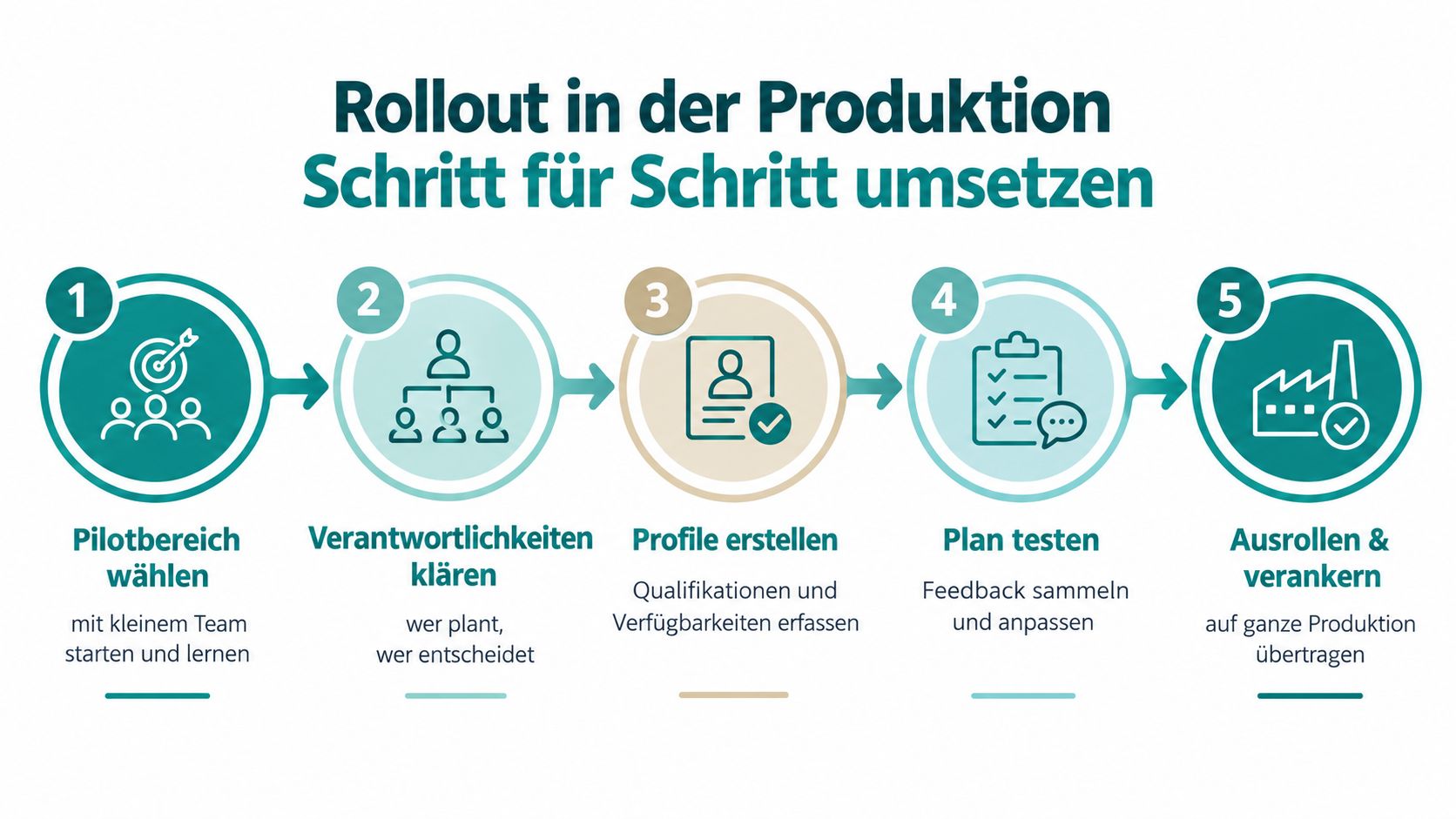
Choose one line or a clearly defined production area. Don’t take the whole factory but an area where shift changes, roles, and absences are visible. Assign one responsible person for planning, a deputy, and someone from shift leadership.
Capture the starting situation in a real production week. This includes planned demand, actual absences, reassignments, open roles, and questions from the team. A rollout process with DESKSPACE can provide additional orientation for introducing a new workflow.
Defining Profiles and Handovers
A profile should include at least role, qualification, deployment area, availability, and any restrictions. Separate between “can be deployed” and “must be deployed.” A person may operate a machine but may not be intended for team leadership or approval of a setup process.
Define a common handover format for early, late, and night shifts. It should show which order is running, which issue is open, what material is missing, and which decision the next shift must make. The handover belongs in the planning process, not in a private note of the outgoing shift leader.
Absences and Test Approval
Define before going live who is contacted first in case of illness. A reserve pool can consist of people qualified for certain roles and reachable for short-term deployment. Create clear swap rules so employees cannot independently change a qualification-critical role without the shift leader knowing.
For approval, check:
- Plan quality: Each shift has the required roles and qualifications.
- Communication: Employees see the plan, changes, and feedback status.
- Handover: The outgoing shift leaves the agreed information.
- Absence: The replacement process works without old phone lists.
- Documentation: Changes and approvals remain traceable.
SECO points out that two-shift day work within the mentioned 17-hour window may be possible without a permit, while night work and other constellations trigger additional requirements. Therefore, test not only the operation but also real shift patterns with their legal checks.
After the pilot, decide based on clear go-live criteria. If roles are missing, handovers unclear, or replacement search still runs over multiple channels, do not scale yet. If the process is clear in the pilot area, transfer profiles, rules, and checklists line by line.
Using Tools and Mobile Services Smartly
Digital shift planning only helps if it reflects the daily work of shift leaders and employees. For production, availability, qualification, role staffing, change communication, and time feedback count. A long feature list won’t help if replacement search still happens by phone and chat.

Separating the Process Clearly
Workforce planning software links people, roles, availabilities, absences, and shifts. It can invite employees to assignments, collect feedback, display shift details, and communicate changes on mobile. Qualification filters help you avoid filling an open role with the first available person.
Your ERP remains responsible for orders, materials, or commercial master data. The MES stays close to machine, process, and production feedback. Machine scheduling belongs in production or plant planning. Maintenance software manages maintenance, malfunctions, and technical tasks. Shift planning only connects this information to personnel where needed for staffing.
In a short-term absence, the process should be: The shift leader marks the role as open, filters available and qualified people, sends an invitation, and receives clear feedback. Then the change is communicated to all affected persons. Check if your chosen system supports this process with a real test case, not just a standard demo.
Mobile Communication in Daily Work
Employees should be able to see their current assignment, start, end, workplace, and assigned role on the go. When the plan changes, a clear notification is needed so the information doesn’t get lost among chat messages. Availability updates and absences should be in the same place as the plan.
If mobile clock-in and clock-out are possible, also check hour validation. Who corrects a missing booking? Who approves a deviation? How do approved times get into payroll preparation? These questions belong in acceptance testing.
Night work in Switzerland is generally between 11:00 p.m. and 6:00 a.m. This period can be shifted by one hour with employee consent. Your mobile planning must not silently misrepresent this time window if you combine early, late, and night shifts.
For selection: Test a sick note, a qualification-critical reassignment, a plan change, and a time correction with the same people who will later work with it.
job.rocks offers shift and workforce planning, employee pools, push notifications, mobile assignment details, availability updates, and time tracking for flexible teams. Still, you should check which processes fit your production area and which tasks remain with MES, ERP, or payroll systems.
Measuring KPIs and Improving Shift Planning Sustainably
A plan can look formally complete yet produce the same gaps week after week. That’s why you need a few clearly defined measurement points. Don’t measure everything a system can show. Measure what shows you why a shift was not stably staffed.
Five Measurement Points for Your Evaluation
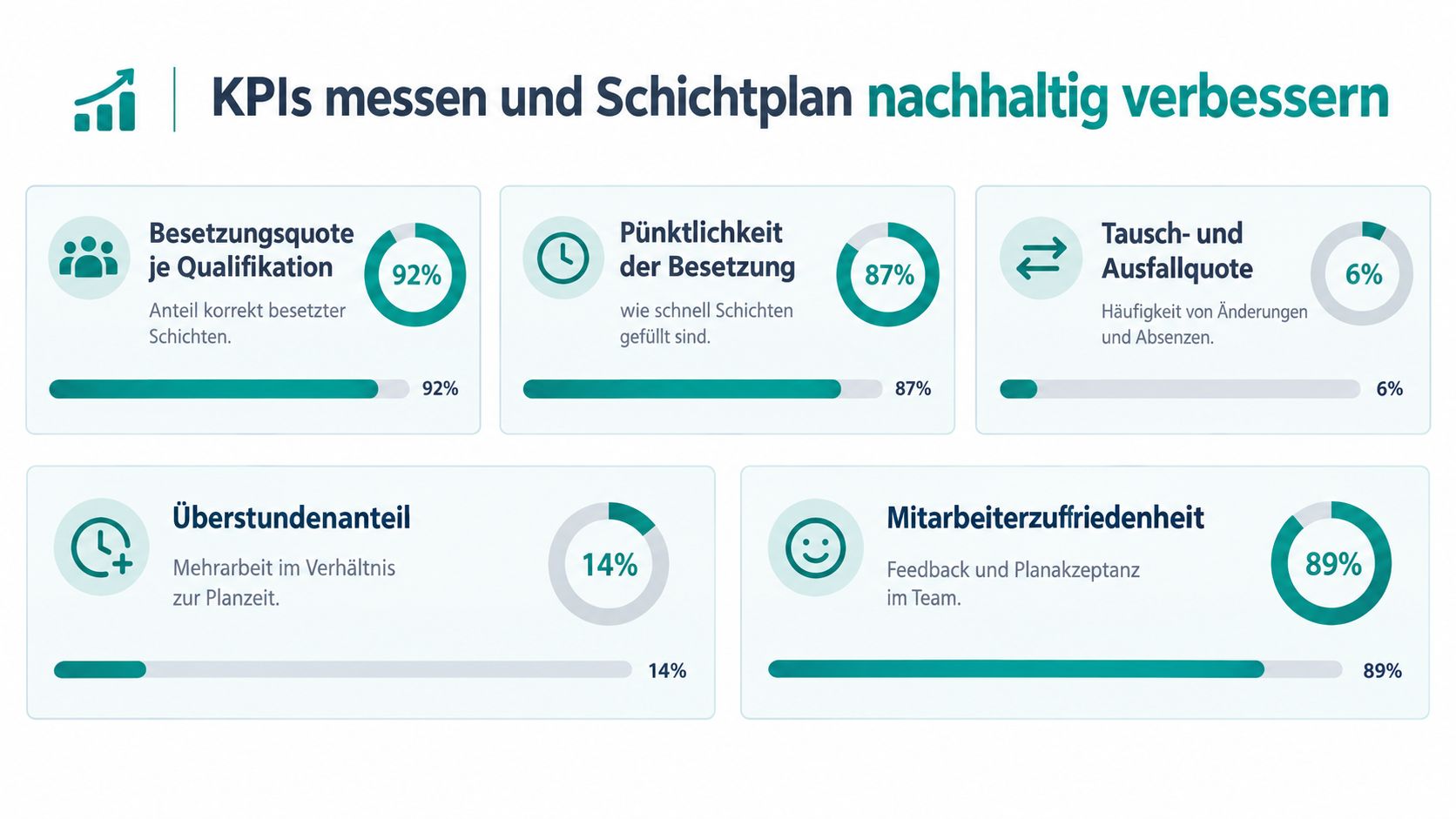
- Staffing rate per qualification: Check if each planned role was filled by a suitable person, not just if the total number matches.
- Punctuality of staffing: Record how early open shifts were closed and if handovers were prepared on time.
- Swap and absence rate: Look for recurring patterns in certain shifts, weekdays, or roles.
- Overtime share: Compare extra work with planned time and clarify if it results from peaks, absences, or incorrect baseline staffing.
- Employee feedback: Ask about plan clarity, last-minute changes, shift sequences, and handover quality.
Regularly evaluate these points with shift leadership. A recurring gap in the night shift may indicate unsuitable rotation, missing qualifications, or too small a reserve. Many swap requests on weekends may show your model does not sufficiently consider private needs.
Considering Health in Staffing
The Swiss target group is large. The FSO reports 593,000 people in shift work in 2022 and 15.9 percent of employees excluding apprentices. Watson additionally cites around 500,000 employees or 15 percent of the working population. These figures are found in the reporting on the prevalence of shift work in Switzerland. The sources are not identical measurements but show the broad importance of the topic.
SECO points out that night and shift work can strain the body, mental health, and social environment. SUVA lists shift work as a health topic with points for improvement. For your planning, this means: recurring short-term changes, adverse effects, and constant weekend load belong in the retrospective, even if the shift was formally staffed.
End every evaluation with a concrete adjustment. This can be a different reserve assignment, clearer handover, a new availability window, or a changed rotation. Document what was changed and whether the problem recurs in the next plan. This way your shift plan becomes not only full but sustainably viable and fair.
job.rocks supports you with shift and workforce planning, availability queries, qualification-based invitations, mobile communication, and time tracking for flexible teams. Test your real production case directly with a pilot plan and visit job.rocks to take the next right step for your operation.