
Staff planning dispatcher: a practical guide to smooth operations
Meta Title: Dispatcher Operations Planning | Your guide for smooth processesMeta Description: As a dispatcher in operational planning, you are the organizational heart. Learn here how to perfect your processes with practical tips and the right tools. As a dispatcher in operational planning, you are...
Meta Title: Dispatcher Operations Planning | Your guide for smooth processes
Meta Description: As a dispatcher in operational planning, you are the organizational heart. Learn here how to perfect your processes with practical tips and the right tools.
As a dispatcher in operational planning, you are the organizational heart of every smooth process. Your job is to deploy the right employees in the right place at the right time - a daily balancing act Availabilities, Qualifications and short-term changes.
What a dispatcher really does in operational planning
Imagine scheduling the entire staff for a huge music festival. Your responsibility goes far beyond simply distributing shifts. You are the linchpin who ensures that every area is optimally staffed - from security personnel with the correct license to the specialized technician at the mixing desk.
Your work not only ensures the success of the company, but also has a direct impact on personnel costs and the satisfaction of your employees. A well thought out one Personnel scheduling is therefore not a purely administrative task, but a real strategic lever.
This central role is also reflected in the salary: in Switzerland, dispatchers earn on average 75,600 CHF gross per year. With over 10 years With professional experience, this value climbs to average 82,400 CHF, which clearly shows the importance of professional personnel management.
The typical process: from demand to occupied shift
In practice, operational planning usually follows a clear, three-stage process. These phases build logically on each other and are the foundation for a successful one Personnel scheduling.
The following diagram shows this basic process from the first inquiry to the final communication with the team.
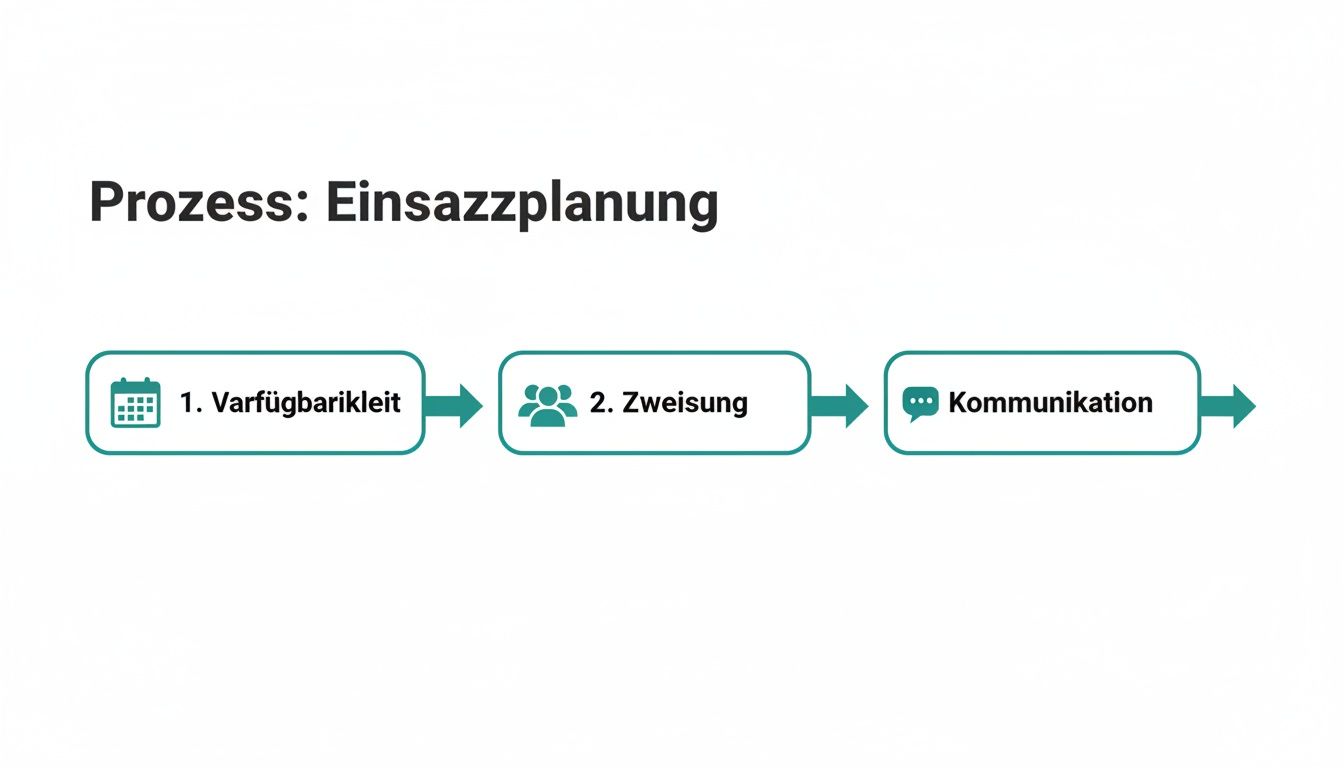
You can immediately see that a structured sequence of availability queries, allocation and communication is the basis for avoiding errors.
To give you a better feel for your daily work, we have summarized the core tasks and their strategic importance here.
Typical tasks and their importance
An overview of the core tasks of a dispatcher and why they are important for operational success.
| Task | Description | Why it matters |
|---|---|---|
| Needs analysis | Determine the exact number and required qualifications for upcoming jobs or shifts. | Prevents over or understaffing. Saves costs and ensures service quality. |
| Availability query | Query the availability of employees, ideally already filtered according to the appropriate skills. | Ensures that only qualified and available individuals are considered for scheduling. |
| Shift assignment | Distribute open shifts to staff based on availability, qualifications and fairness. | Good assignment increases employee satisfaction and ensures balanced workload. |
| communication | Communicate all relevant information (time, location, tasks) to employees clearly and in a timely manner. | Minimizes misunderstandings and no-shows. Make sure everyone knows what to do. |
| Incident management | React to short-term failures (such as illness) and quickly find a suitable replacement. | Ensures operational capability even in the event of unforeseen events and keeps operations running. |
Each of these tasks is a cog in the operational planning machine. If one fails, the entire process quickly comes to a standstill.
Step 1: Availability query and qualification filter
Everything starts with the central question: Who can actually work? Instead of sending countless emails or WhatsApp messages, you ask the availability of employees who actually have the necessary skills.
Let's stick with the festival example: You need security personnel with specific certification for the stage area. With a qualification filter, you only address people who meet this requirement. This saves a lot of time and prevents embarrassing miscasts.
This first step is crucial in order to meaningfully narrow down the pool of potential candidates right from the start.
Step 2: Shift assignment and communication
As soon as the feedback is there, it's time to get down to business: you assign the shifts. Here you don't just look at pure availability, but also take into account factors such as desired working hours or a fair distribution of popular and unpopular assignments.
This is followed by perhaps the most important step: the communication. Each assigned employee must be crystal clear about all details:
- When? Exact start and end time.
- Where? Exact location, approximately “stage 2, backstage entrance”.
- What? Specific tasks and the contact person on site.
Clean communication is not a “nice-to-have” – it prevents misunderstandings and ensures that everyone knows exactly what is expected of them. This is an absolute cornerstone of success in personnel scheduling.
This is how you overcome the biggest hurdles in operational planning
Anyone who works in operational planning knows the feeling: you are constantly navigating through a minefield of unforeseen problems. Short-term sick notes, complex working time laws and a roller coaster need for personnel – that's everyday life. But don't worry, there is a working strategy for each of these hurdles.
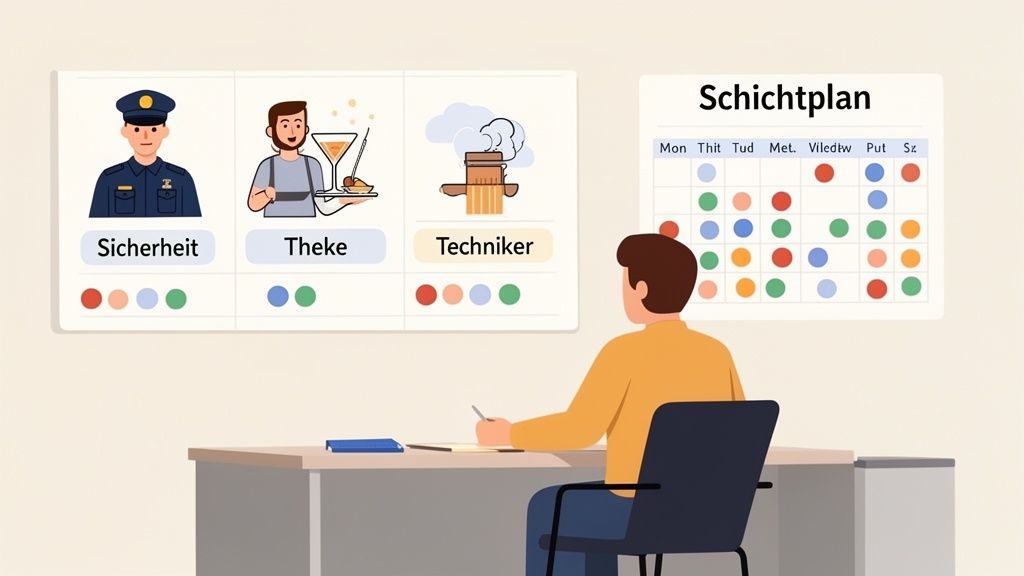
Let's take a closer look at the typical pitfalls and find out which solutions really work in practice.
Compliance and labor law: your legal shield
Compliance with legal requirements is not an optional extra, but the foundation of your planning. A violation of the Working Hours Act can not only result in severe fines, but can also permanently damage your company's reputation.
The biggest stumbling blocks often lurk here:
- Maximum working hours: The daily and weekly limits are non-negotiable.
- Rest times: Statutory breaks between two shifts must be adhered to.
- Sunday and public holiday work: There are special regulations and compensation claims that you need to be aware of.
Imagine you are planning a big New Year's Eve gala. The employee who stands at the bar until late at night on December 31st is not allowed to simply take the first shift on New Year's morning. Good planning software is like a vigilant co-pilot: it automatically warns you of such rule conflicts and prevents them before they even arise.
The regulations are particularly strict in sectors such as nursing. A deeper look into the legal framework for duty rosters in nursing shows how complex this topic can be.
Sudden failures: confident instead of stressed
It's Saturday morning. Your main bartender for the evening event calls in sick. Panic? Completely unnecessary. A well-positioned one Dispatcher in operational planning always has a plan B. The key to this lies in a flexible and well-maintained personnel pool.
Your personnel pool is like the substitutes' bench in football. You have qualified and motivated people who you can bring into play immediately if necessary. Instead of frantically calling around, send a targeted request to all available bartenders in your pool.
Modern tools make this child’s play. A single push message to all appropriate employees is enough. Whoever agrees first gets the shift - fully automatically and often within a few minutes. This turns a potential crisis into a quickly solved routine task.
Scaling when demand fluctuates: The art of flexibility
In the event and catering industry, highly fluctuating personnel requirements are the order of the day. On a quiet Tuesday, you might just need 20 Employees, but suddenly on Saturday for a large catering event 200. Managing these peaks in demand without chaos is the true art of scheduling.
The trick lies in clever segmentation of your personnel pool. You not only divide your people according to their qualifications, but also according to their flexibility and reliability.
- Core team: Your permanent and absolutely reliable employees, who form the backbone of every planning.
- Flex pool: Experienced part-time workers and freelancers who you can bring in flexibly if your needs are medium.
- Springer pool: Temporary help for absolute peak needs who are ready to step in at short notice.
For catering with 200 So you plan your core team for the key positions. You recruit the majority of the service staff from your flex pool, which you have set up specifically for such major events. With a platform like job.rocks, you can easily manage these pools and query availability for large-scale use at the push of a button. That's what yours does Dispatcher operational planning manageable and impressively effective even with extreme fluctuations.
Measure your success with the right metrics
Good operational planning is not a gut feeling – it is measurable. Without solid data, you can neither really improve your processes nor prove to management the value of your work. In order to objectively evaluate and control your performance as a dispatcher, you need clear key figures, the so-called KPIs (Key Performance Indicators).
Think of these KPIs like a pilot's cockpit: They provide you with all the data you need to reach your destination safely and effectively. They uncover weak points, make your successes visible and help you finally make informed decisions.
Fill rate: the reliability of your planning
The Fill rate, or occupancy rate, is probably the most important metric of all. It simply tells you what percentage of the requested shifts you were actually able to fill. A high fill rate is the best evidence of reliable and functioning personnel planning.
A simple example: A security company has to work for a big event 20 Cover security posts. You can do it, 19 to occupy it. Your fill rate is 95 % (19 shifts filled / 20 requested). This value shows you and your boss immediately where you stand.
A consistently high ratio is evidence of a strong staffing pool and effective assignment processes. But if it suddenly drops, this is a clear alarm signal - time to get to the bottom of the causes.
Time-to-fill: the speed of your process
How quickly can you fill an open shift? That's exactly what it measures Time to fill. This metric is worth its weight in gold, especially when it comes to short-term absences, such as calling in sick in the morning. It measures the time from the notification of the loss to the final confirmation of a replacement employee.
Let's stay with the security company: At 10:00 a.m. an employee for the evening shift calls in sick. Thanks to your well-maintained pool and a quick, automated request via the app, you found a qualified replacement by 10:30 a.m. So your time-to-fill here is just 30 minutes.
A short time-to-fill proves that your communication channels and pool management are working excellently. If it's too long, you'll lose valuable time and run the risk of shifts remaining unfilled.
Overtime rate: control over costs and utilization
The Overtime rate, i.e. the overtime rate, is a tough indicator of your personnel costs and the workload on your team. It shows the proportion of overtime worked compared to regular working hours. If this rate shoots up, it often indicates structural understaffing or ineffective planning.
Let's say your security company performs in a month 2’000 regular working hours, but additionally fall 200 overtime. Your overtime rate is now 10 %. This value signals to you that you may have your Personnel capacity planning urgently need to adapt.
If you keep this value in mind, you can distribute the workload more fairly, increase the satisfaction of your employees and, above all, reduce expensive overtime pay. This key figure is a direct lever for cost control.
In order not only to understand these key figures, but also to use them strategically, a clear overview helps. Each KPI tells its own story about the effectiveness of your operational planning.
Important KPIs for dispatchers at a glance
A comparison of the central key figures, their calculation and their importance for operational planning.
| Key figure (KPI) | What it measures | Why it is important |
|---|---|---|
| Fill rate | The percentage of successfully filled shifts out of all requested shifts. | Shows the reliability and effectiveness of your personnel planning. A direct indicator of operational strength. |
| Time to fill | The average time required to fill an open shift (especially in the event of cancellations). | Measures the speed of response and the effectiveness of your communication and assignment processes. |
| Overtime rate | The share of overtime in total hours worked. | An important indicator for cost control, employee workload and possible structural personnel bottlenecks. |
By regularly tracking these three metrics, you can transform your operational planning from a reactive task into a proactive control tool. You can see immediately where the problem is and can take targeted countermeasures before small problems become big ones.
No more confusing Excel lists, endless telephone chains and the dreaded WhatsApp chaos. The times when dispatchers had to piece together their planning manually are finally over. Today will be a professional one Dispatcher operational planning driven by smart software and targeted automation. These tools not only relieve you of annoying routine tasks - they make your decisions fundamentally better.
Imagine no longer having to call every single employee to clarify their availability. Instead, a system does this job for you: quickly, precisely and without the risk of human error.
Mobile apps: The direct connection to your team
Perhaps the most important component of modern scheduling are mobile apps for your employees. They are the direct connection to your team and make communication easier and smoother than ever before.
Let's take an event agency as an example: An employee receives a push notification on his cell phone with a new shift request for a concert at the weekend. With one click he can accept or decline. Even better: He simply maintains his availability for the next few weeks in his app calendar. This saves you as a dispatcher countless manual queries and emails.
The advantages are obvious:
- Personal responsibility: Employees manage their availability and shift details completely independently.
- Speed: Information flows between you and your team in real time - no more delays.
- Transparency: Everyone has access to their personal, daily operational plan at any time.
Some apps even go one step further and allow colleagues to swap shifts directly. If an employee is unavailable, they can offer their shift to a qualified colleague. The system automatically checks the necessary qualifications in the background and you only have to approve the exchange with one click.
AI-supported planning: Your personal co-pilot
Artificial intelligence (AI) is no longer a dream of the future. In operational planning, it works like an intelligent assistant that helps you in the background to make the best possible decisions.
AI-supported planning software automatically suggests the most suitable employees for an open shift based on countless data points. It not only takes into account hard facts such as qualifications and availability, but also soft factors such as the route to work, previous operational evaluations or strict adherence to statutory rest periods.
Imagine you need to find an experienced logistician at short notice for a complex trade fair setup. The system analyzes your entire personnel pool and doesn't just slap you anyone before. Instead, it presents you with the three candidates who had the best reviews for similar jobs and live closest to the job site.
This not only saves you a huge amount of time researching, but also ensures the quality of your cast on a whole new level.
Automation from A to Z with job.rocks
A specialized one Dispatcher software like job.rocks bundles all of these advantages and automates the entire process - from the first inquiry to the final confirmation. All you have to do is define your requirements – for example “10 service staff with experience in banquet service for Saturday evening” – and the system does the rest.
This is how a fully automated process works in practice:
- Targeted request: The system immediately identifies all employees who meet the required qualifications.
- Personalized invitation: A push notification is automatically sent to the appropriate candidates.
- Quick feedback: Employees say yes or no directly in their app.
- Automatic confirmation: The first ten RSVPs receive immediate shift confirmation, all others receive a friendly rejection. The job is filled.
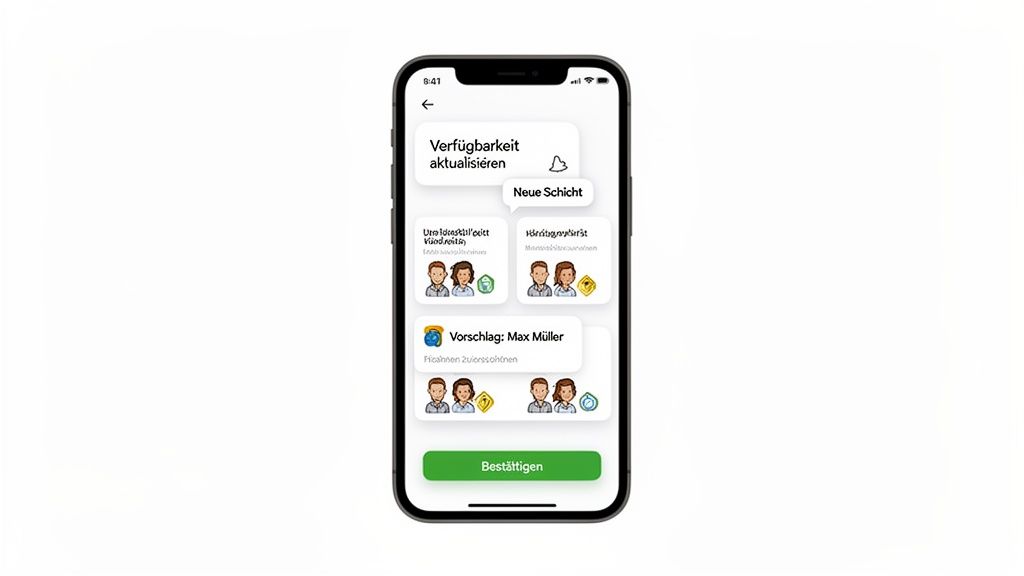
Here you can see how such a platform visually prepares and simplifies planning.
The dashboard gives you a crystal-clear overview of all upcoming assignments and the current status of the staffing.
This automated approach drastically reduces your administrative effort. At the same time, human errors, such as accidentally booking an unqualified employee, become virtually impossible.
Modern computer-aided deployment planning also offers full transparency about GPS positions and remaining working times, which is particularly crucial in logistics. Intelligent systems calculate the distances and travel times of all vehicles to new assignments in order to dynamically adapt follow-up plans. Without such tools there is a threat 20-30 % empty runs. Through qualification filters and automated booking, administration costs can be reduced by up to 50 % sink.
The use of such technologies makes your Dispatcher operational planning not only faster and more effective, but above all more strategic and cost-effective.
Practical tips that you can implement immediately
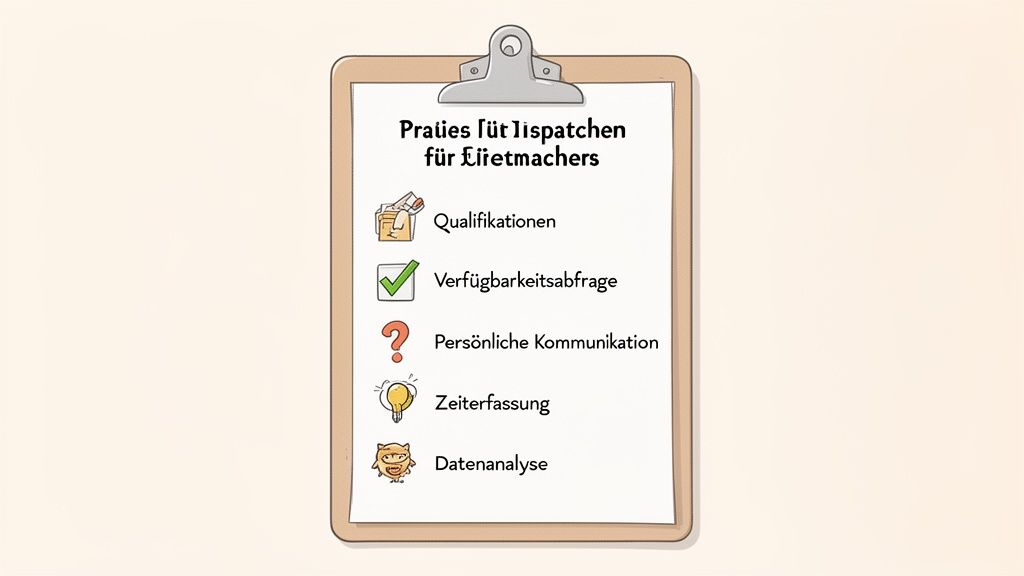
Theory is all well and good, but what really counts is the practice. Instead of just talking about concepts, you'll get concrete, immediately actionable tips to help you Dispatcher operational planning take it to a new level. You can do these steps directly with a platform like job.rocks Apply to instantly save time and achieve better results.
Each of these tips is a small but extremely effective lever. A lever that makes your everyday work noticeably easier. Let’s start with the foundation: the qualifications of your people.
Tip 1 Define crystal-clear qualification profiles
The most common mistake in operational planning? The assumption that everyone can do everything. Before you plan even a single shift, you need to know exactly which skills are really needed for which task. An insufficiently qualified employee can jeopardize the success of an entire order - and your reputation at the same time.
Therefore, create a detailed qualification profile for each role. Think about:
- Certificates and licenses: Does the person have the necessary official credentials? This can be a forklift license or a specific safety license.
- Abilities (skills): Which practical skills are a must? This ranges from experience in banquet service to knowledge of foreign languages.
- Experience level: Is it a junior who still needs guidance, an experienced senior or a true specialist?
A practical example: A cleaning company for a hospital needs an employee with experience in disinfecting sensitive areas. Instead of writing to all the cleaning staff, you filter your system specifically for the “hospital cleaning” skill. That's just how you speak 3 from 50 employees who are truly qualified. This not only saves time, but also prevents costly mistakes.
Tip 2 Use automated availability queries
The endless phoning of availability is a real time waster and a relic from the past. Modern systems take this step completely away from you. Send a request to all qualified employees with one click and have them accept or decline digitally.
The request should always contain all important information: date, exact time, location and a short, clear description of the task. The employees react directly in their app, and the system automatically records the confirmations according to the “first come, first served” principle until the shift is full. It's that easy.
Tip 3 Rely on personal communication
Even if the processes are automated – at the end of the day we still work with people. Instead of impersonal mass messages, you should address your employees specifically and appreciatively. Good software will help you personalize messages without increasing the effort.
Instead of a generic message like “Employee wanted for event,” you could write: “Hello Anna, we have an exciting job as a hostess on Saturday that fits your skills perfectly. Would you have time?"
This personal touch is no small thing. It shows appreciation and often significantly increases the willingness to take on a shift.
Tip 4 Implement transparent time recording
Fair and accurate billing is the be-all and end-all for team satisfaction. Mobile apps with GPS-supported time clock functions create transparency and fairness – for both sides. Your employees clock in when they arrive at the site and clock out again at the end of the day. Very uncomplicated.
The recorded times are automatically validated and prepared directly for payroll. This not only eliminates the hassle of paperwork, but also prevents unnecessary discussions about hours worked.
Regional wage differences are particularly prevalent in Switzerland Dispatcher operational planning strong. In cantons like Aargau, salaries are often above the national average 71,500 CHF, as flexible personnel pools for events or logistics are often managed here. Without software that accurately validates hours and integrates payroll, companies quickly lose out 10–15 % due to manual errors. More about the You can find wage structures for personnel deployment management in Switzerland on jobs.ch.
Tip 5 Analyze your data regularly
Your planning software is a gold mine of data. Use them! Regularly analyze your most important key figures, such as the occupancy rate (fill rate) or the time until a shift is filled (time-to-fill). This is not a nice extra, but rather the basis for smart decisions.
And another example: You notice that the staffing rate for assignments early on Sunday mornings is always particularly low. This insight gives you the chance to act proactively instead of falling into the same trap over and over again. You may need to offer a higher hourly rate for these shifts or create a dedicated pool of employees who are happy to work weekends. This means your planning is data-supported – and a little better every time.
Questions from practice: Your most burning topics regarding operational planning
We constantly receive questions from dispatchers who want to improve their everyday lives. Here I have collected the most common ones and will give you tried-and-tested answers that will hopefully help you immediately.
What skills does a really good dispatcher have to have?
Of course, organizational skills and a thick skin are the basis. But what really makes the difference are two things: first class Communication skills and lightning-fast comprehension. You must be able to clearly and understandably communicate a short-term change to an employee while at the same time professionally explaining to the customer why there is a small delay.
Nowadays, however, a good feel for technology is just as crucial. Anyone who still tries to knit together complex plans manually will lose touch. Added to this is the ability to draw the right conclusions from the planning data. By recognizing patterns, you can proactively avoid future shortages instead of just reacting to them.
How can I noticeably increase employee satisfaction with my planning?
Quite simply: through fairness and transparency. Give your team a voice. When employees can easily submit their availability, requests and vacation requests via a mobile app, they feel valued. It's even better if you really take these wishes into account and send out the plans as early as possible.
Think about it: An employee can offer a shift that they absolutely cannot take on to a qualified colleague directly in the app. Small features like these give your team a lot of flexibility and a feeling of self-determination.
A fair distribution of “good” and “bad” shifts and avoiding constant last-minute changes are also absolute game-changers for team morale.
When does specialized software really pay off?
The short answer: sooner than most people think. As soon as you notice that manual planning in Excel lists is costing you more than a few hours per week or that errors in the assignment are increasing, the time has come. These are clear signs that your processes are no longer scaling.
At the latest when you are juggling flexible personnel pools, different qualifications or even multiple locations, a professional solution is no longer a luxury but a necessity in order to remain competitive.
A practical example: A security service with 20 The staff has people with various certificates – from first aiders to fire protection officers. You quickly lose track of things by hand. Good software automatically filters the right people for the respective assignment and prevents expensive incorrect bookings. Not only will you work faster, but above all you will also work more safely and reliably.
Are you ready, yours Dispatcher operational planning from a manual stress factor to a strategic advantage? Look at how job.rocks helps you shed the administrative ballast and take your personnel planning to a new level.