
Time tracking for promotions: smart and legally compliant
Functioning time recording for your promotion teams is essential - not only for fair billing, but also for your legal protection. Without a clean system for work, break and travel times, ambiguities are inevitable. This quickly leads to frustration in the team and...
A working one Time tracking for your promotion teams is the be-all and end-all – not only for fair billing, but also for your legal protection. Without a clean system for work, break and travel times, ambiguities are inevitable. This quickly leads to frustration in the team and huge chaos in payroll.
Why clean time recording is not a luxury for promotion teams
Imagine this: You're juggling a big roadshow, with promoters in ten different cities. Your team works on different days, at completely different times and the locations are constantly changing. How are you going to keep track of the hours worked?
The classic paperwork or confusing Excel lists are more than just impractical here. They are a ticking time bomb for mistakes and mistrust.
A digital one Time recording for promotional campaigns gets to the root of this problem. It finally creates comprehensible proof of work from which everyone benefits. Your team can rely on every minute worked being recorded correctly and paid for at the end. This is not only fair, but also increases motivation and the feeling of appreciation.
For you as an agency or organizer, this means one thing above all: clarity and control.
Legal security and fairness as a foundation
Honestly, you don't want to have to deal with legal disputes over unpaid overtime or incorrectly billed breaks. In Switzerland the matter is clear: the obligation to record working hours has been regulated by Article 46 of the Labor Act (ArG) and Article 73 of Ordinance 1 (ArGV 1). January 1, 2016 firmly anchored.
Every employer must fully document the daily and weekly working hours of their employees - this includes start, end, breaks and overtime. The system not only helps to monitor maximum working hours and rest times, but also protects you if discussions arise. For example, if a promoter claims months later that he has worked overtime that was never approved. With a clean protocol you are on the safe side.
A digital system is not a control instrument, but a tool for fairness. It ensures that your company and your employees work together on a solid, data-driven basis.
More than just stamped time
A modern solution also provides you with valuable data for your project calculation. You can see at a glance how many hours have actually gone into a campaign and can evaluate the profitability much more precisely. Imagine you plan 100 promoter hours for a campaign. When you're done, you'll see in the system that there were actually 130. This information is worth its weight in gold when planning your next action.
- Accurate payroll: No more errors that occur when transferring handwritten timesheets.
- Transparency for the team: Every promoter can view their recorded times at any time - this creates trust.
- Less administrative effort: You save a lot of administrative effort and finally have more time for your actual tasks.
The goal is a system that simply runs in the background and is easy for your team to use, right? A good software for that Time recording at promotional events takes away the complexity so you can concentrate on what's important: the success of your campaigns.
You can find even more details in our comprehensive guide Time tracking for mobile teams.
Manual vs. digital time tracking for promotion teams in comparison
To make the differences more tangible, let's look at the two worlds side by side. This table shows the direct differences between the classic paper system and a modern, digital solution in everyday promotion.
| feature | Manual time recording (e.g. Excel, timesheets) | Digital time recording (app-based) |
|---|---|---|
| accuracy | Prone to errors due to manual entry, rounding errors, illegible handwriting. | Highly precise thanks to stamping accurate to the second via smartphone, often with GPS verification. |
| Expense | High administrative effort: collecting pieces of paper, typing up data, checking it. | Minimal effort: Data is synchronized in real time and is immediately available. |
| transparency | Small amount. Promoters often do not have up-to-date insight into their hours. | High. Team members can view their recorded times in the app at any time. |
| Legal certainty | Difficult to prove, susceptible to manipulation. Often not GDPR compliant. | High. Audit-proof protocols, automatic break regulations, GDPR compliant. |
| flexibility | Inflexible. Corrections are cumbersome and difficult to understand. | Very flexible. Times can be easily corrected by managers, with a complete change log. |
| Cost | Apparently cheap, but high hidden costs due to administrative effort and errors. | Transparent monthly costs per user that quickly pay for themselves thanks to the reduced administrative effort. |
| Data analysis | Hardly possible. Evaluations for projects are extremely time-consuming. | Simple and quick. Detailed reports on projects, customers and employees at the touch of a button. |
The comparison makes it clear: While manual entry may seem uncomplicated at first glance, it quickly turns out to be a time and cost trap. A digital solution, on the other hand, is an investment in clear processes, fairness and legal security that is worthwhile for every promotion agency.
What requirements your system really needs to meet
Careful preparation will save you a lot of headaches later. Before you settle on a system for the Time tracking for your doctorate To determine this, you need to take a close look at your own processes. It's best to start with the basic questions that determine your team's everyday work.
Are your promoters mainly working at a fixed location or constantly changing locations? This is crucial because a reliable app is an absolute must for mobile teams. Also consider whether you need location tracking when clocking in and out. This can provide certainty that working hours actually begin and end at the place of work.
A very classic example: Your team is overseeing a roadshow through several cities. Without GPS verification, you could never be sure whether the time is recorded on the way to the event location or on site. This creates clear relationships for both sides.
Define functionalities: what you need and what you don’t
Next is the details of your processes. How do you regulate break times? Are these legally required and fixed, or can your team members take them flexibly? A good system should be able to map both scenarios so that the billing is correct in the end.
Just sit down and make a list. Divide them into two columns:
- Essential Features: These are the things without which your workflow doesn't work. A mobile app, a simple start-stop function and an export for payroll are usually included.
- “Nice to have” features: Extras come in here that would make everyday life easier, but are not absolutely necessary. A function that allows promoters to upload photos of the event setup directly into the app would be such a bonus.
This simple exercise will help you stay focused and not be blinded by countless features that you will never use in the end.
The following process shows the simple path from time recording to fair billing for promotion teams.
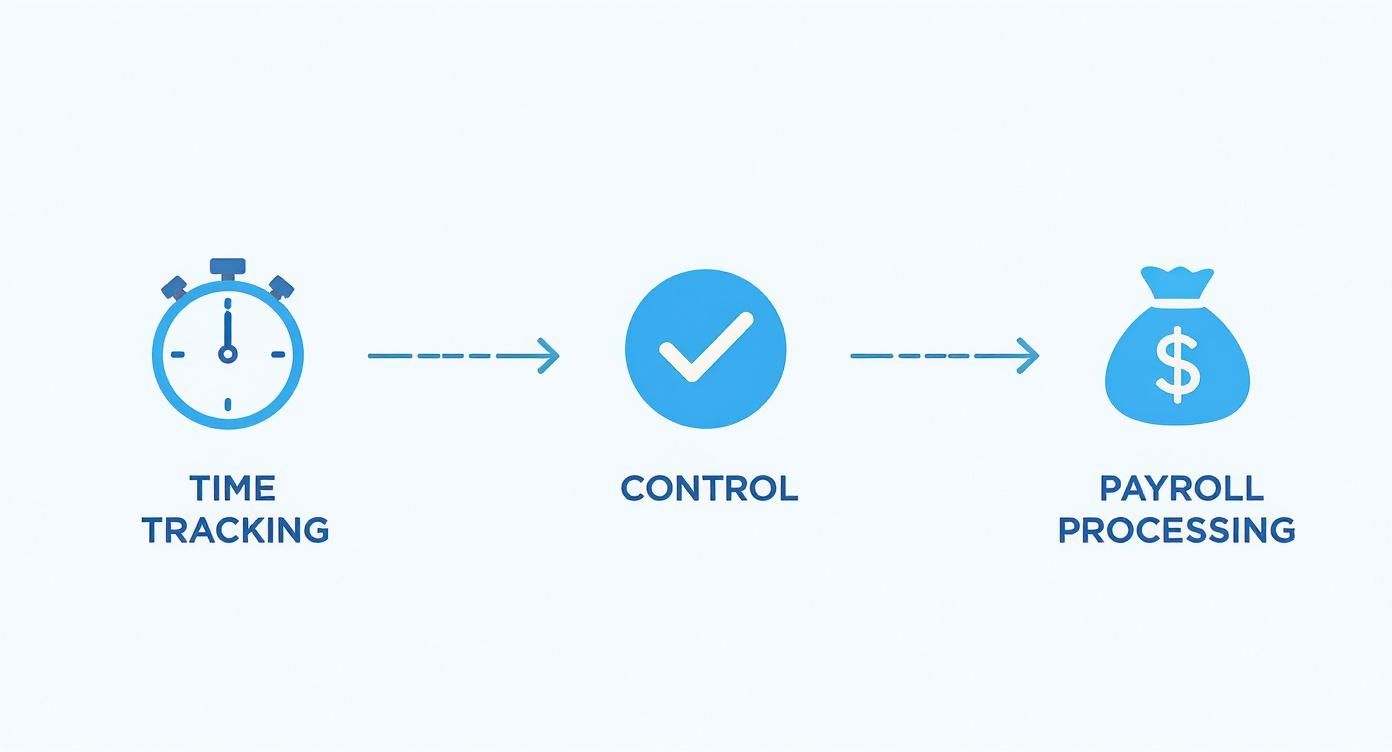
The graphic shows that a smooth process consists of three core steps: precise recording of working hours, subsequent control and finally correct payroll accounting.
Think about billing and data
An often overlooked but extremely important point: the connection to your payroll accounting. How do you get the recorded data out of the system? In the best case scenario, there is a direct interface to your payroll software or at least a clean export option as a CSV file.
The more precisely you define your requirements in advance, the more accurate your decision will be. You not only save money by avoiding an expensive bad investment, but above all you save time and nerves in your daily work.
Also consider whether your system should automatically calculate special wage types. Work on weekends or at night is not uncommon in the promotion industry. If the system recognizes and calculates surcharges independently, it takes an enormous burden off your administration's shoulders.
Imagine a concrete scenario: A promoter works from 6 p.m. to 2 a.m. on a Saturday night. A good system should be able to correctly assign the hours before and after midnight to the respective surcharges without you having to intervene manually. The clearer your list of requirements is, the easier it is for you to find a tool that really suits your agency and your team.
Find the right software for mobile teams
The market for time tracking software is huge. The problem: Not every tool is really suitable for you and your promotion team. It's best to concentrate your search on providers who specialize in the needs of mobile and flexible teams. A good app for that Time recording for promotions-Inserts must be one thing above all: extremely easy to use.
Your promoters don't have time to click through complicated menus on site. A large, clearly visible “Start” and “Stop” button is often the best solution. This simplicity will determine whether your team embraces the tool or finds it a chore.
Core functions that really count for promotion agencies
Make sure that the software works even without an active internet connection. The captured data should simply be automatically synchronized later. This is an invaluable advantage for events in exhibition halls or in remote locations with poor reception. Nothing is more annoying than lost time data due to a dead spot.
Also check the deployment planning functions. Can you create shifts directly in the tool and assign them to your staff? Ideally, you will receive a notification directly on your smartphone and can confirm the use with one click.
Another crucial point is traceability. If a team member forgets to clock out, you need to be able to correct the time easily and quickly. A good system logs every single change so that it is always clear who adjusted what and when.
Choose software built for use in the field, not the office. The operation must be so intuitive that it works without thinking even in stressful situations - such as shortly before the start of an event.
The huge selection of apps in the Google Play Store shows how many different solutions there are.
What is immediately noticeable here: Many apps have high ratings, but differ massively in their range of functions and their target group. Some are intended for freelancers, others for large corporations.
How to make the right choice
To separate the wheat from the chaff, you should specifically look at reviews from other agencies. Experience reports from the same industry often provide the best insight into whether a tool is really useful in everyday life. The digital one Time recording for promotionsteams are ultimately becoming more and more standard in Switzerland.
Statistical data from Switzerland shows growing acceptance. In the canton of Zurich, for example 74 % of employers surveyed as part of the Swiss HR Barometer 2020 to use new technologies positively to better monitor working hours. This development has increased since then. You can find out more about this in this article about Company regulations for time recording in Switzerland.
Always request a free and non-binding test phase. Nothing is more insightful than trying out the software in a real deployment with a small, selected team. This is the only way you can really find out whether the app fits your processes.
Ask the following questions during the test:
- How quickly is the app ready to go? Do you have to fight through endless settings or is everything self-explanatory?
- How does support react? Test customer service with a simple question. This is how you check the response time and the quality of the answer.
- Is data export easy? Check whether you can easily export the recorded times for your payroll accounting.
The combination of ease of use, offline capability and solid operational planning is what makes a good one Time tracking for promotionteams. If you want to go deeper into personnel scheduling specifically for promotion agencies, take a look our tips for efficient PEP to.
How to successfully get your team on board
The best software is of no use to you if your team doesn't use it. Very easy. The moment you find a new solution for the Time tracking for your doctorate-Introduce actions decide whether you succeed or fail. A well-planned start ensures acceptance and saves you countless hours of corrections and frustrated questions later.
The biggest mistake? Wanting everything at once. Resist the urge to immediately activate the new system for all employees. This almost always ends in confusion, resistance, and a flood of support requests that you can't possibly handle on your own. It's better to take it step by step - that's the sure way to reach your goal.
Start with a pilot project
Choose a small, manageable project to start with. A single event or a short promotional week is perfect for this. Grab one or two of your most experienced promoters who are tech-savvy and open to new things. These “test pilots” are worth their weight in gold in the introductory phase.
Explain the goal to them and ask them to put the system through its paces under real-world conditions. They should not only clock their times, but also actively look for hooks and eyes. Gather their honest, unfiltered feedback.
- What was immediately clear and simple?
- Where were there hurdles or ambiguities?
- Does the app run smoothly or does it jerk?
- Are there any concrete suggestions to improve the process?
You use exactly this feedback to optimize your internal instructions and training materials. What is unclear for an experienced promoter will be even more challenging for the rest of the team.
Clear communication and targeted training
As soon as the pilot project is in place and the initial feedback has been incorporated, you can prepare the rollout for the entire team. But don’t just throw a login at them. A clean introduction requires good preparation.
Create short and sweet instructions. Let’s be honest: Nobody reads long PDFs. A short video tutorial works much better – maximum five minutes – which shows the most important functions of the app in action: log in, start an assignment, clock a break, end the day. Complete.
The biggest mistake when introducing new software is assuming that the benefits are obvious to everyone. You have to actively show your team what she what you get out of it – not just what the company gets out of it.
Schedule a short online training course. Half an hour is often enough. Introduce the system, show the tutorial and give your team the chance to ask questions directly. This creates trust and takes away many people's initial fear of the new tool.
Show the benefits for your team
Acceptance depends on whether your employees recognize the personal benefit. The new one Time tracking for the doctorate is not only a control instrument for you, but also brings tangible benefits for you.
Communicate these points clearly:
- Fair and punctual payment: Every minute worked is recorded precisely. This ensures correct payroll that everyone can understand.
- No more lost timesheets: The tedious process of collecting and submitting papers is a thing of the past.
- Full transparency: Anyone can view their own recorded hours directly in the app at any time.
- Less questions and stress: Unclarities in billing are minimized from the outset.
Also appoint a designated contact person for technical questions in the first few weeks. This gives your team security and ensures that small problems are solved quickly before they lead to major frustration. A well-thought-out introduction is an investment that quickly pays for itself through motivated employees and smooth processes.
Check recorded times and prepare them for payroll
The stamped times are the heart of your fair billing. But before this data goes into payroll accounting, it is essential to take a closer look. It's best to make a habit of a fixed, recurring process for this control - this will save you a lot of headaches later and ensure clean data.
A good rhythm is to go through the times immediately after each event or at the end of each week at the latest. Then the memories are still fresh for you and your team. Take a look at the recorded hours and ask yourself: Does it all seem consistent? Are there noticeably long shifts or entries where people obviously forgot to clock out?
Imagine that a promoter has working hours for a Saturday assignment 14 hours detected because he simply forgot to press “Stop”. Modern tools are a real blessing here, as they usually highlight such unrealistic entries in color or mark them as “open”. This is your signal to take action.
The key to squeaky-clean billing is timely communication. Clarify any uncertainties directly with the promoter instead of waiting for weeks. A quick call or message is often enough to determine the correct end time and enter it into the system.
From control to data export
As soon as all times for a pay period have been checked and found to be correct, you release them in the system. This is an important step because it “freezes” the data, so to speak, and protects it from subsequent changes. This creates a binding, unassailable basis for payroll accounting.
Next up is data export for accounting. A good system for them Time tracking for your doctorate-Actions offers you flexible options here. By default you should be able to pull the data as a CSV or Excel file. These files usually contain all the information that payroll accounting needs:
- Employee name
- Date of use
- Hours worked (often already in the correct decimal representation)
- Recorded break times
- Assigned project or customer
This structured handover ensures that your payroll department can process all data quickly and without questions.
Use the payroll accounting interface
Ideally, you won't even have to manually export files and send them via email. Many modern systems offer direct interfaces to common payroll programs. This means: The released time data is automatically and error-free transmitted to the payroll software at the push of a button. This not only saves a huge amount of time, but also eliminates the risk of typing errors, which are all too easy to make when entering numbers manually. Be sure to check whether your time tracking tool has this Integrations and interfaces to payroll systems offers.
This precise recording is becoming more and more important. The average weekly working hours in Switzerland in 2023 was around around 41.4 hours. Almost half of the employees (47,7 %) used flexible models such as flextime. Particularly in the project-driven promotion industry, meticulous recording is crucial for planning and correct billing. More about the legal basis for recording working hours In Switzerland you can find out directly from SECO.
A clean handover process from time recording to billing is the final but crucial piece of the puzzle. He ensures that your team is paid correctly and on time for their great work - and that is the best basis for long-term and motivated collaboration.
The most burning questions about time recording at promotion events
The same questions always arise in everyday agency life when it comes to digital time recording for promoters. No wonder, because the legal framework and practical implementation have their pitfalls. We shed light on the matter and answer the most frequently asked questions from practice.
Do breaks also have to be recorded?
A resounding yes. In Switzerland, recording breaks is not only good practice, but also required by law. The labor law is clear: breaks are mandatory after a certain length of work has been completed - and this must also be verifiable. A clean one Time tracking for promotion-Teams can't get around it.
Imagine one of your promoters is on duty for eight hours. A smart system can be configured to automatically book a 30-minute break if your employee forgets to clock out manually. This is not mistrust, but rather insurance – for you and your team. This way you avoid legal gray areas and ensure fair conditions.
What about travel time to the event location?
Ah, the classic. Travel time is often a tricky point. The rule of thumb is: If the route to the place of work is significantly longer than the everyday commute, it can be considered working time. This is a central issue, especially in promotional activities that sometimes take place in Zurich and sometimes in Geneva.
Our practical tip: Make the travel time regulations crystal clear in the employment contract. A transparent agreement from the start creates trust and prevents later discussions. This means everyone in the team knows whether the journey is part of the job or not.
A good digital tool makes the difference here. It should allow your team to clock between different activities, such as “travel time” and “onsite time.” This ensures a sparkling clean data basis for billing and gives you an exact overview of who was deployed where and when.
Is GPS location tracking data protection compliant?
The GPS location query when clocking in is extremely useful to ensure that working hours are actually recorded at the event location. And yes, it is absolutely data protection compliant – if you follow a few rules.
- Be transparent: Openly communicate that location is recorded when stamping and explain why this is necessary for accurate billing.
- Stick to the purpose: The tracking may only be used for the moment of clocking in and out. Permanent monitoring or movement profiles are an absolute no-go.
- Get consent: It's cleanest if you get your employees' consent in writing.
A typical scenario: Your promoter arrives at the trade fair stand and clocks in using the app. At this moment, the app records the location and confirms: “Check-in successful at the correct location.” After clocking out at the end of the day, the tracking is finished again. This ensures your privacy is maintained and you have the security you need for complete security Time recording during the doctorate need.
Are you looking for a solution that easily meets all of these requirements? job.rocks was developed precisely for the needs of promotion agencies: intuitive scheduling and precise, GDPR-compliant time recording that has your back. Simplify your processes and finally create transparency for your entire team.