
What is an authorised signatory and how much power do they really have?
Imagine your company is growing, but as managing director you cannot be everywhere at once. This is where an authorised signatory comes in: a trusted representative with extensive legal powers to keep the business running.
Imagine your company is growing, but as managing director you can't possibly be on all fronts at the same time. This is exactly where the authorized sign comes in: He is basically your “second self”. and is given extensive powers by law to keep the business running.
What an authorized representative means for your company
An authorized representative is so much more than just a fancy title on a business card. He is an absolute trustworthy person who can legally represent your company externally. This comprehensive power of attorney is called Prokura.
Think about a successful event agency. A large customer wants to sign a contract for a festival at short notice, but you are abroad at the moment. Without an authorized representative, this business could collapse. However, with an authorized representative at your side, your representative can conclude the contract immediately and in a legally secure manner. This ensures your company's ability to act at all times.

The legal basis of the power of attorney
In Switzerland, the role of the authorized representative is clearly regulated. According toArt. 459 Para. 1 OR, he is a person with comprehensive power of representation who can carry out almost all business actions “that the purpose of the company may entail”.
This enormous power makes the authorized representative a key figure, especially in industries such as event services, catering or logistics, where quick decisions are required. The power of attorney is historically deeply anchored in the Swiss Code of Obligations, which has been in force since 1911. If you want to delve deeper into the historical background of the Prokura, you will find exciting details on Wikipedia.
The appointment of an authorized representative is an enormous sign of trust. Among other things, it can:
- Hiring and firing employees.
- Conclude important contracts with suppliers or customers.
- Conduct banking transactions on behalf of the company.
An authorized representative ensures continuity and speed. It ensures that important decisions are made even when management is not available - a decisive advantage, especially in the fast-moving project business.
These powers make it clear why selecting the right authorized representative is one of the most important strategic decisions for your company. You are transferring a huge responsibility that can directly determine the success or failure of your business.
The authorized representative at a glance
This table summarizes the core characteristics of an authorized representative and gives you a quick overview of their role and legal anchoring.
| Feature | Description |
|---|---|
| Definition | A natural person with extensive, legally defined authority (power of attorney). |
| Legal basis | Swiss Code of Obligations (OR), in particular Art. 458 ff. OR. |
| Scope of the power of attorney | May carry out all legal transactions that the purpose of the company entails. |
| Grant | Only by the owner of a company registered in the commercial register, expressly and personally. |
| Commercial Register | The granting and expiry of the power of attorney must be entered in the commercial register. |
| Signature | Draws with the addition "ppa." (per procura). |
The table shows: The role of authorized representative is not an informal title, but rather an instrument firmly anchored in the law that ensures stability and ability to act.
After we have clarified what an authorized representative actually is, let's take a closer look at the legal rules of the game. The power of attorney is not a casual agreement over coffee, but a formal power of attorney with a solid foundation in the Swiss Code of Obligations (OR). Their granting and scope therefore follow clear and strict rules.
First of all, the most important hurdle: Only those who are the owner of a company registered in the commercial register are allowed to grant power of attorney. This can be the owner of a sole proprietorship, the board of directors of an AG or the shareholders' meeting of a GmbH. What is crucial is that the appointment must be express - there is no such thing as a tacit appointment, it would be legally ineffective.
Entry in the commercial register as a protective mechanism
An absolutely central step is the entry of the power of attorney in the commercial register. This is much more than just bureaucracy. This entry is a protective shield for all business transactions.
It makes the power of representation public and visible to everyone. A business partner who is negotiating with your authorized representative can make sure with a quick look at the commercial register that this person is actually allowed to sign for your company. The law deliberately creates transparency and the necessary trust in everyday business.
Individual or collective procuration – what is the difference?
Fortunately, the law offers some flexibility. You can decide for yourself how much control you want to give up or keep:
- Individual procuratorate: The authorized representative may represent the company alone. This form offers maximum speed and is perfect for key people you trust implicitly.
- Collective procuration: Here at least two people must act together to legally represent the company. This ensures the tried and tested four-eyes principle and distributes the great responsibility across several shoulders.
Imagine a large hotel. With a collective power of attorney, the F&B manager and the purchasing manager could only jointly conclude delivery contracts for 10,000 francs. This prevents expensive solo efforts and provides double security for strategically important decisions.
Issuance and revocation of power of attorney
The appointment of an authorized representative is a conscious act - and the revocation must be just as conscious. You can revoke a power of attorney at any time and without giving reasons, even if it was agreed as part of an employment contract.
Important to know: The revocation will only become effective against third parties, i.e. your business partners, once the power of attorney has been deleted from the commercial register. As long as the entry still exists, outsiders can rely in good faith on the power of representation of the (former) authorized representative.
Handling these formal steps correctly is crucial to preventing abuse and protecting your company. Anyone who doesn't know the rules here risks significant financial and legal consequences - a classic example of the pitfalls of Swiss labor law.
What an authorized representative is allowed to do and what his limits are
An authorized representative is entrusted with one of the most far-reaching powers that a company can ever grant. But this power is not limitless. It is absolutely crucial that you understand exactly which doors the power of attorney opens and where the legal or internal barriers are.
Basically, power of attorney covers all types of legal transactions that the purpose of your company entails. This is an extremely broad field and gives the authorized representative enormous ability to act in everyday life.
The comprehensive scope for action
Imagine you run a security company. Within this framework, your authorized representative can do almost everything that is necessary for ongoing business operations. This makes it a real support when you are not there yourself.
- Make personnel decisions: He can easily hire new security guards or terminate existing contracts. The conclusion of employment contracts is clearly part of his area of responsibility.
- Conclude contracts: He can sign new monitoring orders with customers, lease company vehicles or extend the rental contracts for your office space.
- Conduct financial transactions: He may take out loans to finance new equipment or manage the company account and make transfers.
This broad scope ensures that the company remains fully operational even if the management is unavailable. To ensure that such contracts are legally watertight, it is worth taking a look at our guide to the employment contract according to L-GAV.
The following flowchart illustrates the formal path from the granting of power of attorney by the management to its legal effectiveness through entry in the commercial register.
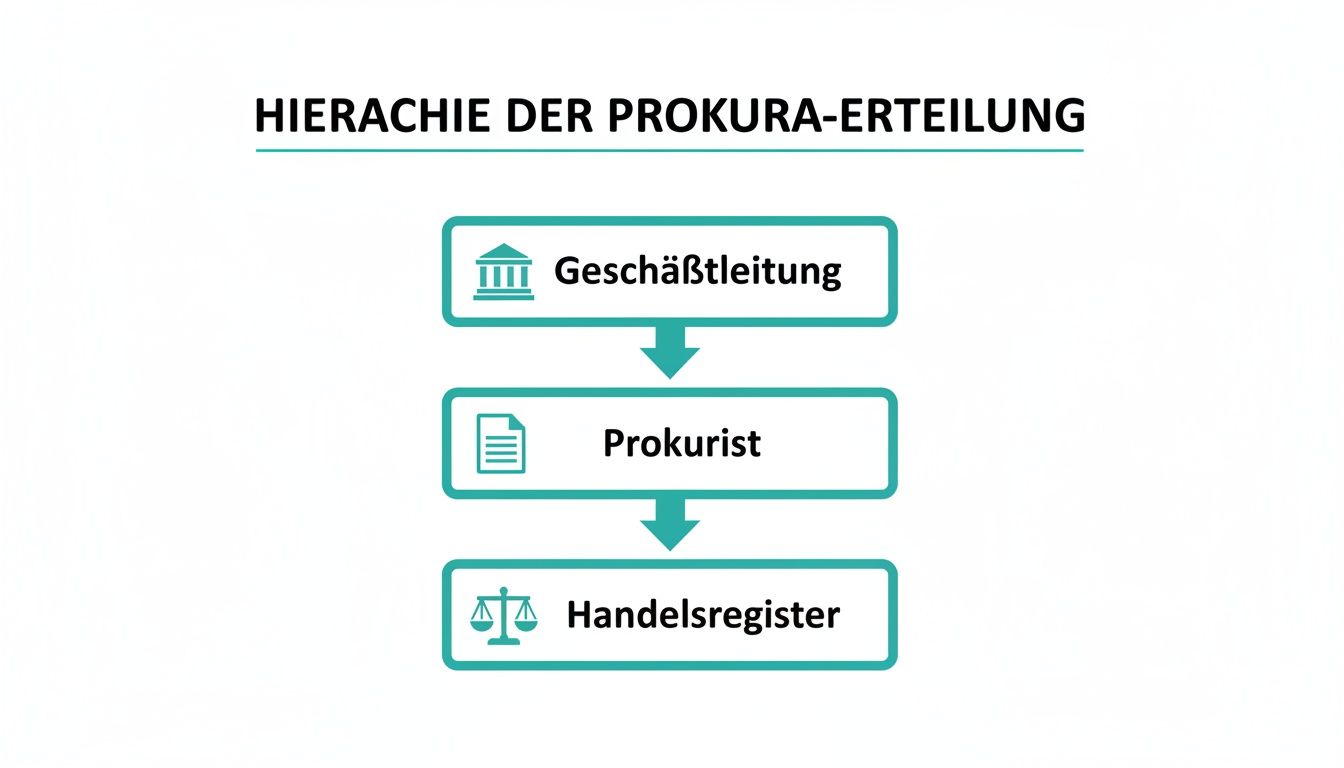
The graphic makes one thing clear: Procuration is not a casual handshake, but a formalized process. It is based on the deep trust of the management and only becomes visible and legally binding to everyone when it is publicly registered.
The clear legal boundaries
Despite the great power, the law draws very clear red lines. An authorized representative may not carry out certain fundamental actions that affect the foundation of the company without special, additional authorization. These so-called "fundamental transactions" always remain reserved for the owner or management.
These include above all:
- Sale and encumbrance of real estate: Your authorized representative cannot simply sell the company premises or take out a mortgage on it. That doesn't work.
- Sale of the company: He is not authorized to sell the entire company or significant parts of it.
- Issuance of a power of attorney: An authorized representative cannot appoint additional authorized representatives himself. This power remains at the top.
- Registration of changes in the commercial register: This also remains the responsibility of the management.
These restrictions are not a vote of no confidence, but a protective mechanism. They protect the substance of your company from ill-considered or unauthorized decisions.
Important to know: In external relationships, i.e. with business partners, the scope of the power of attorney is stipulated by law and cannot be limited. Internal instructions to the authorized representative do not change this at all.
What does that mean specifically? Let's assume you give your authorized representative internal instructions to only sign contracts up to a value of 50,000 CHF. However, he still concludes a contract for 70,000 CHF. This contract is completely valid and binding for your company!
Your business partner could and had to rely on the commercial register entry. Internally, you can of course hold your authorized representative accountable for ignoring the instructions - but the contract with the third party remains in effect. This is the risk that comes with trusting an authorized representative.
The exact differences to other forms of representation
There are a lot of titles floating around in the company hierarchy that indicate powers of representation: authorized signatory, managing director, authorized representative. At first glance they may sound similar, but in practice their rights and obligations are sharply separated. Knowing these differences is not a legal detail, but absolutely crucial to clearly defining responsibilities in your company and avoiding costly misunderstandings.
Just imagine the roles as levels of a pyramid. At the top is the managing director, in the middle is the authorized representative and at the base is the authorized representative. Each level has its clearly defined scope for action.
The managing director as the highest body
The Managing Director (in the case of an AG, the board of directors) is the ultimate management body of the company. Its powers come directly from its position as a body of society - they are not delegated to it by anyone else. He bears full strategic responsibility and has tasks on the table that he simply cannot delegate.
This includes the major strategic decisions, such as setting company goals or selling the entire business. Only he is allowed to sign balance sheets, call the general meeting or, in an emergency, declare bankruptcy. His power is primal and all-encompassing.
The authorized signatory is the derived all-purpose weapon
One level below we find the authorized signatory. His power is not original, but is given to him by management. Nevertheless, his authority, the power of attorney, is extremely far-reaching and clearly outlined in the law. It covers practically all in-court and out-of-court transactions that the purpose of the company entails.
An authorized representative acts as an extended arm of the management in operational business. His powers are so far-reaching that business partners must be able to blindly rely on his signature - a security that the entry in the commercial register creates.
A simple example makes the difference crystal clear: An authorized representative can easily sign a rental agreement for a new warehouse. The managing director, on the other hand, is the only one who can make the decision to sell the entire warehouse building.
The authorized representative for day-to-day business
The world looks completely different for the authorized representative. His authority is much narrower than that of a power of attorney. It is limited to transactions that are usual and everyday for a particular business area. It is also important: his power of attorney is not entered in the commercial register.
A buyer in a catering business is the perfect example here. He is allowed to order groceries from well-known suppliers every day. What he is not allowed to do is conclude a long-term exclusive contract for 100,000 francs or purchase a new company car. That would be an extraordinary business and clearly the task of the authorized representative or managing director.
This clear demarcation of competencies brings structure and security to everyday business. Everyone knows exactly what they are responsible for and where their authority ends.
How an authorized representative practically supports your company
The theory of procuration is one thing, but what does it really mean for you in the daily chaos of business? Quite simply: Especially in industries that rely on high and flexible personnel requirements - think of the event industry, catering or security services - an authorized representative becomes the crucial piece of the puzzle for smooth processes. It is the bridge between your strategic vision and operational implementation at the front.

Imagine a very typical situation: You are the owner of an event agency and are currently on the way to an important customer meeting. Suddenly your cell phone rings. It's a supplier's turn - a contract for the stage technology for a major event must be signed immediately, otherwise the delivery will fail.
Without an authorized representative, you would now have to drop everything or let the deal collapse. With an authorized representative at your side, the situation remains relaxed. He can sign the contract in the office in a legally secure manner, thereby ensuring the success of your project. You stay focused.
Efficiency in human resources management
In personnel-intensive companies, the greatest leverage often lies in the management of employees. This is exactly where an authorized representative with personnel responsibility can provide enormous relief and massively accelerate your processes.
An authorized representative can act completely independently as an authorized user of a workforce management platform such as job.rocks. This takes work away from you in your day-to-day business.
- Confirm shifts: If staff is needed for an event at short notice, the authorized representative can confirm the shifts without further inquiry.
- Validate working hours: After the event, he checks and approves the employees' recorded hours directly in the system. No more waiting for you.
- Prepare payroll: He releases the validated data for payroll accounting and ensures that everyone gets their money on time.
This task transfer is much more than just a time saver. It ensures that your company remains 100% operational even if you are not on site or reachable. Decisions are made faster and the satisfaction of your employees increases because administrative hurdles simply disappear.
By appointing an authorized representative, you create a reliable second level of management. This solves operational bottlenecks and gives you the freedom to concentrate on the strategic growth of your company.
At the end of the day, it's about distributing responsibility wisely. An authorized representative is not just insurance in case of an emergency, but rather an active contributor to your success. He has your back free so that you can concentrate on the really important things: securing the future of your business and seizing new opportunities.
Checklist for appointing an authorized representative
The decision to grant an employee power of attorney is more than just an administrative act - it is an enormous sign of trust and a strategic step. So that you don't overlook anything, we have put together a practical checklist. It will guide you safely from the first consideration to legally compliant implementation.
1. Select candidates carefully
The first and probably most important step is choosing the right person. Since an authorized representative is given extensive powers that bind the company externally, absolute trustworthiness and strong professional competence are non-negotiable. Analyze the candidate's previous performance, reliability and, above all, entrepreneurial thinking. Is the person suitable for this great responsibility not only professionally but also personally?
2. Determine the form of procuration
Not every procuratorate is the same. Before you act, you need to decide which form is best suited to your business structure and risk tolerance.
- Individual procuration: The most powerful but also the riskiest variant. A person can act alone and without restriction.
- Collective procuration: The four-eye principle applies here. At least two people must sign together, which increases control and reduces the risk of wrong decisions.
3. Make an official decision
The appointment of an authorized representative does not happen with a handshake. It requires a formal resolution from the responsible body - for example, the board of directors of an AG or the shareholders' meeting of a GmbH. This decision must be recorded in writing.
A clearly documented decision is the legal basis for registration with the commercial register and avoids later ambiguities. It proves the official will of the company.
4. Prepare necessary documents
For entry in the commercial register you must have the correct papers ready. As a rule, these are the registration letter to the commercial register office, a copy of the appointment decision and a certified signature of the new authorized representative. This signature serves as a reference for the register.
5. Register with the commercial register
Finally, you submit all documents to the responsible commercial register office. This step is more than just a formality: the power of attorney only becomes effective against third parties once it is registered. This is required by law and creates the necessary transparency and legal certainty in business transactions. From this moment on, the person with the addition "ppa." can and must; draw (per procura).
Carefully carrying out these steps is crucial. In order to maintain an overview and manage such processes efficiently, it is worth checking how you can digitize your HR processes and thus also seamlessly manage appointments and changes in competencies.
The most frequently asked questions about authorized representatives in practice
In everyday business life, the same questions about power of attorney always arise. Here we clarify the most important points briefly and succinctly so that you have absolute security at the crucial moment.
Can an authorized representative actually terminate the contract?
Yes, of course. An authorized representative may terminate employees as well as terminate his own employment. Giving notice of termination is a normal business transaction that is fully covered by the power of attorney. If he leaves himself, the normal deadlines and conditions of his employment contract apply.
What does this abbreviation “ppa.” mean? under the signature?
You've probably seen it before, right? The addition ppa. stands for “per procura” and is more than just a formality – it is required by law. If an authorized representative puts his signature with this abbreviation underneath, he immediately signals to every business partner: Attention, I act with the company's extensive authority, which is anchored in the commercial register.
Can't the power of attorney be restricted somehow?
No, and that is one of the most important points of all. In relation to third parties - i.e. in external relationships - a limitation of the power of attorney is legally excluded. Business partners must be able to rely blindly on the fact that the registered scope of the power of attorney applies.
Of course, you can specify internally that your authorized representative is only allowed to conclude contracts up to a certain amount. The problem? Such an internal directive is completely ineffective externally.
If an authorized representative concludes a contract and ignores an internal upper limit, this contract is still fully binding for the company. The risk of exceeding competence is always borne by the company, not the external business partner.
Is it possible for an authorized representative to also be a partner?
Yes, that is possible without any problems. The two roles have nothing to do with each other legally and exist independently of each other. The power of attorney regulates his power of representation externally, while his status as a partner affects his ownership rights and co-determination within the company.
How do you actually get appointed authorized representative?
You don't just become an authorized representative. The path leads through an express appointment by the management or the owner. There is no such thing as a tacit appointment just because someone takes on certain tasks. This formal resolution must then be registered for entry in the commercial register - only then is the power of attorney officially effective.
job.rocks helps you to clearly define responsibilities and optimize your HR processes. Discover now at https://job.rocks how you can make deployment planning for managers and authorized representatives more efficient.