
CBA guide: what a collective employment agreement is and why it affects you
A collective employment agreement, or GAV for short, is like a common rule book for an entire industry in Switzerland. It is negotiated and established between employers' associations and trade unions binding minimum sta…
A collective employment agreement, or GAV for short, is like a common rule book for an entire industry in Switzerland. It is negotiated and established between employers' associations and trade unions binding minimum standards fixed for everyone. You can imagine it as a foundation that stands above and complements your individual employment contract.
What a GAV means for you
Imagine you work in the event industry. Without a GAV, your employer could reduce your hourly wage overnight or ask you to work a 12-hour shift without an extra cent. Your personal employment contract offers some protection, but the bargaining power is rarely balanced.
This is exactly where the GAV comes into play. It works like a protective shield for all employees in an industry and ensures clear, fair rules. He states unequivocally:
- Minimum wages: There is a clear minimum wage that no one is allowed to fall below.
- Working hours: The maximum weekly working hours and the rules for overtime are clearly defined.
- Holiday entitlement: Your right to paid vacation days is fixed and non-negotiable.
- Notice periods: Fair and, above all, uniform deadlines apply to both sides.
A GAV creates a stable and fair basis for cooperation. It prevents arbitrariness and ensures that all companies in an industry operate under the same basic conditions. This not only protects you as an employee, but also fair employers from wage dumping by the competition.
This overview shows how comprehensively a GAV structures the world of work and creates clarity for both sides – employers and employees.
The key points of a GAV at a glance
This table summarizes which key areas a collective employment agreement typically covers.
| Regulatory area | What that means for you | Practical example |
|---|---|---|
| Wages & allowances | Your income has a binding lower limit and special services are paid extra. | A GAV stipulates that your work at night is subject to a surcharge of 25% must be remunerated. |
| Working & rest times | Your maximum working hours per week and your breaks are clearly regulated. No more endless shifts. | The maximum weekly working hours are set at 42 hours fixed. Overtime must be compensated. |
| Holidays & Holidays | Your right to rest is secured and does not depend on the goodwill of your boss. | You are entitled to at least 4 weeks Paid holidays per year, even higher from the age of 50 5 weeks. |
| Protection against dismissal | There are clear deadlines that protect you from sudden and unexpected termination. | After the probationary period, the notice period is at least one month in the first year of service. |
The table makes it clear: A GAV is not an abstract set of rules, but a very concrete instrument that directly influences your everyday work.
A practical example from the event sector
Imagine you are hired as a technician for a major concert tour. The job is demanding, the working hours are irregular - often at night and on weekends.
The GAV that applies to the event industry ensures that you are fairly compensated for this flexibility. It stipulates that you receive a wage supplement of 25% receive. If a show lasts longer than planned and you have to work overtime, the GAV clearly stipulates how this must be compensated for - either through free time or with a wage supplement. Without this contract, it would be purely a matter of negotiation and could be handled completely differently from company to company.
A GAV is therefore much more than just a dry document. It is an active tool that brings planning and security into your everyday working life. These common rules are worth their weight in gold, especially in industries with very flexible working models, such as in the catering industry. If you want to delve deeper into this topic, check out our Guide to the L-GAV in the catering industry to. This avoids conflicts from the outset and allows you to concentrate on what really counts: your work.
How to find out whether a GAV applies to you
Not every employment contract in Switzerland is automatically subject to GAV. Whether the common rules of the game also apply to you depends on a few clear criteria. There are basically two ways in which a GAV becomes binding for you and your employer.
The first and at the same time the most far-reaching way is this GAV declared generally binding. If the Federal Council or a canton declares a GAV to be generally binding, it suddenly applies all companies and employees a specific industry in a specified area. From this moment on, it no longer matters whether your boss is a member of an employers' association or not - the rules are the law.
A very well-known example of this is the state collective employment agreement for the hospitality industry (L-GAV). Every single restaurant business in Switzerland must adhere to its requirements for minimum wages, working hours and holidays. There are no ifs and buts about it.
The difference to the “normal” GAV
In contrast to this is the normal GAV, which has not been declared generally binding. This is only binding for those companies that actually Member of the signatory employers' association are. All other companies in the same industry can theoretically adhere to different rules as long as they do not join the contract voluntarily.
Imagine you work for a small, private security company. There is a GAV for the security industry, but your employer is not a member of the relevant association. In this case, the individual rules of your employment contract apply to you as long as the industry GAV is not generally binding.
This simple decision tree will help you quickly clarify whether your contract is influenced by a GAV.
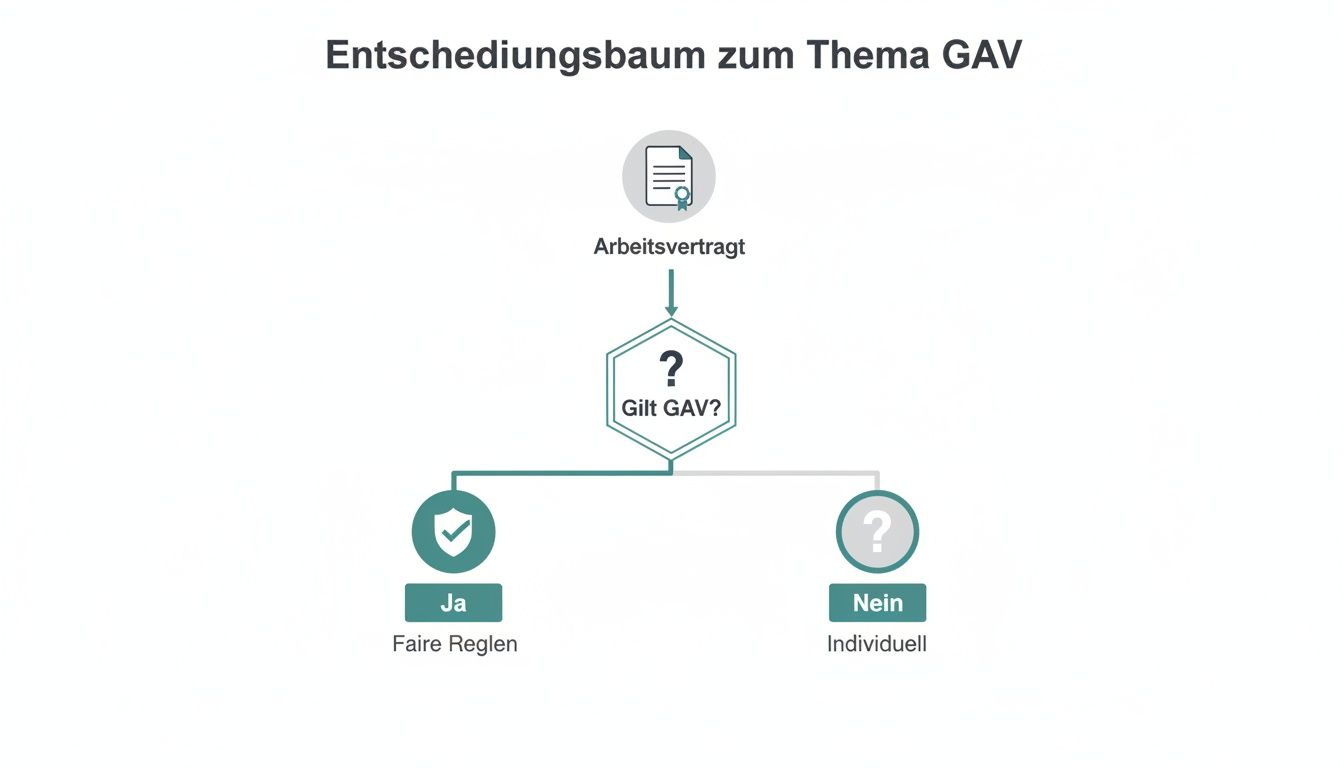
The graphic shows it nicely: The first step is always to check whether a GAV exists for your industry and whether it applies to your business.
A GAV usually includes the vast majority of the workforce. This means that the rules usually also apply to:
- Learners
- part-time workers
- Temporary employees
There is often an important exception for higher management positions. Employees with extensive decision-making authority and great responsibility may be exempt from the GAV provisions. The reason? Individual contracts are usually negotiated for them, which are often even more advantageous.
Particularly in industries such as the gig economy, where flexible working models dominate, GAVs ensure important minimum standards and prevent wages from being undercut. If you would like to delve deeper into how the employment contract and the GAV interact, you can find it in ours Guide to the employment contract and L-GAV everything you need to know.
Understand your rights and responsibilities as an employee

A GAV is not a one-way street. It not only guarantees you important rights, but also defines clear obligations. Imagine it like a scale: on one side are your demands, on the other side are your obligations. Only when both sides are in balance can the system function fairly and stably.
Your rights as an employee under GAV
For you as an employee, the rights side of the scale is of course particularly interesting. These guarantees create a reliable and secure working basis – no matter which company you work for in your industry. They ensure that you are treated and compensated fairly.
The most important rights that are anchored in almost every GAV include:
- Guaranteed minimum wages: Your salary must not fall below a defined lower limit. This is the best protection against wage dumping.
- Surcharges for special services: There is additional compensation for work at night, on Sundays or on public holidays.
- Regulated working and rest times: The maximum weekly working hours and the minimum duration of breaks and rest periods are clearly defined.
- Entitlement to paid holidays: How many vacation days you are entitled to is fixed and non-negotiable.
Let's imagine this in concrete terms: You work as a nursing specialist in a hospital that is subject to GAV. You fill in for an additional shift at short notice and show up this week 48 working hours, although the GAV 42 hours provides.
Here the GAV regulates crystal clear what happens: These six hours of overtime must either be accompanied by a wage supplement of 25% paid out or later compensated with free time. Without GAV it would be purely a matter of negotiation.
Your obligations as an employee
On the other side of the scale are your responsibilities. They are just as important because they ensure professional and smooth operations. They form the basis for good cooperation within the team and with the employer.
Perhaps the most important duty is this Duty of peace. It means: As long as the GAV applies, you and the unions will refrain from industrial action such as strikes. In return, of course, the employer also adheres to all agreements.
There are also other basic obligations that you must comply with as an employee:
- Duty of loyalty: You are obliged to protect the interests of your employer. This means not divulging business secrets or working on the side for direct competition.
- Duty of care: You must carry out your work conscientiously and handle work equipment and materials carefully.
- Compliance with the operating rules: You are required to follow the company's internal rules, i.e. follow instructions from superiors or safety regulations.
A GAV therefore creates a balanced system. He protects you from arbitrariness and ensures you fair conditions, but in return he also expects loyal and professional behavior from you. This creates a stable environment from which everyone ultimately benefits.
What you as an employer need to keep in mind when complying with GAV
For you as an employer, compliance with a GAV is much more than just an administrative obligation - it is a business necessity. Those who implement the rules properly protect their company from legal consequences and build a reputation as a fair and reliable employer. Violations, on the other hand, can quickly become expensive and permanently damage the image.
The greatest responsibility lies in complete and correct documentation. Every single hour of work, every break and every overtime must be meticulously recorded. This is the absolute basis for a GAV-compliant payroll, in which all supplements - be it for night, Sunday or public holiday work - are calculated and paid correctly.
The hidden complexity of shift planning
Particularly in industries with irregular working hours, scheduling quickly becomes an ordeal. Imagine a typical scenario from logistics: You have to set up a night shift for your warehouse team at short notice in order to handle an urgent delivery.
Suddenly you have to juggle a whole bunch of GAV requirements at the same time:
- Minimum rest period: Every employee has the prescribed rest period of at least 11 hours between the end of the last shift and the start of the new shift?
- Night work supplement: Is the correct wage supplement stored in the system? Is it really automatically taken into account in billing?
- Maximum weekly working hours: Is no one in danger of exceeding the maximum permitted working hours per week as a result of this additional effort?
Overseeing all of this manually is extremely error-prone. A small mistake can trigger a chain reaction - from frustrated employees to official complaints at the next inspection.
Incorrect GAV implementation not only leads to fines. It undermines your team's trust and makes it harder to find and retain skilled and flexible workers - a real problem in a tight labor market.
The Swiss labor market showed mixed signals in 2025: While the number of employed people increased, the unemployment rate according to the ILO definition climbed at the same time 5.0 percent. This makes planning more difficult, especially for industries such as logistics or catering, which rely heavily on seasonal forces. A decrease in job advertisements by over 33 percent With more job seekers at the same time, the pressure to act efficiently and in accordance with GAV increases in order to retain good people in the long term. You can find out more about this in the article about the Developments on the Swiss labor market on srf.ch. Modern tools can massively reduce administrative effort and ensure compliance.
GAV-compliant processes? Smart software is your digital watchdog
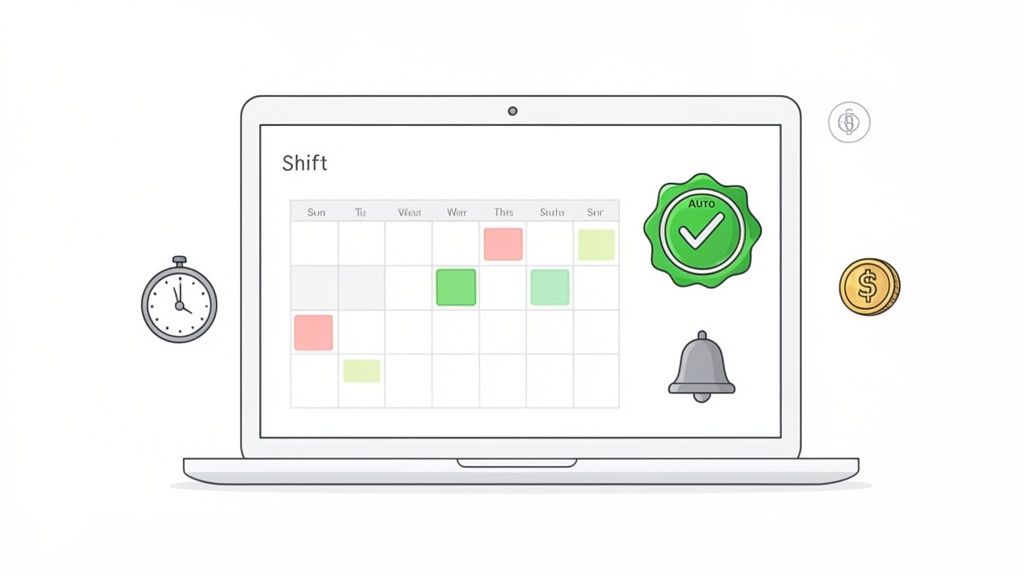
To be honest: Anyone who manages GAV regulations manually with Excel lists and sticky notes risks headaches. This method is not only tedious, but a ticking time bomb for errors. A small mistake in shift planning, an incorrect calculation of the surcharges - and you are at risk of violations that end up costing you a lot of money and nerves.
Modern software takes this burden off your shoulders and ensures clean, completely understandable processes.
Imagine you are planning the staff for a large festival. The GAV for the event industry specifies a maximum weekly working time of 45 hours and a minimum rest period of 11 hours between missions. A good workforce management platform works like a digital watchdog looking over your shoulder.
If you try to schedule an employee for a shift that violates their rest time, the system will immediately raise an alarm. This way you can avoid unintentional errors before they can even happen.
Automatic time recording and payroll – finally without stress
One of the biggest challenges in everyday life is the complete and correct recording of working hours. This is exactly where digital helpers come in. They automate the entire process from the time clock to payroll and make everything transparent.
- Digital time clock: Your employees simply clock in and out using the app on their smartphone. Every minute is recorded accurately and fairly - no more discussions.
- Automatic surcharges: The software automatically recognizes whether a shift takes place at night or on a Sunday and calculates the surcharges specified in GAV. Manual calculations are over.
- Seamless data export: All recorded data is neatly prepared and can be transferred directly to payroll with one click. The administrative effort is reduced to a minimum.
This is more important today than ever. One Analysis of the Swiss labor market 2025 at jobcloud.ch has shown that job search activity is around 10 percent increased while the number of advertisements decreased. For event agencies and recruiters, this means more pressure to work more efficiently and meticulously adhere to all standards. Digital tools are not a luxury, but rather a real competitive advantage.
The following screenshot shows how easy such an export for payroll accounting looks in practice.
Here you can see a crystal-clear breakdown of working hours, breaks and all applicable surcharges per employee. Such automated reports are the basis for GAV-compliant billing and save you extremely valuable time every pay period.
If you want to delve deeper into the digitalization of your processes, you can find it in our article Working time recording according to L-GAV even more practical information.
What happens if you don't adhere to the GAV?
Anyone who ignores the rules of a GAV should not think that it will go unnoticed. The consequences are often serious and go far beyond a mere reminder. As an employee, it is important that you know that your rights are not just enshrined on paper, but are also actively enforced.
As a rule, control is taken by the so-called joint commissions. These committees are fairly staffed - with exactly the same number of representatives from employer associations and unions. They ensure that the rules of the game are adhered to by both sides. If such a commission finds a violation, it has a whole catalog of sanctions at its disposal.
From back payments to the blacklist
The consequences are staggered and depend entirely on the severity of the violation. The most common measures are:
- Back pay: If the commission finds that wages were paid below the GAV minimum rate, the matter is clear: the employer must pay the difference retroactively to all affected employees. Without ifs and buts.
- Contractual penalties: These are fines specified in the contract that the company must pay in the event of a violation. However, this money does not simply disappear, but often flows into a common fund from which further training or other social projects for the entire industry are financed.
- Entry on a public list: Particularly serious or repeated violations have particularly painful consequences. The company ends up on a public “blacklist”. This not only damages the company's reputation, but can also exclude the company from future public contracts.
Comprehensive insights into Labor law violations and excessive demands, such as underpaid performance, make it clear why compliance with GAV is so elementary and how serious the consequences of violations can be.
A GAV violation is not a trivial offense. It undermines trust, creates unfair competitive conditions and ultimately harms everyone – employees, fair employers and the reputation of the entire industry.
Imagine a case in the construction industry: During an inspection, a joint commission uncovers that a company systematically pays wages that are too low and ignores the prescribed break times.
The result was devastating for the company: it not only had to Back pay in six figures but also have to pay a hefty contractual penalty. The greatest damage, however, was the public entry, which led to a massive drop in orders. This example shows crystal clear: strict compliance with the GAV rules is not an option, but a business necessity.
The most frequently asked questions about the GAV – short and sweet
In the jungle of regulations, the same questions keep cropping up. Here I have summarized the most important answers to the collective employment agreement for you so that you can quickly gain clarity.
What is the difference between GAV and employment contract?
Imagine the GAV as the big set of rules for your entire industry - something like the road traffic regulations for everyone. He puts them mandatory minimum standards such as the minimum wage, the maximum working hours or the number of vacation days.
Your personal employment contract is then your individual vehicle: It regulates the details for your specific job, i.e. your exact function and your salary. It is important: Your contract must never undercut the GAV rules, only improve them.
Are GAVs always binding in Switzerland?
Not automatically. A GAV only becomes mandatory for all companies in an industry if the Federal Council or a canton approves it generally binding explained. Without this stamp, it is only valid for companies that are members of the employers' association that signed the contract.
What happens if my contract offers better conditions than the GAV?
A clear case for that Principle of favorability. This means: The regulation that is more advantageous for you always wins. So if your contract guarantees you a generous five weeks of vacation, but the GAV only provides for four, then of course you keep your five weeks. The GAV is a minimum, not a maximum.
Do the GAV rules also apply to part-time and temporary work?
Yes, absolutely. In the vast majority of cases, the protective provisions of a GAV also apply to employees working part-time or with temporary contracts. The rules, such as wage claims or vacations, are then simply converted proportionately to the hours worked. This guarantees fairness for everyone.
Where can I find out whether GAV applies to me?
The most direct way is to ask your employer or a union. In addition, the State Secretariat for Economic Affairs (SECO) maintains a public and always up-to-date list of all collective employment agreements in Switzerland that have been declared generally binding. A quick look there often provides certainty.
If you have questions about general business or software processes in the context of compliance beyond the GAV, you may find these useful Answers in the nova360 FAQs.
Are you ready to make your personnel planning GAV-compliant and still effortless? job.rocks automates compliance with working hours, bonuses and rest breaks so that you can concentrate on your core business again. Discover now how you can save time and be legally on the safe side with job.rocks.