
Calculating working days per month: your guide for Switzerland
Wondering how many working days there are per month? In Switzerland, a five-day week averages 20 to 22 working days, depending on canton, holidays and work model.
Are you wondering how many? working days per month are they actually? This number is much more than just a number on the calendar - it is the linchpin for fair payroll and clever personnel planning.
As a rule of thumb in Switzerland, the average for a five-day week is 20 to 22 working days. But as is often the case, the devil is in the details, as cantonal holidays or individual working models can quickly change the outcome.
⚡ Quick answer: How many working days are there in a year in Switzerland?
A year in Switzerland has an average of 252 working days (with a 5-day week, Monday to Friday). The exact number varies by canton and depends on the cantonal holidays:
- 2026: 251-254 working days (depending on canton)
- 2027: 253-255 working days (depending on canton)
- Per month: Average 21 working days (between 20-22)
Formula: 365 days − 104 weekend days − 9-13 cantonal holidays = approx. 252 working days
Calculate working days for 2026 immediately
Get the free annual planner for Switzerland with public holidays, canton logic and quick target hour planning.
- Working days 2026 and 2027 at a glance
- Plan public holidays better in each canton
- Calculate target hours faster and cleaner
Free. No spam. Available immediately.
Why the exact number of working days is crucial
Determining the correct number of working days per month is not just a formality. It is the foundation for fair payroll, functioning operational planning and transparent vacation management. If this basis is not correct, misunderstandings and errors are inevitable, which in the end only cost time, money and nerves.
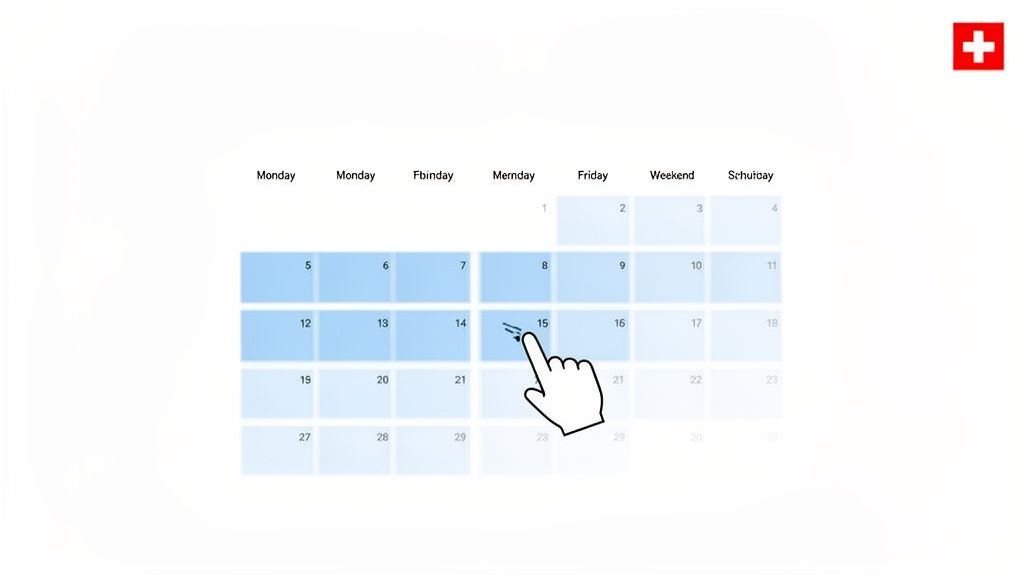
Target working days vs. actual working days: The small but noticeable difference
To create clarity, you have to distinguish two terms that are often confused in everyday life:
- Target working days: This is the contractually agreed number of days that an employee would have to work in a month. This number is the immovable basis for payroll accounting.
- Actual working days: These are the days that actual work was done. The difference to the target days arises naturally due to vacation, illness or other planned absences.
This clear separation is crucial in order to maintain an overview and precisely control resource planning. Imagine you run an event agency. Your target days tell you how many staff days you have to plan for the month. The actual days show you at the end of the month who worked how much, which is important for the billing of overtime or minus hours.
To give you quick orientation, we have summarized the most important average values for Switzerland in a table.
Average working days per month at a glance (five-day week)
This table gives you a quick guide to the average number of working days and working hours per month in Switzerland.
| Key figure | Average value | Notice |
|---|---|---|
| working days per month | 21 days | Average value that varies depending on the month and canton (between 20-22). |
| working days per year | ~252 days | Based on 365 days minus weekends and holidays. |
| Hours per week (full-time) | 42 hours | Common average value according to Swiss labor law. |
| working hours per month | ~182 hours | Calculated from 42 hours per week ÷ 5 days × 21.67 days. |
Working days per year: Overview for 2026 and 2027
The exact number of working days per year depends heavily on the cantonal holidays. While some cantons only have 9 public holidays, others have up to 13 days. This makes a difference of up to 4 working days per year - relevant for your personnel planning and payroll.
Working days in 2026 by canton (5-day week)
| Canton | Working days 2026 | Special features |
|---|---|---|
| Zurich, Bern, Aargau | 252 | Average, excluding special regional holidays |
| Basel-Stadt, Basel-Landschaft | 251 | May 1st (Labor Day) as a public holiday |
| Geneva | 250 | Additionally Geneva Prayer Day (Jeûne genevois) |
| Ticino | 251 | Peter and Paul (June 29th) + Assumption of Mary (August 15th) |
| Graubünden, Uri, Schwyz | 252-253 | Varies by municipality (local patron festivals) |
Working days in 2027 by canton (5-day week)
| Canton | Working days 2027 | Difference to 2026 |
|---|---|---|
| Zurich, Bern, Aargau | 253 | +1 day (Easter is postponed) |
| Basel-Stadt, Basel-Landschaft | 252 | +1 day |
| Geneva | 251 | +1 day |
| Ticino | 252 | +1 day |
Practical tip: For precise personnel planning, we recommend one modern personnel planning software, which automatically takes cantonal holidays into account and helps you with the Operations planning helps.
Why do working days vary between years?
The number of working days per year is never identical. Main reasons:
- Moving holidays: Easter, Ascension and Pentecost fall on different days of the week every year
- Leap years: February 29th can be an additional working day
- Weekend holidays: If a public holiday falls on Saturday/Sunday, there is no compensation day
For complete annual planning, it therefore makes sense to have one Time tracking software to work, which automatically calculates the correct target days and compares them with the actual working hours.
Of course, these numbers are only guidelines. However, they will help you with rough planning and salary calculation. You will find out how to determine the exact values for your company in the next sections. More details about You can also find the calculation of working days in Switzerland on job.rocks.
Exact knowledge of the monthly working days avoids errors in payroll and puts your personnel planning on a solid basis.
With the right tools and a clear understanding of the calculation, you can create transparency – for yourself and for your entire team. We will now show you step by step how you can determine the exact number of working days and also master special cases such as part-time or shift work.
The exact calculation explained step by step
The exact number of working days per month Calculating it is not rocket science if you know how to proceed. It is a clear, logical process that creates a reliable basis for all your planning and payroll. Let's go through this together.
Always use the total number of calendar days in a month as a starting point. First, you subtract all weekend days, i.e. Saturdays and Sundays. This simple step brings you surprisingly close to the right result.
Deduct weekends and holidays
The really crucial second step is to take public holidays into account. This is exactly where most mistakes happen, because public holidays in Switzerland are regulated by canton. What is a public holiday in the canton of Zurich does not necessarily mean that it is a public holiday in the canton of Bern.
The most important thing is that you only deduct the holidays that actually fall on a weekday from Monday to Friday. If a public holiday falls on a Sunday, it doesn't change the number of working days at all.
The best way to find the correct public holidays for your location is to take a look at the official list for your canton. Many cantonal administrative websites offer current calendars that you can easily download.
A practical example for Zurich
Let's imagine that you calculate the working days for May 2024 in the canton of Zurich. The month has a total of 31 calendar days.
- Total days: You start with 31 days.
- Deduct weekends: There are 4 Saturdays and 4 Sundays in May 2024. That's 8 days that you can deduct directly.
- 31 – 8 = 23 days
- Check cantonal holidays: Now it's getting exciting. In the canton of Zurich, Labor Day (May 1st, a Wednesday) and Ascension Day (May 9th, a Thursday) are public holidays that fall on weekdays. Whit Monday (May 20th) will also be added. So that's 3 additional days off.
- Subtract holidays: 23 – 3 = 20 working days
It's that easy to find the exact number of target working days for this specific month and location. You can use this method for any month and canton.
What you need to consider about leap years
A small but important point are leap years, such as 2024. The additional February 29th can influence the number of annual working days if it falls on a weekday. This is hardly relevant for individual monthly calculations, but you should keep it in mind for annual planning. Do you want to know more about it? In our article about the Calculation of working days per year let's take a closer look at this topic.
Plan holidays and weekends properly
Holidays are often the sticking point when you... working days per month want to calculate exactly. A day off in the middle of the week, such as a Tuesday, wreaks havoc on your planning in a completely different way than a holiday that conveniently falls on the weekend. Let's take a look at this in detail so that you can always keep track of things in the future.
Proper planning is actually quite simple: you take the calendar days of a month as a basis and systematically subtract all the days on which you don't work. This is how you ultimately determine the exact number of target working days.
The following graphic shows you this process at a glance.
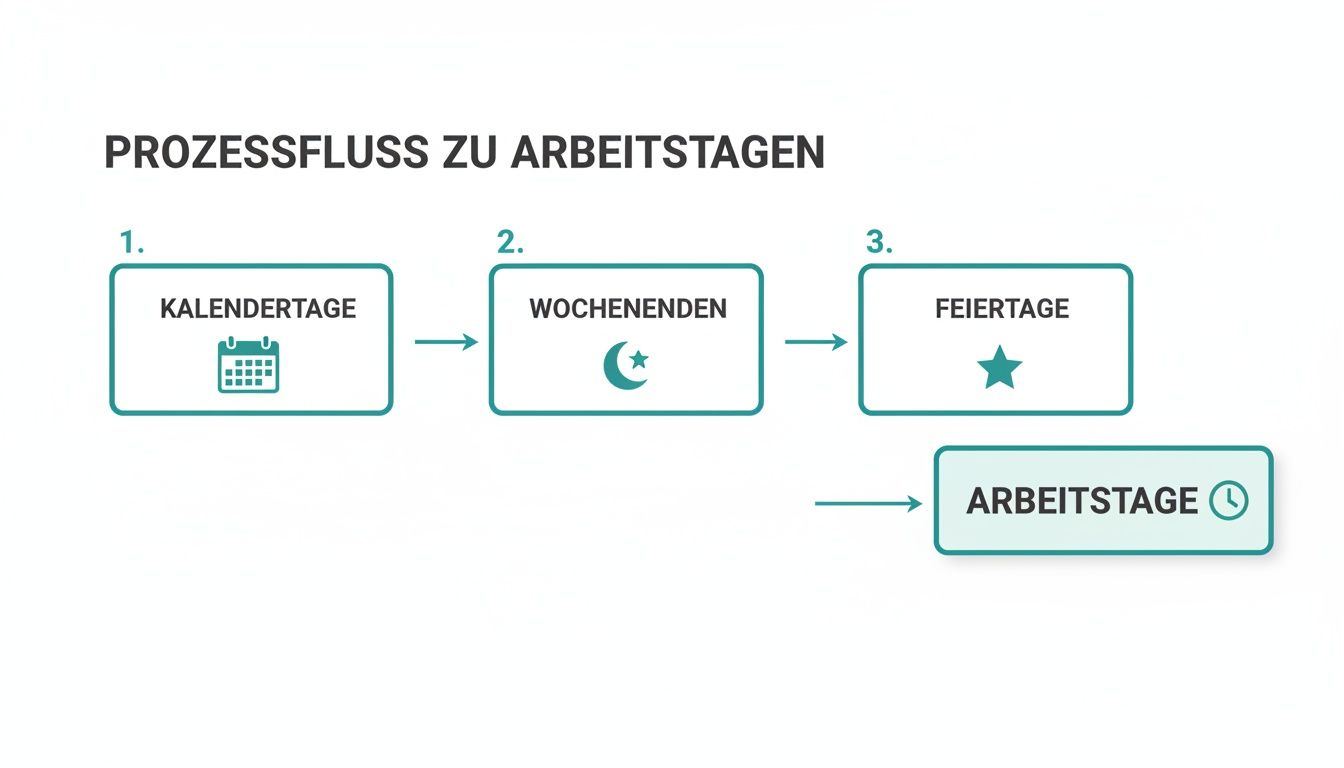
As you can see, the path from calendar days to actual working days is a simple deduction process. The holidays are the last but often crucial step.
Distinguish between national and cantonal holidays
This is a particular challenge, especially in Switzerland. In addition to the few national holidays like... August 1st There are a number of cantonal holidays. So you always have to consult the calendar for your specific canton. You can usually find a reliable overview directly on the cantonal administration website.
The difference between holidays with a fixed date (such as Christmas on.) is also important December 25th) and movable holidays (such as Ascension Day), which always fall on a weekday. The latter are guaranteed to reduce your working days, while a holiday with a fixed date can sometimes fall on a Saturday or Sunday and therefore has no influence on your planning at all.
The annual number of working days in Switzerland varies between 250 and 255 days. Depending on the canton and leap year, this works out to around 20.8 to 21.25 days per month.
Of course, holidays further reduce this number. In the canton of Zurich, for example, there are around 100,000 10 additional days off per year on top of that. This precise planning becomes all the more important as the average full-time weekly working hours are constantly falling - 2023 it was just 40 hours and 12 minutes. You can find more details about this in the Current working time statistics from the Federal Statistical Office.
The importance for your personnel planning
Imagine you run a restaurant. Properly planned holidays have a direct financial impact. Working on a public holiday often means that you have to pay statutory or contractual wage supplements.
- Surcharge calculation: Precise planning will help you correctly budget the costs of holiday work.
- Personnel disposition: You know exactly when you need more staff and can avoid bottlenecks right from the start.
- Bridge days: The days between a public holiday and the weekend are extremely popular vacation days. Keep an eye on them in order to be prepared for changes in your team's vacation planning and to manage your resources accordingly.
Planning these special days in advance will help you keep operations running smoothly and at the same time act fairly towards your employees.
Master special cases such as part-time and shift work
The classic five-day week from Monday to Friday is no longer the only rhythm in the working world. That's why you have to know exactly how to do it working days per month can also be clearly determined for part-time employees, employees in shift work or with flexible flexitime models.
But don't worry, it's often easier than it seems at first glance. The key is always to understand the contractual basis and apply it logically to the respective month. Whether part-time, shift work or entry and exit during the month - there is a clear and fair method for every case.
Calculate part-time models pro rata
For part-time workers, the calculation depends heavily on the specific working model. If someone works on fixed days, for example always from Monday to Wednesday, things are very simple: you count the Mondays, Tuesdays and Wednesdays of the month in question and you have your result.
Things get a little trickier when someone has a percentage workload without fixed days, let's say 60%. It's best to proceed step by step:
- Determine the target days of the full-time employee: First, calculate the regular working days for a full-time employee this month (e.g. 22 days).
- Multiply by the workload: Then multiply this result by the part-time workload.
- A practical example: 22 working days × 0.60 = 13.2 target working days.
In practice, the target hours are often calculated more precisely. This creates a more precise basis, especially when it comes to payroll.
Shift work and irregular schedules
Irregular working hours are the norm in the catering industry, healthcare or logistics. The number of working days can vary greatly from month to month. Instead of rigid daily calculations, the shift schedule is the only reliable basis.
The individually created roster defines the target working days for the month. The payroll is then based on the shifts actually worked and planned in the plan.
Careful and forward-looking planning is the be-all and end-all here to guarantee fairness and keep an overview. Comprehensive strategies for efficient shift planning help you get this complexity under control and use your team optimally.
Entry and exit during the month
If employees start or leave the company in the middle of the month, their wages and vacation entitlements must of course be calculated proportionately. The logic behind it is simple: you simply count the working days from the entry date to the end of the month or from the beginning of the month to the exit date.
A quick example: Someone starts work on May 16th in a month with 22 regular work days. As of May 16th, there are still 12 working days left in the month. Exactly these 12 days then form the basis for the pro rata wage calculation. This way you can ensure that everything is billed fairly and correctly.
Why the exact number of working days makes the difference
The correct number of working days per month knowing is much more than just a bureaucratic exercise. This one number is the foundation on which some of the most important processes in your company rest. If it is correct, payroll, personnel planning and controlling run like Swiss clockwork.
An inaccurate calculation, on the other hand, is a guarantee for chaos. Incorrectly recorded overtime, incorrect vacation entitlements or unfair pay cuts are often the direct result - problems that are not only expensive, but also undermine trust in the team.
Precision in payroll accounting
The exact number of target working days is the pivotal point for error-free payroll accounting. Every single day counts here, especially when variable salary components or special cases come into play.
Imagine an employee joining or leaving the company in the middle of the month. Only if you know the exact number of working days can you calculate the salary pro rata fairly and in accordance with the law. The same applies to the correct accounting of overtime or the evaluation of vacation days - a clean database prevents costly errors and creates the necessary transparency.
Efficiency in personnel deployment planning
The target working days are the basis of all forward-looking shift and deployment planning. They tell you in black and white how many working days you have to cover in a month, thus enabling planning that is based on actual needs.
- Avoid bottlenecks: You can see early on when things are getting tight, for example around holidays or during peak seasonal periods.
- Prevent overstaffing: At the same time, you avoid scheduling too many employees, which unnecessarily increases costs.
- Create a fair workload: Well-thought-out planning ensures a balanced distribution of work and thus sustainably increases satisfaction within the team.
Data-driven planning based on the correct working days is the key to neither overwhelming nor leaving your team idle.
This point is becoming increasingly important as working hours change. Between 2018 and 2023 weekly full-time working hours in Switzerland fell 46 minutes on 40 hours and 12 minutes. You can read more about this trend and what it means for the world of work in this exciting article on watson.ch.
Clarity for controlling
In controlling, exact working days are pure gold. They provide you with the hard facts you need for meaningful analyzes and solid cost control.
With this data you can determine reliable key figures such as sales per working day or analyze personnel costs per hour actually worked. This is exactly the information you need to make informed business decisions and set the course for the long-term success of your company.
How clever tools do the math for you
Juggling working days by hand in Excel lists or even calculating them on paper is not just a test of patience - it is also one of the most common sources of error in personnel planning. Luckily, today there are smart helpers who can take this time-consuming task off your hands and make the whole process child's play.
Instead of gathering everything manually, you can rely on proven formulas and specialized software. This not only saves you valuable time, but also avoids calculation errors that can cost you dearly when it comes to payroll.
Excel formulas for a quick overview
Excel is an incredibly powerful tool if you know how to use it correctly. Instead of laboriously counting calendar days, you can simply use the built-in functions to working days per month to be determined in no time.
A particularly useful formula for this is NETTOARBEITSTAGE. It automatically calculates the number of working days between two dates and excludes weekends by default. You can even create a separate list of holidays and include them directly in the formula.
- This is how it works: Simply enter the start and end dates of the month.
- Take public holidays into account: Create a list of all relevant cantonal holidays and refer to this area in the formula. Excel then deducts these days all by itself.
Even though Excel is super practical for simple cases, it quickly reaches its limits when it comes to complex shift schedules or different working time models. More tips on Personnel planning with Excel By the way, you can find it in our additional guide.
Professional software for deployment planning
For companies that want to go one step further and truly professionalize their planning, specialized software solutions are the answer. Personnel deployment planning systems not only calculate the target working days, but also take care of the entire process for you - from planning to billing.
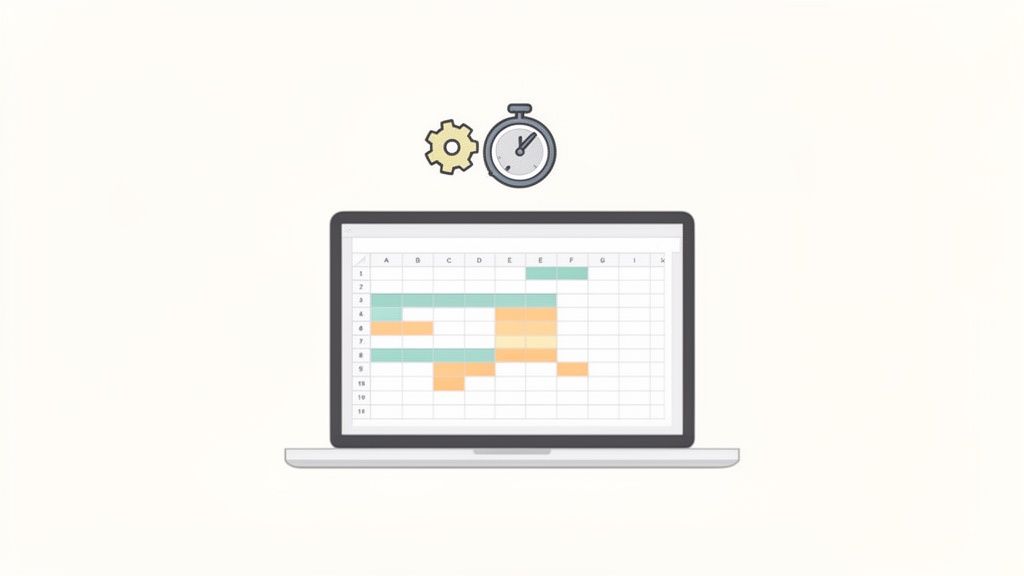
Such tools automatically take cantonal holidays, individual working time models and any absences into account. A specialized one can be used, especially for practices that want to comprehensively manage and automate their processes Practice software for occupational therapy Massively simplify working time planning and recording.
These systems drastically reduce administrative effort, minimize errors and give you the time back to concentrate on what's important: your core business.
If you no longer want to manually collect working days, target hours and shifts, book a short demo with Fabio here: https://job.rocks/demo-agreement
Frequently asked questions about calculating working days
When it comes to calculating the working days per month In practice, the same questions arise again and again. Whether for payroll, vacation planning or shift organization - clear answers are worth their weight in gold in order to avoid errors and ensure transparency.
Here I have collected the most frequently asked questions for you and summarized them briefly and succinctly.
How many working days are there on average in a month in Switzerland?
With a classic five-day week you can work on average in Switzerland 20 to 22 working days go out per month. The rule of thumb for quick calculations is: 21 working days proven as a practical guideline.
How does this number come about? It's simple: you take the total calendar days of a month and subtract the weekends and the average number of cantonal holidays. Of course, the exact number varies depending on the month, year and the specific holidays in your canton.
How do I calculate working days for part-time employees?
For part-time workers, the calculation is always pro rata and depends heavily on the working model. This is easier than it sounds.
- Fixed working days: For example, if someone only ever works on Mondays and Tuesdays, you simply count the Mondays and Tuesdays in the respective month. Simple and direct.
- Flexible workload: With a 60% workload without fixed days it becomes mathematical. You take the target working days of a full-time employee (e.g. 22 days) and multiply them by the workload: 22 days × 0.6 results 13.2 target working days. For payroll purposes, the calculation using the target hours is often even more precise and avoids rounding errors.
What role do public holidays play in the calculation?
Public holidays reduce the number of your target working days, but only if they fall on a weekday from Monday to Friday. If a public holiday falls on a Saturday or Sunday, this has no effect on your calculation.
A very important point: the holiday regulations vary extremely from canton to canton in Switzerland. It is therefore essential that you always have the valid calendar for your company location at hand. This is the only way to ensure that payroll and your entire personnel planning are correct.
This precise distinction is the key to avoiding misunderstandings and creating a fair basis for all employees.
Would you like to finally leave the calculation of working days, shift planning and wage preparation behind you? job.rocks offers you an integrated solution that reduces administrative effort to a minimum and really simplifies your HR processes. Discover the advantages of job.rocks now.
Frequently asked questions about working days per month and year
How many working days are there in a year in Switzerland?
A year in Switzerland has an average of 252 working days with a 5-day week (Monday to Friday). The exact number varies depending on the canton between 250 and 254 days, depending on the cantonal holidays. For 2026, 251-254 working days are expected and for 2027, 253-255 working days.
How do I correctly calculate the working days per month?
The calculation takes place in three steps:
- Take the total number of calendar days in the month
- Subtract all weekends (Saturday + Sunday)
- Subtract the cantonal holidays that fall on weekdays
Example January 2026 (Zurich): 31 days − 8 weekend days − 1 public holiday (New Year) = 22 working days. One is recommended for automated calculation Workforce planning software.
What is the difference between target and actual working days?
Target working days are the contractually agreed working days per month (basis for payroll). Actual working days are the days actually worked after deducting vacation, illness or absences. The difference is important for calculating overtime and vacation entitlements.
How many working days are there on average in a month in Switzerland?
On average one month in Switzerland 21 working days (with a 5 day week). The actual number varies between 20 and 22 days, depending on:
- Month length (28-31 days)
- Number of weekends (4-5 per month)
- Cantonal holidays that fall on weekdays
How do I calculate working days for part-time work?
If you work part-time, you calculate the working days proportional to your workload. Formula: (Full-time working days × workload) ÷ 100.
Example: A month has 21 full-time working days. At 60% workload: 21 × 0.6 = 12.6 working days. For flexible working models, it's best to use one Operations planning app, which calculates part-time work automatically.
Which cantons have the most working days per year?
Cantons with the least holidays have most working days. These are typical Zurich, Bern, Aargau and other German-speaking cantons with 9-10 public holidays per year (approx. 252-253 working days). Cantons with more public holidays like Geneva, Ticino or Catholic cantons have 250-251 working days.
How do I plan working days for shift work and flexible teams?
Digital planning is essential for shift work and flexible teams:
- Use one Shift scheduling software instead of Excel
- Take into account target working days per employee (including part-time work)
- Plan buffer times for absences (illness, vacation)
- Automate the availability query via a Employee app
This way you can ensure that all legal requirements are adhered to and that your team is optimally utilized.
What happens if a public holiday falls on a Sunday?
If a public holiday in Switzerland falls on a Sunday, there are usually no compensation day. The holiday practically “lapses” because Sunday is already a work-free day. This is what sets Switzerland apart from some other countries. The only exception: Some companies voluntarily grant an additional day off if important holidays such as Christmas or New Year fall on a weekend - but this is not required by law.