
L gav gastro clearly explained for your business
Are you wondering what the state collective employment agreement in the hospitality industry, L-GAV Gastro for short, actually is? It's best to imagine it as the common rule book for the entire Swiss gastronomy. It ensures fair and uniform rules of the game - regardless of whether you have a small café in the mountains or a large...
Translate the following HTML fragment from German into en. Preserve all HTML tags, attributes, links, image paths, tables and iframes. Translate only visible text.
Are you wondering what the state collective employment agreement in the hospitality industry, L-GAV Gastro for short, actually is? It's best to imagine it as the common rule book for the entire Swiss gastronomy sector. It ensures fair and uniform rules of the game - regardless of whether you run a small café in the mountains or a large city hotel.
What the L-GAV Gastro means for your business
The L-GAV is much more than just a legal document. It is the basis for functioning and fair cooperation in one of the most vibrant industries in Switzerland. It was negotiated by the social partners, i.e. the employers' and employees' associations. His clear goal: create stability and clarity for everyone involved.
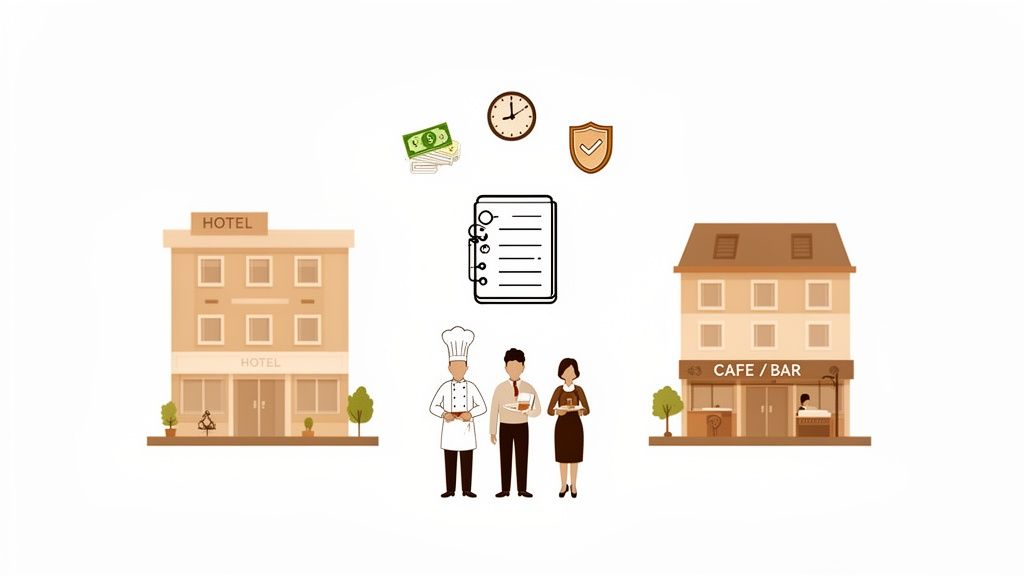
This contract regulates the most important working conditions for almost all companies in the hospitality industry. Think restaurants, hotels, guesthouses, cafes and even catering companies. It applies to most of your employees, from service staff to the kitchen brigade to administrative staff.
The core areas of L-GAV Gastro
The regulations of the L-GAV are quite comprehensive and affect almost every aspect of your everyday business. It sets the minimum standards for the following areas:
- Wages: It defines mandatory minimum wages that are based on the training and professional experience of your employees. No room for improvement.
- Working hours: It regulates the maximum weekly working hours, breaks, rest days and how overtime is to be dealt with.
- Holidays: The number of vacation days is clearly prescribed and binding for all employees.
- Social benefits: Topics such as daily sickness benefit insurance and occupational pension provision (BVG) are also covered here.
For you as an employer, compliance with the L-GAV does not just mean fulfilling a legal obligation. You also create a transparent and fair working environment, which has a direct impact on the satisfaction and motivation of your team.
Why compliance is so crucial
Especially in an industry that is characterized by personnel fluctuations, the L-GAV provides important guidance. The catering industry in Switzerland has recently been struggling with a noticeable decline in jobs, and at the same time companies reported significantly fewer vacancies than in the previous year. This volatility makes stable framework conditions such as the L-GAV all the more important for planning security. You can find out more about the current developments on the Swiss labor market at the Adecco Group.
A violation of the regulations can result in severe sanctions, ranging from back pay to contractual penalties. But the reputation of your company is even more important. Satisfied employees are the basis for excellent service and therefore for your business success. So don't view the L-GAV Gastro as a hurdle, but rather as a guide for successful and sustainable business management.
Apply minimum wages and wage categories correctly
Correct remuneration is a central point of L-GAV Gastro. Not only does it create fairness in the team, but it is also a legal obligation. But the system of wage categories can seem like a jungle of regulations at first glance. Don't worry, we'll shed some light on it.
Translate the following HTML fragment from German into en. Preserve all HTML tags, attributes, links, image paths, tables and iframes. Translate only visible text.The focus is on a simple principle: qualifications and responsibility should be paid fairly. The wage categories are there for exactly that. They are a clear tier system based on training, professional experience and the actual role in the company. Anyone who has an overview of this will avoid expensive back pay and ensure motivated employees.
Understanding the wage category system
The L-GAV divides employees into different categories that logically build on one another. This classification determines the legal minimum wage - and a mistake can quickly lead to problems.
Here is an overview of the most important categories:
- Category Ia: Employees without vocational training in the hospitality industry. This is the classic entry level for unskilled workers who are getting their first taste of the industry - for example, the new dishwashing aid in your restaurant.
- Category Ib: Employees without vocational training, but with a Progresso certificate. Anyone who has this recognized, industry-specific further training under their belt will move up a level.
- Category II: Employees with Federal Professional Certificate (EBA). Here you will find everyone who has successfully completed a two-year apprenticeship, such as a kitchen employee EBA.
- Category IIIa: Employees with a Federal Certificate of Competence (EFZ). These are the trained specialists after a three-year apprenticeship - the EFZ chef or the EFZ restaurant specialist belong here.
- Category IIIb: Employees with EFZ and additional professional examination. This level is reserved for specialists who have further qualified after their apprenticeship, for example a chef de partie with a federal specialist certificate.
- Category IV: Employees with a higher technical examination or a degree from a higher technical school. Here we are at the management level, as with the qualified chef or the qualified Hôtelière-Restauratrice HF.
Correct classification is more than just bureaucracy. It is a clear sign of appreciation for the performance of your people and a central requirement of L-GAV Gastro.
The following table gives you a quick overview of the monthly gross minimum wages according to the L-GAV, divided into the official wage categories. It serves as a practical guide for the correct classification of your employees.
Minimum wages in L-GAV Gastro by wage category (gross wages per month)
| Wage category | Description of the function | Minimum wage (gross/month) |
|---|---|---|
| Category Ia | Employees without vocational training | CHF 3,583.- |
| Category Ib | Employees without vocational training with Progresso certificate | CHF 3,814.– |
| Category II | Employees with federal Professional certificate (EBA) | CHF 3,927.- |
| Category IIIa | Employees with federal Certificate of Competency (EFZ) | CHF 4,368.- |
| Category IIIb | Employees with professional certification | CHF 5,108.- |
| Category IV | Employees with a higher professional qualification/technical school | CHF 5,966.– |
These numbers represent the absolute lower limit. Depending on your experience and responsibility in the company, the wage can and should of course be higher.
Practical examples for the correct classification
Let's make it concrete.
Imagine that you are hiring a new service assistant for your café. She is a student, highly motivated, but has no gastronomy experience. Quite clearly: it falls into Category Ia. Your salary must at least correspond to the rate for employees without vocational training.
Another scenario: You are looking for a chef. One applicant completed his culinary apprenticeship (EFZ) four years ago and then worked as a commis de cuisine. It belongs to Category IIIa. Work experience is a strong argument for wage negotiations, but the minimum wage is determined by the category.
It is important: the classification is not set in stone. If your service assistant from the first example completes the Progresso training, she will be moved up to Category Ib - and her wages must be adjusted immediately.
Note special cases and surcharges
Of course, not every case fits the scheme perfectly. What about learners? They have their own minimum wages, which are staggered according to the year of training and are also anchored in the L-GAV. Special rules also apply to interns who do a compulsory internship for their training.
Another sticking point is the surcharges. The L-GAV clearly regulates how work on Sundays, public holidays or at night must be paid additionally. These surcharges are not a bonus, but a requirement. They are added to the basic wage and must be clearly shown in the payslip.
Complete documentation of all wage components is the be-all and end-all. We will show you how to regulate this contractually from day one in our guide to the correct employment contract according to L-GAV. This puts you on the safe side.
Plan working hours, holidays and breaks correctly
The wages have been clarified? Great, then let’s move on to the next central point of your personnel planning: working hours. How many hours is your team allowed to work per week, how do you juggle overtime and when are breaks really mandatory? Fortunately, the L-GAV Gastro is very precise here, because it not only protects your employees from overload, but also gives you the necessary flexibility for operations.
The correct planning of working and rest times is more than just an administrative act. It is the basis for a healthy working atmosphere and consistently high service quality. If you know the rules of the game, you can create shift schedules that are fair and at the same time fit your business perfectly.
The basics of working hours in the L-GAV
The normal weekly working time in the hospitality industry is 42 hours. However, there are exceptions for companies with strong seasonal fluctuations. These allow longer working hours per week as long as the average over the year is correct. This gives you the air you need to absorb peak times.
Overtime is always a hot topic. They arise as soon as the contractually agreed working hours are exceeded. The L-GAV stipulates crystal clear how this is to be dealt with:
- Compensation through free time: The best way is to compensate with free time of the same duration. However, this must always be done in agreement with the employee.
- Financial compensation: If compensatory time off is simply not possible, overtime must be paid with a wage supplement of 25%.
A complete recording is the be-all and end-all here. Modern digital tools take this burden off your shoulders and document every minute automatically. If you want to delve deeper into the details, you will find comprehensive instructions in our article on correct working time recording according to L-GAV.
Translate the following HTML fragment from German into en. Preserve all HTML tags, attributes, links, image paths, tables and iframes. Translate only visible text.The following infographic shows the typical wage structure in the hospitality industry, which is of course closely related to working hours and qualifications.
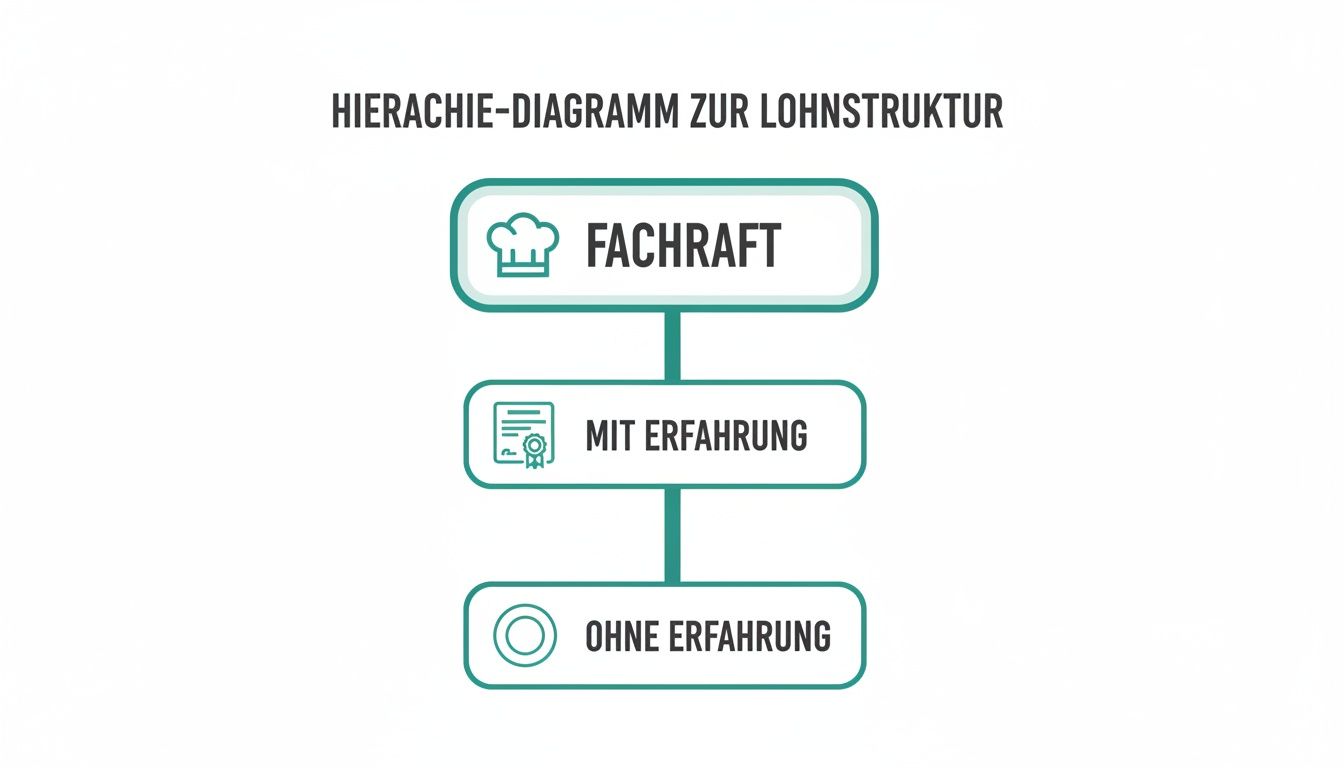
You can immediately see how important the correct classification is for fair remuneration for the hours worked - from the unskilled temporary worker to the trained specialist.
Breaks and rest days should not be neglected
Breaks are not a nicety, but rather legally required relaxation times. The rules are simple and clear:
- If you work more than 5.5 hours, a break of 15 minutes is mandatory.
- If more than 7 hours it is 30 minutes.
- If more than 9 hours it is 60 minutes.
Important to know: These breaks are considered paid working hours if the employee is not allowed to leave the workplace. Otherwise they are unpaid rest time.
The rest days are just as crucial. Every employee is entitled to two days of rest per week. There must be a full Sunday at least twice a month. Balancing this when planning shifts for an entire team can quickly become a challenge.
A well-planned roster takes into account not only operational needs, but also statutory rest periods. This is a clear sign of professionalism and appreciation for your team.
Holiday entitlement and public holidays are clearly regulated
According to the L-GAV, every employee is entitled to five weeks of vacation per year. This also applies to employees up to the age of 20. As a company, you determine the timing of the holidays, but you should take the wishes of your people into account as much as possible.
Holidays that fall on a normal working day entitle you to a paid day off. If a public holiday falls during the holidays, it will of course not be counted as a holiday day.
Practical example: Shift planning in event catering
Imagine that you are planning the staffing for a large wedding catering event on the weekend. You need service staff, cooks and logistics staff – quite a puzzle. A digital shift plan will help you keep track of things.
You can see at a glance who is available, what qualifications the person has and how many hours they already have in their account this week. The system automatically warns you if you exceed the maximum weekly working hours or violate rest periods. You can plan overtime directly and determine whether it will be compensated with free time or wages. This creates a plan that not only works, but is also 100% L-GAV compliant.
Especially because the job market in the catering industry is cooling down somewhat, such smart tools are becoming increasingly important. SECO recorded an increasing annual unemployment rate, while the number of job vacancies fell. For companies like yours, this means: efficient and legally compliant personnel planning is the key to remaining flexible and successful.
Your obligations regarding social insurance and pensions
Translate the following HTML fragment from German into en. Preserve all HTML tags, attributes, links, image paths, tables and iframes. Translate only visible text.
A fair wage and regular working hours are the basis, but the L-GAV Gastro goes an important step further. He supports your employees even when life throws unforeseeable snags. The social insurance regulations are the central protective shield and an unavoidable obligation for you as an employer.
Essentially, this is about two components that create a real safety net: daily sickness benefit insurance (KTG) and occupational pension provision (BVG), better known as pension fund. If you know the regulations exactly and implement them, you will not only be compliant with the law, but you will also position yourself as a responsible and attractive employer who really cares about his team.
Daily sickness benefit insurance in detail
What actually happens if your service specialist is absent for a long period of time due to illness? Without solid daily sick pay insurance, you would have to continue paying your wages for a limited period of time according to the law - an incalculable financial risk for your company. This is exactly why the L-GAV makes the KTG mandatory for all companies.
The insurance must meet clear minimum requirements:
- Duration of benefits: It must guarantee a daily allowance for 720 days within a period of 900 days.
- Continued payment of wages: The daily allowance must cover 80% of the gross wage.
- Waiting period: The period until the insurance takes over the payments may be a maximum of 60 days.
- Premium distribution: The costs are shared fairly. As an employer, you pay at least half of the premium.
An example: Imagine your chef is out for three months due to an operation. After the waiting period has expired, KTG steps in and pays him 80% of his salary. This massively reduces the burden on your wage costs and gives your employee the financial security they need to recover.
Implement occupational pension plans correctly
The occupational pension scheme (BVG), i.e. the pension fund, protects your employees for the period after retirement. Registration becomes mandatory once an employee reaches the legal entry threshold. This is currently an annual income of CHF 22,050.- (as of 2024).
As soon as an employment relationship that meets these criteria begins, you must immediately register the person with the pension fund. It is just as important to sign off cleanly when you leave. Seamless administration is the be-all and end-all here, because this is the only way to avoid gaps in coverage that can have serious consequences for your employees in old age.
Incidentally, all salary components subject to AHV must be insured. This is not just the basic wage, but also the 13th monthly wage, allowances and even regular tips if they make up a significant part of the income.
Other important contractual points
In addition to the major insurance issues, the L-GAV Gastro regulates a few other points that always play a role in everyday work.
- The 13th monthly salary: Every employee is entitled to a full 13th monthly salary if the employment relationship lasted for the entire calendar year. If you join or leave during the year, this is simply paid out proportionately.
- Work clothing: If you require special clothing that could theoretically be worn outside of work (like simple black trousers), you can request a deposit for this. However, if it is clothing that is clearly intended only for work (for example a chef's jacket with a logo), you will bear the entire cost of purchasing and cleaning yourself.
By carrying out these administrative duties carefully and conscientiously, you create a solid foundation of trust. Your team then knows that they not only have a job with you, but also have all-round social security. This greatly strengthens the bond with your company and is a valuable contribution to a positive working atmosphere.
Your L-GAV gastro checklist: From employment to billing
The theory works. But what does it all look like in the hectic everyday life of a restaurant? That's exactly what this checklist is intended for - your practical guide to ensure that your personnel planning is L-GAV-proof from A to Z.

We go through the critical points step by step, from the first contract to payroll. Use this list to review your processes or as a solid foundation for new employees. This way you can keep an overview and avoid traps that can quickly become expensive.
Phase 1: Before employment
Even before your new team member serves their first coffee, you are laying the foundation for clean collaboration. Nothing can go wrong here.
- Correct classification: Take a close look at your training and professional experience. Assign the person to the correct wage category (Ia to IV). This is the basis for ensuring that the minimum wage is correct from the start.
- Written employment contract: Write down everything important. This includes the function, the gross wage, the weekly working hours, the holiday entitlement and of course the wage category. No verbal agreements!
- Registering with social insurance: Register the person immediately with the AHV, the pension fund (if the entry threshold has been reached) and the daily sickness benefit insurance. This is your duty as an employer.
Phase 2: During the employment relationship
During ongoing operations, complete documentation and fair planning are important. The most common and most expensive stumbling blocks lurk here.
- Complete time recording: Every single minute of work must be recorded - including start, end and breaks. A digital system is actually indispensable here to avoid errors and keep paperwork under control. Our Template for recording working hours is a good starting point if you still work manually.
- Break and rest period regulations: When planning shifts, pay close attention to ensuring that the statutory breaks and weekly rest days are adhered to. Modern planning tools automatically sound the alarm if something doesn't fit.
- Overtime management: Every overtime hour must be documented. Clarify with the employee whether it will be compensated with time off or paid with a surcharge of 25% and record this agreement in writing.
A transparent and comprehensible process for working hours and overtime creates trust. It shows your team that you value their performance and act fairly.
The Swiss job market in the catering industry is quite tense at the moment. According to SECO, the number of job seekers has increased while fewer positions are open. This means for us restaurateurs: We have to plan flexibly in order to cover peak times without violating the L-GAV. Digital tools are a huge help in mastering this balancing act. You can find out more about developments on the labor market directly from SECO.
Phase 3: Payroll accounting
Translate the following HTML fragment from German into en. Preserve all HTML tags, attributes, links, image paths, tables and iframes. Translate only visible text.The monthly payroll is the acid test. All threads must come together correctly - mistakes are taboo here.
- Create correct pay slip: Check carefully: Is the basic wage correct? Are all overtime bonuses, night or Sunday bonuses and the share of the 13th month's salary listed correctly?
- Social security deductions: Make sure that all statutory deductions for AHV/IV/EO, ALV and BVG are calculated and paid correctly.
- Transparent payout: Every payslip must be crystal clear and understandable for the employee. A detailed breakdown of all items is not only mandatory, but also creates clarity and trust.
How digital tools really make your work easier
Let's be honest: Managing all of these points manually with Excel lists and sticky notes is not only a huge time-waster, but also extremely error-prone. A digital HR tool like job.rocks takes a lot of your worries away.
Imagine you are creating the shift plan. The system knows the L-GAV rules and warns you immediately if you violate a rest period or forget a break. Working times are recorded to the minute via the app and are incorporated directly into payroll - including all surcharges, completely automatically.
Here you can see at a glance how a digital tool simplifies and secures your processes relating to L-GAV Gastro compared to manual planning.
| Task | Manual planning (e.g. with Excel) | Planning with one tool |
|---|---|---|
| Time recording | Manual entries, prone to errors, high administrative effort. | Automatic, minute-by-minute recording via app, directly audit-proof. |
| Shift planning | Tiresome puzzling, L-GAV rules (rest times, breaks) must be kept in mind. | Intelligent suggestions, automatic warnings for rule violations. |
| Payroll | Manual transfer of hours, calculation of surcharges by hand, high risk of errors. | Data flows automatically into the billing, surcharges are calculated correctly. |
| Documentation | paperwork, tedious searching during checks, confusing. | Central, digital storage of all data, everything available at the push of a button. |
In the end, you not only save yourself countless hours in the office, but above all you gain the security that everything is carried out legally and fairly. And that is exactly an invaluable advantage in today's job market.
L-GAV Gastro: The most frequently asked questions from practice, explained briefly and succinctly
In the hectic everyday life of a restaurant, there is rarely time to wade through dry legal articles. Instead, the same questions keep cropping up that require a quick, clear answer. We have put together the most common stumbling blocks and uncertainties surrounding L-GAV Gastro for you - your cheat sheet for everyday life.
What happens to overtime for part-time employees?
This question often causes headaches, but the rule is quite logical: overtime is simply all hours of work that go beyond the contractually agreed time. This applies exactly the same to full-time and part-time employees.
Translate the following HTML fragment from German into en. Preserve all HTML tags, attributes, links, image paths, tables and iframes. Translate only visible text.Imagine that a service worker has a contract for 20 hours per week. If she suddenly works 25 hours in a week, she has worked 5 hours of overtime. Point. These must either be compensated with free time of the same length or paid with a wage supplement of 25%. The statutory normal working hours of 42 hours per week have no significance for the definition of this overtime.
Do tips have to be shown in wages?
A sensitive topic. In principle, tips belong to the employees, not to the company. But the devil is in the details: As soon as the tips are collected centrally in a pot and distributed according to a fixed key, they are considered part of the wages.
This means that they must be clearly listed in the pay slip and are therefore also subject to AHV. This regulation is crucial because it has a direct impact on your people's future pension entitlements. Crystal clear and transparent regulations within the team are worth their weight in gold here in order to avoid misunderstandings and trouble from the outset.
Does the L-GAV also apply to hourly wage workers?
Yes, without restrictions. The L-GAV Gastro makes no difference and applies to all employees in subordinate companies - regardless of whether they receive a fixed monthly wage or an hourly wage.
For you in practice this means:
- Minimum wage: Temporary workers must also be correctly classified into a wage category. Your hourly wage must correspond to the corresponding minimum rate.
- Holiday entitlement: Hourly wage earners are also entitled to the statutory five weeks of holiday. This is usually compensated for by a percentage surcharge of 10.64% on the hourly wage.
- Holidays: You are also entitled to compensation for public holidays, which is usually a surcharge of 2.27%.
The belief that temporary workers are exempt from the L-GAV provisions is a widespread and potentially expensive misconception. When it comes to pay and scheduling, treat them just like your permanent employees.
Can I call employees back from vacation at short notice?
This is an absolute emergency brake and is only permitted in extremely exceptional cases. An unexpected, massive staff shortage in the middle of the high season could be such an emergency. But one thing is also clear: As an employer, you have to cover all costs that arise as a result.
This doesn't just mean the cancellation fees for hotels and flights. You also have to completely replace the vacation days you have already enjoyed. Such a recall should really remain the last option, as it can permanently damage the relationship of trust. Forward-looking personnel planning with a flexible temporary pool is definitely the better strategy here.
My employee is often sick – what do I have to consider?
If someone falls ill, your obligation to continue paying wages applies. Luckily, as an employer you are financially protected thanks to the mandatory daily sickness benefit insurance (KTG). After a waiting period of a maximum of 60 days, the insurance steps in and covers 80% of the lost wages.
It is important that you completely document all sickness reports and doctor's certificates and forward them to the insurance company immediately. If the short absences become more frequent, this can be a signal of deeper problems. Instead of waiting, you should proactively seek a conversation and look for solutions together before the situation escalates.
How do I deal with breaks that are interrupted?
Everyone in the catering industry knows this: the break begins, but after just a few minutes you have to step in for an urgent task. The rule here is simple: If an employee is not allowed to leave their workplace during the break or has to be available for short assignments, then this break is considered paid working time.
Translate the following HTML fragment from German into en. Preserve all HTML tags, attributes, links, image paths, tables and iframes. Translate only visible text.This must then also be reflected in the time recording. In order for a break to count as unpaid rest time, your team must actually be able to leave the workplace and must not be used for operational tasks during this time. Clear agreements and accurate recording are the key to avoiding later, tedious discussions.
Ready to take your personnel planning to the next level and at the same time ensure that all L-GAV Gastro requirements are easily met? job.rocks gives you the right tools - from intelligent shift planning to automated time recording. Discover now how you can minimize your administrative effort and concentrate fully on your guests again: Find out more about job.rocks.