
Deployment planning for trainees: Your guide for practical training
Well-thought-out deployment planning for trainees is so much more than just a calendar entry - it is the decisive lever for training that also deserves the name. This is exactly where you ensure that your learners really go through all relevant departments, build practical skills and...
A well thought out one Deployment planning for trainees is so much more than just a calendar entry - it is the decisive lever for a training that also deserves the name. This is exactly where you ensure that your learners actually go through all relevant departments, build practical skills and develop into the valuable specialists that you will so urgently need later.
Why good deployment planning for trainees really helps your company advance
Let's be honest: Imagine if your new apprentice spends the first six months just in the warehouse sorting screws. What does he or she learn about your company, your commercial processes or customer contact? Almost nothing. A strategic one Scheduling for learners prevents exactly that. It is your roadmap that ensures that the training is not left to chance, but is targeted and follows a clear plan.
Cleanly structured planning brings tangible benefits to you and your learners. You avoid idleness and dull under-challenge, but also overload due to tasks that are too complex and for which the basics are missing. Every assignment in a new department becomes a targeted learning unit with clear goals. The result? Motivated young people who feel part of the team and want to make a real contribution right from the start.
More than just a schedule
Planning is the foundation on which all training success is built. It specifically helps you achieve the following goals:
- Build skills systematically: Instead of random tasks, your trainees learn exactly the skills they need Education plan (BiPla) are required for basic vocational training in Switzerland. A merchant EFZ, for example, first learns the basics in the inbox before later creating offers independently in sales.
- Increase motivation and retention: Learners who see and understand a clear plan in front of them, Why They complete certain tasks and are significantly more committed. They recognize the value of their work and develop a much stronger bond with your company - often beyond the apprenticeship period.
- Use resources better: You can see early on which department can provide meaningful support to a learner and when. This way you avoid bottlenecks and ensure that there is always a competent person Vocational trainer is available as a contact person.
Good deployment planning turns the legal obligation to train into a strategic investment. You not only form employees, but also future specialists who know and understand your company from the ground up.
At the end of the day, planning ahead will create a real win-win situation. Your learners receive first-class training that optimally prepares them for their final exams and their future careers. In return, your company benefits from capable, loyal employees who become productive quickly and often bring the freshest ideas.
The legal and operational basis of your planning
Before you even create the first plan for your learners, you need a solid foundation. The Deployment planning for trainees It doesn't start with an empty calendar, but with the tough legal and operational framework. Without this knowledge, every plan is just a well-intentioned attempt that quickly reaches its limits in practice.
The heart of the legal requirements in Switzerland are the Education Ordinance (BiVo) and the associated one Education plan (BiPla) for the respective professional field. These are not dry theoretical documents – they are your specific specifications. Here it is written in black and white which skills and knowledge your learners must have acquired by the end of their training.
Your job is to translate these abstract learning goals into tangible, practical uses. A short example: If the goal is in the training plan for a logistician EFZ "Accept and inspect goods" your plan must clearly include work in goods receipt, where exactly this activity is the focus.
Include operational reality
In addition to the legal requirements, internal reality plays at least as important a role. Not every department is able to provide meaningful support to a learner at all times. Therefore, ask yourself the following questions before you start detailed planning:
- Who are the vocational trainers? Which people in the departments not only have the necessary qualifications, but above all the time resources to really take care of the learner?
- What capacities are there? Are there seasonal peaks when a department is completely overloaded? In such phases, good care is simply impossible.
- Is the necessary infrastructure in place? Does the learner have their own workplace, the appropriate protective equipment or access to all relevant systems?
A plan that ignores operational reality is doomed from the start. The best theoretical rotation is of no use if the responsible vocational trainer is on vacation for three weeks or simply doesn't have a job.
Carefully weighing these points will help you make realistic and, above all, implementable plans. A helpful one Shift schedule template can serve as a good starting point for you to roughly visualize availability and resources.
The financial side is also a factor that should not be underestimated. A study on basic vocational training has shown that the average net benefit per apprenticeship is around 4,500 Swiss francs per year. This knowledge gives you an idea of what scope there may be for additional support or special training. The same survey found that 82% of companies see the content of the educational plans as relevant - a clear signal that the activities required therein should be consistently reflected in your operational planning.
How to create a rotation plan that really works
A good rotation plan is at the heart of yours Scheduling for learners. It provides structure, ensures learning success and makes the training transparent for everyone involved. But how do you systematically build such a plan so that it doesn't just exist on paper, but is actually lived in everyday life?
The process begins pragmatically with an inventory. First, record all departments that are relevant to the training. You then define clear learning goals for each assignment, which are based on the official training plan. This means everyone – from the learner to the department head – knows exactly what is expected.
The following process shows the central building blocks of good planning - from the legal basis to the operational conditions to the finished operational plan.
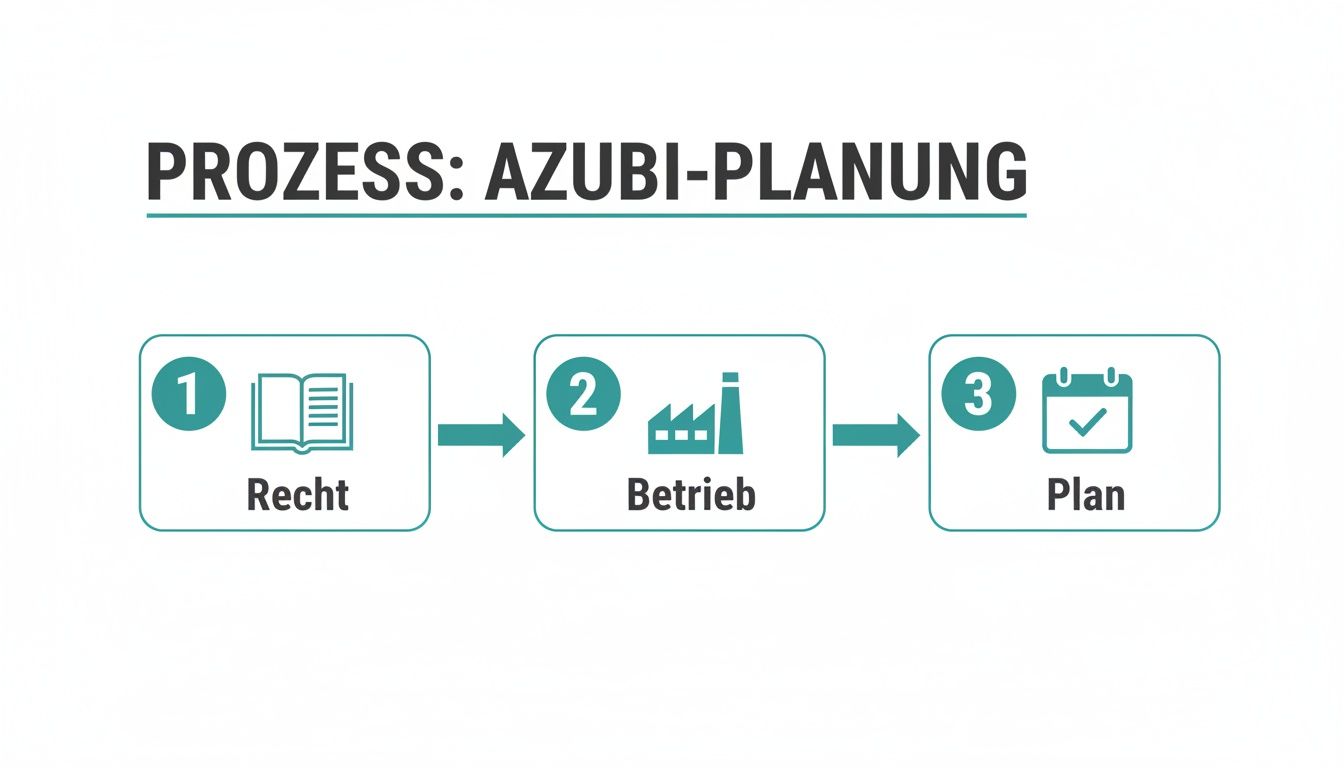
The visualization makes one thing very clear: successful operational planning is always based on legal requirements, takes operational reality into account and only then results in a concrete, implementable plan.
From the sketch to the finished plan
Imagine you are planning the assignment for a prospective businessman EFZ in his first year of training. A well-thought-out plan might be to start with basic administrative departments before moving into more complex areas such as sales or marketing.
- Months 1-3: Post Office & Reception
Here the learner gets to know the basic communication channels and the structure of the company. Learning objectives could be: processing incoming and outgoing mail, answering and forwarding telephone calls correctly. - Months 4–6: Accounting (Accounts Payable)
The next step leads directly to finances. The focus here is on understanding the receipt of invoices. Learning objective: Check incoming invoices, account for them and prepare them for payment. - Months 7-9: Shopping
Here the learner learns how the company procures its resources. He supports simple ordering processes and gets to know the first suppliers.
This gradual increase prevents overwhelm and ensures that knowledge builds on each other logically.
This table shows a possible department rotation for the first year of training in order to get to know the basic operational processes.
| Period | Department | Main learning objectives according to the educational plan | Responsible practice trainer |
|---|---|---|---|
| Month 1-3 | Reception / Central Services | Receive customers, make telephone calls, process mail | Mr. Meier |
| Month 4-6 | Accounting (accounts payable) | Check and account for invoices, understand payment processes | Ms. Keller |
| Month 7-9 | Shopping | Place orders, maintain contact with suppliers | Mr. Huber |
| Month 10-12 | Personnel administration | Simple administrative tasks (e.g. checking holiday balances) | Ms. Graf |
Such a plan serves as a common thread and gives everyone involved the necessary orientation for a successful apprenticeship year.
A good rotation plan is always flexible. Consciously plan buffer times. This gives you the opportunity to respond to unexpected failures or to extend an assignment if a learner shows particular strengths in an area or needs more support.
Timing the duration of assignments correctly
The length of the individual stations is crucial. Phases that are too short only lead to superficial knowledge, while phases that are too long can quickly become boring and motivation decreases. A good mix makes the difference here.
- Trial phases (2–4 weeks): Ideal for smaller departments or to get an initial overview of a new area.
- Basic missions (2–3 months): Perfect for really understanding core processes and completing initial routine tasks independently.
- In-depth assignments (4–6 months): Absolutely useful in the later years of training when learners are expected to work on their own small projects and take on responsibility.
Managing such plans can quickly become complex, especially if you manage multiple learners. While many companies initially rely on spreadsheets, these quickly reach their limits when there are multiple learners and departments. For example, you can read our guide on how to get one Excel Create shift plan to create a first base.
For a dynamic and error-free Scheduling of learners However, specialized tools are often the better and, in the long term, more time-saving choice.
Planning early is the key to success
The best Scheduling for learners it's no use if she's late. The planning process does not start on the first day of work, but ideally many months earlier, in the middle of the selection process. Anyone who misses the boat here will not only end up fighting for the best talent, but also against time.
If you hesitate for too long, you may no longer find the right candidates or simply no longer have time to prepare meaningfully for the first important months. Early planning gives you the freedom you need to set rotations, supervisors and learning goals without hectic and stress. This is the only way to make the start of your apprenticeship a real success for both sides.
The apprenticeship market dictates the schedule
In Switzerland the competition for qualified apprentices is fierce. Data from spring 2025 shows a clear picture: already in March and April 67% of all apprenticeships offered forgive. What does that mean for you as a training company? It's simple: the apprenticeship contract must be signed early so that you have enough lead time for the actual deployment planning. You can find detailed information about these trends in the 2025 Seam Barometer.
This dynamic has a direct impact on your internal processes. If you don't sign the contract until July, you only have a few weeks until the course starts in August or September. This is often far too short to prepare departments, instruct vocational trainers and create a clear plan for the first few months.
Signing a contract early is more than just an administrative act. It is the starting signal for high-quality deployment planning and secures the best talent before they decide to move to another company.
Trial apprenticeships as part of your planning
Another important finding is that 96% of those interested in learning complete a trial apprenticeship before making your decision. This makes the trial phase an indispensable tool – not only for recruiting, but also for your early planning.
Use this time to get to know potential candidates and their skills better. You can see directly where their strengths lie and in which departments they would be particularly well looked after. These observations are worth their weight in gold for the later rotation plan.
- Watch closely: Does a young person show great interest in technical details? Write this down for possible use in production or engineering.
- Collect feedback: Ask the supervising employees for their assessment. Does the person fit into the team? Does she show initiative?
- Check suitability: A trial apprenticeship is the ultimate practical test. This shows whether the expectations on both sides really match.
If you see the trial apprenticeship as an integral part of your advance planning, you will gain valuable insights that go far beyond what an interview can provide. This is how you make sure that the Deployment planning for your learners based right from the start on a solid foundation of real observations and not just assumptions.
Digital tools and clear communication in everyday life
A perfectly developed rotation plan is only half the battle. If no one knows about it or the information is hopelessly out of date, it will cause more confusion than benefit. The successful one Deployment planning for trainees thrives on clear, continuous communication and the right tools to keep the administrative stuff off your back.
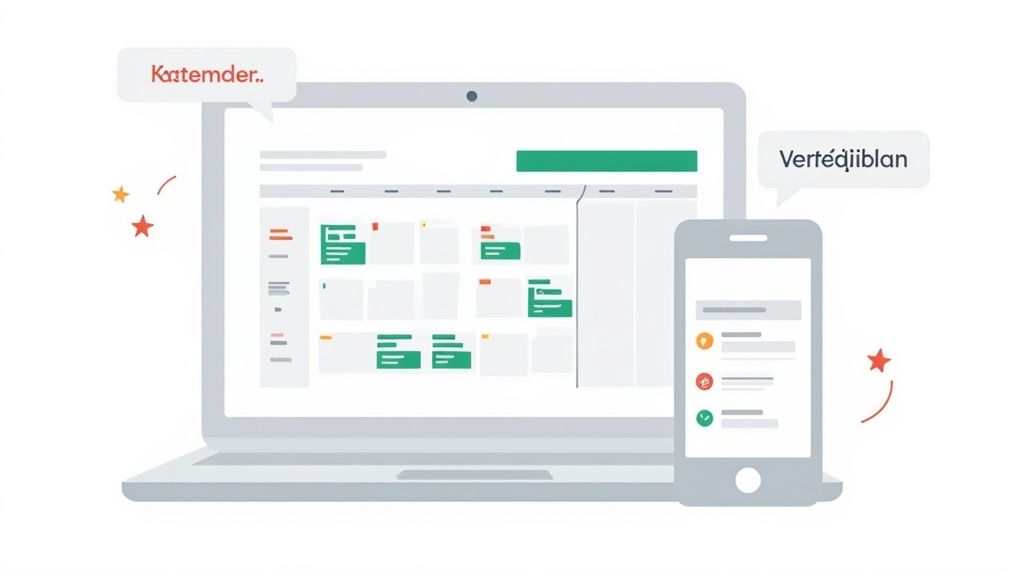
The key is to make the plan accessible and understandable for everyone involved – learners, practice educators and department heads. A kick-off conversation at the beginning of every new assignment is absolutely essential. Here you clarify expectations, discuss the learning goals and make sure that everyone is really on the same level.
The right tools for your planning
Paper plans and confusing Excel lists? They are finally a thing of the past. Digital helpers make yours Scheduling for learners not only easier, but also significantly more dynamic. Depending on the size of your company and the number of your learners, different solutions come into question.
- Common calendars (e.g. Google Calendar, Outlook): This is the easiest and cheapest method. You can create a separate calendar for each learner and enter the assignments as appointments. Practical educators and learners subscribe to the calendar and see all changes in real time. Simple but effective.
- Project management tools (e.g. Trello, Asana): Here you can create a separate board for each learner. The individual department assignments become cards to which you can assign checklists for learning goals, responsible people and deadlines. That brings structure.
- Specialized deployment planning software: This is the professional solution. Such systems are designed to automatically take availability, qualifications and legal requirements into account. They make coordination much easier, especially if you have to manage several learners at the same time.
Choosing the right tool depends largely on your needs. For a single learner, a shared calendar is often sufficient. But as soon as you coordinate three or more learners whose school times, holidays and department changes constantly overlap, professional software quickly becomes indispensable. If you want to delve deeper into this topic, you can find a comprehensive overview of different ones here Provider of deployment planning software.
A good digital tool is like a central compass for your training. It ensures that everyone involved always navigates in the same direction and no one gets left behind.
Communication as a success factor
But digital tools are only one side of the coin. Open and regular communication is what brings the plan to life in the first place. Regular check-ins, for example every two weeks, are absolutely crucial here.
In these short conversations you ask the learner how he is doing, whether the tasks correspond to the learning goals and where there might be a problem. This gives you the chance to take countermeasures early on if an operation doesn't go as planned.
In addition to digital tools, effective communication within the team is also important for smooth deployment planning and support of trainees. Good suggestions like you Improve communication within the team can be found in further guides. In the end, the combination of clever digital helpers and a transparent culture of conversation ensures that your everyday deployment planning really works and that your learners are supported in the best possible way.
Regional and industry-specific differences – this is the key
Sure, a template for them Scheduling of learners is a great starting point. But let's be honest: What works in a Zurich IT startup can hardly be transferred one-to-one to a production company in the country. In order for your planning to really take effect, it must be tailored to the local conditions - both regionally and industry-specific.
The training market and the interests of young people work a little differently in every canton. These local trends directly influence how best to structure your training and departmental rotations.
Reflect cantonal characteristics in planning
A closer look at the types of training chosen and their duration is worth its weight in gold. Let's take data from the canton of Solothurn as an example: started in the 2023/2024 school year 54.2% school leavers receive basic vocational training. Of these, there were stable ones 14-15% on the two-year, very practical EBA apprenticeship, while the EFZ training made up the lion's share. A deeper insight into the Learner statistics in the canton of Solothurn shows how important it is to know such local patterns.
What does this mean specifically for your planning? Very easy:
- For EBA learners: Plan shorter but more intensive assignments with close supervision. This is about learning practical skills quickly.
- For EFZ learners: Longer-term rotations over several months make sense here. This allows learners to really delve deeply into complex processes and gradually take on more responsibility.
Good operational planning is not a rigid corset. It breathes with the form of training and the local conditions. This is the only way to ensure that every learner receives exactly the support they need for their journey.
Identify industry-specific trends early on
Not only the region, but also the industries themselves are constantly changing. Keep an eye on which career fields are currently on the rise among young people – and which are becoming less attractive. The same Solothurn report, for example, shows a whopping increase of +19.3% in training in the social sector.
What does that mean for you, even if you're not in this industry? It's a clear signal that the expectations of the next generation are shifting. Topics such as teamwork, social responsibility or meaningful activity are becoming more of a focus.
You can react to this with small adjustments to your operational plans:
- Promote team projects: Create cross-departmental tasks in which learners work together towards a goal.
- Show that "sense" of work: With every assignment, make it clear what important contribution the department – and therefore also the learner – makes to the bigger picture.
- Strengthen social skills: Incorporate targeted customer-facing or internal communications tasks to practice these critical skills.
By incorporating such regional and industry-specific developments into your... Scheduling for learners If you take this into account, your training will not only remain attractive. In this way, you are also optimally preparing your young talent for the working world of tomorrow.
The most frequently asked questions about student deployment planning
In practice, the same questions arise again and again when it comes to planning the deployment of learners. Here are the answers to the most common sticking points so that you can quickly get rid of typical uncertainties and take your planning to the next level.
How flexible should a deployment plan be?
A deployment plan is not a rigid law, but rather a compass. I recommend that you always have a buffer of about 10-15% to plan. Life just happens – illness, unexpected projects in a department or a spontaneous opportunity for an exciting additional project.
This flexibility gives you the freedom you need to react quickly. You can spontaneously extend an assignment if a learner is really thriving in an area or, conversely, needs more targeted support.
What do I do if a practice trainer is unavailable?
This is the classic and exactly the reason why a good Plan B is worth its weight in gold. Make sure that a deputy is defined for each department who can at least provide basic support. For example, an experienced employee can explain the most important tasks for a few days.
Modern planning tools are an enormous help here. You see failures at a glance and can immediately check where there is free capacity for alternative use. This way you avoid idleness and frustration for the learner.
A good plan doesn't just take the ideal case into account. He already has answers to the typical “what if” questions of everyday life. This not only gives you security, but also your learners.
Are learners allowed to work overtime?
Absolutely no. For underage learners, overtime is severely restricted by law and should remain the absolute exception. For example, when an important event is being prepared and all hands are needed.
If overtime occurs, it must either be compensated for with free time of the same duration or with a wage supplement of 25% be remunerated.
Be sure to pay attention to cantonal regulations and the regulations in your collective employment agreement (GAV). Complete time recording is not a “nice-to-have” here, but rather a requirement in order to be legally on the safe side.
How often should I review and adjust the plan?
An operational plan is a living document, not a work set in stone. Sit down with the learner at least once per quarter and go over the plan. An example: After the assignment in accounting, you discuss whether the learning goals were achieved and what will be important in the next assignment in purchasing.
These conversations are priceless. You get direct feedback, see early on whether the direction is still right, and can adjust the plan if necessary. This way you can ensure that the planning always fits the learner’s current development and that motivation remains high.
Are you ready to professionalize your deployment planning for learners and employees and finally minimize the administrative effort? job.rocks gives you the digital tools to dynamically create plans, manage availability and simplify communication.
Discover now how you can save valuable time and ensure more transparency for everyone involved: https://job.rocks