
Workdays in the Month: How to Calculate Them Correctly
How many workdays does a month have on average? The answer for Switzerland is quickly found: In workforce planning, you typically calculate with 21.75 workdays per month. This figure is more than just an estimate – it is the reliable basis for payroll, capacity planning, and project calculations.
How many workdays does a month have on average? The answer for Switzerland is quickly found: In workforce planning, you typically calculate with 21.75 workdays per month. This figure is more than just an estimate – it is the reliable basis for payroll, capacity planning, and project calculations.
Why a Fixed Average Value Is So Important
You might wonder why you don’t simply count the days of the current month. The answer lies in two words: predictability and fairness.
The actual number of workdays per month varies significantly. February has fewer days than March, and public holidays are unevenly distributed throughout the year. A fixed average value creates a stable and, above all, comparable basis for all months. Without this standard, every monthly payroll and resource planning would be an administrative gamble.
By the way, this average is not a random figure but the result of a clear calculation method that has become established in Swiss HR practice.
The Calculation Behind the 21.75 Days
The logic is simple: You take the total number of potential workdays in a year and divide it by twelve months. This ensures a fair balance between short and long months.
Here is an overview of the two most common methods:
Average Workdays per Month Overview
This table shows the two most common methods for calculating the average monthly workdays in Switzerland and the result of each method.
| Calculation Method | Formula | Result (Workdays/Month) |
|---|---|---|
| Method 1 (Calendar Days) | (365 days – 104 weekend days) / 12 months | 21.75 |
| Method 2 (Weekly Basis) | (52 weeks * 5 workdays) / 12 months | 21.67 |
As you can see, both approaches lead to a very similar result. However, the value of 21.75 has established itself as the more common standard and is used by most payroll systems and planning tools.
Detailed Fluctuations
A quick glance at the calendar is enough to see how large the real differences from month to month can be. In practice, a month can have between 19 and 23 workdays.
This deviation may seem small at first glance but has direct and tangible effects on daily operations.
A practical example: One more or one fewer workday can noticeably affect payroll for hourly workers, project planning, and personnel resources. A blanket assumption without precise checking often leads to errors.
The following factors cause these monthly fluctuations:
- Month length: A month has 28, 29, 30, or 31 days. This alone creates a different basis.
- Weekends: Depending on which weekday a month starts, it can include four or five weekends.
- Public holidays: National and cantonal holidays that fall on a weekday further reduce the number of workdays irregularly.
With this knowledge, it becomes clear why a standardized average is so important. If you want to dive deeper and understand the practical significance, you will find more details in our main article about the average workdays per month.
The Formula for Calculating Workdays Explained Step by Step
Determining the exact number of workdays in a month is easier than you might think. You don’t need complex software, just a clear formula and the right data. We guide you step by step through the entire process.
The basic idea is simple: You start with the total number of days in a month and subtract everything that is not a workday. These are primarily weekends and, of course, public holidays that fall on a weekday.
Step 1: Establish the Base
First, take the total number of calendar days in the month in question. This number varies between 28 and 31 days. This is your starting value from which you perform all further calculations.
Then count all Saturdays and Sundays in that month. You subtract these completely from the total number of calendar days.
Calendar days − Number of Saturdays − Number of Sundays = Potential workdays
With this intermediate result, you have already determined the number of pure weekdays (Monday to Friday). But the calculation is not quite finished yet.
Step 2: Correctly Account for Public Holidays
Now comes the crucial part that often leads to errors: the public holidays. You only subtract the holidays that actually fall on one of your potential workdays, i.e., a day from Monday to Friday.
If a holiday like August 1st falls on a Sunday, it is not subtracted because that day would be a day off anyway. This is a common stumbling block.
This infographic shows the simple process for calculating the final workdays.
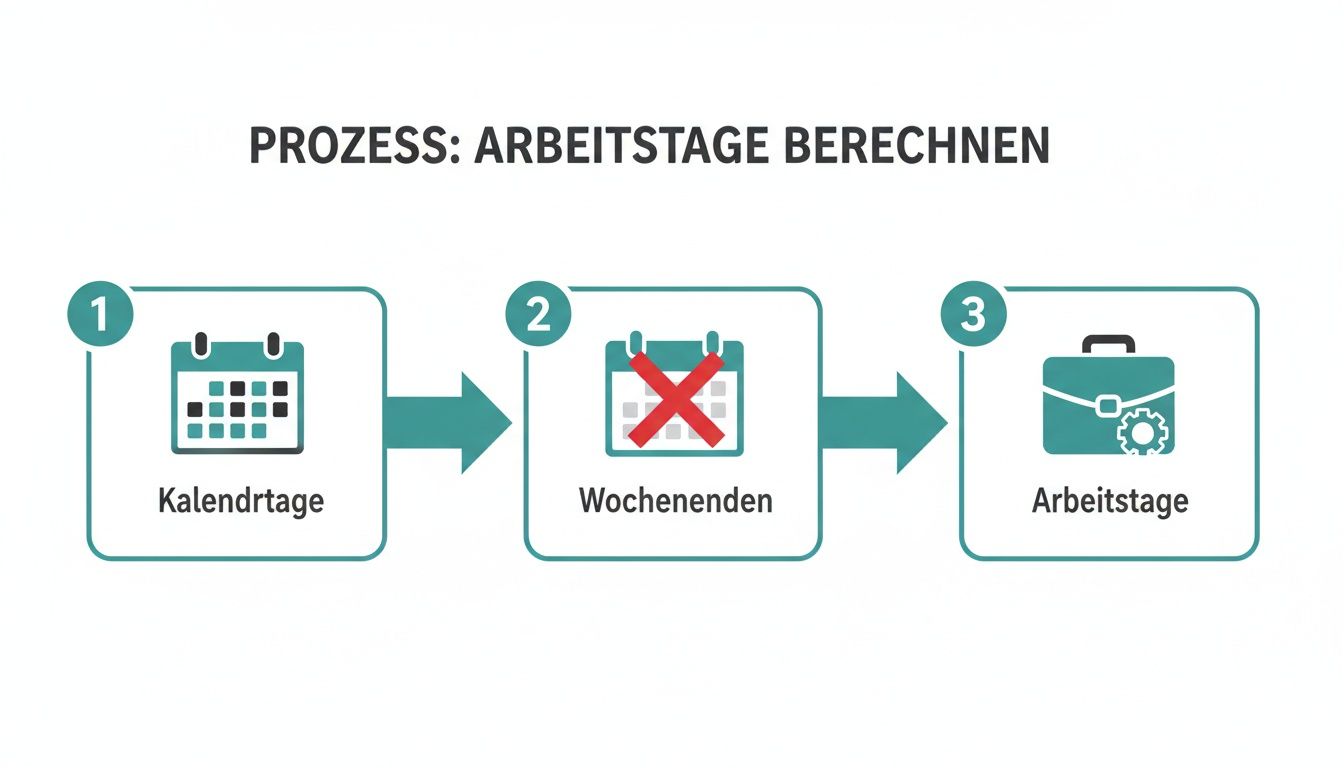
The process shows how the total number of calendar days is reduced step by step by subtracting days off until the actual number of workdays remains.
A Practical Example from Zurich
Let’s apply the formula concretely. Take May 2024 in the canton of Zurich.
- Calendar days in May: May has 31 days.
- Subtract weekends: In May 2024, there were 4 Saturdays and 4 Sundays. So you subtract 8 days.
- 31 days − 8 weekend days = 23 potential workdays
- Check and subtract public holidays: In May 2024, the following holidays in the canton of Zurich fell on a weekday:
- Labour Day: Wednesday, May 1
- Ascension Day: Thursday, May 9
- Whit Monday: Monday, May 20
- These are 3 holidays that must be subtracted.
- Calculate final result:
- 23 potential workdays − 3 holidays = 20 workdays
For May 2024 in the canton of Zurich, there are exactly 20 workdays. With this simple, step-by-step method, you can precisely determine the exact number for any month and any canton.
Cantonal Holidays: The Big Unknown in Swiss Planning
Anyone calculating the workdays per month for a team in Switzerland must understand a peculiarity of our country: pure federalism. It’s not just about national holidays. Each of the 26 cantons has its own public holidays – and this quickly makes personnel planning a tough nut to crack.
What is a day off in Geneva can be a completely normal workday in Zurich. These are not small details but facts that have direct effects on payroll, project deadlines, and overall capacity planning. Anyone who doesn’t keep the cantonal rules in mind is sure to fall into a planning trap.

Why Cantonal Differences Are Match-Deciding
Imagine a project team whose members are spread across Switzerland. An employee from Lucerne celebrates Corpus Christi, while a colleague from Bern works normally. If you don’t consider this, wrong expectations and missed deadlines are practically guaranteed.
These cantonal peculiarities strongly influence the total number of annual workdays. Depending on the canton, the number of days off can vary by up to a whole week.
Knowing the holiday rules at the respective workplace is the foundation for fair and legally compliant personnel management. Only in this way do you avoid payroll errors and create transparency within the team.
Working hours in Switzerland are already a complex topic. In 2023, the average weekly working time for a full-time position was 40 hours and 12 minutes. Including part-time employees, the value drops to 35 hours and 30 minutes – clear evidence of the high part-time share. If you want to learn more about these figures, watson.ch offers fascinating insights into working hours in Switzerland. Cantonal holidays simply add another layer of complexity.
Concrete Examples from Practice
A few examples make the differences crystal clear:
- Berchtold's Day (January 2): A classic holiday in cantons like Aargau, Bern, Jura, Schaffhausen, and Zurich. In Basel-Stadt, Geneva, or Valais, however, it is a normal workday.
- Corpus Christi: An important holiday in Catholic cantons like Appenzell Innerrhoden, Lucerne, Schwyz, Ticino, or Valais. In Protestant cantons like Bern or Zurich, people work on this day.
- Geneva Fast (Jeûne genevois): A holiday that exists only in the canton of Geneva. It always takes place on the Thursday after the first Sunday in September.
The golden rule is: For correct planning, the employee’s workplace counts, not the company headquarters.
Reliable Sources for Your Planning
Where do you get reliable information so you don’t lose track? The safest place is always the official websites of the cantonal administrations. There you will find the binding holiday calendars for each year.
Even easier is using modern workforce management systems. Good tools already have the holiday calendars of all cantons integrated and keep them automatically up to date. This turns calculating the workdays in the month for every employee – no matter where they are located – from an administrative nightmare into a breeze. This not only ensures accuracy but also saves a tremendous amount of time.
Correctly Calculating Special Cases Like Part-Time and Shift Work
The standard formula for workdays in the month works great as long as everyone works Monday to Friday. But what about part-time employees or shift work in healthcare? Once flexible models come into play, the simple calculation reaches its limits.
Here you need adapted methods to guarantee fairness and correctness for everyone – whether someone is new, works part-time, or works weekends.
Part-Time: Simple and Fair Accounting
For part-time employees, the general number of weekdays in the month is completely irrelevant. What counts are only the contractually agreed workdays. The calculation must always be based on the individual work pattern.
Imagine an employee who only works on Mondays, Tuesdays, and Wednesdays. In this case, you count only these weekdays in the respective month for their target. If a holiday falls on a Thursday, it has no significance for them.
A public holiday that falls on one of their regular days off (e.g., Thursday) has no effect on their target working time. They only benefit from a holiday if it falls on one of their fixed workdays.
Accounting for Shift and Weekend Work
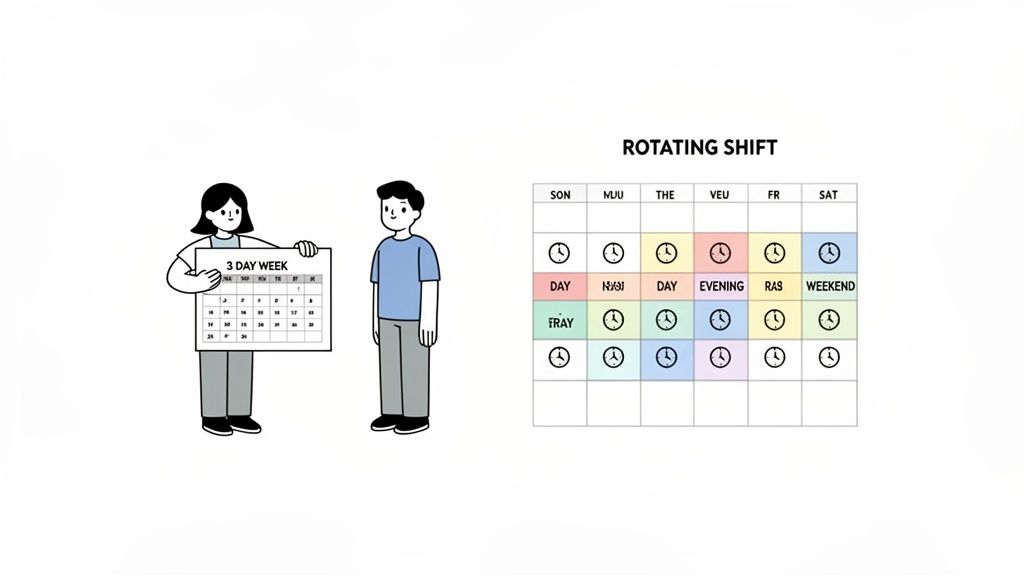
In shift work, as known from gastronomy or healthcare, the concept of classic weekdays loses all meaning. Here, work often takes place seven days a week, including weekends and holidays.
For these employees, not the calendar days but the number of planned shifts according to the duty roster is decisive. The target working time results from the contractually agreed weekly hours and the respective shift rhythm. If you want to dive deeper into how to create a solid Excel shift schedule, you will find a practical guide here.
- Practical example shift work: A nurse works 15 shifts of 8 hours each in a month. Their target working time is therefore 120 hours – completely independent of whether these shifts fell on a Monday, Sunday, or holiday.
Pro Rata for Joiners and Leavers
If employees start in the middle of the month or leave before the end of the month, everything must be calculated proportionally. This is called pro-rata calculation.
For this, you count exactly only the workdays from the entry date to the end of the month (or from the beginning of the month to the exit date).
- Example entry: A new employee starts on May 16. May has a total of 22 workdays in this example.
- Only the workdays from May 16 to May 31 count for them. Let’s assume this is exactly 12 workdays.
- Their salary is calculated proportionally: (monthly salary / 22 workdays) * 12 workdays.
This precise approach ensures that all work models are accounted for fairly and correctly – and everyone is satisfied in the end.
Why Accurate Calculation Is Crucial for Payroll and Planning
Precisely determining the workdays per month is much more than dry number crunching. It is the foundation on which your payroll and entire personnel deployment planning stand. A small mistake here can quickly grow into a big problem.
Just imagine you miscalculate by one day. For an employee with a fixed monthly salary, this might not be immediately noticeable. But for hourly workers or when calculating continued salary payments during illness, this one day has direct financial consequences. Such inaccuracies not only cause understandable frustration in the team but can also lead to legal consequences in the worst case.
A precise and transparent calculation of workdays is a sign of professionalism and fairness. It builds trust and prevents unnecessary discussions at the end of the month.
The Direct Consequences for Workforce Planning
Apart from correct payroll, the exact number of available workdays is the linchpin of your capacity planning. Only if you know exactly how many man-days you have available in a month can you realistically plan projects and confidently accept orders.
An inaccurate estimate almost always leads to one of two problems:
- Personnel shortages: You plan with too many workdays, take on too many orders, and then realize in the middle of the project that you lack people to finish everything on time.
- Inefficient deployment: You assume too few workdays, plan overly cautiously, and thus leave valuable revenue potential unused.
Modern Tools as a Solution
Fortunately, you no longer have to do these calculations by hand with a calendar and calculator. Modern workforce management systems take this work off your hands completely. They already have the cantonal holiday calendars stored and automatically consider individual working time models. This not only saves a huge amount of time but also eliminates human error sources.
In Switzerland, the annual working time in 2024 was around 1,533 hours, which corresponds to an average of about 21.75 workdays per month. These figures clearly show how crucial an accurate planning basis is to optimally deploy the available personnel. More details on these international comparisons can be found in this analysis of working hours in Europe. Ultimately, the precise calculation of workdays helps you effectively use the available working hours per month and optimize your planning.
Frequently Asked Questions About Calculating Workdays
Calculating the workdays per month often raises detailed questions in practice. Here you will find clear and direct answers to the most common uncertainties so that you are on the safe side with your planning and payroll.
How many workdays does a year have on average in Switzerland?
A year in Switzerland has on average between 252 and 255 workdays. The exact number always depends on two factors: the calendar year and the respective canton.
The logic behind it is simple: You start with 365 calendar days. You subtract 104 weekend days (52 Saturdays and 52 Sundays), which leads to 261 potential workdays.
In the last step, you only need to subtract the public holidays that fall on a weekday from Monday to Friday. Because the number of cantonal holidays varies and holidays fall on different weekdays each year, the exact number fluctuates. For reliable planning, a guideline value of around 254 workdays is often used.
What happens if a holiday falls on a weekend?
If a public holiday falls on a Saturday or Sunday, there is generally no legal entitlement to a substitute day off during the week in Switzerland.
For most employees, this holiday is effectively “lost” because these days would have been days off anyway.
That is exactly why it is so important in the monthly calculation of workdays to only consider holidays that actually fall on a regular weekday (Monday to Friday).
There are collective labor agreements (GAV) or generous company regulations that provide compensation, but these are exceptions and not the legal rule.
How do I calculate workdays for hourly employees?
For hourly employees, the number of potential workdays is initially secondary for payroll. What counts is only one thing: the number of hours actually worked.
However, determining workdays is still important for you – namely for workforce planning and determining your personnel needs.
To pay wages correctly, multiply the total number of hours worked by the contractually agreed hourly wage. Precise and complete time tracking, such as via an employee app, is essential for this. Only in this way do you ensure correct and transparent payroll for both sides.
Is there an official calculator for workdays in Switzerland?
No, there is no single “official” web application issued by the government for calculating workdays. However, many cantonal administrations and business associations provide reliable online holiday calendars.
The most reliable and at the same time simplest method is to use professional workforce management software. Such systems already have the holiday calendars of all cantons firmly integrated and perform the calculations automatically and error-free.
They can even consider individual working time models and complex shift schedules. This not only saves you a lot of time but also minimizes the risk of costly errors in payroll and overall personnel planning.
Would you like to finally automate the calculation of workdays, shift planning, and payroll preparation for your team? job.rocks offers you an integrated platform specially developed for flexible personnel pools. Reduce your administrative effort and gain time for what really matters. Discover the advantages of job.rocks now.