
Workforce Management: what it really delivers – and why your team benefits
Workforce management gives you strategic control over your most valuable resource: your people. Learn how WFM improves planning, reduces admin work and strengthens flexible teams.
Workforce management brings you one thing above all:strategic control over your most valuable resource – your people.It goes far beyond a simple roster. At its core, it ensures that the right people with the right skills are in the right place at the right time. In this way, you avoid costly overstaffing and understaffing and noticeably reduce your administrative effort.
Workforce Management is your strategic partner
Imagine organizing a large festival or managing the peak season in a hotel. Suddenly employees call in sick, important shifts remain unfilled, or you simply can't find anyone at short notice. You are probably familiar with situations like this when you work with staff. They lead to stress, unhappy customers and unnecessary costs.
This is exactly where Workforce Management (WFM) comes into play. It is not just a digital duty roster, but your strategic partner who keeps an eye on the entire personnel cycle - from demand planning and deployment planning to time recording and payroll.
More than just a digital roster
A simple roster shows you who works when. A true WFM system goes much deeper and answers strategically crucial questions:
- Who has the necessary qualifications for a particular task?A bartender needs different skills than a security guard. A good system compares this automatically and only suggests suitable people to you.
- How many employees do I really need?Based on sales figures, visitor forecasts or booking data, WFM helps you to precisely determine your staffing needs - not too much, not too little.
- Who is available and doesn't have overtime yet?The system takes into account labor laws, rest periods and even individual wishes. This not only increases fairness, but also satisfaction within the team.
Think of your staff like an orchestra. Without a conductor (WFM), everyone plays whatever they want - the result is pure chaos. With a conductor, a harmonious symphony is created in which every instrument is used at the right time. A WFM system takes on exactly this role and automatically compares availability, qualifications and workloads.
You need short notice for an event20 service staffwith experience in catering. Instead of writing dozens of emails or making phone calls, you send a single request to all qualified people in your pool through your WFM system. You will receive feedback within minutes and the shifts will be filled.
The administrative effort is noticeably reduced
Manual personnel planning is a real time-waster and very error-prone. Excel spreadsheets, confusing WhatsApp groups and endless email chains are a thing of the past with a WFM system.
Your employees enter their availability independently via the app, apply for open shifts and can even swap assignments with each other - all according to rules that you set in advance. If you want to delve deeper into this topic, see our article aboutthe art of efficient personnel schedulinglots of other useful information.
A modern WFM system automates these routine tasks so that you can finally concentrate on what's important: your business and your employees. This saved time is a direct financial gain.
This is how you measure the success of workforce management in concrete numbers
Are you wondering what workforce management really means for your business? The answer lies in the right key figures, the so-calledKey Performance Indicators (KPIs). They make the value of WFM tangible and show you in black and white exactly where your investment will pay off.
Good intentions alone are not enough. In the end, the numbers have to be right. The true benefit of workforce management is not reflected in vague promises, but rather in concrete, measurable improvements to your operational processes.
From gut feeling to hard facts: The administrative effort
Let's start with the most obvious point: the administrative burden. Imagine an event agency, week after week10 hoursspent solely on shift planning. Phone calls, emails, Excel lists – a huge time waster. After introducing a WFM system, this effort shrinks to just one2 hours.
The calculation is simple: these are8 hours of working time savedper week, which can be directly converted into money. Your team can now use this time for value-adding tasks instead of wasting it in repetitive coordination. This clear savings is often the first and most tangible part of yourReturn on Investment (ROI).
The following graphic shows nicely how the benefits are distributed across the areas of personnel, time and location.
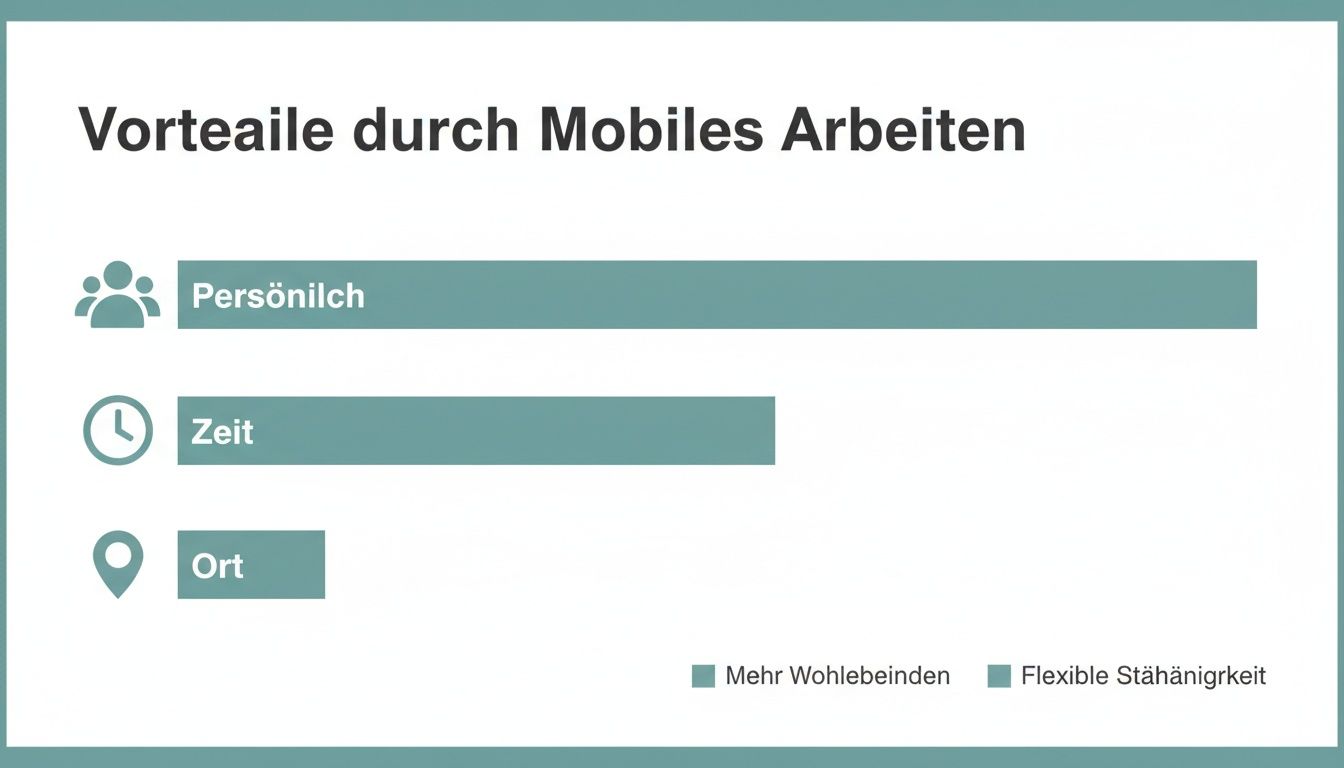
As you can see, the profits are spread across all areas, which illustrates the comprehensive benefits of a well-thought-out system.
The ROI is much more than just time saved. It is made up of various factors: lower personnel costs through needs-based planning, less spending on short-term replacement workers and avoided fines through better compliance with laws.
KPIs that really count
In addition to the pure time savings, there are other crucial KPIs that prove the success of your workforce management. Let's look at the most important ones:
-
Time to fill rate: This metric measures how quickly an open shift is filled. Manually, this can take days. With automated notifications and a mobile employee app, this time often shrinks to just a few minutes. Qualified and available employees are reached immediately.
-
Employee turnover: Satisfied employees stay longer, it's that simple. A fair, transparent planning system that takes wishes into account and allows flexible shift changes demonstrably increases job satisfaction. A decreasing fluctuation rate saves you enormous costs for recruiting and training.
-
Productivity per capita: When planning is correct and employees know what to do, productivity increases. You avoid idleness caused by understaffing as well as stress caused by overload. The result is a team that is focused and can complete its tasks well.
-
Adherence to legal requirements (compliance): A good WFM system automatically monitors working time laws, break regulations and rest periods. The risk of legal problems and significant fines is reduced to zero.
The following table shows at a glance how these key figures typically change as a result of a WFM system.
Before and after comparison with workforce management
This table shows the typical improvement in metrics after implementing a WFM system.
| Key figure (KPI) | Without WFM system (manual) | With WFM system (automated) | Concrete benefit |
|---|---|---|---|
| Administrative effort | 8-10 hours/week | 1-2 hours/week | Time savings, focus on strategic tasks |
| Time to fill | 24-48 hours | 5-30 minutes | Fast staffing, fewer absences, no loss of sales |
| Employee turnover | High (e.g. 25-30%) | Significantly reduced (e.g. 10–15%) | Lower recruiting and training costs, more know-how in the team |
| Compliance violations | Regularly (risk of fines) | Almost zero | Legal certainty, avoidance of fines |
This comparison makes it clear: switching from manual processes to an automated system is not just a convenience gain, but a strategic decision with measurable financial added value.
Current data from the Federal Statistical Office show that employment in Switzerland grew only minimally in the second and third quarters of 2023 and the number of job vacancies fell. For industries such as catering and logistics, this means that precise control of flexible employee pools becomes crucial in order to fill gaps in hours instead of days. AI-supported planning and mobile time recording are the tools of choice here.
These numbers will show you clearly how your decision to choose WFM will pay off. It's not about a diffuse feeling of improvement, but about hard, verifiable facts. If you would like to find out more about how automation actually works, ourStudy on the automation of deployment planninginterested.
How different industries benefit from WFM
Workforce management is not a one-size-fits-all solution. Its full value is only revealed when it is tailored to the specific needs of your industry. Let's look at concrete examples that show how different the needs and therefore the solutions are.

Every industry has its own challenges, be it seasonality, short-term orders or strict legal requirements. A good WFM system adapts to these circumstances and becomes a strategic tool instead of just an administrative aid.
Event agencies and promotion: Speed is everything
In the event industry, every minute counts. A nationwide campaign is coming up and you need it at short notice50 promoterswith specific foreign language skills and a driving license. Manually it would be a nightmare of phone calls and confusing email chains.
With a WFM system you can solve this problem with just a few clicks. You filter your personnel pool according to the required qualifications –Languages, driving license, experience– and send a targeted request to all suitable people. They receive a notification on their app, can view the details and apply directly for the job. This means that all positions are filled within a very short time, guaranteed to be with the right personnel.
Typical challenges for event agencies:
- Short-term changes:Events are postponed and staffing levels have to be adjusted quickly.
- Specific qualifications:Employees with special skills are needed (such as bartenders, technicians, multilingual hosts).
- High administrative effort:Coordinating hundreds of flexible workers takes an enormous amount of time.
A good WFM solution offers a central platform that bundles availability, qualifications and communication. If you would like to know more about how you as an agency can improve your processes, also read oursGuide to human resources management in the event industry.
Gastronomy and hotel industry: personnel costs under control
Personnel costs are one of the largest items in the catering and hotel industries. At the same time, capacity utilization fluctuates greatly – depending on the day of the week, the weather or the season. Rigid duty scheduling quickly leads to expensive overstaffing on quiet days or to stressed staff and dissatisfied guests during busy times.
Here, a WFM system helps to link personnel costs exactly to the expected number of guests. Based on past data and current bookings, the system predicts staffing requirements and shift planning is adjusted accordingly.
Imagine that in your hotel restaurant, employees organize shift swap requests directly via an app. The system automatically checks whether the exchange partner has the same qualifications and whether statutory break times are not being violated. All the manager has to do is agree – or the process can even run fully automatically.
In addition, the system ensures complete compliance with the complex labor laws in the hospitality industry. Break times, maximum working hours and rest times are automatically monitored. This protects you from fines and ensures fair working conditions.
Security services: Complete staffing and exact billing
For security services, complete occupation of objects is non-negotiable. Any failure represents an enormous risk. At the same time, the hours worked must be precisely documented in order to be billed correctly to the customer.
A WFM system ensures continuous presence here. If an employee is absent at short notice, a notification is automatically sent to all available and qualified colleagues nearby. The open shift can be filled within minutes without the control center having to intervene manually.
This is particularly usefulGPS-based mobile time tracking. The employee clocks in and out directly at the property via the app. The system records the exact working time and the exact location. This data flows directly into payroll and invoicing the customer. This prevents discussions and ensures maximum transparency and accuracy.
These examples show the versatility of workforce management. It's not about imposing the same solution on everyone. The real benefit comes when the software understands the individual problems in your industry and provides tailored answers.
The most common mistakes when introducing - and how to avoid them
The decision in favor of a workforce management system has been made, and management is looking forward to it. But the path from the idea to its smooth application in everyday life is often paved with typical stumbling blocks. Let's look at the most common pitfalls and how to avoid them skillfully right from the start.
One of the biggest hurdles with any new software is resistance within your own team. That's human. Employees are creatures of habit and often fear more control from superiors, complicated technology or that the new transparency will be disadvantageous to them. You have to take these concerns seriously.
The key to success? Get your team on board from the first minute. Communicate openly and honestlyWhyyou introduce the new system. It's not about monitoring anyone, but about making collaboration easier, more transparent and fairer for everyone.
The focus is on people, not technology
Forget dry Powerpoint presentations with endless feature lists. Instead, show your team specifically what advantages the new system brings to each individual in their everyday work. Imagine explaining to an employee how she can enter her availability and holiday requests directly in the app in the future - without any cumbersome emails or phone calls.
Another key point is the fear of injustice in shift planning. Emphasize how the system contributes to a fairer distribution through clear rules.
Communicate the benefits for employees clearly:
- More flexibility:Employees can easily swap shifts using the app. The system automatically checks the necessary qualifications in the background without a manager having to intervene manually.
- Transparency:The current roster can be viewed on your mobile phone at any time. Short-term changes arrive immediately via push notification - no more uncertainties.
- Fairness:The system objectively takes working hours, overtime and qualifications into account. The result is significantly fairer operational planning for everyone.
By showing the personal benefits, you quickly convert initial skepticism into curiosity and acceptance. Actively involve your team in the testing phase. Your feedback is worth its weight in gold in order to optimally adapt the system to your real needs.
The wrong software is a costly mistake
Another, unfortunately very common, mistake: choosing unsuitable software. Many workforce management systems on the market are overloaded, complicated and not at all designed for the needs of flexible teams. Essentially, you're buying an expensive truck when you actually need a maneuverable van.
A cleaning company chooses a system that has good time tracking, but does not offer mobile route planning. Employees must continue to use separate apps or printed lists to coordinate their orders. The result? Lost time, unnecessary kilometers and frustration in the team – exactly what you actually wanted to avoid.
When choosing, make sure that the software really solves the problems you have. A simple, intuitive mobile app is often more important than hundreds of functions that no one ends up using. Check whether qualification filters can be flexibly adjusted or whether an interface to payroll accounting exists.
The Swiss shortage of skilled workers will have eased noticeably in 2024, which will reduce the pressure on the labor market somewhat. The corresponding index fell by22 %. Nevertheless, it remains crucial, especially in industries such as healthcare, to make optimal use of existing staff. Flexible platforms for availability queries and shift planning are central here in order to fill gaps quickly without having to resort to panic recruiting campaigns. You can find out exactly how the job market is developing in the current analyzes fromEconomy of Valais.
Your 5-step roadmap for optimal personnel deployment planning
Are you convinced and want to finally get started with a workforce management system? Perfect. Switching from countless Excel lists and paperwork to a clean, automated process is often easier than you think. We'll show you a clear one5 step plan, which allows you to approach the introduction in a structured manner and avoid the typical pitfalls.
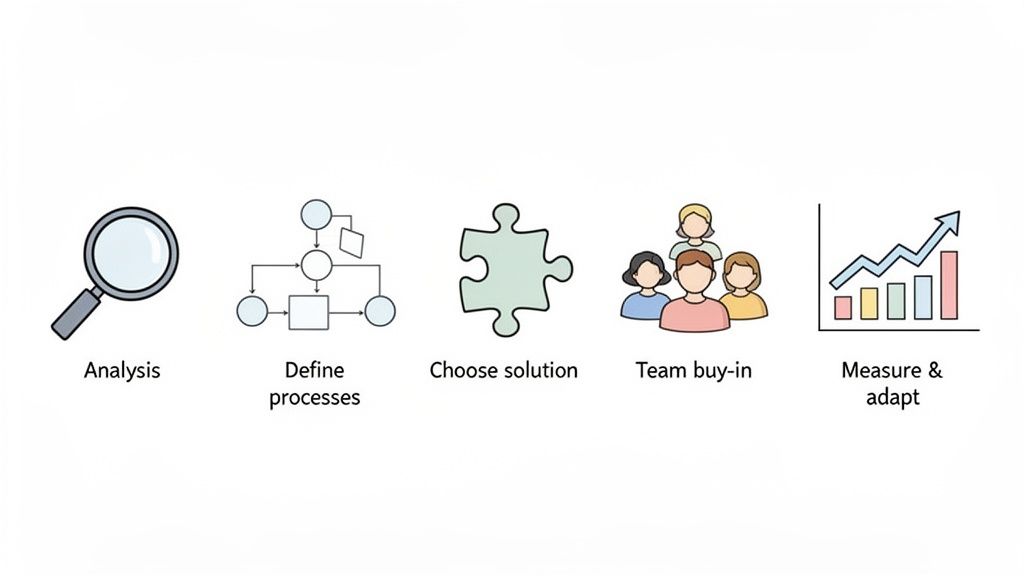
Each of these steps builds on the previous one. So take the time to pour the foundation cleanly. This is the only way you can exploit your full potential later.
Step 1: The needs analysis – Where does it really hurt?
Before you plunge into the jungle of providers, you have to have one thing crystal clear: What specific problem do you want to solve? Ultimately, a workforce management system is not a magical panacea, but rather a targeted tool.
So ask yourself the honest question: What are your biggest pain points in workforce planning?
- Enormous time investment: Are you wasting hours or even days creating rosters and communicating with the team? An event agency that makes countless phone calls for every event has a clear pain point here.
- Lousy occupancy rate: Do shifts keep going unfilled because you can't find anyone in a hurry? If short-term sick calls regularly cause chaos in your restaurant, this is a central problem.
- Compliance risk: Do you find it difficult to fully comply with all working time laws and break regulations? This can mean an enormous legal and financial risk, especially for security services.
Write down these pain points and goals. They are your compass that guides you in choosing the right solution.
Step 2: Put your processes on the table
Now it’s time to put your internal processes on paper. How does your planning work today – and what should it ideally look like in the future? Even if your current processes sound more like organized chaos, this inventory is worth its weight in gold.
To do this, answer the following questions in a simple checklist:
- Availabilities: How do employees report when they can work? Via WhatsApp, email or shouting in the hallway?
- Shift planning: Who creates the plan? And according to what criteria are shifts distributed (qualifications, fairness, costs)?
- communication: How do employees find out about new shifts or short-term changes?
- Time tracking: How are the hours worked recorded and released? With paper timesheets?
- Payroll: How do the hours end up in payroll accounting? Are they laboriously typed out by hand?
This sketch of your processes will help you to specifically look for software that can digitize and improve exactly these processes.
Step 3: Choose the right solution
Now you are ready to start looking for providers. But be careful: don't be blinded by endless feature lists. Concentrate hard on the points that you defined for yourself in the first two steps.
You should pay particular attention to these three aspects:
- Mobile app: Your employees have to love the system, not hate it. An intuitive and fast app for availability, shift applications and time recording is the be-all and end-all for acceptance.
- Scalability: Choose a system that grows with your business. You might start with20people, but want to join in two years100be? The software must be able to handle this easily.
- Industry functions: Do you need very special features, such as a qualification filter for events or GPS-based time tracking for cleaning services? Check whether the provider really understands your industry.
Efficiency is now more important than ever, especially for recruiters. The Adecco Group Swiss Job Market Index for Q4 2023 shows stabilization, but also massive declines in commercial and administrative jobs-36 %. Automated processes, from availability queries to wage preparation, become a decisive competitive advantage in keeping costs under control. Find out more about theDevelopments on the Swiss job market.
Step 4: Get your team on board
Honestly, the best software is of no use to you if your team doesn't accept it. Resistance to new things is human, but you can take the wind out of its sails by involving your team early on.
Plan a test phase with a small, motivated group. Let them put the system through its paces and collect their honest feedback. These “champions” will later become your most important advocates across the team.
Communicate the advantages clearly and, above all, from the perspective of your employees: more transparency in planning, fairer shift distribution and the freedom to easily manage assignments via the app. Show them that it's not about more control, but about massive simplification for everyone.
Step 5: Measure, adjust, optimize
The launch is not a one-time project that you check off. It is a continuous process. Right from the start, track exactly the key performance indicators (KPIs) that you defined as your pain points in step 1.
- How much has the administrative effort actually been reduced?
- How quickly are open shifts filled now (time-to-fill)?
- How many errors still creep into payroll?
Use the data your new system provides you to continually improve your planning. You may notice that certain shifts are always unpopular or that there are always shortages at certain times. With a good WFM system, you can recognize these patterns early and act proactively instead of just reacting.
Frequently asked questions about workforce management
Are you thinking about taking the next step, but still have a few specific questions? That is absolutely understandable. Here we answer the concerns we see most often - clearly, directly and without further ado, so you can make the right decision for your business.
Is a WFM system also worth it for my small business?
Yes, absolutely. Especially in smaller teams, where one person often wears many hats at the same time, the time savings through automated processes are worth their weight in gold. Instead of spending hours on countless calls and confusing Excel lists, you can finally concentrate fully on your core business again.
Imagine you are running a small café20 employees. With a WFM system, your people enter their availability directly via the app and even swap shifts with each other if necessary - without you having to constantly step in as an intermediary. Modern, cloud-based systems are now flexible, scalable and absolutely affordable even for small teams. You gain professional processes, more planning security and, most importantly, happier employees.
How do I ensure my employee data is safe?
An extremely important point, especially today. When choosing your provider, you should definitely make sure that they:GDPR compliance guaranteedand its servers are ideally located in Switzerland or the EU. Reputable providers who specialize in the European market know how important data protection is for their customers.
All data is transmitted and stored encrypted. A crucial feature is also a differentiated oneRights management. This allows you to control who can see and edit which information with millimeter precision. This means that sensitive personnel data such as wage rates or personal notes remain absolutely protected and you are always legally on the safe side.
A practical example: A planner only sees the names and qualifications of the employees. The HR department also has access to contract details. The employees themselves only see their own data and the shifts relevant to them.
My employees are not very enthusiastic about technology. Is the training complex?
We often hear this concern, but in most cases it is unfounded. Good WFM systems today are designed to be extremely user-friendly - this is called intuitiveUser Experience. The employee app is often as easy to use as the social media applications that everyone uses every day.
With just a few clicks, availability can be entered, shifts accepted or working hours recorded. As a rule, a short introduction or a crisp explanatory video is sufficient. The key point is to make the benefits clear to each individual:
- No more calls in your free time.
- The shift schedule is always available on your cell phone.
- The allocation of assignments will be more transparent and fair.
As soon as your team notices that the system makes their lives noticeably easier, acceptance is usually very high. The technology then quickly turns from a feared obstacle into a welcome helper in everyday work.
Are you ready to simplify your workforce planning and strengthen your team?job.rocksoffers you the tools to automate your planning processes, improve communication and increase the satisfaction of your employees. Discover now how you can save time and money with our solution:https://job.rocks