
Working Days per Year Switzerland 2026 & 2027: Calculator, Table for All Cantons
Calculate working days per year in Switzerland: interactive calculator, canton table for 2026, comparison to 2027, FAQ and practical tips for HR, payroll and workforce planning.
📅 Working Days per Year Switzerland 2026 — Quick Answer
In 2026, Switzerland has between 252 and 255 working days, depending on the canton (based on a 5-day workweek). Most cantons have 253–254 working days.
Formula: 365 calendar days − 104 weekend days − cantonal public holidays (on weekdays) = gross working days
- Zurich: 253 working days (8 public holidays on weekdays)
- Bern, Basel, Geneva: 254 or 255 working days
- Lucerne, Jura: 252 working days (most holidays)
🧮 Working Days Calculator Switzerland 2026
Calculate Working Days for 2026 Immediately
Get the free annual planner for Switzerland with holidays, canton logic, and quick target hours planning.
- Working days 2026 and 2027 at a glance
- Better plan holidays by canton
- Calculate target hours faster and more accurately
Free. No spam. Immediately available.
Key Points in Brief
- Working days per year in Switzerland depend on the canton, calendar year, and your workload.
- In 2026, values for a 5-day workweek range between 252 and 255 working days.
- For target hours, vacation, and budget planning, you should calculate not only gross but always net working days.
- For companies with multiple locations or shifts, a digital planning solution is usually more robust than a manual Excel file.
Working Days per Year Switzerland 2026 — Overview
The number of working days per year varies significantly in Switzerland depending on the canton — between 252 and 255 days for a 5-day workweek. The difference results from the cantonal public holidays.
For 2026: The calendar year has 365 days, of which 104 fall on weekends. This leaves 261 potential working days. Subtracting the cantonal holidays that fall on a weekday gives the actual number.
Important for 2026: The Swiss National Day (August 1) falls on a Saturday — so it does not reduce working days. The same applies to Assumption Day (August 15, Saturday), All Saints' Day (November 1, Sunday), and St. Stephen's Day (December 26, Saturday).
How to Calculate Working Days per Year
The basic formula is simple:
Working days = 365 calendar days − 104 weekend days − holidays on weekdays
For the net working days (the days you actually work), subtract your vacation days:
Net working days = gross working days − vacation days
In Switzerland, the statutory minimum vacation entitlement is 4 weeks (20 days). Many collective agreements and employers grant 25 days, often 30 days from age 50.
Working Days 2026 by Canton
The following table shows for each canton how many statutory holidays in 2026 fall on a weekday and how many gross working days result.
| Canton | Holidays on Weekdays | Working Days 2026 |
|---|---|---|
| Zurich (ZH) | 8 | 253 |
| Bern (BE) | 7 | 254 |
| Lucerne (LU) | 9 | 252 |
| Uri (UR) | 8 | 253 |
| Schwyz (SZ) | 7 | 254 |
| Obwalden (OW) | 8 | 253 |
| Nidwalden (NW) | 8 | 253 |
| Glarus (GL) | 7 | 254 |
| Zug (ZG) | 7 | 254 |
| Fribourg (FR) | 8 | 253 |
| Solothurn (SO) | 8 | 253 |
| Basel-Stadt (BS) | 7 | 254 |
| Basel-Landschaft (BL) | 7 | 254 |
| Schaffhausen (SH) | 8 | 253 |
| Appenzell A.Rh. (AR) | 6 | 255 |
| Appenzell I.Rh. (AI) | 7 | 254 |
| St. Gallen (SG) | 6 | 255 |
| Graubünden (GR) | 6 | 255 |
| Aargau (AG) | 7 | 254 |
| Thurgau (TG) | 8 | 253 |
| Ticino (TI) | 8 | 253 |
| Vaud (VD) | 7 | 254 |
| Valais (VS) | 8 | 253 |
| Neuchâtel (NE) | 8 | 253 |
| Geneva (GE) | 6 | 255 |
| Jura (JU) | 9 | 252 |
Range: Between 252 days (Lucerne, Jura) and 255 days (Appenzell A.Rh., St. Gallen, Graubünden, Geneva) there is a difference of three full working days.
Working Days 2026 vs. 2027 — Comparison
The year-on-year comparison shows interesting fluctuations: 2027 will have fewer working days because several important holidays fall on weekdays.
| Canton | 2026 | 2027 | Difference | Reason |
|---|---|---|---|---|
| Zurich (ZH) | 253 | 251 | −2 | Swiss National Day (Fri), St. Stephen's Day (Sun→Mon) |
| Bern (BE) | 254 | 252 | −2 | Swiss National Day (Fri) |
| Lucerne (LU) | 252 | 250 | −2 | Swiss National Day (Fri), Assumption Day (Sun→Mon) |
| Geneva (GE) | 255 | 253 | −2 | Swiss National Day (Fri) |
| St. Gallen (SG) | 255 | 253 | −2 | Swiss National Day (Fri) |
Why fewer working days in 2027? The Swiss National Day (August 1, 2027) falls on a Friday, and St. Stephen's Day (December 26) on a Sunday (→ substitute holiday Monday in some cantons). This causes a difference of 1–2 working days.
What this means for workforce planning: In 2027, annual salary costs are slightly higher with the same weekly working hours because fewer working days are available. With professional workforce planning software, you can detect such fluctuations early and adjust your resource planning accordingly.
Working Days per Year in Practice: What You Really Need the Number For
Many search for "working days per year" because they need a concrete number for salary, workload, vacation, or deployment planning. A good calculator should therefore not only provide an average but also consider the canton, workload, and vacation.
This metric is especially relevant in these situations:
- HR and Payroll: Target hours, vacation accounts, and annual working time must fit the cantonal holiday logic.
- Shift Planning and Deployment: Those working with shifts, assignments, or multiple locations need reliable target days per team and canton.
- Part-time Models: At 60%, 80%, or fixed weekdays, calculation errors quickly arise if using flat averages.
- Offers and Budget Planning: Personnel service providers and SMEs calculate personnel needs, revenue potential, and absence reserves based on available working days.
Calculating Working Days per Year: The 5 Most Common Mistakes
In practice, calculation rarely fails due to the basic formula but rather the details. These mistakes are especially common:
- Assuming holidays are the same across all Switzerland: Differences of up to three working days exist between cantons in 2026. This is immediately relevant for teams in Zurich, Lucerne, and Geneva.
- Confusing gross and net working days: For contracts, budgets, and target hours, you usually need the net view after subtracting vacation.
- Incorrectly deriving part-time: An 80% workload is not automatically "four days times 52 weeks." Holidays, vacation days, and fixed deployment days must be calculated correctly.
- Calculating only with monthly averages: The value of about 21.75 days per month is practical but often too rough for May, December, or vacation peak periods.
- Ignoring year changes: Available working days change between 2026 and 2027. Those updating budgets or deployment plans should plan this early.
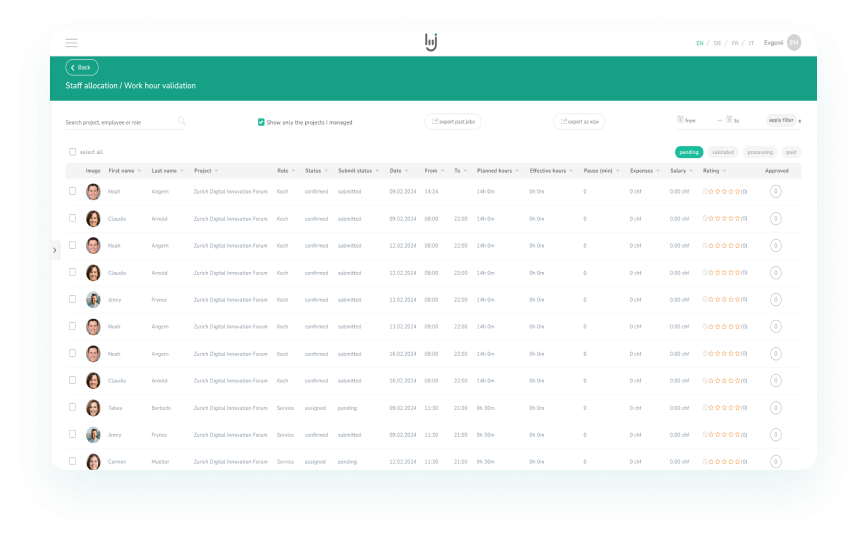
If you need to manage working days per year for multiple teams, cantons, or locations, a clean digital process is worthwhile. With workforce planning software, time tracking, and centralized personnel management, you significantly reduce manual errors.
Excel, Calculator or Software? How to Proceed Sensibly
| Approach | Suitable for | Advantages | Limitations |
|---|---|---|---|
| One-time quick calculation | Individuals, simple inquiries | Fast, no setup | No history, no team logic, error-prone for part-time and cantons |
| Excel solution | SMEs with low complexity | Flexible, individually customizable | Maintenance effort, formula errors, holidays and vacation often manual |
| Digital planning and time tracking software | Multiple employees, shifts, personnel service providers | Automatic target times, holidays, vacation and evaluations | Setup required, choosing the right solution important |
A calculator is often sufficient for a single inquiry. But as soon as you regularly work with annual working time, vacation days, target hours, and deployment plans, an integrated solution is much more robust. This is exactly where a look at job.rocks pricing overview or a short demo is worthwhile if you no longer want to maintain working days, availabilities, and time tracking separately.
For legal classification of working and rest times, additional guidance is available from SECO. For basic information on personnel administration in SMEs, the Federal SME Portal is also helpful.
As soon as multiple teams, cantons or absences come together, planning in Excel quickly becomes tedious. If you want to solve this more cleanly, book a short demo with Fabio here: https://job.rocks/demo-vereinbaren
Working Days per Month 2026 (Example Zurich)
The monthly distribution fluctuates between 18 and 23 days. Here is the overview for the canton of Zurich (5-day workweek):
| Month | Working Days | Holidays (Weekday) |
|---|---|---|
| January | 21 | New Year's Day (Thu), Berchtold's Day (Fri) |
| February | 20 | — |
| March | 22 | — |
| April | 20 | Good Friday (Fri), Easter Monday (Mon) |
| May | 18 | Labour Day (Fri), Ascension Day (Thu), Whit Monday (Mon) |
| June | 22 | — |
| July | 23 | — |
| August | 21 | Swiss National Day falls on Sat |
| September | 22 | — |
| October | 22 | — |
| November | 21 | — |
| December | 21 | Christmas (Fri) |
| Total | 253 | 8 holidays on weekdays |
The national average is about 21.75 working days per month (261 ÷ 12) — a value often used for flat calculations in employment contracts.
Calculating Working Hours per Year
To convert working days to annual hours, you need your daily working time:
Working hours per year = net working days × hours per day
The standard weekly working time in Switzerland ranges between 40 and 42 hours depending on the industry. With a 42-hour week and 5 working days, the daily working time is 8.4 hours.
| Weekly Working Time | Hours / Day | Annual Hours (ZH, 20 vacation days) |
|---|---|---|
| 42 hours | 8.4 h | 1’957 h |
| 40 hours | 8.0 h | 1’864 h |
| 38.5 hours | 7.7 h | 1’795 h |
Tip: For monthly conversion, the factor 4.33 is often used (52 weeks ÷ 12 months). With a 42-hour week, this results in an average of 181.86 monthly hours.
Full-time, Part-time & Workload — Calculation Examples
Example 1: Full-time 100% (42h, Canton Zurich)
253 gross working days − 20 vacation days = 233 net working days
233 × 8.4 h = 1’957 working hours per year
Example 2: Part-time 60% (3 days/week, 25.2h)
253 working days × 3/5 = 151.8 → 152 gross working days
152 − 12 vacation days (20 × 60%) = 140 net working days
140 × 8.4 h = 1’176 working hours per year
Example 3: 80% Workload (4 days/week, 33.6h)
253 × 4/5 = 202.4 → 202 gross working days
202 − 16 vacation days (20 × 80%) = 186 net working days
186 × 8.4 h = 1’562 working hours per year
Practical Tips for HR and Workforce Planning
For HR managers and companies, working days per year are a central planning metric. Here is a practical checklist:
✅ Checklist for Annual Planning 2026
- Check cantonal holidays: Especially important for teams in multiple cantons — differences can lead to bottlenecks.
- Plan vacation balances early: With 253 working days and on average 20 vacation days, 233 productive days remain. With 10% absences (illness, accidents), effectively only about 210 days remain.
- Consider year change 2026/2027: 2027 has fewer working days — ideal for budget planning and capacity models.
- Optimize shift planning: In industries with 24/7 operation (hospitality, healthcare, production), exact working day calculations are essential. With workforce planning software, you automate availability planning.
- Convert part-time models correctly: For 80% workload, do not simply calculate "4 days × 52 weeks" but work with the ratio 4/5 of the cantonal working days.
- Coordinate payroll: Ensure your time tracking software stores the correct target working days per canton.
For SMEs and personnel service providers: Working days calculation is the basis for offer calculation, resource planning, and personnel requirements planning. job.rocks automatically calculates with the correct cantonal values and considers part-time workloads, vacation, and holidays.
Frequently Asked Questions (FAQ)
How many working days are there in Switzerland in 2026?
It depends on the canton. Most cantons have between 252 and 255 working days for a 5-day workweek. Zurich has 253 days, Geneva and St. Gallen 255 days, Lucerne and Jura only 252 days. The difference results from the cantonal holidays.
How do I calculate working days per year?
Formula: 365 calendar days − 104 weekend days − holidays on weekdays = gross working days. For net working days, subtract your vacation days. In Switzerland, this is at least 20 days (4 weeks).
Why do different cantons have different numbers of working days?
Each canton has its own statutory holidays in addition to national holidays (August 1, Ascension, Whit Monday, Christmas). For example: Zurich has Berchtold's Day (January 2), Geneva the Geneva holiday (Jeûne genevois), and Catholic cantons have additional Marian holidays.
How many working days per month are there on average?
The national average is 21.75 working days per month (261 weekdays ÷ 12 months). However, monthly values fluctuate strongly: May often has only 18–19 days (many holidays), July usually 23 days.
How do I calculate part-time working days?
Multiply the gross working days by the workload ratio. Example 80% workload: 253 days × 4/5 = 202 working days. Then subtract proportional vacation days (20 days × 80% = 16 days) → 186 net working days.
What is the difference between gross and net working days?
Gross working days are all weekdays minus holidays. Net working days are the days actually worked, i.e., gross minus vacation (and optionally minus illness/absences). For resource planning, net working days are the relevant figure.
Do half holidays count as a full working day?
No. In some cantons, there are half holidays (e.g., Berchtold's Day afternoon in certain municipalities). These count only as 0.5 working days less. Our calculator currently only considers full holidays — for exact calculations with half holidays, check cantonal regulations or use personnel management software with an integrated holiday calendar.
How many working hours does a year have with a 42h/week?
With a 42-hour week, 253 gross working days, and 20 vacation days (Canton Zurich), there are 1’957 working hours per year (233 net days × 8.4 hours/day). With 40h/week, it is 1’864 hours.
How does the number of working days change in 2027?
In 2027, there are fewer working days than in 2026 because Swiss National Day (August 1) falls on a Friday. Zurich has only 251 working days in 2027 (−2 days). This is relevant for annual budget planning and capacity models.
How do I use working days per year for target hours and deployment planning?
It is best to combine the annual working days with your workload, vacation days, and weekly hours. This gives realistic target hours instead of flat estimates. For shift operations, personnel service providers, and teams in multiple cantons, this is much more reliable than a fixed Excel formula.
Can I have working days calculated automatically?
Yes! Modern workforce planning and time tracking software calculates working days, target hours, and vacation balances automatically — per canton, per employee, and per workload. This saves time and avoids errors in payroll. With job.rocks, you have all cantonal holidays and workload models preconfigured.