
Working Despite Sick Leave: What You Are Allowed to Do and the Risks Involved
Meta description: You are on sick leave but feel well enough to work? Learn when you are allowed to work, what risks you need to be aware of, and how to protect yourself legally.
Meta description: You are on sick leave but feel well enough to work? Learn when you are allowed to work, what risks you need to be aware of, and how to protect yourself legally.
You are on sick leave but actually feel well enough to answer a few emails? In principle, working despite sick leave is allowed. A medical certificate is not a general work ban, but a recommendation to take it easy. The most important thing is: The work must not endanger your recovery in any way.
The Fine Line Between Duty and Recovery
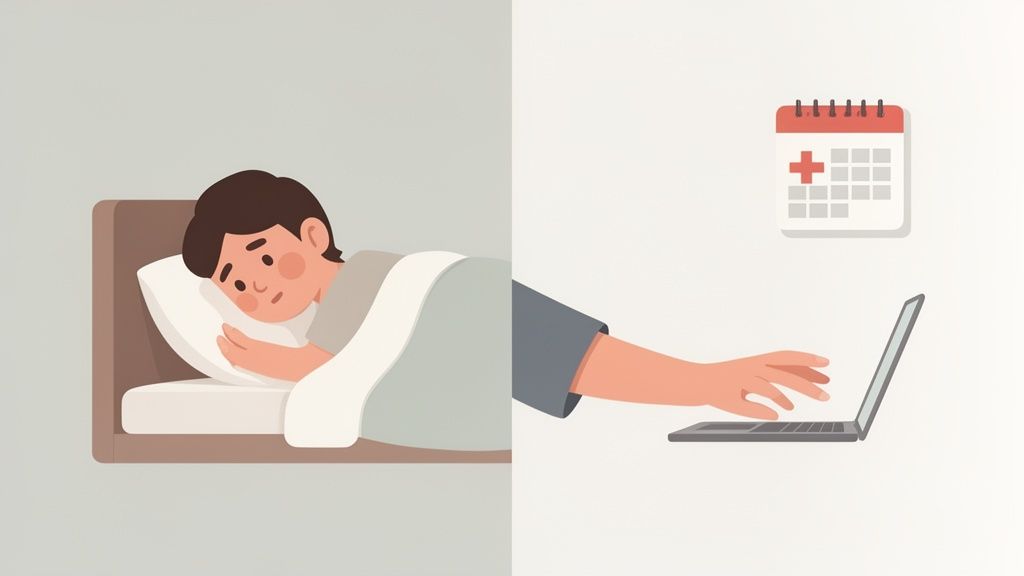
The thought of working despite being on sick leave troubles many. Maybe you feel guilty because the team is understaffed without you. Or you simply don’t want to leave an important project hanging. Especially in industries like event planning, hospitality, or care, where every absence immediately creates a gap, the pressure to get back quickly is often high.
But it’s not that simple. It’s not just about whether you personally feel fit enough. You are moving in a legal grey area where your insurance coverage and, in the worst case, even your job could be at risk.
So before you open your laptop, here are the key points at a glance:
Working Despite Sick Leave at a Glance
This table summarizes the central points you should know immediately before making a decision.
| Aspect | Explanation | Recommendation |
|---|---|---|
| Permission | Basically yes, as long as recovery is not endangered. A medical certificate is not a work ban. | Be sure to coordinate with your employer before working again. Open communication is everything. |
| Insurance Coverage | In case of relapse or a new accident, insurance coverage (accident insurance, daily allowance) may be at risk. | Have your doctor confirm that a partial resumption of work is safe. |
| Medical Certificate | It is a professional recommendation on how limited your ability to work is. | Consider the certificate as a guideline. Always consult your doctor if unsure. |
| Duties | You have a duty to recover. That means you must avoid anything that delays your healing. | Choose only tasks that do not strain your health (e.g., no physical work with back problems). |
The decision to work again should never be taken lightly or alone.
Why This Topic Is Especially Relevant Now
The numbers speak clearly: In Switzerland, sickness and accident-related absences increased from an average of 44.3 to 59.1 hours per year per full-time position between 2010 and 2024. That is an increase of over 33 percent. This development of work absences in Switzerland hits industries like hospitality, events, and cleaning particularly hard, where flexible shift planning is crucial.
No wonder many employees want to take on light administrative tasks or work from home despite sick leave to relieve the team.
This guide aims to give you clear orientation. We clarify the most important questions and shed light on the perspectives of employees and employers. This way, you get the knowledge you need to make a safe decision for your health and your job.
It covers these key points:
- What is legally allowed? The role of the medical certificate and your duties as an employee.
- What risks do you take? A close look at insurance coverage in case of accident and illness.
- What consequences may arise? Possible consequences for you and your employer.
- How to proceed practically? The crucial role of communication and clear agreements.
Do not see sick leave as a rigid ban but as what it really is: a professional recommendation to help you recover quickly. Sometimes, adapted work can even be part of the recovery process—as long as everyone pulls together: you, your doctor, and your employer.
The Legal Basics Explained Clearly
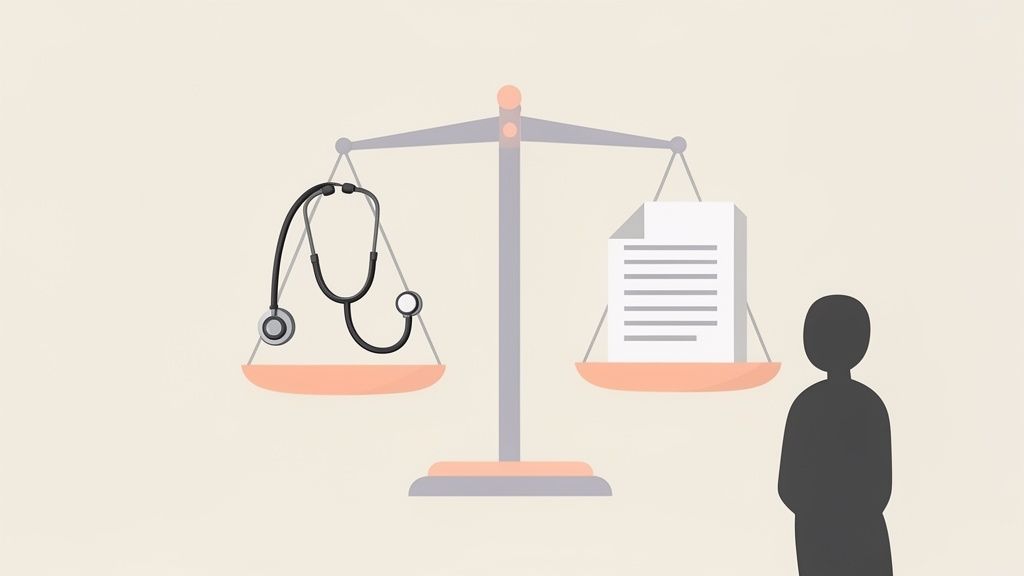
There is a persistent myth in everyday work life: A medical certificate is a strict work ban. That is not true. Swiss labor law does not generally forbid you to work during sick leave. Rather, the certificate is a professional assessment of your current inability to work and a clear recommendation to rest.
The all-important principle is: Your recovery always takes priority. As long as the work you want to do neither endangers nor delays your healing process, working despite sick leave is legally possible.
Your Duty to Take It Easy as an Employee
As an employee, you have a so-called duty to take it easy or recover. This means concretely that you must avoid anything that could negatively affect your healing. This duty forms the core of any legal assessment.
A medical certificate is therefore not a rigid shackle but a prognosis of your ability to work, primarily intended to protect your health. The final decision whether to work is never yours alone but always in dialogue with your doctor and employer.
If you work despite sick leave, it must be absolutely certain that the tasks do not impair healing. Ideally, they even promote it.
Imagine an event technician who is 100% on sick leave due to a broken leg. Clearly, setting up a heavy stage is forbidden—it would directly endanger healing. Light administrative tasks at home, like planning upcoming assignments on the computer, could be allowed. Condition: The doctor gives the green light and the task can be done comfortably sitting down.
Why the Type of Sick Leave Matters
It is extremely important to distinguish between full and partial sick leave:
- 100% sick leave: Here the doctor assumes complete inability to work for your usual job. Any form of work must be critically examined and ideally approved in writing by the doctor.
- Partial sick leave (e.g., 50%): Here the doctor certifies that you are fit for part of your working hours or for certain less demanding tasks. The rest of the time is strictly reserved for recovery.
The legal guardrails to protect employees are clearly defined in Switzerland. The State Secretariat for Economic Affairs (SECO) emphasizes this prominently on its website.
Employee protection is therefore no toothless tiger. Your employer has a legal duty of care and must actively ensure that your health is protected. That is exactly why open communication and a written agreement are absolutely essential before you resume work even partially. Your employment contract forms the basis for such agreements.
Why Your Insurance Coverage Is at Risk
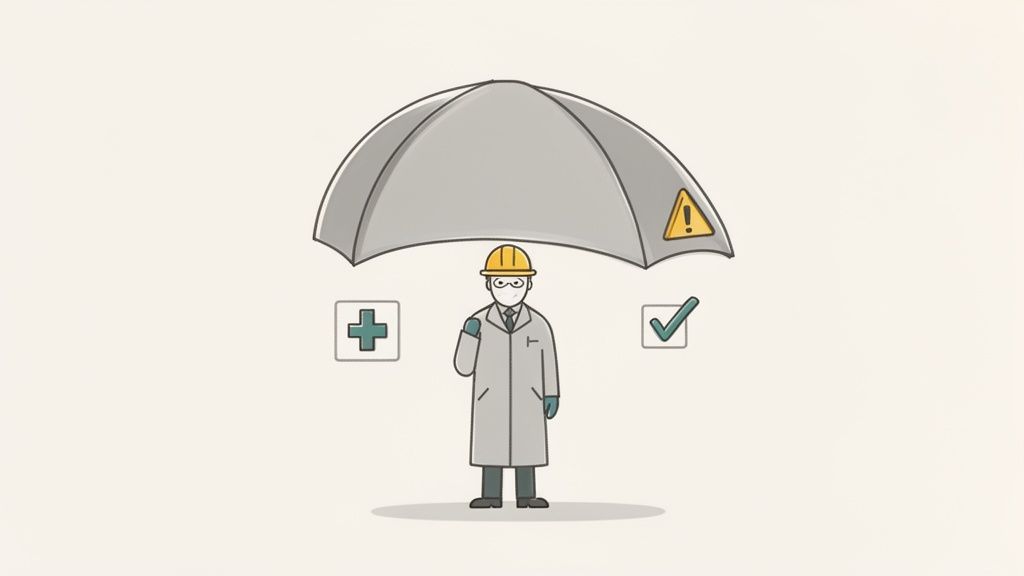
If you are considering working despite sick leave, you should be aware of a huge stumbling block: insurance coverage. Your sense of duty is admirable, no question, but the financial consequences in case of an incident can be life-threatening. As soon as you act against medical advice, you are on very thin ice.
Imagine you work as a hotel service staff and drag yourself to work despite the flu and sick leave. Because you are weakened by the illness, you fall on the way to work and get injured. Here, accident insurance (UVG) could argue that you violated your duty to recover.
The consequence? The insurance reduces its benefits or refuses them altogether in the worst case. The logic behind this is harsh: If you had stayed home as recommended by the doctor, the accident would not have happened.
When Insurance Assumes a Breach of Duty
Both accident insurance (UVG) and daily sickness allowance insurance (KTG) are very strict. In every accident or relapse during sick leave, they check whether you neglected your duty to recover. Lawyers call this a breach of obligation.
Such a breach occurs if you consciously do something that delays your healing or causes new damage. And yes, working despite sick leave is often interpreted exactly that way.
Here is a practical example from the event industry:
A stage technician is on sick leave for six weeks after ankle surgery. After four weeks, he feels fit and spontaneously helps dismantle a small event. An unfortunate step, he twists his ankle and injures the operated joint again.
In this case, it is almost certain that the insurance will reduce its benefits. The reason is obvious: He performed an activity that clearly violated the doctor’s instruction to rest and thus actively jeopardized the healing success.
How to Protect Yourself and Your Employer
To avoid risking insurance coverage lightly, clear agreements and thorough documentation are needed. Independent decisions are taboo here. Solid insurance coverage is essential in working life—whether at home or traveling, as this guide to work travel health insurance shows.
These steps are indispensable to stay on the safe side:
- Get a medical clearance certificate: Before you lift a finger, talk to your doctor. Have it confirmed in writing that the planned, specific activity does not interfere with your recovery. Ideally, the certificate lists the allowed tasks and exact scope.
- Make a written agreement with your employer: Document with your supervisor in writing which tasks you will take on and to what extent. This agreement must be based on the medical certificate.
Always remember: Verbal agreements are practically worthless in case of damage. An email summarizing the agreement and confirmed by the employer is the absolute minimum. Only this way can you both prove that you acted responsibly.
Concrete Case Examples from Various Industries
Theory is one thing, practice another. The abstract rules around working despite sick leave only become tangible when you apply them to concrete situations. This is where the real challenges lie.
Let’s therefore play through some typical scenarios from everyday work life. These case examples help you better classify legal grey areas and draw the right conclusions for your own situation.
Case 1: Event Agency – The Online Meeting with Burnout
Imagine a project manager in an event agency. She is 100% on sick leave due to burnout. Her team is about to complete a huge project, and a crucial online meeting with the client is scheduled. She does not feel able to work a full day but wants to participate in this one-hour meeting to clarify the last critical details.
- Is this allowed? This is a classic borderline case. Mental illnesses like burnout require rest and a consistent reduction of stress. A potentially tense client meeting could directly endanger the recovery process.
- What to do? The first and most important step is to talk to her doctor or therapist. Only they can assess whether this short work effort hinders healing. If the doctor gives the green light, she should get it in writing. Then a clear agreement with the employer is needed that this participation remains a one-time exception.
- The risk: If her condition worsens after the meeting, the daily sickness allowance insurance could argue that she violated her duty to recover and reduce benefits.
Case 2: Hospitality – Administrative Tasks with a Casted Arm
A cook cut his hand deeply in the hectic kitchen routine. He is on sick leave for a week because the wound must heal and must not come into contact with food. Physically, he feels great and wants to use the time to create the menu plan for the next season on the PC. More about specific rules in hospitality can be found in our guide to the L-GAV Gastro.
- Is this allowed? Yes, very likely. Working on the computer does not endanger the healing of the cut. On the contrary: meaningful activity can even prevent him from returning to the kitchen too early out of boredom.
- What to do? Often a short, clear agreement with the supervisor is enough here. The cook should clearly communicate that he only takes on administrative tasks. A medical confirmation is recommended but not always mandatory in such a clear case.
- The risk: As long as he strictly sticks to the agreed tasks and does not “just quickly” help in the kitchen, the risk is minimal.
The type of activity is decisive. If the alternative task does not impair or even promotes recovery by offering meaningful work without strain, the chances are good.
Case 3: Security Service – Sitting Duty Instead of Patrol
An employee in security suffers from acute back problems. His doctor has put him on sick leave for the physically demanding patrol duty. His employer offers him a proposal: He could instead take on sitting gate duty for a few hours.
- Is this allowed? Absolutely. This is a prime example of successful adapted work. The sitting task spares the back and does not endanger recovery. At the same time, the employee remains present and productive in the company.
- What to do? Ideally, the employee gets a written confirmation from the doctor that sitting work for a few hours is safe. He should present this confirmation to the employer.
- The risk: There is practically no risk here. As long as medical instructions are followed (e.g., regular standing up), full insurance coverage is guaranteed.
These examples make it clear: There is no blanket answer; it always depends on the individual case. The industry plays a big role. Especially in health and social care, where sickness absences averaged 8.3 days per full-time position in 2023, the pressure is particularly high. As this report on staff health shows, auxiliary staff often continue working despite complaints to fill personnel gaps—a risky undertaking.
The Employer’s Perspective
As an employer, you face a real balancing act on the topic of working despite sick leave. On one hand, your legal duty of care—the health of your people comes first. On the other, staff absences, especially in industries like logistics, events, or security, can quickly paralyze the entire operation.
A clear and transparent process is your most important tool here. When a sick employee wants to work anyway, it’s not about brushing them off or pressuring them. The goal is to find a solution together that is safe and legally unassailable.
What You May Ask as an Employer—and What Not
You may and should critically question the willingness to work, but never the diagnosis itself. Your questions must always relate to operational processes and the specific offered task.
- Allowed questions: “Do you feel fit enough for this lighter task?”, “Has your doctor confirmed that this activity does not hinder your recovery?”, “Which tasks do you feel able to do specifically?”
- Forbidden questions: “What exactly is wrong with you?”, “Why are you on sick leave?”, “When will you likely be fully back?”
Create an atmosphere where employees can openly talk about their capacity without fearing disadvantages. Pressure here is not only counterproductive but also violates your duty of care.
How to Act Legally Secure and Responsibly
A structured process protects you, your employee, and the whole team. The key is thorough documentation of every single agreement. Record in writing which adapted tasks you agreed on and that a medical clearance certificate is available.
This infographic shows what an ideal process flow can look like—whether in events, hospitality, or security.
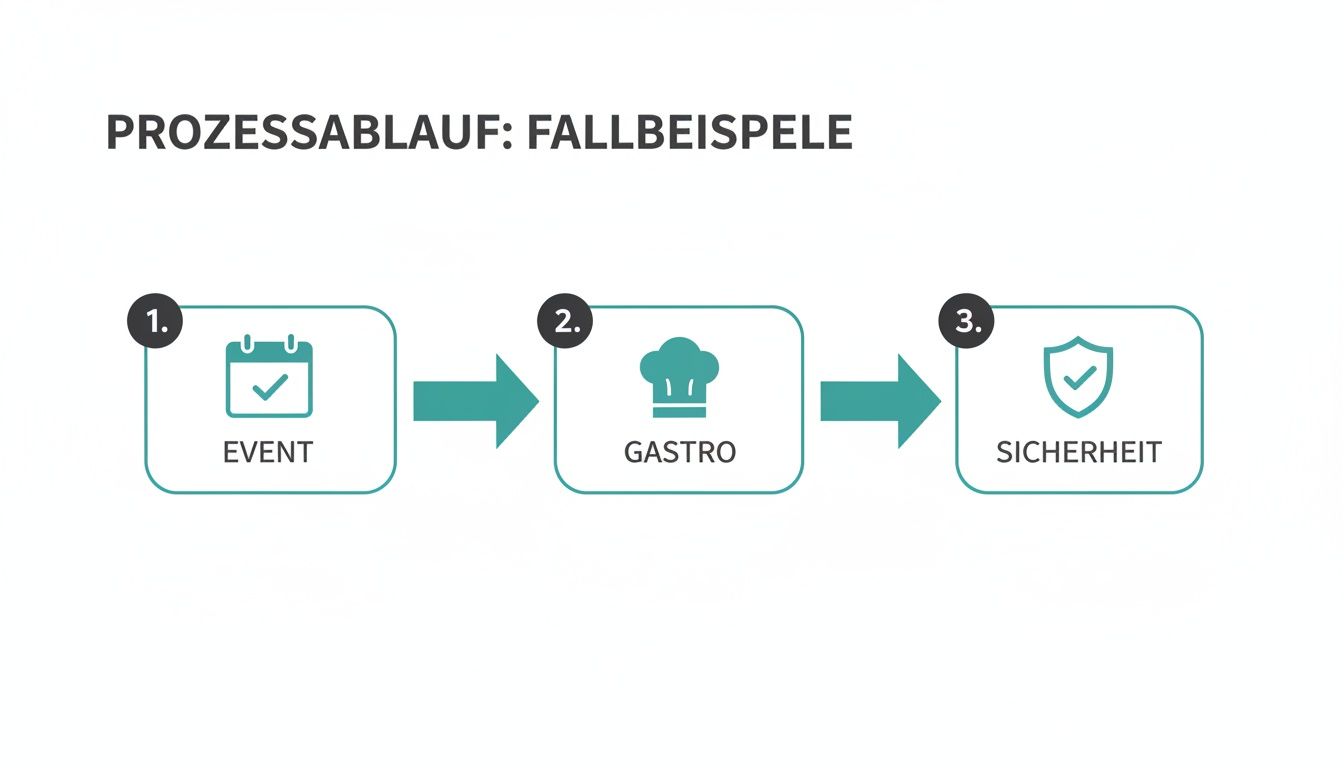
The procedure always follows the same pattern: dialogue, medical review, and written agreement. Only this way do you minimize risks for all involved.
Staff absences are a huge burden, especially for service-intensive industries. The absence rate in Switzerland was 3.4 percent in 2023. Particularly relevant for industries like logistics, cleaning, or hospitality: unskilled workers top the list with 4.3 percent. Sickness-related absences rose by a third to an average of 8.6 days per employee the year before last, with sectors like healthcare strongly affected at 8.3 days. More details can be found in the latest statistics on absence rates in Switzerland.
Important: Document every agreement about adapted work in writing. A simple email summarizing the discussed tasks and medical approval is often enough to be on the safe side in case of dispute.
Modern personnel planning tools help you cleverly cushion short-term absences. With flexible employee pools, you quickly close gaps and relieve pressure on the rest of the team. How to stay legally safe in the process is explained in our article on how to create legally compliant shift planning.
The Most Frequent Questions About Working Despite Sick Leave
The topic of working despite sick leave is a minefield full of uncertainties and legal pitfalls. Both employees and supervisors repeatedly face the same pressing questions. We shed light on them and give you clear, practical answers.
Do I Have to Tell My Employer the Reason for My Sick Leave?
No, you don’t have to. Your exact diagnosis is and remains private. The medical certificate confirms your inability to work and gives a prognosis on duration—nothing more. All medical details are subject to doctor-patient confidentiality and are none of your supervisors’ business.
However, open communication can sometimes work wonders. If you want to take on alternative, gentle tasks despite sick leave, it makes it easier for your employer to find suitable activities if they know the rough scope of your limitations. The decision about what and how much you share is always yours.
What Happens If I Work a Side Job While on Sick Leave?
This is an extremely delicate situation that can quickly lead to serious problems. The basic rule is the same as for your main job: The activity must not endanger or delay your recovery under any circumstances. For example, if you are on sick leave as a logistics worker due to back problems, heavy physical work in a side job is an absolute no-go.
A light office job you do from home could be allowed, however.
It is crucial that you inform your main employer about the side job. Ideally, have your doctor confirm that the side job is safe for your recovery. Acting on your own here risks severe labor law consequences, up to and including immediate dismissal.
Can My Employer Require Me to Work Despite Sick Leave?
A clear and unequivocal no. If there is a medical certificate classifying you as unable to work, your employer cannot force you to work. Sick leave is a medical instruction to rest, and your employer is obliged to respect this.
What they can do is offer you alternative, lighter tasks that do not hinder your recovery. You can accept this offer but do not have to.
Any pressure from the employer is inadmissible and violates their legal duty of care. The decision whether you can and want to work is yours alone—ideally in consultation with your treating doctor.
What Role Does Working from Home Play When Working Despite Sick Leave?
Working from home can be an ideal bridge to stay productive despite illness without risking recovery. The advantages are obvious:
- Infection protection: With contagious illnesses like the flu, you can work from home without endangering your colleagues.
- Rest: With physical limitations—such as a broken leg—the often difficult commute is eliminated.
Here too, the basic prerequisite remains the same: The work must be compatible with your health condition and your doctor must give the green light. A clear, preferably written agreement on the type and scope of tasks is also essential here to avoid misunderstandings and legal grey areas from the outset.
With job.rocks, you can easily manage flexible employee pools and respond to short-term absences without overloading your team. Plan and document assignments legally compliant and transparently. Visit https://job.rocks to learn how to optimize your workforce management.