Digitalization in HR: your path to modern personnel management
No more paperwork: that is what it feels like when your HR department finally takes the leap into digital. Imagine shedding administrative ballast and focusing on what really matters: your employees.
No more paperwork - that's what it feels like when you finally take the leap into digital in the HR department. Imagine being able to shed all the administrative burden and concentrate on what really counts: your employees. That's exactly the core of it Digitalization in Human Resources: switching from manual, often error-prone processes to intelligent, automated solutions that make your everyday work noticeably easier.
What digital processes in HR really mean
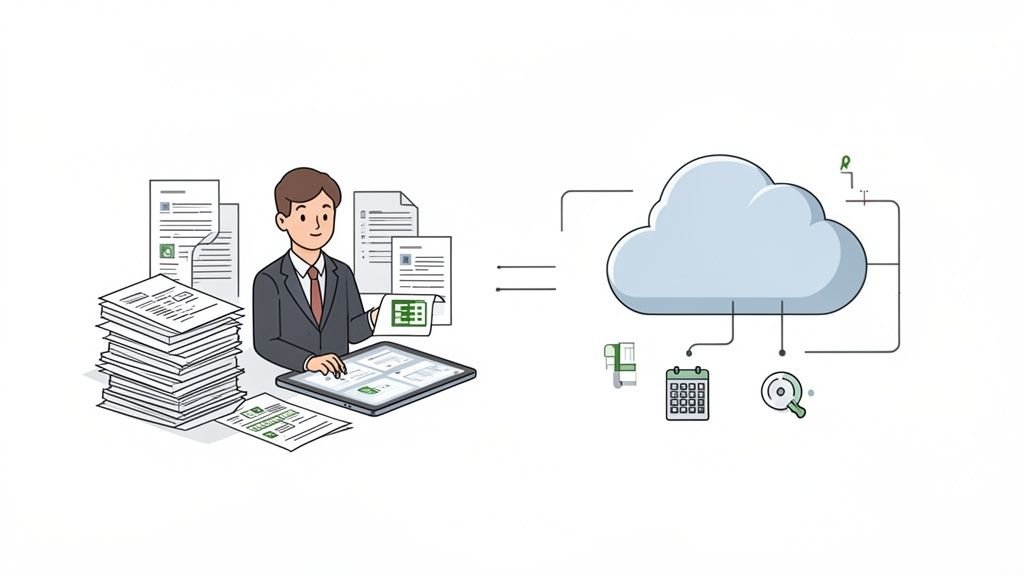
HR digitization is much more than just scanning old personnel files. It's about rethinking workflows from the ground up and supporting them with clever digital tools. Instead of laboriously sorting applications in a crowded email inbox, hunting for employee data in endless Excel lists and piecing together rosters by hand, you use a single, central platform.
This change brings structure into chaos. Let's take an event agency that coordinates hundreds of events every weekend. In the past, this meant countless phone calls, confusing tables and an enormous risk of planning errors. Today a digital solution does how job.rocksComplete coordination with just a few clicks – from quick availability queries to the final shift assignment.
From theory to practice: the status quo in Switzerland
This development has long been a reality. In Switzerland the degree of Digitalization in HR departmentsincreased rapidly in recent years. An insightful study from 2023 shows that around 59 percent of HR managershave experienced massive changes in the last three years.
Bet today 71 percent of HR departmentson digital solutions for your document management. Those surveyed clearly see the greatest and most direct benefit in administration (79 percent) and in recruiting (56 percent). If you want to delve deeper into the numbers: You can find more insights into HR digitalization in Switzerland here.
Digital change is primarily changing the central areas of your daily work:
- Recruitment:Instead of going through each application manually, a smart system pre-filters suitable candidates and automates all communication.
- Operations planning:You can create complex shift schedules simply using drag-and-drop, automatically taking qualifications into account and informing your team immediately about any changes.
- Time recording & payroll:Employees clock in their working hours using a mobile app. The result? An error-free and punctual payroll without any headaches.
To make the difference more tangible, let's look at a few typical HR processes in a direct before and after comparison.
Comparison of manual and digital HR processes
This table shows the direct difference between traditional, manual HR tasks and their digital, automated counterparts.
| HR process | Manual approach (before) | Digital approach (after) |
|---|---|---|
| Applicant management | View emails, keep Excel lists, send rejections/invitations manually | Automated pre-selection, central candidate pipeline, templates for communication |
| Operations planning | Telephone chains, confusing tables, high risk of double bookings | Drag-and-drop scheduling, automatic availability query, push notifications for changes |
| Time tracking | Paper timesheets, manual transfer to Excel, high risk of errors | Mobile time clock via app, live overview of working hours, direct export for payroll |
| Data maintenance | Physical personnel files, scattered information in various documents | Central, digital personnel file, all data in one place, GDPR-compliant storage |
| Communication | Circular emails, calls and information are often lost | Central dashboard, targeted messages to specific teams, all information understandable |
The contrast is clear: digital processes not only save time, but also minimize errors and create transparency that was unattainable with manual methods.
A look at the implementation
Modern platforms offer you a crystal-clear overview of all HR-relevant processes - from initial personnel planning to final payroll accounting.
Such dashboards bundle all important information and make the management of personnel and operations radically easier.
A central system not only helps you keep track of things, but also helps you easily comply with legal requirements such as the GDPR.
In the end, digitalization in human resources is about much more than just new software. It's about creating strategic freedom. When you spend less time on routine administrative tasks, you finally have more capacity for what makes your work valuable: personal support and the targeted development of your employees.
Discover the tangible benefits for your company
Switching to digital HR processes is much more than just a theoretical time saver. It's about tangible benefits that you and your team will immediately feel in everyday life. Instead of being slowed down by administrative work, you act faster, more precisely and more strategically.
A key benefit lies in speeding up the entire hiring process. From the tender to the acceptance, reaction times are reduced dramatically. This not only makes you a more attractive employer, but also ensures you have the best talent at the right time.
Faster filling of shifts
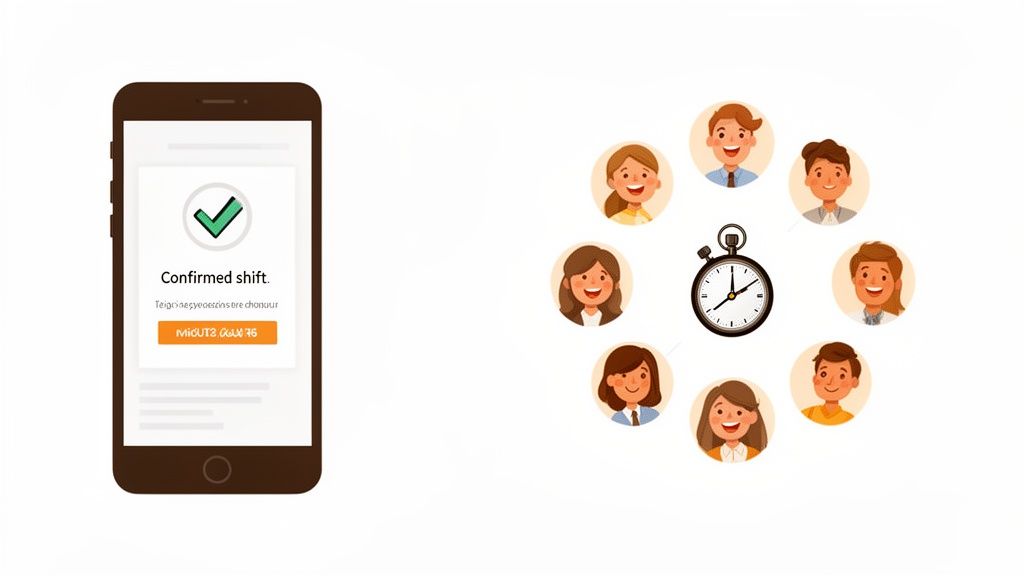
Imagine a hotel that needs staff at short notice for a large evening event. This used to mean countless calls and messages to find out who was available. A process that could last for hours.
Today things look completely different. With a modern HR solution, you send a single request to a pool of qualified employees. The system automatically collects feedback and you can see who can take over the shift within a few minutes. The occupation time drops from hours to minutes.
Digitalization in human resources transforms reactive problem solving into proactive planning. You no longer wait for feedback, but receive it in real time.
This speed is not only a decisive competitive advantage in the catering industry. It is worth its weight in gold in any industry that relies on flexible and responsive workforce planning.
Error-free processes and secure compliance
Another huge advantage: human errors are minimized and legal requirements are easily adhered to. Manual processes are a source of errors - transposed numbers on timesheets or forgotten entries can cause a lot of trouble in payroll accounting.
Digital tools create clear conditions here and bring security:
- Precise time recording:Employees clock their working hours via app. No more inaccurate, handwritten notes.
- Automated documentation:All working times, breaks and absences are recorded seamlessly and in accordance with the law. This way you are always on the safe side during exams.
- Correct salary preparation:The data flows directly into the payroll. This massively reduces the risk of expensive errors.
At the same time, transparent and flexible planning also improves employee loyalty. If your team can easily report availability, swap shifts and view schedules via an app, satisfaction increases noticeably. This clarity in communication is an often underestimated but extremely important factor for a motivated and loyal team.
Understand practical tools for everyday HR
Which digital tools really make a difference in everyday HR? Instead of talking about abstract concepts, let's now look at the concrete helpers that will really help you. There is now a smart solution for almost every area of your job that easily takes over time-consuming, manual tasks.
The first big chunk we're tackling is this digital recruiting. This is where so-called applicant management systems (ATS) come into play. Think of it like a personal assistant: Instead of wading through hundreds of emails, the system collects all applications centrally in one place. It helps you filter candidates, standardize communication, and keep the entire process transparent for everyone.
From planning to billing
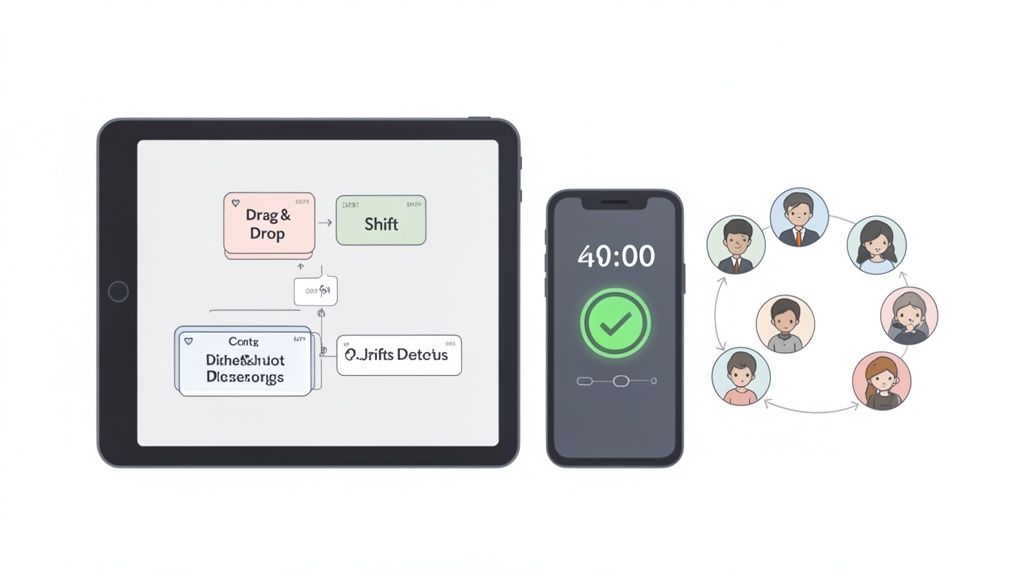
Once the right candidate has been found, the organization really begins. The Personnel deployment planningis often a huge time waster, especially if you work with flexible teams or in shifts. Instead of juggling endless Excel lists, you can easily plan operations in a visual overview using drag-and-drop.
A good planning tool automatically takes into account the qualifications and availability of your employees. This way you avoid double bookings and ensure that the right person is always in the right place.
Another central point is that digital time recording. Your employees can conveniently clock their working hours using an app on their smartphone. This is not only more accurate than any handwritten timesheet, but also creates the direct basis for correct payroll. The recorded hours can often be exported for payroll with just a few clicks.
The following table summarizes the most important digital helpers and their direct benefits for you.
Overview of digital HR tools and how to use them
| Tool category | Main function | Direct benefit |
|---|---|---|
| Applicant management system (ATS) | Centralizes applications and automates communication. | Faster time-to-hire, better candidate experience. |
| Personnel deployment planning | Visual planning of shifts and operations. | Less planning effort, error-free allocation. |
| Digital time recording | Accurately records working hours via app or terminal. | Correct payroll, less manual effort. |
| Payroll software | Automates payroll processing. | Reduces errors, ensures compliance. |
| Workforce Management System | Combines planning, time recording and wage preparation. | End-to-end process, 360° overview of the workforce. |
These tools are the building blocks that make your everyday HR life easier step by step.
Connected systems as the key to success
The greatest leverage arises when these tools do not exist in isolation from each other, but come together in a single platform. A comprehensive one Workforce management softwarelike job.rocks connects exactly these areas seamlessly.
The process then looks like this:
- Check availability:You send a request to your employee pool and immediately see who is available to work.
- Plan shift:You assign the shift with one click and everyone involved is automatically notified.
- Record time:Your team stamps the start and end of the assignment directly in the app.
- Prepare wages:The validated hours are exported and are ready for payroll accounting.
This consistent digital process without system breaks is the true core of a successful one Digitalization in Human Resources. This means you always have a full overview and can concentrate on strategic tasks instead of getting lost in administration.
Data protection in digital HR management: How to master the GDPR
As soon as you manage employee data digitally, you take on an enormous responsibility. The General Data Protection Regulation (GDPR) sets out crystal clear rules here. But don't worry, you don't have to be a lawyer to avoid the pitfalls and do everything right.
A classic mistake that happens every day is collecting application documents in a normal email inbox. This is not only chaotic, but above all a massive data protection risk. You immediately lose track of who has access to this sensitive data and – more importantly – when you actually have to delete it again.
Avoid risks and create security
Professional HR software takes exactly this burden off your shoulders. Good systems are designed from the ground up so that you meet legal requirements almost automatically. This particularly applies to sensitive topics Storage and deletion periods. A smart tool actively reminds you of this or – even better – deletes outdated applicant data fully automatically after a period of time that you define.
Another point that many overlook is the so-called Order processing agreement (AVV). This is the contract you sign with your software provider. It clearly regulates how your partner processes your data, protects it and where it stores it.
A reputable partner will always transparently show you how they ensure GDPR compliance. Ask specifically about the server location – ideally it is in the EU or Switzerland. This is the only way you can be sure that the highest protection standards apply.
Separate data cleanly and control access specifically
Especially in recruitment or in the event sector, it quickly becomes clear how crucial a well thought-out system is. Here you often juggle not just one, but many different candidate pools for countless customers. Clean, technical separation of this data is absolutely mandatory to prevent confidential information from being mixed up.
Modern platforms solve this with a sophisticated solution Roles and rights concept. This allows you to determine exactly who can see and edit which data with just one click. A recruiter for customer A has no technical way of viewing customer B's applicants.
These structured access rights are the heart of secure digital HR management. They give you back control and ensure that sensitive data remains confidential.
Interestingly, according to the Swiss HR Barometer 2020, whole 82 percent of employees see digitalization as a clear opportunity. At the same time, the study also shows that a high level of digitalization can reduce job satisfaction if the work-life balance suffers. Platforms that give employees more control over their own data and their deployment planning via self-service functions can create a positive balance and massively increase acceptance. Find out more about the connections between digitalization and job satisfaction in Switzerland here.
Your roadmap for a successful introduction
Introducing new software often feels like a huge project. However, with a clear plan it will be a complete success. This guide will take you step by step through the process and ensure that you and your team are on the right track from the start.
The first step is always an honest inventory. Take a close look at your current HR processes and ask yourself: Where is the most time lost? Which processes are particularly error-prone and always cause headaches?
Maybe it's the manual typing of timesheets into payroll or the endless back and forth when planning shifts. Write down these points - they are the starting point for everything else.
Define clear goals
Once you know your weak points, you can set specific, measurable goals. General resolutions like “get better” don’t help here. Be as specific as possible so you can actually measure success later.
Here are a few examples of clear goals:
- Reduce planning time:We want to reduce the weekly effort required to create rosters from the current 8 hours to less than 2 hours.
- Accelerate job filling:The average time to fill an open shift should be reduced from 48 hours to a maximum of 3 hours.
- Reduce error rates in payroll accounting:We aim to correct incorrect payslips due to incorrect time recording 90%to reduce.
Such goals give you clear direction. They will help you enormously later in choosing the right software because you know exactly which problems it has to solve for you. Learn how to do yours Digitize HR processescan to achieve these goals.
Pick up your team right from the start
The best software is of no use if no one uses it. That's why it's crucial to get your team on board from the start. Don't just explain whatchanges, but above all, why. Show how the new digital tools make everyday work easier for everyone: less paperwork, clearer communication and fairer, more transparent planning.
Plan training early and offer open question and answer sessions. Sometimes you encounter resistance, often out of insecurity or habit. Listen carefully to these concerns and take them seriously.
A security service has mastered this transition cleverly: instead of the new software for everyone 200 employeesto introduce it at the same time, he started with a small pilot team of 20 people. This team was able to test the software in practice, give valuable feedback and later act as ambassadors for their colleagues. This gradual rollout made the transition smooth and ensured a high level of acceptance across the company.
The following infographic shows a simple three-step process to safely implement digital HR systems while respecting data protection.
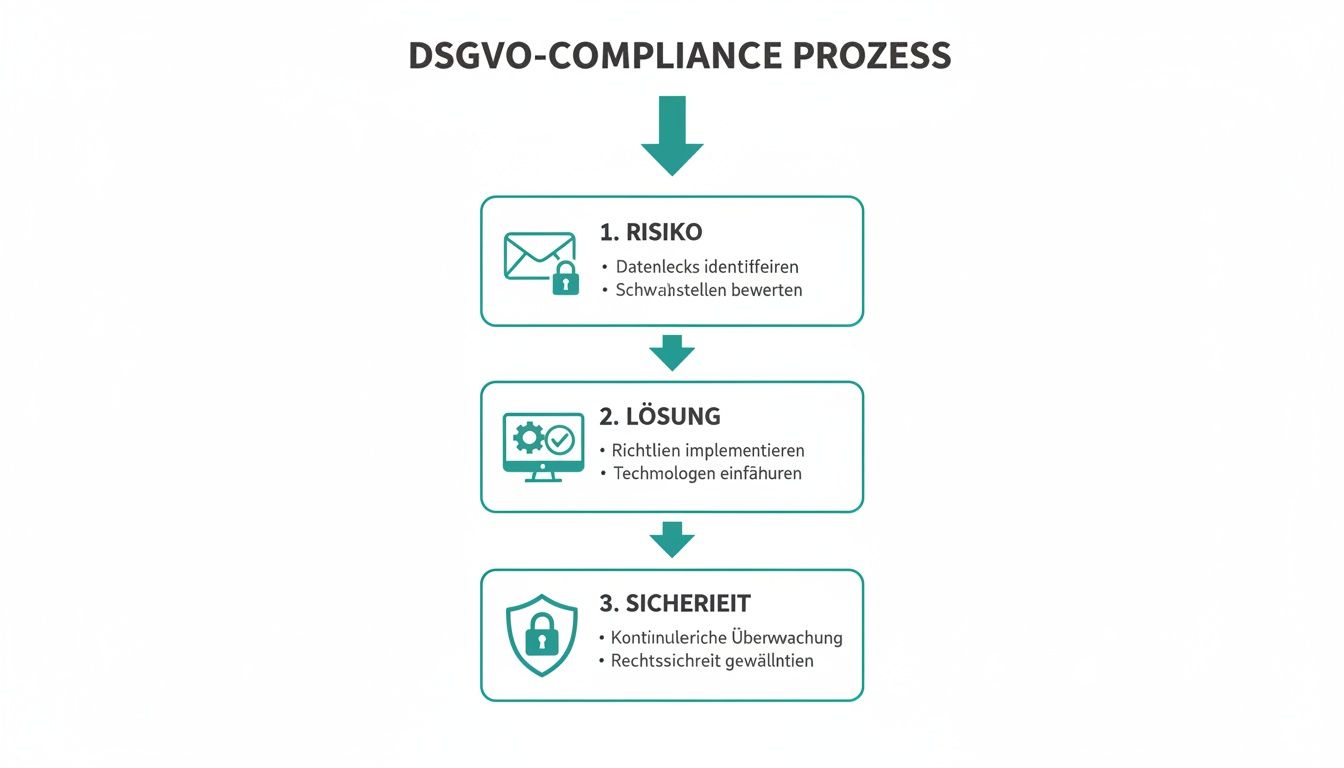
This visual representation makes it clear that the path to safety Digitalization in Human ResourcesStarts with the risk analysis, leads to choosing the right software solution and ends in a permanently secure system.
The Swiss labor market is already benefiting greatly from such developments. The SECO monitoring report 2022 shows that Switzerland is mastering the digital transformation, with an impressive employment rate of 83.7 percentin 2021. This shows how more flexible digital HR tools improve work-life balance.
Find the right HR software for your company
The market for HR software is huge and, to be honest, quite confusing. Fighting through this can quickly become overwhelming. But don't worry: by asking the right questions, you'll find exactly the solution that's perfect for your company, your industry and your goals.
Don't immediately get lost in endless feature lists. Focus on the big lines first. One of the most important questions is that of Scalability: Can the software grow with your business? A solution that works great for 20 employees today must still work in two years when you coordinate perhaps 100 or more people.
Your checklist for the right decision
For each software you shortlist, ask yourself the following questions. They are your compass to separate the wheat from the chaff and ultimately make an informed decision.
- Ease of use:Is the interface intuitive and clear? A complicated system that requires weeks of training for your team is simply not used in the hectic pace of everyday life. Point.
- Interfaces:Can the software be easily connected to your existing payroll or other systems? Manual data transfers are a source of errors Digitalization in Human ResourcesYes, you just want to avoid it.
- Support:Do you get quick and competent help if there is a fire? Especially in the initial phase, a reliable contact person is worth its weight in gold and ensures a smooth start.
- Industry-specific features:Does the software cover the specific requirements of your industry? An event service provider has completely different needs than a care service. The software must reflect this.
The best software is not the one with the most features, but the one that solves your biggest problems most easily. Concentrate on what really makes your everyday work easier.
A well thought out one HR software complete solutionshould help you overcome typical hurdles. Just think of the often nerve-wracking coordination of flexible employee pools, the seamless documentation of working hours to comply with legal requirements or the quick filling of shifts that are open at short notice.
This is exactly where platforms like job.rocks come into play. Instead of just managing data, they intelligently automate these core processes. This way you gain valuable time back and also create more security and flexibility for your entire team.
The most frequently asked questions about digitalization in HR
You now have a good overview of what digitalization means for your human resources. Finally, we will clarify a few questions that we often encounter in practice. This way you can clear up any remaining doubts and take the next steps confidently.
How quickly will I see results after implementation?
You often feel the first positive effects after just a few weeks. Administrative tasks in particular, such as shift planning or time recording, immediately become noticeably easier and faster. A small example: Instead of spending hours on the phone, you often fill an open shift digitally less than an hour. This isn't theory, it's practice.
Is the change also worthwhile for small companies?
Digitalization is a huge lever, especially for smaller companies. You probably don't have the resources for a large HR department. A lean software solution takes over the administrative tasks that keep you from the important things - namely your core business and your employees. So you not only save time, but you also professionalize your processes right from the start.
What costs will I incur?
Modern HR software is usually offered as a subscription model, too SaaS (Software as a Service)called. This means you pay a monthly or annual fee, which often depends on the number of your employees. This makes the costs absolutely predictable and you avoid high initial investments in expensive licenses or your own servers.
The biggest cost factor in the absence of digitalization is the hidden expenses: the countless hours spent on manual planning, correcting errors in payroll and the costs of high fluctuation due to dissatisfied employees.
How secure is my data in the cloud?
This is one of the most important questions of all. Reputable providers, especially those with server locations in Switzerland or the EU, are subject to the strictest data protection laws such as GDPR. All data is transmitted and stored encrypted. This is usually much more secure than local storage on an office PC, which is vulnerable to theft or a simple hard drive failure.
If you want to delve deeper into technical details, you can find more answers here: General Software FAQs.
Are you ready to take your HR processes to the next level and regain valuable time? job.rocksoffers you an intuitive and comprehensive solution for scheduling, time recording and wage preparation. Find out now how easy workforce management can be: https://job.rocks