
The 7 best employee review questions for flexible teams in 2026
The annual performance review is coming up and you're wondering how you can make it really valuable this time? Away from standard phrases and towards a real dialogue that will help you and your employees move forward. These conversations are often seen as a purely compulsory exercise, but they hold the opportunity...
The annual performance review is coming up and you're wondering how you can make it really valuable this time? Away from standard phrases and towards a real dialogue that will help you and your employees move forward. These discussions are often seen as a purely compulsory exercise, but they hold the opportunity to set the course for future success, motivation and stronger employee loyalty. The goal is to move from a pure evaluation monologue to a constructive, future-oriented exchange.
Especially in dynamic industries such as events, catering, security or healthcare, where flexible deployment planning and changing requirements are the order of the day, more than the usual questions are needed. A standardized questionnaire often falls short here and does not capture the specific circumstances and challenges that your employees encounter on a daily basis. It's about finding the right ones questions during employee interviews to truly understand your team's perspective and work together on solutions.
This article gives you exactly that: a collection of practical questions specifically tailored to the challenges of flexible teams. We'll show you how to use targeted questions to not only evaluate performance, but also increase motivation, improve processes and strengthen loyalty. In order to actually make employee reviews a turning point, the strategic use of modern solutions throughout the HR department is crucial, as demonstrated by effective strategies in the HR digitalization. For each question you will find concrete examples of wording, tips for conducting conversations and tips on how to document the results cleanly and in accordance with GDPR in order to achieve sustainable improvements.
1. How did you manage your availability and flexibility during this period?
This question is one of the most important Questions during employee interviews, especially in personnel-intensive industries such as the event industry, catering or security services. It aims to understand how proactively and reliably employees communicate their commitment and how they react to short-term changes in plans. The point is not to demand constant availability, but rather to evaluate the reliability of the planning basis.
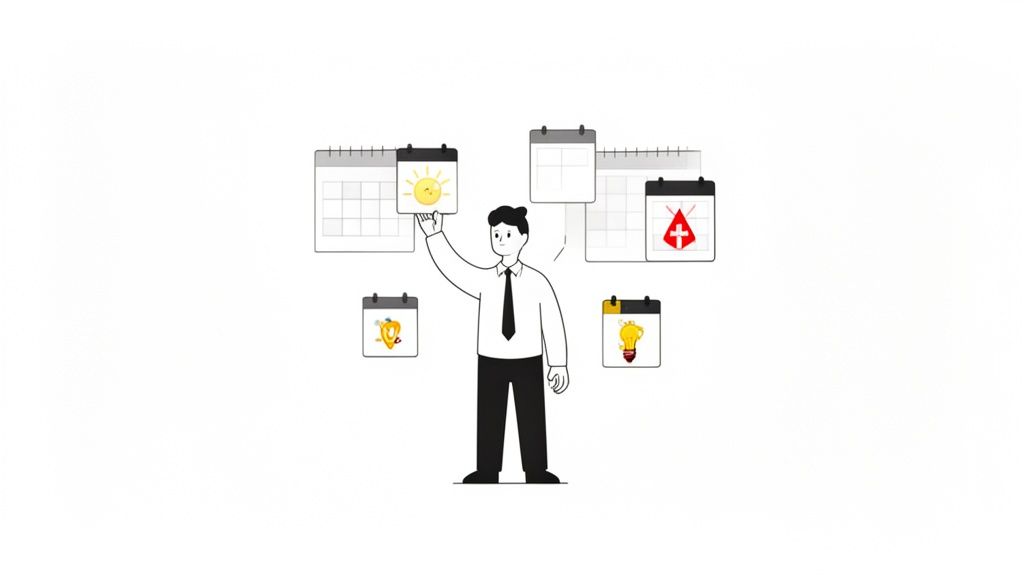
Transparent communication about availability is the basis for functioning and fair communication Roster creation with flexible working hours. If employees keep their data independently and up to date, this reduces administrative effort and prevents misunderstandings.
Why ask this question?
This question helps you assess several aspects of an employee's way of working:
- Personal responsibility: Does the person maintain their availability data independently and in a timely manner in the intended systems, for example in an employee app?
- Adaptability: How does the person deal with unforeseen changes in plans? Is she prepared to step in at short notice if there are bottlenecks?
- Communication skills: Are restrictions or requests communicated clearly and early so that planning can respond to them?
Tip: Use the objectively recorded data from your planning tool as a basis for discussion. Statements like, "I've noticed that for the last three months you've been updating your availability a week in advance. This helps us tremendously with our planning." show appreciation and are based on facts.
Concrete formulations and examples
Instead of just asking a general question, you can make the question more specific depending on your industry:
- Event industry: "There was a short-term extension at the X Festival. How did you deal with it when we were looking for additional helpers for the last shift?"
- Gastronomy: "We had several sickness absences in the service last month. How did you signal your willingness to alternate between lunch and evening shifts during this time?"
- Security: "There was a spontaneous emergency response last weekend. How do you ensure that we can reach you in such cases and know your current availability?"
Action derivations and follow-up
The answers to this question should lead to concrete actions:
- Positive feedback: Expressly praise proactive behavior and flexibility. Maybe combine this with small incentives such as preferred assignment to popular shifts or a bonus.
- Offer support: If an employee has difficulty maintaining their availability, ask why. Is it because of the technology? Are there private circumstances? Offer training for the app or flexible solutions.
- Define goals: Agree on clear expectations for the future. An example: “Let’s agree that you always enter your availability for the following month by the 25th of the previous month.” Document this in the interview minutes.
2. How did you meet the demands of your role and what challenges did you face?
This question is a classic among the Questions during employee interviews and is used to evaluate performance in practice and uncover operational hurdles. It is particularly insightful in dynamic work environments with changing tasks and shifts. It helps to understand whether the assigned roles and the actual skills of the employees match and where there are problems in the daily routine.
The answers give you direct insights into the fit between the job profile and reality. This way you can see whether qualification filters are working properly in personnel deployment planning or whether there are systemic problems that are preventing your employees from fully developing their potential.
Why ask this question?
This question opens the conversation to an honest inventory of daily work and highlights several important points:
- Role fulfillment: How well does the person understand and perform the core tasks of their assigned role?
- Problem identification: What specific obstacles arise at work? Is it a lack of resources, unclear instructions or deficiencies in the processes?
- Solution competence: Does the person proactively think about solutions and offer their own suggestions for improvement?
- Qualification check: Does the task profile still match the skills and level of development of the employee?
Tip: Prepare by reviewing shift details and mission logs. If an employee was repeatedly assigned to a specific task, you can ask specifically about their experiences. During the conversation, clearly distinguish between personal challenges and systemic problems that could affect the entire team.
Concrete formulations and examples
Tailor the question to your industry to get tangible and relevant answers:
- Event service provider: "You were responsible for promoting the new drink at the last three events. What information were you missing in order to confidently communicate the product benefits, and what helped you?"
- Hotel industry: "In housekeeping, we often had time pressure during the morning shifts. What specific challenges did you encounter when cleaning the rooms, for example when replenishing materials?"
- Healthcare: "Staffing has been tight on night shifts recently. How has this affected your ability to meet nursing requirements and where do you see room for improvement?"
- Security: "There were teething problems when using the new monitoring software. Which functions were unclear to you and what would have helped you to get used to it more quickly?"
Action derivations and follow-up
The insights gained should lead directly to measures:
- Take up suggested solutions: If an employee mentions specific ideas, such as better material organization or a checklist for new products, check their feasibility and provide feedback.
- Determine training needs: If it becomes apparent that knowledge or skills are missing, this is a clear indication for targeted training. This can be product training, software training or a communication workshop.
- Adjust processes: If certain challenges repeat themselves among several employees, there is often a systemic problem. Use this feedback to improve workflows, communication or resource allocation.
- Re-evaluate roles: If a person is consistently over- or under-challenged, discuss possible adjustments to the role or future deployment planning. Document the points discussed and agreed steps in the minutes.
3. How did you ensure accuracy and compliance with time tracking?
This is one of the central ones Questions during employee interviews, because precise time recording is the foundation for correct payroll and compliance with legal requirements. The question aims to understand the employee's awareness and care when documenting their work and break times. It's about ensuring that the data collected is reliable and allows for a seamless handover to payroll.
Accurate and legally compliant recording is not only an administrative obligation, but also a question of fairness towards everyone involved. Incorrect data leads to additional work, potential wage adjustments and legal risks. This becomes particularly relevant in the case of Working time recording according to L-GAV, where strict rules apply.
Why ask this question?
With this question you assess crucial aspects of an employee's way of working:
- Care and accuracy: Does the person clock the start of work, breaks and end of work consistently and correctly? Are overtime or special bonuses recorded properly?
- Sense of responsibility: Does the person understand the importance of accurate data capture for their own payroll and for the company?
- Compliance with rules: Does the employee adhere to the internal and legal requirements for time recording, including compliance with break times and data protection regulations (GDPR)?
Tip: Use the evaluations and change logs from your time recording system as a basis for discussions. A statement like "I see in the logs that you regularly validate your hours at the end of the day. This helps us tremendously in avoiding errors in payroll." shows that you notice and appreciate accurate work.
Concrete formulations and examples
Formulate your question in such a way that it directly relates to the employee's daily work:
- Event industry: "You worked at three different events last week. How did you ensure your work hours were accurately recorded for each location?"
- Gastronomy: "It's often hectic in service. How do you go about booking your break times correctly in the system, even when there's a high volume of guests, so that the payroll is correct?"
- Security: "When you patrol multiple locations, you use GPS-based time recording. How do you ensure that check-in and check-out at each property is documented completely?"
Action derivations and follow-up
The answers should lead to clear agreements and actions:
- Positive feedback: Praise conscientious employees for their accuracy. Emphasize how their reliability makes payroll work easier and ensures fairness in the team.
- Offer support: If errors occur during recording, ask why. Is it unclear how to use the app? Are there any technical problems? Offer short follow-up training or step-by-step instructions.
- Define goals: Set clear expectations for the future. An example: “Let’s agree that you will always correct missing entries by the following morning.” Record this agreement in the minutes of the conversation.
4. How did you communicate with your team and your superiors when working together?
This question is one of the central ones Questions during employee interviews, because it highlights teamwork and communication skills. In dynamic work environments where teams are spread across different shifts, locations and assignments, clear and proactive communication is crucial for smooth operations. It's about understanding how actively a person seeks out information, shares it, and contributes to problem-solving within the team.
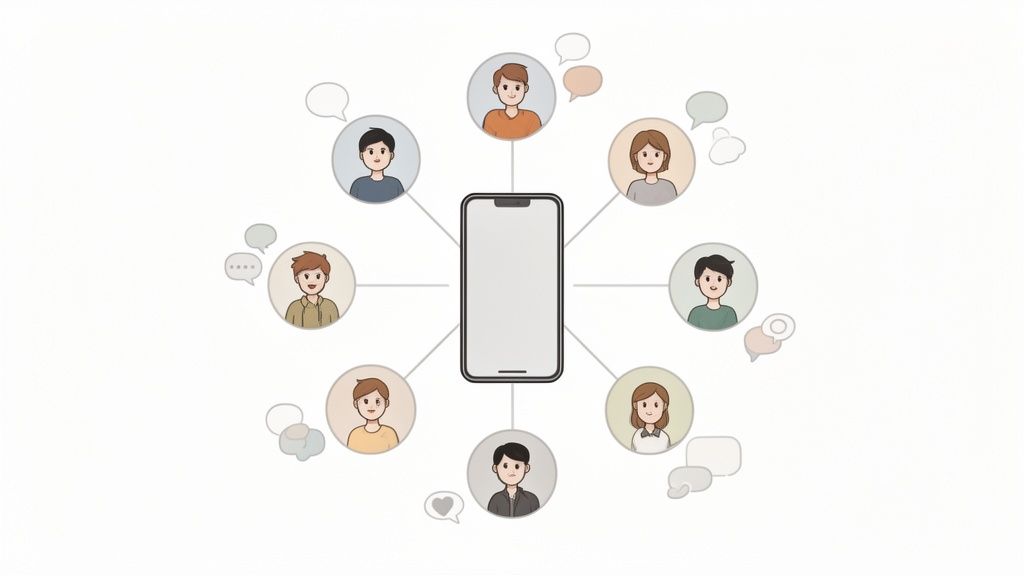
A functioning team relies on relevant information reaching the right people in a timely manner. Using established channels, such as an employee app, ensures that everyone is on the same page and avoids misunderstandings.
Why ask this question?
With this question you assess important aspects of the collaboration:
- Teamwork skills: How well does the person integrate into the team? Is information actively shared or only passed on upon request?
- Proactivity: Does the employee speak up independently if details are unclear, or do they wait until problems arise?
- Conflict resolution: How does the person deal with discrepancies or gaps in information? Does she address them directly or ignore them?
- Use of tools: Are the intended communication channels such as chat functions or notification systems used consistently and correctly?
Tip: Prepare concrete situations from the past. Questions like "I remember the deployment at customer Y where the instructions changed at short notice. How did you ensure that your entire team received the new information?" are more effective than general inquiries.
Concrete formulations and examples
Tailor your question to the specific challenges of your industry:
- Event industry: "Before setting up for the city festival, the final locations of the tents were unclear. How did you communicate with the team leader to get the necessary information before the start of the shift?"
- Hotel & Gastronomy: "There was a guest complaint in housekeeping regarding a forgotten special request. How do you coordinate your team via the app to process such special requests reliably?"
- Security: "You discovered a potential security vulnerability during your patrol. How exactly did you report this observation to the shift leader and subsequent team?"
Action derivations and follow-up
The answers should lead to clear next steps:
- Reinforce positive behavior: Praise employees who communicate proactively and in a solution-oriented manner. Highlight examples where their clear communication prevented a problem.
- Set guidelines: If communication is inconsistent, establish clear guidelines. Determine which channel should be used for which type of information (app for urgent shift changes, email for general information). You can also find useful information about this in our Guide to Text Messaging in the Workplace.
- Recognize training needs: Offer training for the communication tools if you notice that employees are unsure about using them. Sometimes it's just a small technical hurdle.
- Formulate goals: Agree on specific communication goals. An example: “Let us note that if you are unsure about an assignment, always use the chat function directly to contact the project manager.”
5. How did you manage your scheduling and work-life balance?
This question brings into focus a central issue in modern working environments: the well-being of employees. It is one of the crucial ones Questions during employee interviews, because it shows how well a person is able to balance professional requirements with private needs. The point is not to evaluate the private lifestyle, but to understand whether the person uses the planning tools provided to actively ensure recovery and prevent burnout.
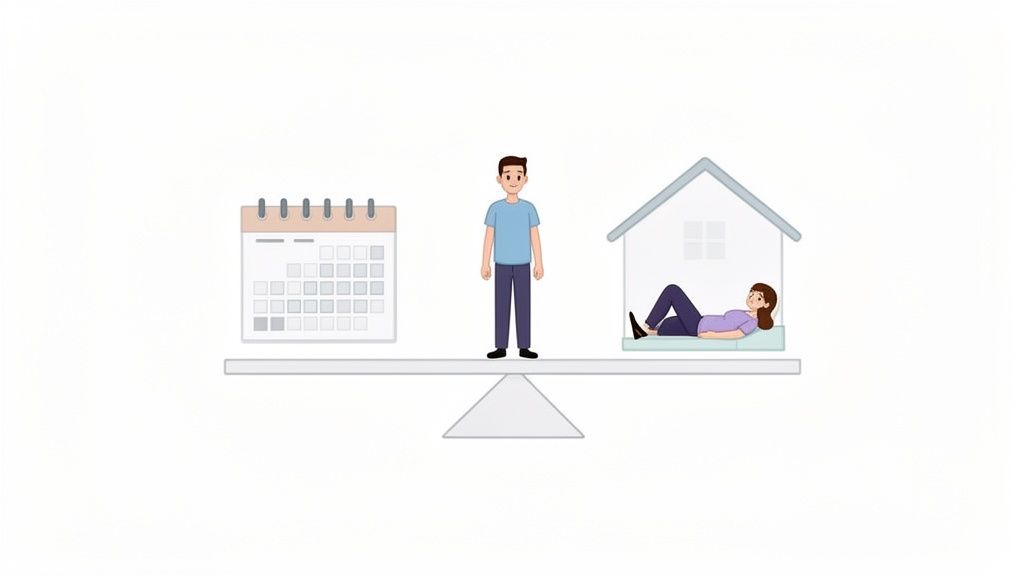
A healthy work-life balance is not just a private pleasure, but rather a basis for long-term performance and job satisfaction. Employees who consciously plan their breaks and days off are often more focused, motivated and resilient to stress. Effective management of work-life balance often requires knowing and actively managing your own stress levels, as a look at them Effects of high cortisol levels shows how prolonged stress affects well-being.
Why ask this question?
This question will help you understand your employee's self-care and planning maturity:
- Self-management: Does the person use functions such as availability planning or shift swapping to actively create recovery phases and avoid overload?
- Planning ahead: Are rest periods and personal appointments planned for the long term, or does the person only react reactively to states of exhaustion?
- Awareness of your own limits: Does the employee recognize when a break is necessary and communicate this proactively instead of failing?
Tip: During the conversation, emphasize that the company actively supports a healthy balance. Statements like "I noticed that you specifically planned two quieter weeks after the intensive project last month. We think that's very responsible." create a positive and trusting atmosphere.
Concrete formulations and examples
Tailor the question to the specific challenges of your industry:
- Gastronomy: "In the high season we had a lot of double shifts. How did you manage to recover sufficiently in between and consciously plan your rest days?"
- Healthcare: "Switching between day and night shifts can be very demanding. What strategies have you developed for yourself to stabilize your sleep rhythm and stay fit?"
- Event industry: "After big festivals there is often a quieter period. How do you use this time to regenerate and how do you plan this using the availability function in our app?"
- Logistics: "Some tours have long travel times. How do you ensure that you take your statutory breaks and maintain the balance between driving and rest times?"
Action derivations and follow-up
The answers should serve as a basis for joint action:
- Recognition and appreciation: Praise employees who manage their work-life balance in an exemplary manner. This underlines the importance of the topic in the corporate culture.
- Offer resources: If someone is struggling to find balance, offer support. These can be workshops on stress management, flexible working time models or just a listening ear.
- Set clear boundaries: Define clear rules together, for example a maximum number of consecutive shifts or a minimum rest period. Record this in the minutes of the conversation: “We agree that after a deployment of more than five days in a row, there will be at least two days off.”
6. How did you ensure quality and customer satisfaction in your assignments?
This question is one of the central ones Questions during employee interviewswhen it comes to service and customer-oriented industries such as hospitality, event services or security services. It checks whether employees not only know your company's quality standards, but also implement them consistently and independently in practice. It is about assessing the ability to deliver a consistently high quality of service that directly contributes to customer satisfaction.
The answer tells you how strongly a person identifies with the company's goals and whether they show initiative to solve problems and actively improve the customer experience. This is crucial for your company’s reputation and long-term customer loyalty.
Why ask this question?
This question helps you assess an employee's performance from different perspectives:
- Understanding of quality: Does the person have a clear understanding of what “high quality” means in their role? Does she know the specific standards and expectations?
- Personal initiative: Does the person wait for instructions or proactively identify opportunities to improve service quality or resolve issues before they escalate?
- Customer orientation: Does the person show empathy and professionalism in direct customer contact? How does she deal with feedback or difficult situations?
Tip: Integrate customer feedback directly into the preparation for the conversation. Quotes from positive reviews or specific praise from customers are an excellent, fact-based basis. A statement like: "Customer Y's event manager specifically praised us for your professional demeanor. What exactly did you do in this situation?" makes the recognition tangible.
Concrete formulations and examples
Tailor the question to the specific work area to get relevant and detailed answers:
- Event promotion: "You received excellent feedback on your product knowledge during the product demo for customer Z. How do you prepare so that you can answer customer questions so competently?"
- Gastronomy/Hotel: "Several guest reviews have highlighted the special attention to detail in the rooms you manage. Can you give me an example where you went the extra step?"
- Security: "There was an unclear situation at the entrance to the X concert. How did you proceed to clarify the situation professionally and at the same time ensure a positive feeling among the guests?"
Action derivations and follow-up
Use the answers to derive concrete measures and promote development:
- Recognition and best practice sharing: Praise outstanding performance and ask the employee whether they would be willing to share their approach as a best practice example within the team. This promotes the exchange of knowledge.
- Offer targeted training: If you identify gaps in your understanding of quality or certain skills, offer targeted training. This can be product training, communication training or de-escalation courses.
- Define goals for quality: Set clear and measurable goals for the coming period. An example: “Let’s set a goal that you actively collect feedback from at least five customers in the next quarter to identify areas for improvement.” Put this agreement in writing.
7. How did you deal with changes and new processes?
In an environment that is constantly evolving technologically, this question is crucial. It is one of the central ones Questions during employee interviews, because it tests your employees’ ability to adapt and learn. This is particularly important if you use digital tools like job.rocks, which regularly release new features, improved processes or updates for shift planning and time tracking.
The question aims to understand how employees react to new things. Do they approach new software features with curiosity or do they react with resistance? How quickly do they adapt to changing work processes? The answers give you information about the future viability and development potential of each individual in the team.
Why ask this question?
With this question you assess several key competencies that are essential for success in dynamic industries such as catering or events:
- Adaptability: How quickly does the person find their way around new systems or processes, for example when updating the employee app?
- Willingness to learn: Does the person show initiative to familiarize themselves with new tools? Does she take advantage of any training or guidance offered?
- Problem-solving skills: How does the person deal with initial difficulties or confusion? Does she actively look for solutions or does she give up quickly?
- Feedback culture: Does the person provide constructive feedback on new processes that can help improve?
Tip: Prepare the conversation by collecting concrete examples of recently implemented changes. A statement like: "I saw that you were one of the first to use the new 'shift swapping' feature. What was your experience with it?" shows that you are attentive and value proactive behavior.
Concrete formulations and examples
Instead of remaining general, make the question tangible using real situations:
- Event industry: "We recently introduced the new skills filter in the app to find the right people for specific tasks. How did you cope with storing and updating your skills there?"
- Gastronomy: "With the last app update, the process for clocking in and out changed slightly. Were there any hurdles for you and how did you solve them?"
- Security: "After the new time tracking rules were introduced, everyone had to keep records more accurately. How did you ensure you met the new compliance requirements?"
Action derivations and follow-up
The answers should serve as a basis for targeted measures:
- Positive feedback: Praise employees who quickly adopt new processes and provide constructive feedback. Consider rewarding these early adopters by using them as mentors to others.
- Offer support: If someone has had difficulties, ask why. Were the instructions unclear? Was there no time for training? Offer targeted support, be it through a short video tutorial, personal instruction or FAQ guides in the app.
- Define goals: Agree on specific expectations. An example: "Let's make it a point to familiarize yourself with the next major feature update within the first week. If you have any questions, reach out to me directly." Record this in the minutes of the conversation.
7-point comparison: Questions in an employee interview
| Question/topic | Implementation complexity 🔄 | Resource requirements ⚡ | Expected results ⭐📊 | Ideal use cases 💡 | Key benefits ⭐ |
|---|---|---|---|---|---|
| How did you manage your availability and flexibility during this period? | Low–Medium: App integration required | Low: Mobile data + monitoring | ⭐⭐⭐: Better planning, short-term availability 📊 | Events, hospitality, security services | Identifies flexible top performers; promotes personal responsibility |
| How did you meet the demands of your role and what challenges did you face? | Medium: qualitative evaluation required | Means: operational protocols + conversations | ⭐⭐: Training needs & matching optimization 📊 | Roles with specific qualifications (nursing, technology, event) | Reveals skills gaps; improves deployment planning |
| How did you ensure time tracking accuracy and compliance? | Medium: Set up compliance processes | Means: technology + regular training | ⭐⭐⭐⭐: Payroll accuracy, GDPR compliance 📊 | Payroll-critical areas (security, logistics, hospitality) | Minimizes wage disputes; ensures GDPR compliance |
| How did you communicate with your team and your superiors when working together? | Low–Medium: Define and use channels | Low-Medium: Notification system & training | ⭐⭐⭐: Faster escalation, clearer coordination 📊 | Decentralized shift teams, promotion, event teams | Closes communication gaps; promotes proactive problem solving |
| How did you manage your scheduling and work-life balance? | Means: Policy + self-service coordination | Medium: Manager check-ins + app data | ⭐⭐⭐: Higher retention, less burnout 📊 | Industries with intensive shift cycles (catering, care, events) | Promotes long-term satisfaction; reduces sick days |
| How did you ensure quality and customer satisfaction in your assignments? | Means: feedback and evaluation processes | Means: customer feedback channels + training | ⭐⭐⭐⭐: Better customer reviews, consistent performance 📊 | Customer-oriented assignments (hotel, service, promotion) | Identifies quality champions; improves matching |
| How did you deal with changes and new processes? | Medium: Change management required | Medium-High: Training, support, documentation | ⭐⭐⭐: Faster adaptation, less resistance 📊 | SaaS updates, new time tracking rules, feature rollouts | Identifies change champions; shortens adoption time |
Your next step to better conversations
The right ones Questions during employee interviews is more than just a formal exercise, it is the core of an appreciative and productive working relationship. As this article has shown, it's not about checking off a checklist. Rather, through targeted, open questions, you create a space for real dialogue in which your employees feel heard and understood. The quality of your conversations determines the quality of collaboration, the motivation in the team and the success of your projects.
A well-conducted appraisal interview is an investment that pays off many times over. It provides you with invaluable insights into the perspective of your team members, uncovers hidden challenges and shows untapped potential. The collections of questions presented here for annual, feedback, development and even exit discussions are your toolbox for making these conversations targeted and effective.
From knowledge to action: implementing the findings
The most valuable question remains ineffective if the answer is not followed by action. The real difference comes after the conversation.
- Listening and understanding: The most important skill is active listening. Try to really understand what is being said between the lines. Is it about a specific process weakness, unclear communication or personal development goals? Write down key points and ask questions to avoid misunderstandings.
- Joint action plans: Develop concrete, measurable and time-defined steps from the results of the conversation. Who will do what by when? An example: If an employee expresses the desire to take on more responsibility in event planning, a first step could be to actively involve them in the next location search and to entrust them with coordination with a supplier.
- Transparent documentation: Clean, GDPR-compliant documentation is essential. It creates commitment and serves as a basis for future discussions. Record in writing which goals have been agreed and what support you as a manager promise. This protects both sides and makes progress visible.
An employee appraisal is not a test, but rather a joint assessment of the situation. The goal is not to find mistakes, but to pave paths for mutual growth.
The cycle of feedback and improvement
Don't view the performance review as an isolated event, but rather as a central part of a continuous feedback culture. The insights from a conversation should flow directly into your processes. For example, if several healthcare workers report unclear handover protocols during shift changes, this is a clear signal that this process needs to be reviewed and standardized.
The adaptation of the Questions during employee interviews to specific industries such as gastronomy, security or event management is the key to success. A question about de-escalation in stressful situations is relevant for security personnel, while for a wedding planner the question of how to deal with demanding customer requests could be in the foreground.
By asking regular and structured questions, you show your team that their opinion counts and that they can actively shape the company's development. This participatory approach strengthens loyalty, reduces turnover and creates a work environment in which people want to develop. Your willingness to listen and act on what is said is the strongest signal of appreciation you can send. Make every conversation an opportunity to demonstrate your leadership skills and strengthen your team for the future.
Are you ready to take your employee reviews and overall HR planning to the next level? job.rocks offers you the right tools to efficiently prepare and document conversations and transfer the resulting tasks directly into operational planning. Simplify your processes and create more time for what really counts: your employees. Discover now job.rocksHow you can sustainably improve your team communication.