
Gen Z and the future of work: Flex Work Study 2026 shows a radical shift in attitudes to work
Study at a glance: the Flex Work Study 2026 (n=141, DACH region, ages 18–29) shows that 85% of Gen Z can imagine project-based work. Pay and flexibility are the top priorities.
Study at a glance: The Flex Work Study 2026 (n=141, DACH region, 18-29 years) shows: 85% of Gen Z can imagine project-based work. Salary (28.8%) and flexibility (25.6%) are the top priorities. Almost half would sacrifice money for freedom.
job.rocks AG (2026): Flex Work Study 2026 - Work attitudes of Generation Z in German-speaking countries. n=141, survey period: 16–22. January 2026.
Study profile
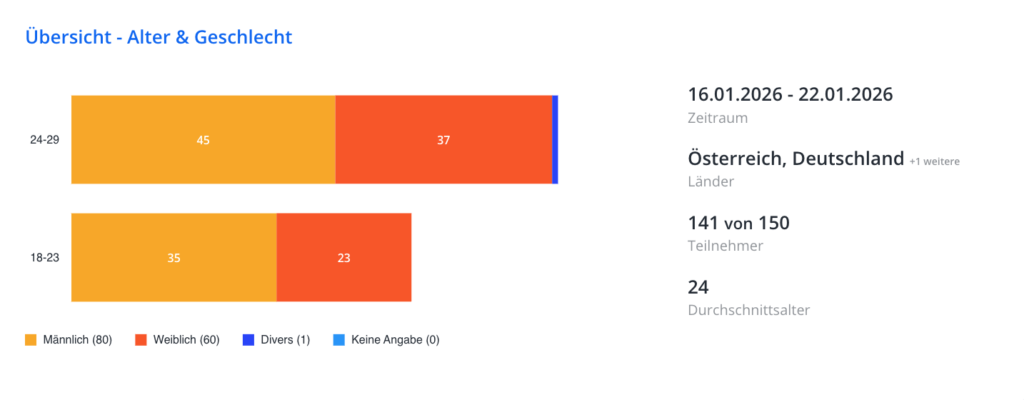
The present study was carried out by job.rocks AG in January 2026 and surveyed 141 young adults aged 18 to 29 from German-speaking countries (Germany, Austria, Switzerland). The average age of the respondents was 24 years. The gender distribution included 80 male, 60 female and 1 diverse participant. The survey period extended from January 16 to 22, 2026
| attribute | Value |
| Study title | Flex work survey |
| Implementation | job.rocks AG |
| Survey period | 01/16/2026 – 01/22/2026 |
| Number of participants | 141 |
| Target regions | Germany, Austria, Switzerland |
| Age group | 18-29 years |
| Average age | 24 years |
Central results at a glance
The study reveals a fundamental change in Generation Z's work expectations. The traditional idea of a permanent 9-to-5 job is increasingly losing its appealflexible working modelsand project-based deployments are becoming increasingly important.
Study at a glance:The Flex Work Study 2026 (n=141, DACH region, 18-29 years) shows: 85% of Gen Z can imagine project-based work. Salary (28.8%) and flexibility (25.6%) are the top priorities. Almost half would sacrifice money for freedom.
Finding 1: Salary remains the most important factor, but flexibility follows closely
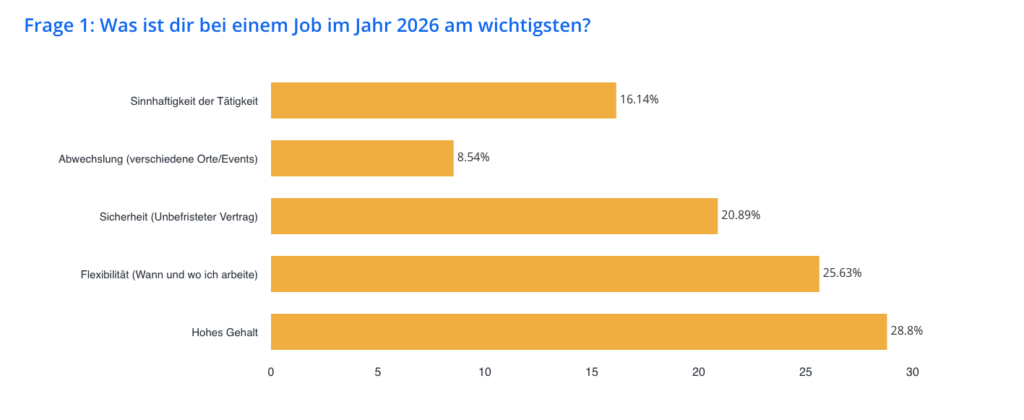
When asked what is most important for a job in 2026, a differentiated set of priorities emerges. Salary is at the top of the preferences at 28.8%. This is immediately followed by flexibility in terms of working hours and place of work at 25.63%. The security provided by a permanent contract reached 20.89%, while the meaningfulness of the job was a priority for 16.14% of those surveyed. Variety through different places and events plays a central role for 8.54%.
This distribution makes it clear that monetary aspects remain relevant, but no longer the only oneMotivatoract. The combination of financial compensation and self-determination in terms of time and location shapes the ideal image of an attractive workplace for this generation.
Finding 2: Massive openness to project-based work
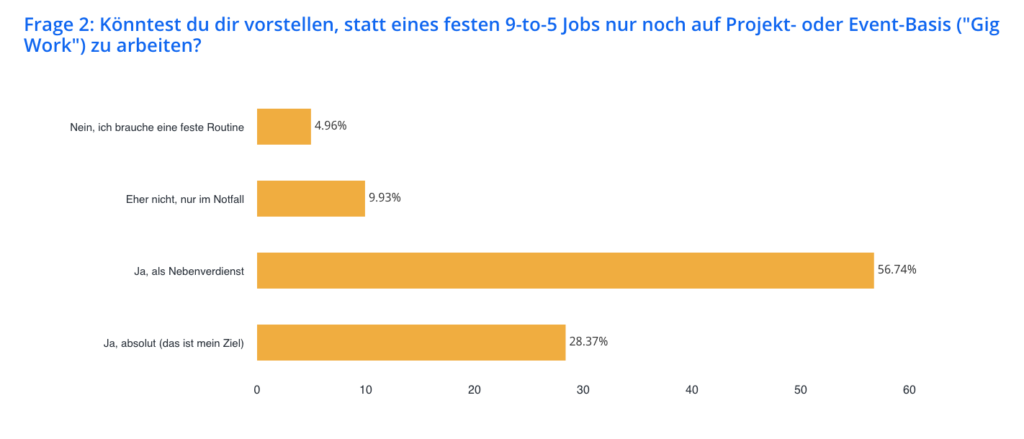
A particularly meaningful result comes from the question of the conceivability of working exclusively on a project or event basis instead of a fixed 9-to-5 job. The numbers speak for themselves: more than 85% of those surveyed can imagine such a working model.
In detail, it can be seen that 28.37% of participants describe project-based work as their declared goal. The largest group with 56.74% can imagine this form of work as additional income. Only 9.93% would only resort to flexible deployments in an emergency, while only 4.96% stated that they needed a fixed routine.
These results mark a paradigmatic shift in work mentality. Classic full-time employment is losing its status as the only desirable employment model. Stattdessen gewinnen hybride Erwerbsbiografien an Akzeptanz, in denen feste Anstellungen mit flexiblen Projekteinsätzen kombiniert werden.
Finding 3: The perceived benefits of event-based work
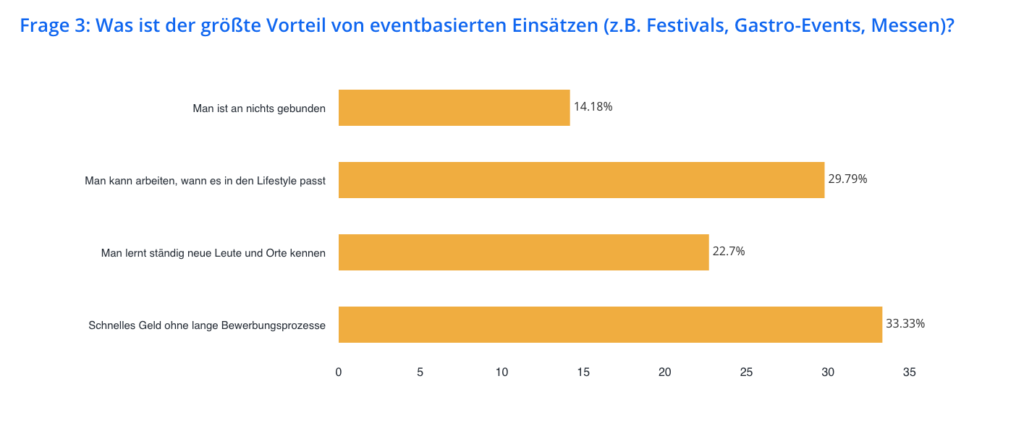
When evaluating the greatest advantages of event-based operations such as festivals, catering events or trade fairs, four main aspects emerge. Quick earnings without lengthy application processes are at the top with 33.33%. The ability to work when it fits into your own lifestyle reaches 29.79%. Getting to know new people and places motivates 22.7% of those surveyed. The freedom of not being tied to anything is the decisive factor for 14.18%.
These results show that theGeneration ZEvent-based work is not viewed as an emergency solution, but rather as a conscious decision for more autonomy and lifestyle compatibility. Direct access to earning opportunities without bureaucratic hurdles corresponds to the desire for immediacy and self-determination.
Finding 4: The flexibility-salary trade-off
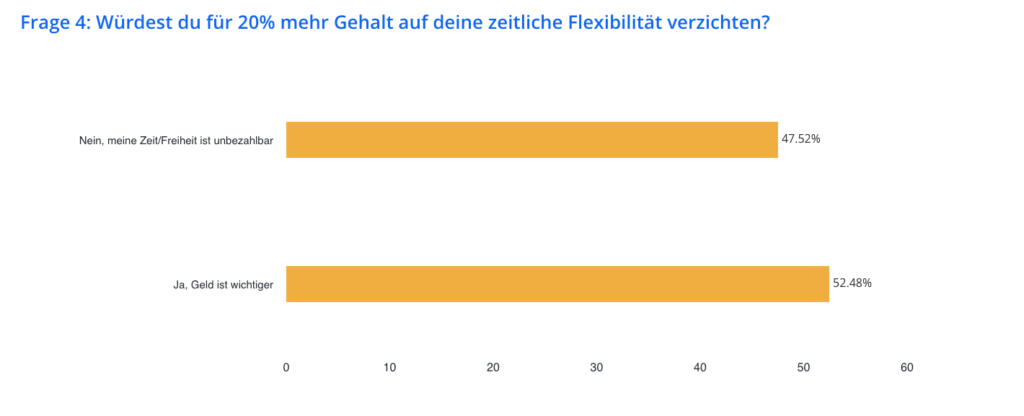
A particularly insightful question confronted the participants with a trade-off: Would they give up time flexibility for 20% more salary? The answers are surprisingly balanced.
A narrow majority of 52.48% would give up flexibility for the higher salary. In contrast, there are 47.52% for whom time and freedom are priceless. This almost equal distribution underlines the high importance that flexibility has for this generation. Almost half of young adults would forego a significant financial advantage in order to maintain their own time autonomy.
For employers, this means that purely monetary incentives are no longer sufficient to attract and retain qualified young specialists. Flexible working models are becoming a key differentiator in the competition for talent.
Finding 5: Information channels for job assignments
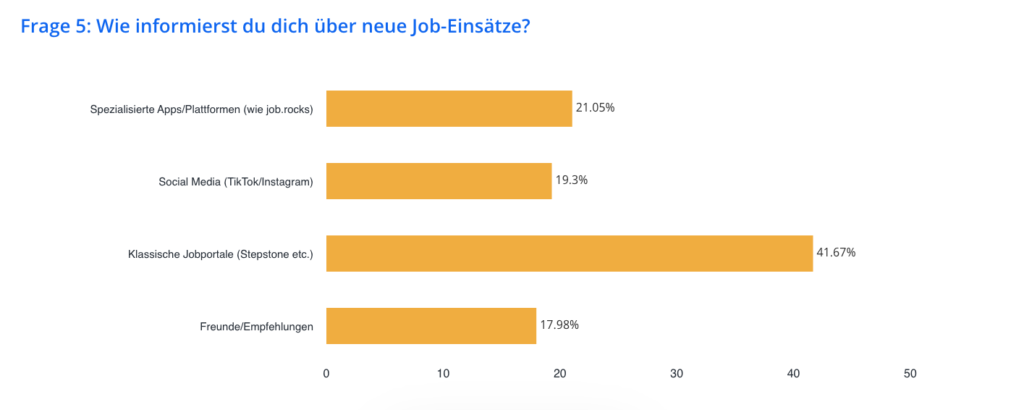
The study also examined how young people find out about new jobs. Classic job portals such as Stepstone continue to dominate as a source of information with 41.67%. Specialized apps and platforms like job.rocks reach 21.05%. Social media channels such as TikTok and Instagram are used by 19.3%. Personal recommendations from friends play a role for 17.98%.
This distribution shows an interesting tension between established structures and new formats. Although Generation Z is considered digital natives, the majority of them still rely on proven platforms when looking for a job. At the same time, specialized apps and social media are continually gaining in importance.
Demographic characteristics
The age distribution of the study focused on two groups: 18 to 23 year olds made up 58 participants (35 male, 23 female), while 24 to 29 year olds made up the majority with 82 participants (45 male, 37 female). This distribution enables statements to be made about students and career starters as well as about young professionals with initial experience in the labor market.
Age distribution by gender
| Age group | Masculine | Female | In total |
| 18-23 years | 35 | 23 | 58 |
| 24-29 years | 45 | 37 | 82 |
Implications for the labor market
The study results have far-reaching consequences for companies, human resources managers and the design of future employment relationships. The traditional employment contract with fixed times and a fixed location is becoming less attractive for a significant part of Generation Z. Companies need to rethink their offering structure and develop hybrid models that offer both security and flexibility.
The high level of acceptanceproject-based workat the same time opens up opportunities for the platform economy and specialized intermediation services. Services that enable quick, uncomplicated access to job assignments hit the nerve of this generation.
Methodological notes
The survey was carried out as an online survey via the Clickworker platform. For some questions, multiple selection was possible, which influenced the percentages accordingly. The sample deliberately focused on German-speaking countries and the 18 to 29 age group in order to enable precise statements about the work attitudes of Generation Z.
Conclusion
The Flex Work Study 2026 paints a picture of a generation in transition. The classic 9-to-5 job is no longer the only desirable goal. Instead, young people want a working world that adapts to their lifestyle and not the other way around. Companies that understand this change and create corresponding offerings will be ahead in the competition for the best talent.
The results invite you to...Relationship between work and lifeto rethink. For Generation Z, work is not an end in itself, but a building block of a self-determined life that should fit flexibly into the overall picture.
Summary of key findings
| knowledge | Value |
| Openness to flex work (overall) | 85.11% |
| Flex work as the main goal | 28.37% |
| Flex work as additional income | 56.74% |
| Would trade flexibility for 20% salary | 52.48% |
| Flexibility is priceless | 47.52% |
| Top priority: salary | 28.80% |
| Top priority: flexibility | 25.63% |
| Use classic job portals | 41.67% |
| Use social media to search for a job | 19.30% |
Interested in the full study?
Download full study details as a PowerPoint
Download full study details as CSV
| attribute | Value |
| Study title | Flex work survey |
| Implementation | job.rocks AG |
| Survey period | 01/16/2026 – 01/22/2026 |
| Number of participants | 141 |
| Target regions | Germany, Austria, Switzerland |
| Age group | 18-29 years |
| Average age | 24 years |
Gender distribution
| Gender | Number |
| Masculine | 80 |
| Female | 60 |
| Miscellaneous | 1 |
| Not specified | 0 |
Age distribution by gender
| Age group | Masculine | Female | In total |
| 18-23 years | 35 | 23 | 58 |
| 24-29 years | 45 | 37 | 82 |
Question 1: What is most important to you in a job in 2026?
Multiple selection allowed, n=316 answers, 141 participants
| Answer | percent |
| High salary | 28.80% |
| Flexibility (when and where I work) | 25.63% |
| Security (permanent contract) | 20.89% |
| meaningfulness of the activity | 16.14% |
| Variety (different places/events) | 8.54% |
Key message:Salary and flexibility together account for over 54% of preferences.
Question 2: Could you imagine only working on a project or event basis instead of a fixed 9-to-5 job?
Single choice, n=141 participants
| Answer | percent |
| Yes, as additional income | 56.74% |
| Yes, absolutely (that's my goal) | 28.37% |
| Probably not, only in an emergency | 9.93% |
| No, I need a fixed routine | 4.96% |
Key message:85.11% of Gen Z are open to project-based work.
Question 3: What is the biggest advantage of event-based operations?
Single choice, n=141 participants
| Answer | percent |
| Fast money without long application processes | 33.33% |
| You can work when it fits into your lifestyle | 29.79% |
| You constantly get to know new people and places | 22.70% |
| You are not tied to anything | 14.18% |
Key message:Over 63% primarily value financial immediacy and lifestyle compatibility.
Question 4: Would you give up your time flexibility for 20% more salary?
Multiple selection allowed, n=228 answers, 141 participants
| Answer | percent |
| Yes, money is more important | 52.48% |
| No, my time/freedom is priceless | 47.52% |
Key message:Almost half (47.52%) would forego a 20% increase in salary in order to remain flexible.
Question 5: How do you find out about new jobs?
Multiple selection allowed, 141 participants
| Information channel | percent |
| Classic job portals (Stepstone etc.) | 41.67% |
| Specialized apps/platforms (like job.rocks) | 21.05% |
| Social media (TikTok/Instagram) | 19.30% |
| Friends/Recommendations | 17.98% |
Key message:Classic job portals still dominate, but over 40% use alternative channels.
Summary of key findings
| knowledge | Value |
| Openness to flex work (overall) | 85.11% |
| Flex work as the main goal | 28.37% |
| Flex work as additional income | 56.74% |
| Would trade flexibility for 20% salary | 52.48% |
| Flexibility is priceless | 47.52% |
| Top priority: salary | 28.80% |
| Top priority: flexibility | 25.63% |
| Use classic job portals | 41.67% |
| Use social media to search for a job | 19.30% |
This study was conducted by job.rocks.
Methodology: 141 participants, January 2026